
I keep getting asked “why” I’m spending my sabbatical recovering from 12 years of CEO stress by doing geopolitical data collection and analyses. I’ve answered it so many times that I should just write it up. I’m putting in reps managing and leading AI and joint AI/human organizations. Lots and lots and lots of repetitions.
The China data collection and analysis is the job of the organization, and my reps come from leading it while it does the work.
Think of it this way: we’ve spent our entire careers inside organizations that had people, and information systems. Those information systems are your HR systems, timekeeping, accounting, software development, etc. The people do the thinking and the work, and the information systems do the unthinking repetitive tasks.
Like it or not, the world is changing and AI can effectively think and reason in ways that previously only people could. This is capitalism, so organizations will evolve accordingly or someone else will outcompete them.
That’s why I’ve been putting in so many reps. Learning to manage pure-AI and joint human/AI organizations. I’ve been publishing some of it here, passing some to where it needs to go, and shelving those that aren’t worth writing up.
I am trying to learn how to build a joint AI/human organization, convert a human organization into a joint organization, or to fix one. So I’m running joint AI/human project, after project, after project. Trying to squeeze a career’s worth of organizational learning into a year.
What does that actually look like?
So how many projects have we run? Nearly 90 in the last eight and a half months. About two dozen were active in the last 30 days. Some were infrastructure, like mass data collection and analysis; some were IT; some were research; and some are a little hard to categorize.
The last month
Let’s look at the last month of projects. I use AI agents, not chatbots. AI agents run my projects, and my local models handle most of the raw scale. In this case, an AI agent is a harness for a Large Language Model (LLM) that includes a system prompt that tells the LLM how to behave, and a bridge that allows the LLM to run software tools as well as feed the output of those tools back into the LLM. A plain call is the model with no harness, just a question in and an answer out.
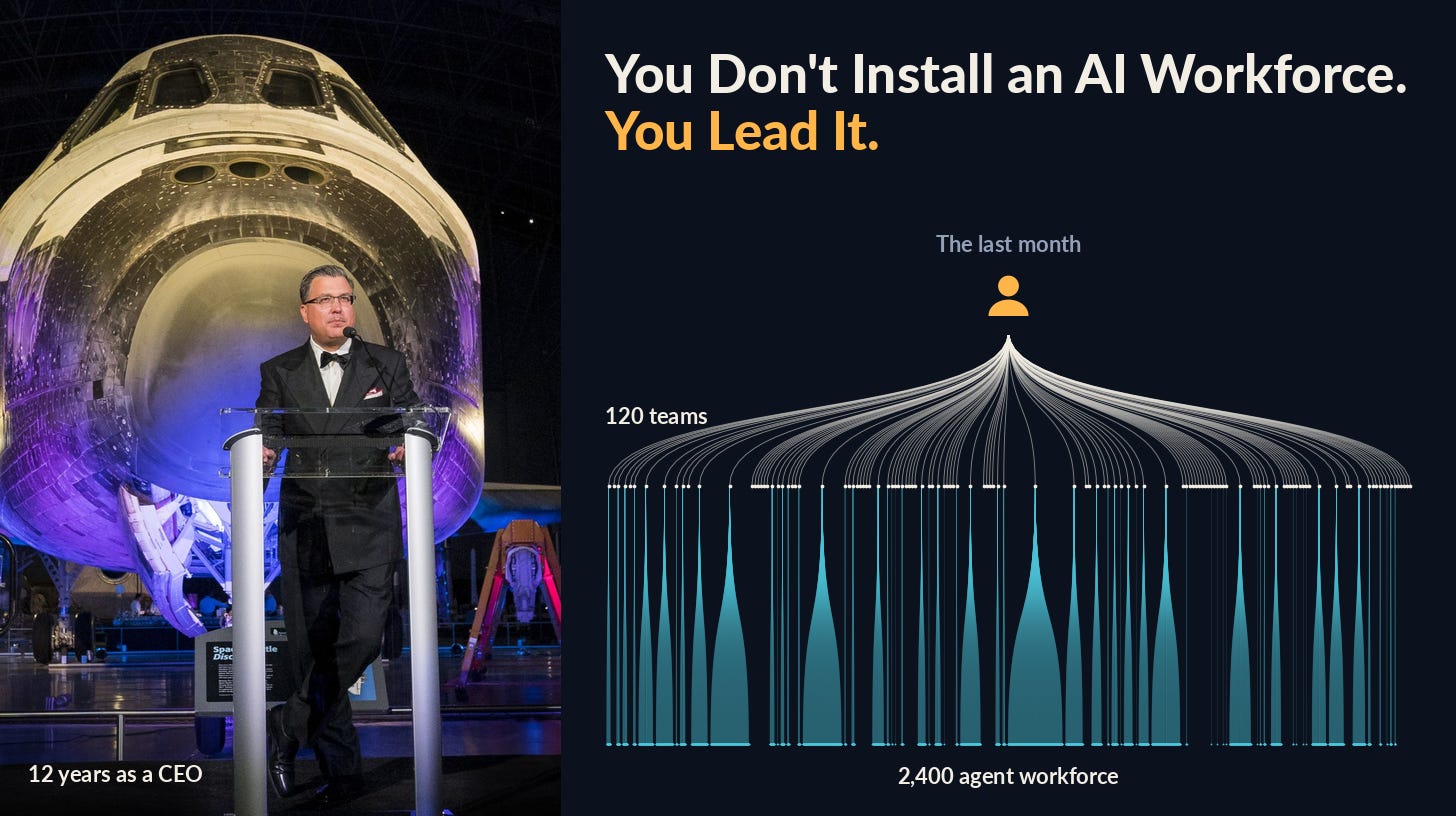
In the last 30 days, I have run about 120 teams with a workforce of about 2,400 agents under them. A typical agent works for about 20 minutes, but some run for more than a week. Only a handful are working at any moment.
Some of them manage research projects. Some manage my data collection, scoring, and research infrastructure. Some do my IT tasks for me. Some are doing all of the functions of my projects. Some are writing the software bespoke to accomplish the tasks for all of this. I lead, manage, and oversee them all, refining my form as the reps build strength.
I replaced thousands of agent sessions with plain model calls
There has been a surprise that I didn’t really appreciate until now, when I saw the numbers. For a while I had AI agents doing all of the AI thinking and reasoning. Think Claude Code and Opencode.
I have terabytes of data that the Chinese government has made available as part of their anti-corruption transparency drives. For a couple of weeks in September, I had one of my research systems start a full Opencode agent for every source of Chinese government data that it needed to understand. Each agent was tasked with understanding one source. In all I ran more than 12,000 agent sessions. Each session ran the whole harness, prompt and toolbox, just to deeply reason about one Chinese source. A costly way to think.
Then I realized that was stupid. Well, that’s not true. One of my Claude agents realized that was stupid. One plain LLM call per source. The same information about the source, sent straight to the same local model, gave the same answer at a far lower cost and in less time. By September 19 I had retired many of the agents. Bulk reasoning had been commoditized. The organizational leadership was figuring out how to take advantage of commoditized reasoning at speed and scale.
I use plain calls on the documents too, one call per document. Now I just throw a document into an LLM with a description of the types of information I’m looking for, and my local LLM reasons over whether the document is worth understanding. It’s great, the visual models are even reasoning about pictures and scanned documents. It doesn’t work as well on maps, but hey, the AI can’t do everything. It sucks on Tibetan-language stuff too, which was not on my bingo card for 2026.
Most of the model output now comes from my own hardware
I run AI in two tiers. The frontier tier is Anthropic’s models, mostly Opus. Last I tried, OpenAI models with a context window large enough for my workflows meant paying the API token rate. The local tier is open-weight models running on my own hardware. Over the days charted below, it answered millions of requests.
AI work is counted in tokens, which you can think of as words and syllables. The chart counts the new ones for each tier, day by day: fresh prompt text and generation.
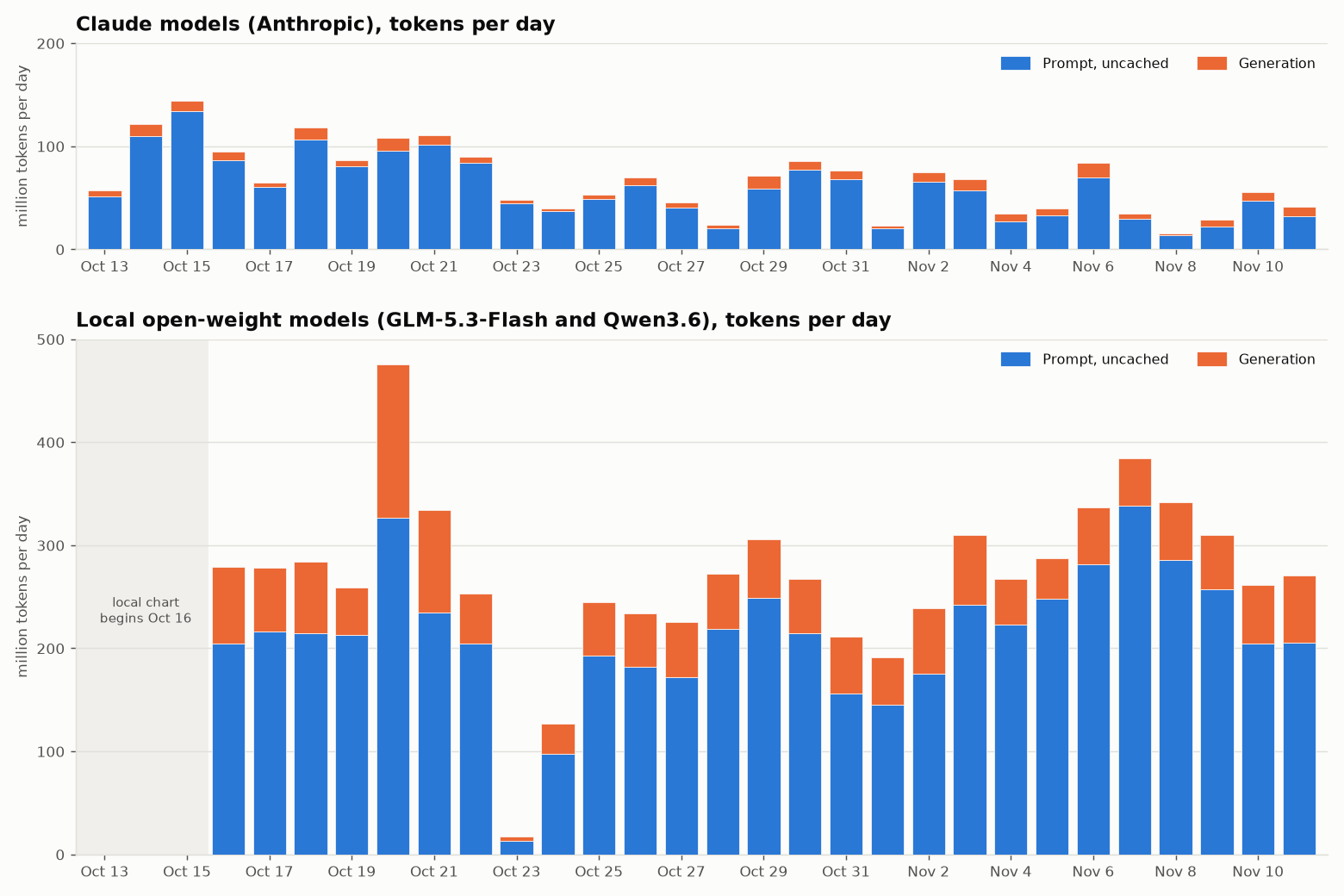
My new AI tokens per day for the last month.
In one week I measured in August, the local models wrote a little under half of the generated text. Now it’s almost 90% because the local models have effectively commoditized bulk thinking and reasoning for me. I still use the frontier models for the more exquisite thinking and reasoning, and I’m still needed for my non-linear thinking, experience, credit card, and having two hands so I can maintain the hardware.
The next rep
Andy Grove was probably the best technical executive, manager, and leader of a generation. I haven’t found the AI leadership equivalent to his seminal book High Output Management. So I’m writing mine an article at a time as I compress a career’s worth of learning about AI organizations into a year. What I have in the meantime is the next project, and the one after that. Somewhere in those projects, we will find ourselves in another unfamiliar situation. The situations always rhyme with those a purely human organization finds itself in, but they’re always just a little bit different. A little bit alien. Recognizing it, dealing with it, and learning from it. Rep after rep. Building strength. Improving form.
The lessons are separate posts
There are too many lessons for one article, and I’m still earning most of them. So when I learn something about leading AI that’s worth a post, I write up that one thing on its own.
Some of what I publish here is the research itself. The posts below are mostly the other kind: what I’ve learned about building and leading AI organizations from the reps and from 12 years as a CEO.
Leading a workforce of AI agents
Running the Swarm: Protecting your Institutional Memory. A joint human/AI workforce still needs the people who remember why things are done, because adding AI doesn’t bring back what an organization has forgotten.
Running the Swarm: The Kill Switch Is a Job, Not a Button. The authority to stop agents belongs to a person whose job is watching them, and a stop isn’t done until nothing can start the work up again.
Running the Swarm: Agents Fail the Way People Do. Lead Them That Way. Agents are a workforce. Supervise them the way you already supervise people, then adjust for their speed and scale.
AI Agents operating in cyberspace need ritalin before they need a kill switch. A team of agents needs a person watching it, because its failure mode is drifting toward doing nothing while problems grow.
Keeping my AI from hacking things. Rules that must hold belong in code that enforces them, and a supervisor watches what agents do.
We are Argo. Whatever model does the work will keep being replaced, so continuity has to live in written plans and records that each new one reads and inherits.
Running AI Like a 200-Hacker Org. What holds AI agents back now is how you structure the work, and anyone who has run an organization already knows most of the answer.
The FT Mistook an Anthropic Promotion for a Layoff. A sophisticated AI workflow is staffed like a services firm, with the expensive frontier models supervising and cheaper models doing the work.
Checking AI’s work
Humans vs AI at Imagery Analysis of a Chinese Submarine Base. The highest-scoring AI may deserve the least trust, because an answer it recalls from memory looks exactly like analysis of the evidence in front of it.
AI Adoption Is a Management Problem. How closely you review AI should follow the task’s risk and how reversible it is, even after the AI has built a good track record.
The AI Governance Trap. When the work has no clear right answer, the leader’s job is designing how AI output gets verified and escalated. The leader is still accountable.
Workflows built around human limits
Code was code, and then language was language. Workflows keep steps built around their designers’ old limits. Ask whether each step is there for the work or for you, and move yours to the end.
The Coming Collapse of the Software Monoculture. When AI removes the human limits a piece of work was designed around, redesign the work. Bolting AI onto the old workflow is the least competitive choice.
Converting a human organization, and the politics around it
The Classified AI Doctrine. If the approved AI path is too slow or too weak, some work will route around it, so delaying adoption doesn’t keep AI out.
The AI Slop Comes Before the Skill. I’d rather hire the person visibly learning the tools, rough early output included, than the person proudly refusing to adapt.
AI Didn’t Replace Engineers. It Replaced the Excuse to Hire. Scarce talent once gave executives permission to hire ahead, and AI now gives them permission to cut, freeze and stop backfilling.
From AI Backlash to AI Institutions. Count public and political permission as part of your runway, because society can turn on a whole category no matter how good your product is.
AI Span of Control: A Lever Long Enough to Move the Middle [Management]. In a large organization, the AI transition fails if adopting AI makes a middle manager look smaller. Change what gets managers promoted.
Jumping the track from a legacy to an AI-First organization. Ignore the slogan and follow the budget. A real AI-first organization gets flatter, with wider spans of control and output per person you can measure.
Your point that a sophisticated AI workflow “is staffed like a services firm” has a mirror image in Anthropic's own data.
Its study of its workforce (16 October) found the agents employees direct logging six hours of work for every human hour, and spending around 80 percent of their interactive time idle, waiting for a human to respond. Meta-work, such as writing specifications and setting one agent to review another, rose from 10 to 22 percent of employees' Claude sessions.
Your 2,400-agent month sounds like the far end of that curve. When your own attention became the constraint, what did you stop reviewing first, and what did you refuse to stop reviewing?