
One of my recurring conversations is when folks ask me if I am going to start another company some day. I usually shrug and say the pace of change today means you need to find the right runway to launch a durable business off of, or you should be placing many bets.
It is not just technology change.
If there is one thing that unites a surprising amount of society right now, it is hostility to data centers and fear that AI is going to take their job. The data center backlash is local, bipartisan, and visceral. The job fear is broad enough that it shows up in Hollywood contracts, copyright lawsuits, state AI laws, federal preemption fights, board conversations, and the ambient dread in every “what should my kids study?” conversation.
I wanted to understand this with data instead of doom scrolling.
So I turned it into an agent research project. I had the agents build event corpora for 19th century Industrial Revolutions in several countries, score the events, compare them to the AI era, try to break their own answer, and then project what survived forward into today. They say that history doesn’t repeat itself, but it rhymes. The AI Revolution rhymes with the German Industrial Revolution.
Results up front
This is long, and I do not expect most people to read the whole thing. The rest of the post tells you how I got here. This section is the part I would actually make decisions from.
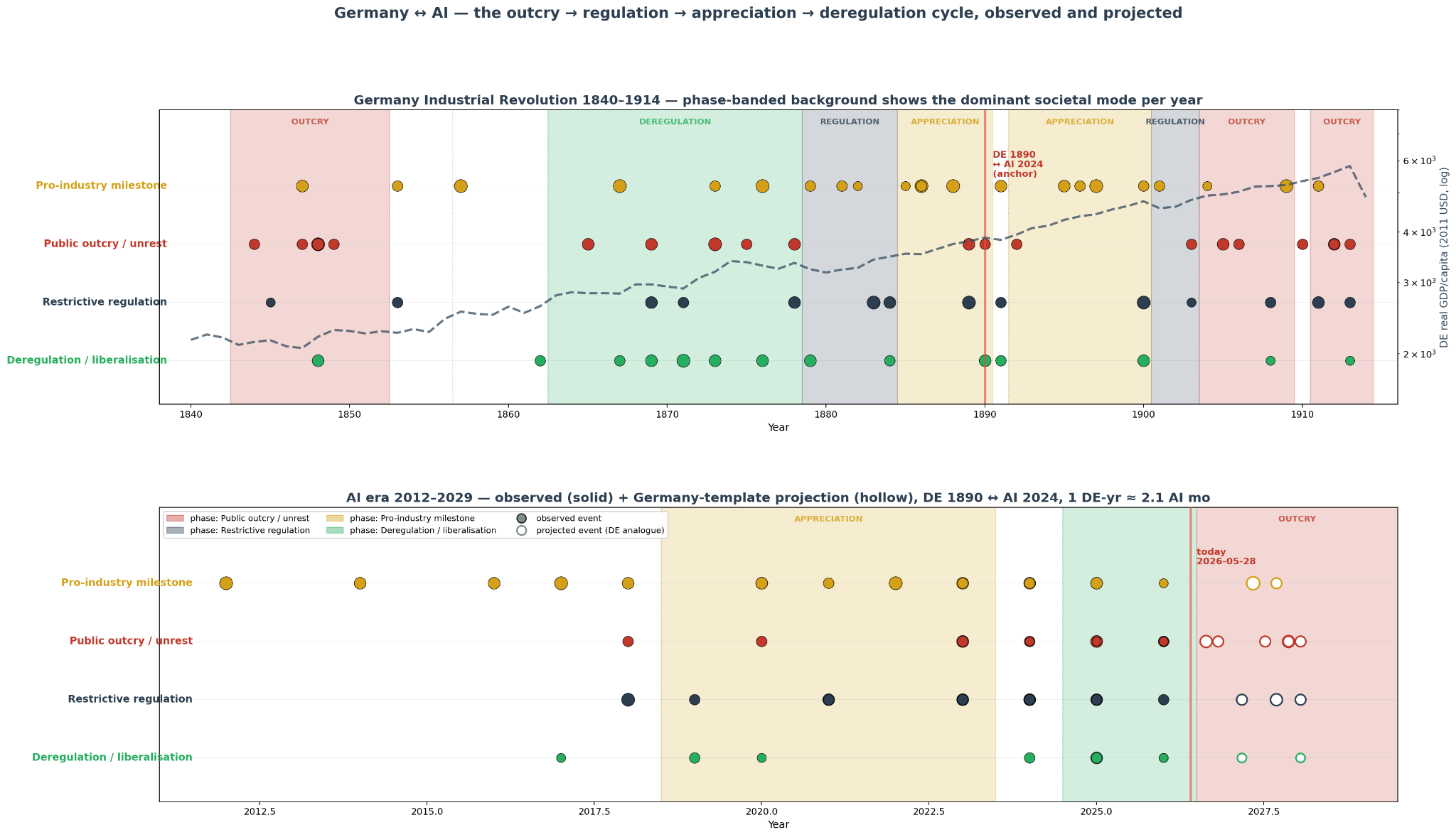
The result is what follows if today’s AI revolution is closer to Germany’s industrial revolution than Britain’s or America’s. Britain and America still matter. They bracket the German path. Britain is the cleaner bull case. America is the higher-growth, higher-crash-risk bear case.
The central estimate says AI discontent normalizes in the late 2020s, with 2027-2028 as the planning case and 2024-2032 as the honest window.
Normalization does not mean people stop being angry about AI. People are still angry about industrialization. It means the conflict becomes legible and routinized. The state decides who carries the downside risk of AI, who pays for worker adjustment, what liability regime applies, how much local control survives, and which political factions own the issue.
The Germany path normalizes through institutions. In the historical German case, that meant compulsory social insurance, worker-protection law, political accommodation, and the incorporation of labor into ordinary politics. In the AI case, the analogues would be AI displacement insurance, worker retraining funds, model liability, bargaining rights, federal/state settlement, and a mass political faction built around AI adjustment.
Before normalization, I would expect five fights to merge:
data-center backlash becomes a national energy, water, tax, and local-control issue
AI labor fights move beyond artists, writers, actors, and coders into ordinary white-collar and service work
liability becomes unavoidable because companies cannot deploy into hidden legal risk forever
state-by-state AI governance collides with a technology that wants national scale
under the US-bear bracket, capital markets test the AI story if valuations, private credit, power commitments, and data-center capex outrun social permission
Personal income is the part that matters most. The Germany path is the only analogue where workers eventually do better than productivity alone would predict. In the historical data, German real wages ended the period about 30% ahead of GDP per capita. Britain was a partial catch-up. Japan was more extractive. The AI inference is: near-term wage pressure first, then upside only if institutions force AI productivity into wages, insurance, bargaining power, or transfers.
GDP grows in every path. The difference is distribution and volatility. Germany’s historical GDP per capita rose about 2.7x and total GDP about 4.8x. Britain was a little lower per person, about 2.3x, with total GDP around 4.5x. The US path produced much higher per-capita growth, about 4.5x, and enormous total GDP growth, but it also carried labor violence, wages lagging productivity, and a 1929-class crash at the end of the arc.
So the short version:
Societal normalization with AI: 2027-2028 central case, with 2024-2032 as the realistic statistical window
disruptions first: data centers, labor, liability, federalism, and market stress
personal income: bad if institutions lag, good if AI worker insurance and bargaining mechanisms arrive
GDP: strong in all cases, but the US-style highest-growth path is also the most fragile
The watch list is simple:
a serious AI displacement-insurance or portable-benefits proposal
a data-center fight that moves from local zoning into national energy or tax politics
an AI liability insurance market that starts pricing model/deployment risk
a federal preemption fight that forces Congress or the courts to decide who governs AI
widening credit or equity stress around the AI capex chain
Those are the places the abstract social conflict becomes measurable.
For the readers who didn’t spend their 20s drinking with Germans, the below DE abbreviation is the two letter country code for Deutschland (Germany).
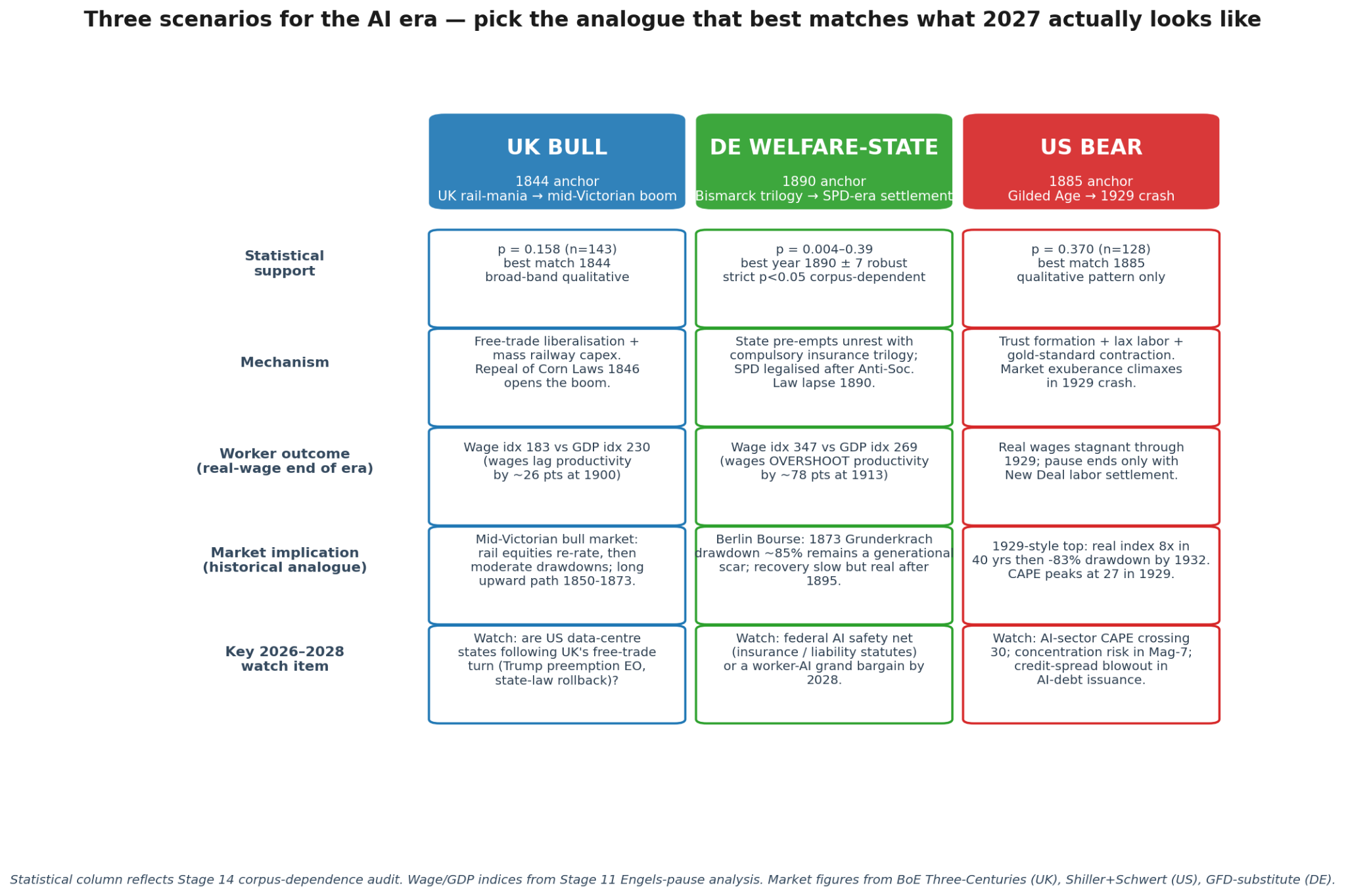
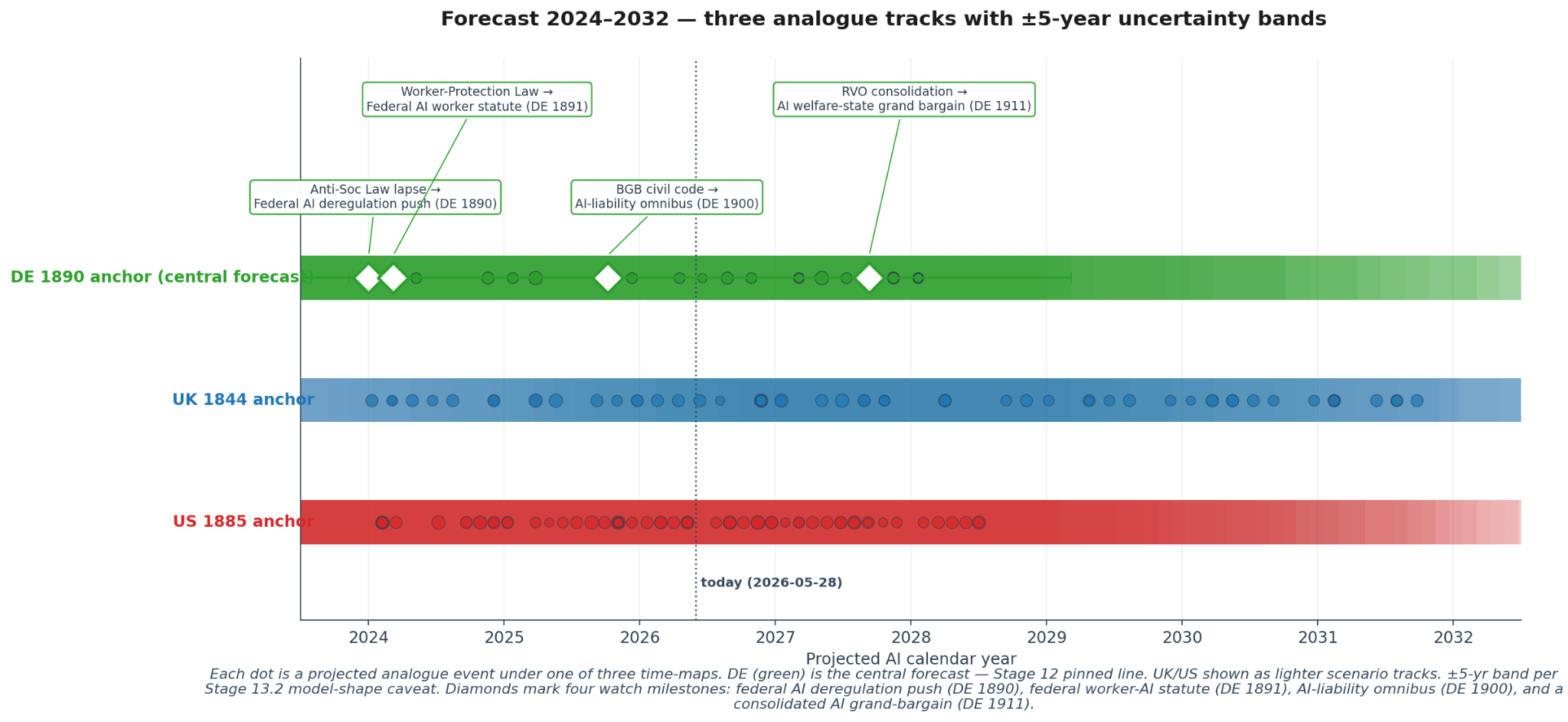
This below graph was my eureka moment. It shows German society progressing through the Industrial Revolution based on societal events, and statistically projects it into the AI era. Notice that the German Industrial Revolution ends in public outcry in the 1910s, and the AI revolution ends in public outcry in 2027-2028. The archetype’s actual claim is that the culmination of the revolution converts discontent into ongoing-but-managed conflict. Not peace. In the case of Germany, strikes happened inside accepted union-employer bargaining frameworks, and political mobilisation channelled through parties instead of barricades. Progress, not perfection.
I assumed UK or US Industrial Revolution
I’ve been audiobooking the Great Course “The Industrial Revolution” and had focused this research correlating the current AI revolution to the US and UK Industrial revolutions.
Those answers were too clean.
Then it broke in a useful way.
The hypothesis changed.
I started with the obvious comparison: AI adoption today versus the British Industrial Revolution. Then the research expanded to the US, Germany, Japan, and electrification. The best qualitative match was not Britain. It was Germany around 1890, right at the Bismarck welfare-state inflection.
Why Germany?
Germany around 1890 was not just “industrialization.” It was a specific social phase.
The technology had already become real. Capital formation was moving. Labor unrest was not going away. Socialist politics had become too large to suppress cleanly. The state had to decide whether to keep treating discontent as a policing problem or convert it into institutions.
The Bismarckian answer was compulsory social insurance plus political management.
That is why the Germany match matters. It implies that the AI story from here is not mainly about model capability. It is about the institutional settlement around model capability.
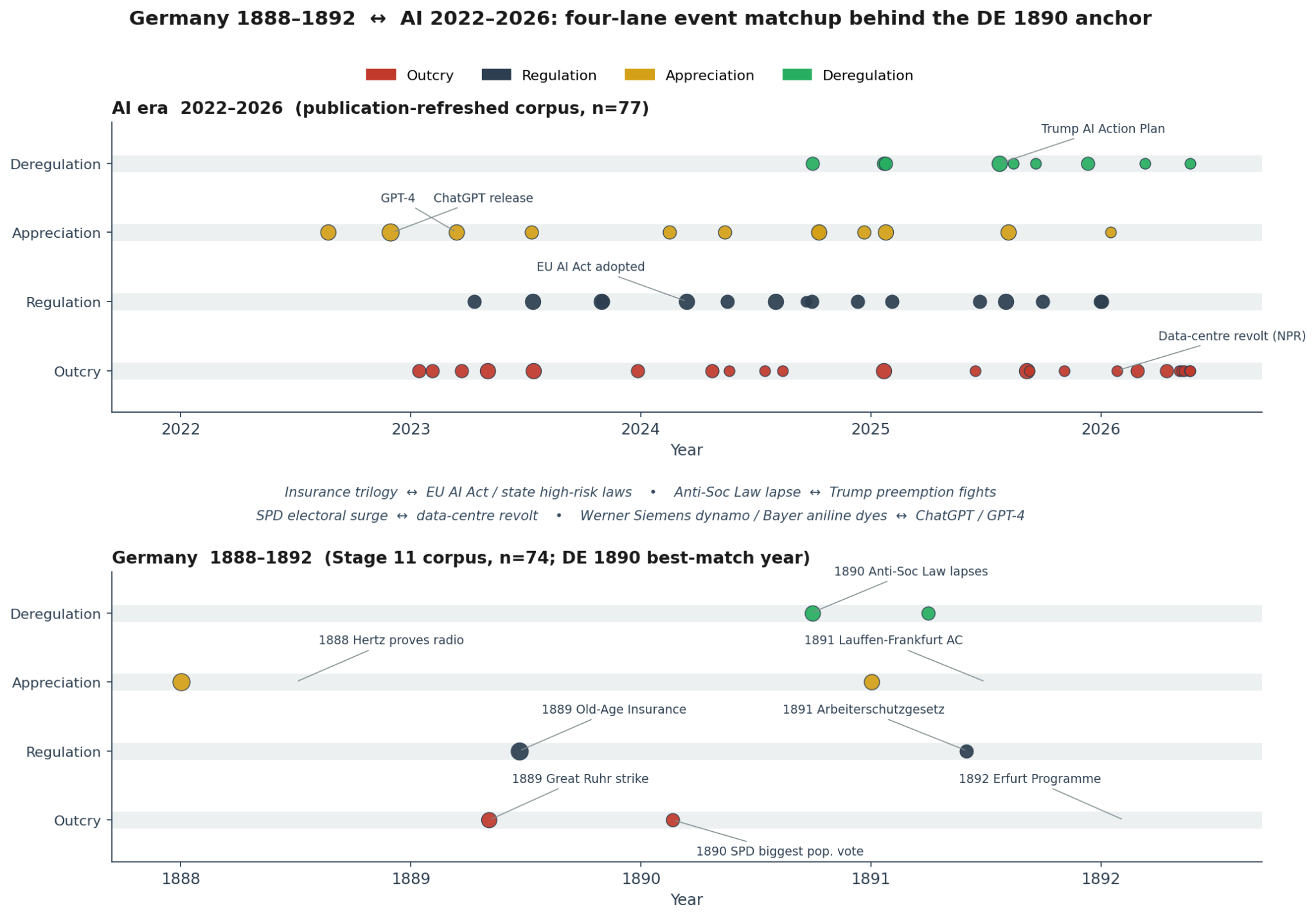
The research measured four lanes.
Public outcry. Germany had labor unrest and SPD electoral pressure. AI has copyright suits, union fights, job fears, local data-center protests, and an increasingly broad legitimacy problem.
Regulation. Germany had worker insurance and labor-protection laws. AI has the EU AI Act, state AI laws, model-liability debates, executive orders, and early labor protections.
Appreciation. Germany had electrical systems, chemicals, engines, and industrial showcases. AI has ChatGPT, GPT-4, multimodal models, coding agents, and enterprise productivity enthusiasm.
Deregulation. Germany had the Anti-Socialist Law lapse and a move from direct suppression to political management. AI has preemption fights, deregulatory pressure, and pro-acceleration national strategy.
The interesting thing is not that any one item maps perfectly. Perfect analogies are usually fake. The interesting thing is the shape (or rhyme). Society is no longer deciding whether the technology matters. It is deciding who pays for the downside, who captures the upside, and what institutions absorb the anger.
That is a much better planning frame than “AI is like steam engines.”
When does societal discontent normalize?
Central case: 2027-2028.
Honest range: 2024-2032.
The Germany projection puts the key institutional cluster in the 2024-2028 window:
2024: preemption and worker-protection fights become explicit
2025-2026: civil/commercial code and liability analogues
2026-2027: labor recognition and large-scale worker conflict analogues
2027: consolidated AI worker insurance or displacement-compensation analogue
2028: mass political faction around AI adjustment
The dates are weak. The model has several years of uncertainty and should not be read like an earnings calendar. But the order of operations is useful.
First, the technology becomes socially unavoidable.
Then the fights spread from narrow affected groups to broad political coalitions.
Then the state tries suppression, preemption, or patchwork regulation.
Then a more durable settlement emerges because the conflict is too expensive to keep treating as an exception.
That is what I mean by normalization.
It is not “people stop being mad about AI.” It is “the anger has institutions to flow through.”
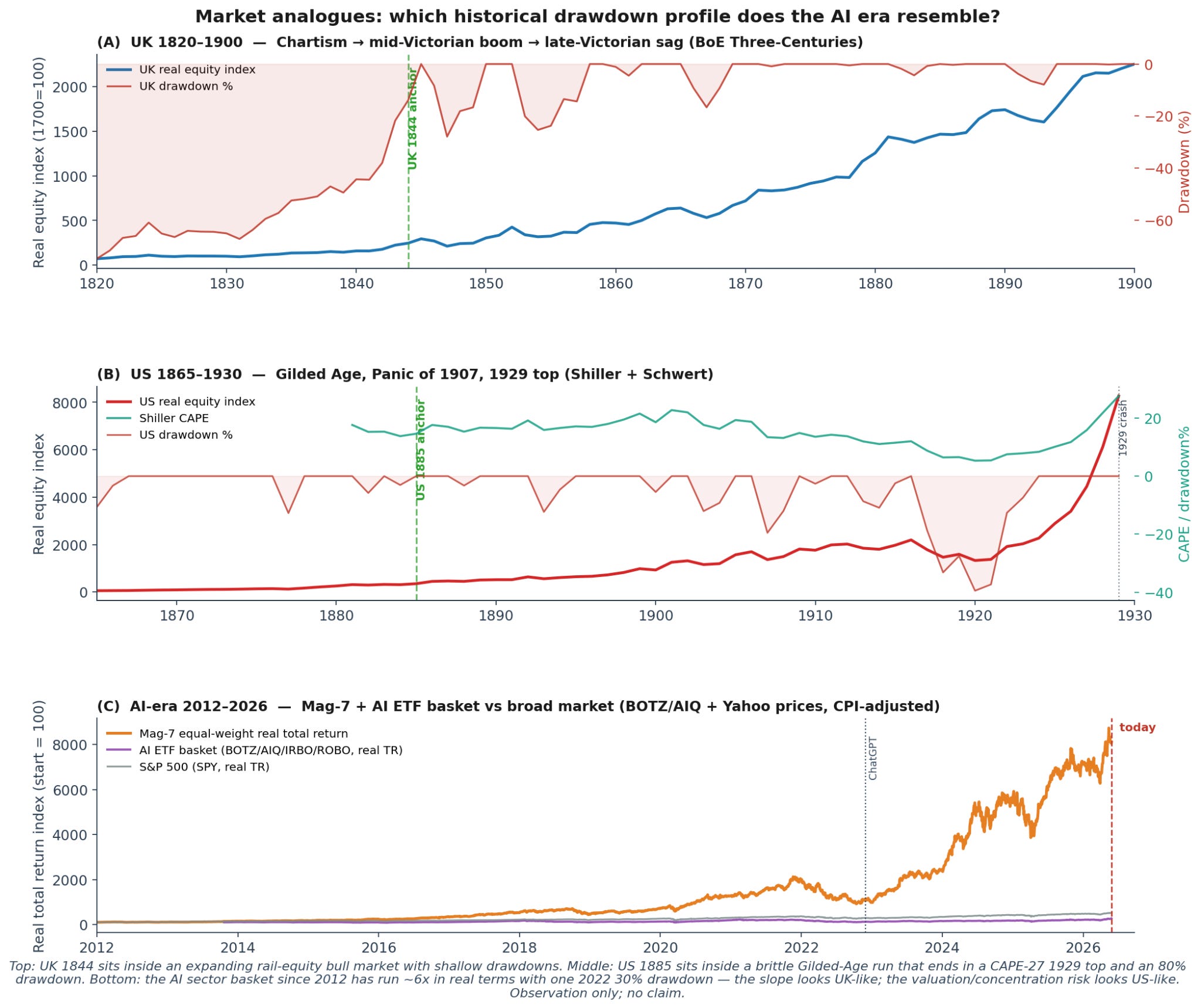
The UK bracket says this can normalize more gently. The British path after the 1840s is liberalization plus selective protection, then a long mid-Victorian boom. If AI follows the UK path, we muddle through data-center fights, labor laws, and permitting, but the boom remains politically acceptable.
The US bracket says normalization can come late and violently. The American path leaves more pressure in the system. It generates huge growth, but labor conflict and speculative excess keep compounding. If AI follows the US path, the late 2020s are less a settlement and more a stress test.
What disruptions come first?
I would not watch for one giant “AI backlash” event. I would watch for several fights merging.
1. Data centers become the visible symbol
Data centers are where an abstract technology becomes concrete. They touch land, water, power prices, tax abatements, noise, transmission lines, local politics, and trust in elites.
That makes them a perfect container for broader AI resentment.
The Germany inference is that local industrial conflict eventually becomes national social policy. If data-center fights remain local zoning fights, the Germany thesis weakens. If they merge with job displacement, energy costs, and federal preemption, it strengthens.
2. Labor conflict leaves the obvious occupations
Artists, writers, actors, and software engineers are early. They are not the whole story.
The Germany path would imply that AI labor politics becomes broader and more ordinary. The important moment is when the issue moves from “protect creative workers from the model” to “how does a normal office worker, call-center worker, analyst, teacher, nurse, paralegal, or public employee insure against AI-driven displacement?”
That is when the politics changes.
3. Liability becomes code
Germany’s industrial society needed a legal architecture for accidents, contracts, commercial relations, and social insurance.
AI will need the same thing. Who is liable when an AI system causes harm? The model provider? The deployer? The employer? The integrator? The user? The board?
Until that is legible, every deployment carries hidden political and legal leverage.
4. Preemption is where settlement shows up
The US is drifting into state-by-state AI governance. That can work for a while. It probably cannot work forever if the technology becomes embedded in national labor markets, national infrastructure, national finance, and national security.
The fight to watch is not “regulation or deregulation.” It is who gets to decide.
States? Federal agencies? Courts? Congress? Whitehouse? Trade associations? Insurers? Procurement rules?
The normalizing moment would be when that governance stack becomes predictable enough for companies and workers to plan around it.
5. The US-bear bracket puts the market in play
The US bracket adds the uncomfortable part: the crash scenario. This is not the central Germany forecast. It is the bear-case bracket.
I do not think the model says “1929 in 2029.” That is fake precision. It says if AI valuations, data-center leverage, power commitments, vendor financing, and private credit all keep expanding faster than the social settlement, the market becomes one of the places the adjustment can happen.
The slope of AI equities looks like the UK bull case if you want to be optimistic. The concentration and valuation risk look more American if you are worried.
What happens to personal income?
This might be the most important result in the project.
In the German path, workers eventually win a larger share of the gains.
The wage data are stark:
Britain 1820-1900: real wages end at 183, GDP per capita at 230
Germany 1840-1913: real wages end at 347, GDP per capita at 269
Japan 1886-1925: real wages end at 138, GDP per capita at 186
Same broad industrialization story. Very different worker outcomes.
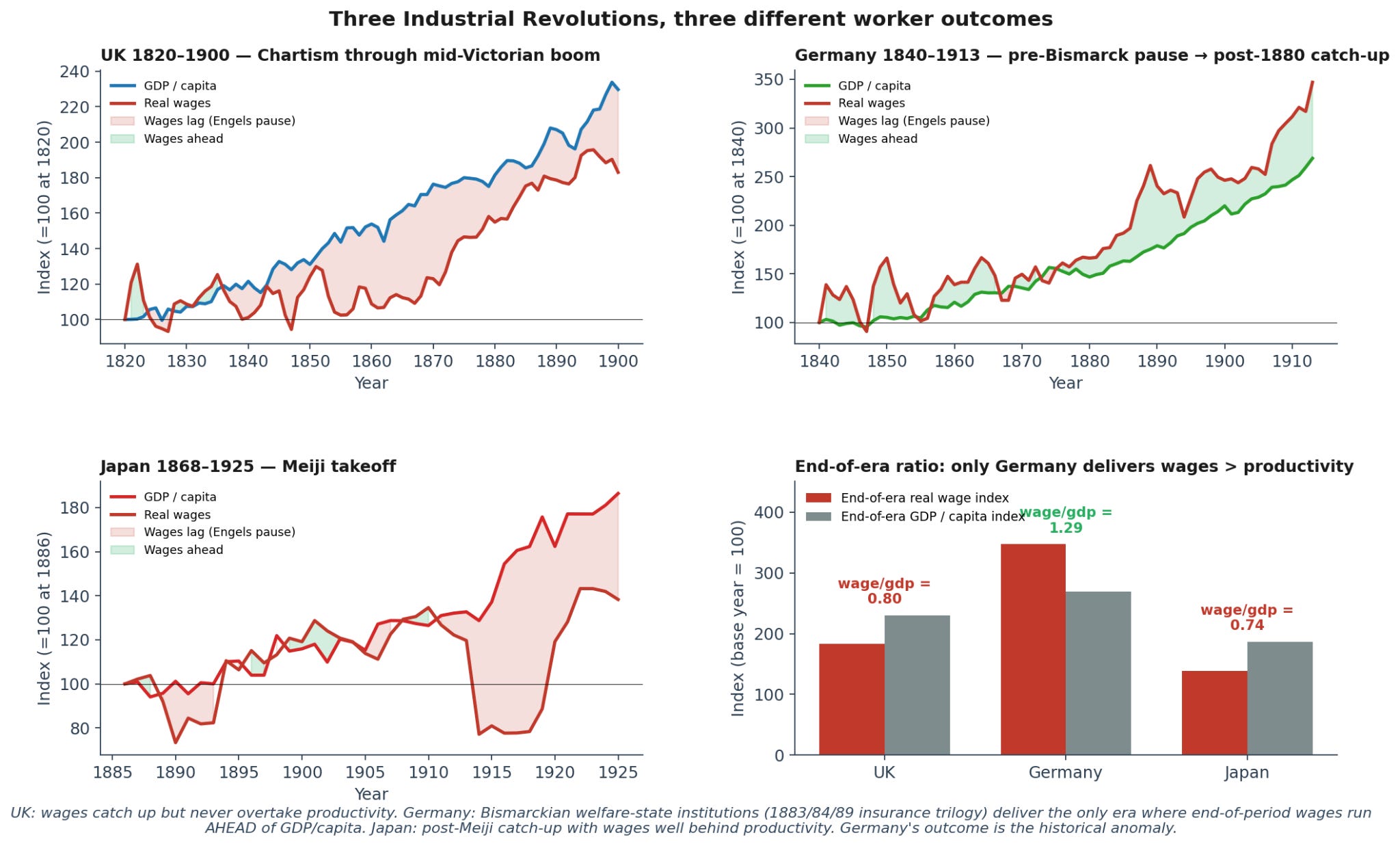
The German result says personal income does not automatically rise because the technology is productive. It rises when institutions force the gains to flow through wages, insurance, bargaining power, or social transfers.
That is the distinction that matters for AI.
In the near term, I would expect measured personal-income pressure. AI can raise productivity while weakening labor’s bargaining position. That is the default path if companies adopt AI faster than workers get new leverage.
The German inference is that the catch-up comes after the institutional settlement. In AI terms, that means after some mix of displacement insurance, portable benefits, retraining funds, liability rules, and worker bargaining. Without those, the German income result does not arrive. You get the productivity without the wage catch-up.
The brackets are useful:
UK bull: wages lag at first, then partially catch up as the boom broadens
Germany central: wages lag at first, then outpace productivity if institutions redistribute gains
US bear: GDP grows a lot, but labor remains behind until crisis-driven reform
This is why I do not like the generic question, “Will AI be good for workers?”
Wrong unit of analysis.
The better question is: what mechanism makes AI productivity show up as worker income?
Germany has an answer. Britain has a softer answer. The US path mostly says: later, after pain.
What happens to GDP?
GDP grows in all three paths.
That is easy to miss because the politics are ugly. Industrial revolutions can be socially destabilizing and economically powerful at the same time. That is the whole problem.
The historical multipliers:
UK bull: GDP per capita about 2.3x, total GDP about 4.5x
Germany central: GDP per capita about 2.7x, total GDP about 4.8x
US bear: GDP per capita about 4.5x, total GDP much higher because population and continental scale explode
The AI inference is not “GDP will literally 2.7x by year X.” That would be silly. The inference is about the shape.
The Germany path says growth is strong but institution-mediated. You do not get the maximum speculative upside, but you get a more durable settlement and a better worker outcome.
The UK path says growth is also strong, and the market path may be friendlier, but worker gains are less institutionally guaranteed.
The US path says the highest-growth story can also be the most fragile. You can get extraordinary aggregate gains while personal-income distribution, labor peace, and financial stability deteriorate underneath.
For founders and investors, that is the hard part.
The best GDP path may not be the best personal-income path. The best market path may not be the best social-stability path. The best worker path may require institutions that slow some forms of capital formation but make the whole system more durable.
I would summarize it this way:
If you want maximum upside, you are implicitly underwriting more US-bear risk.
If you want durable adoption, you should care more about the German settlement.
If you want the cleanest builder environment, you are hoping for the UK bull case.
How much should we trust this?
Enough to use it as a planning frame.
Not enough to bet on the exact dates.
The research process did not just ask an agent for a historical analogy. It built event corpora, scored events by severity, bucketed them into outcry/regulation/appreciation/deregulation, and compared the AI state vector to historical years across Britain, the US, Germany, Japan, and electrification.
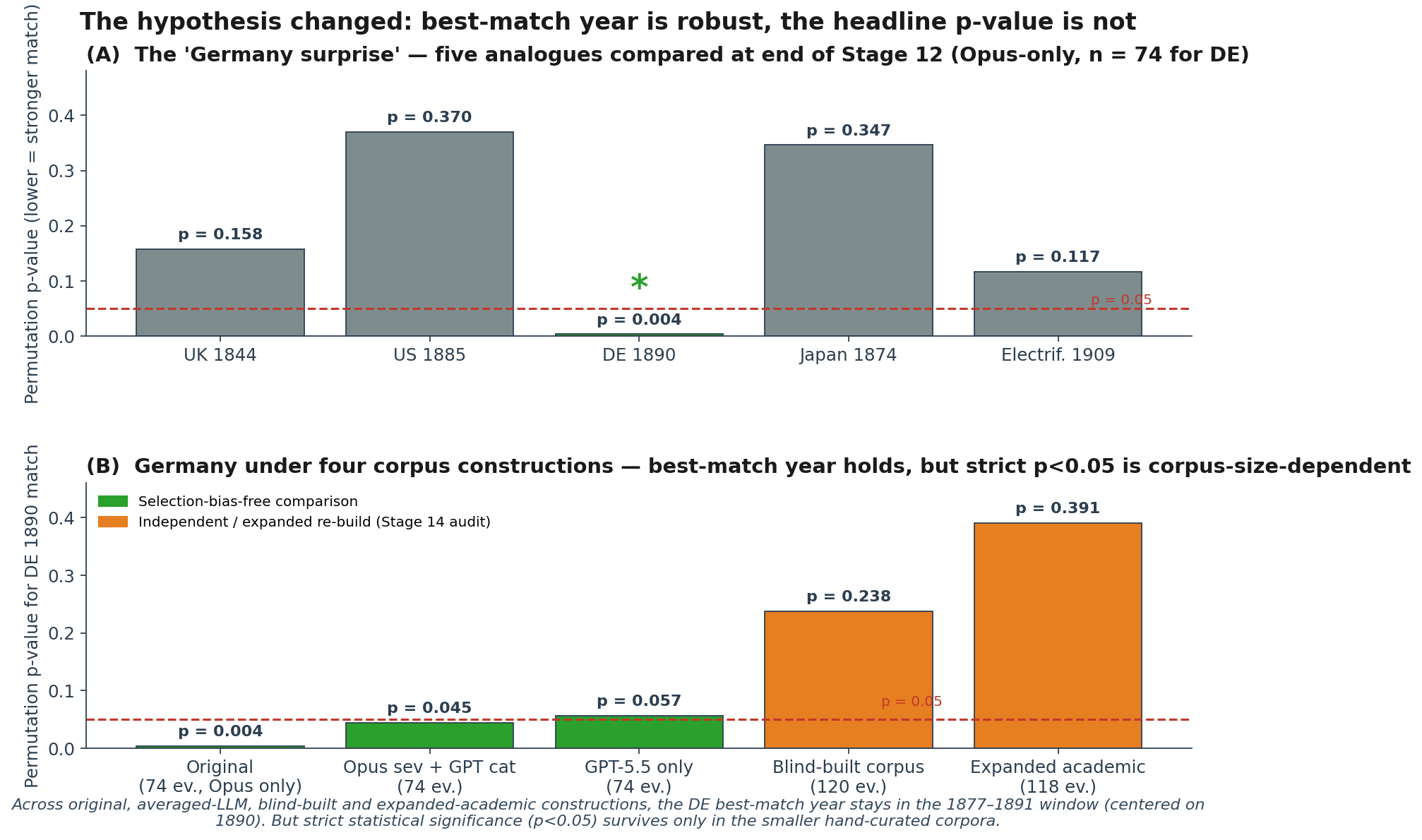
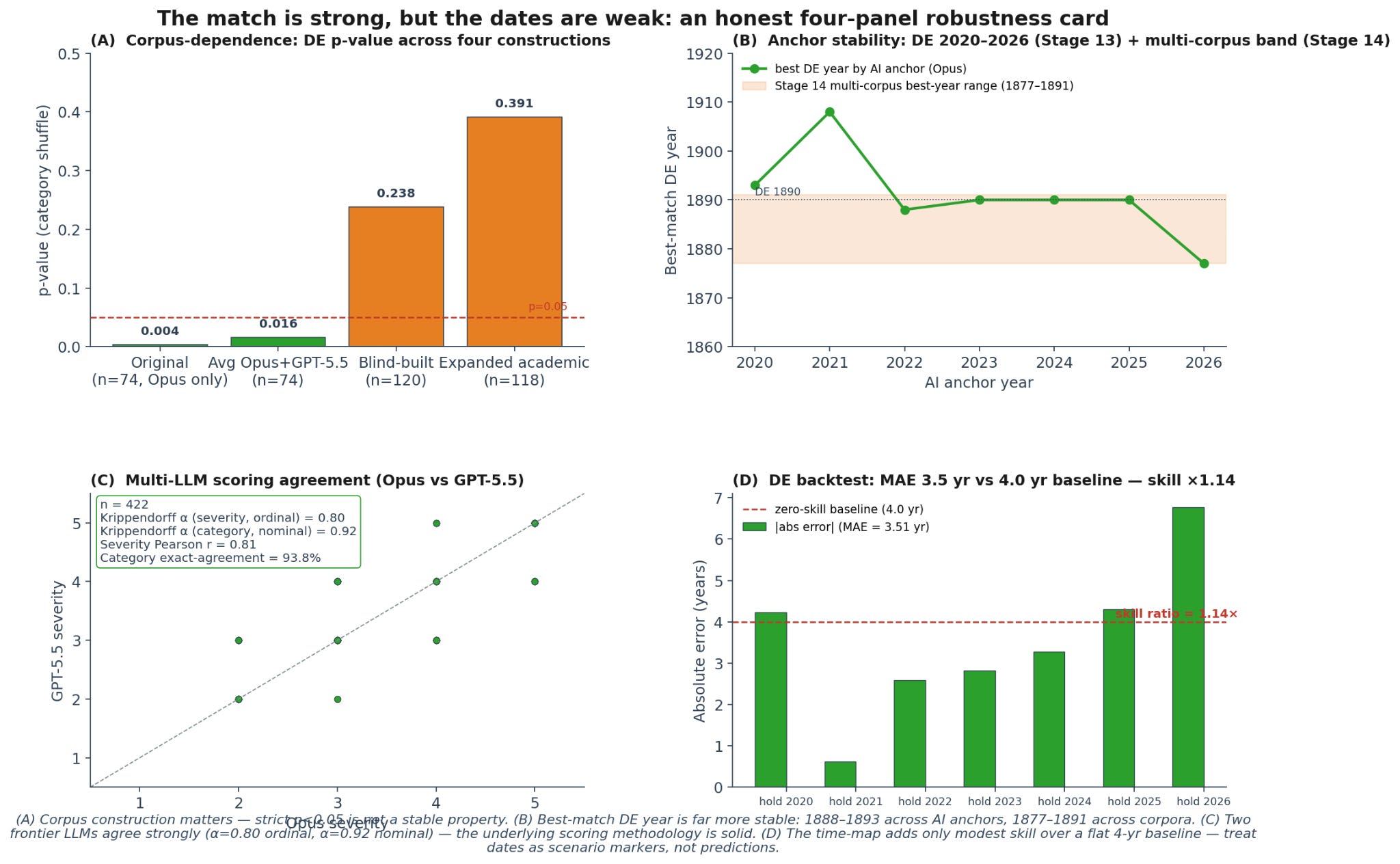
The first answer was too clean: Germany 1890, p = 0.004.
So I asked another research agent to try to break it.
It rebuilt the German corpus two ways. The exact p-value broke. The welfare-state window did not.
original German corpus: best year 1890, p = 0.004
expanded academic-cited corpus: best year 1877, p = 0.391
blind-built corpus: best year 1891, p = 0.238
That means the strict statistical claim does not survive. The directional claim does.
The confirmatory agent also rescored the full 422-event UK/US/Germany/AI corpus with two different frontier models. Severity agreement was good: Krippendorff alpha 0.80, Pearson r 0.81, and 100% of severity scores were within one point. Category agreement was stronger: alpha 0.92 and 93.8% exact agreement.
So I trust the shape more than the p-value, and the order of events more than the dates.
This chart is the honest version:
The corrected claim is narrower and more useful:
AI’s current social pattern most closely rhymes with the German welfare-state inflection around 1890. The strict significance is fragile, but the inference is stable enough to plan against. The UK and US analogues bracket it: Britain is the friendlier bull case; America is the higher-growth, higher-crash-risk bear case.
What I am doing with this
I am not starting from “AI will take every job” or “AI will make every founder rich.” Both are lazy.
The useful question is: what societal bargain lets the technology keep scaling and society improving?
If the UK bull case wins, the answer is liberalization plus enough worker adjustment that the boom keeps political permission.
If the US bear case wins, the answer is that nothing settles until after a market or labor crisis forces the issue.
If the German case wins, the answer is that society builds an AI-era welfare-state layer: insurance, liability, bargaining, and political accommodation.
I’m not advocating any of the three. The overlaps between them are where I would look for durable companies and durable policy. Not “AI for X” in the abstract. Not yet another model wrapper. The interesting opportunity may be in the institutional plumbing that helps channel societal discontent into mutually acceptable outcomes:
compliance systems that make AI labor rules operational
insurance products for AI displacement and AI liability
workforce-transition infrastructure that employers actually have to fund
data-center designs that turn local NIMBY into repeatable YIMBY
audit systems that let regulators, insurers, and courts decide fault
financing structures that survive if AI CAPEX gets politicized
I keep coming back to runway.
In a calm world, a founders’ runway is mostly cash divided by burn. In this world, runway is also social permission divided by political volatility. You can have the best model, the best tooling, the best data-center design, the best reward function, and the best go-to-market motion, and still lose if the society around the technology decides your category is the problem to be solved.
Germany 1890 says renormalization happens when the political system stops treating industrial discontent as noise and starts converting it into institutions.
That is the clock I am watching.
The new normal probably does not arrive when the models recursively self improve, or when agents can solve all of the Erdős problems, or when AI creates benchmarks expert humans can’t pass. It arrives when society decides who carries the downside risk of AI and builds the machinery to enforce that decision.
If the rhyme holds, that fight is not in the distant future.
It is the next few years.
Nice deep and thorough dive at this.
A comment about the current surface level of it. I understood and then try explaining it to others that it is similar to any major paradigm shift seen in at least US history.
Like the combustion engine replacing horses for the main mode of transportation, or how AutoCAD upended the drafting industry, etc.
"It's just a fad", "You didn't do it yourself", "Get a horse!"
At times having a strong pro-AI stance is like declaring your political party to a room of people from the opposite isle. I'm an "AI bro" or whatever.
Even some of my own family members after bringing it up. I'm afraid they'll disown me.
I find it all humorous really..
The strangest reaction is from the development side. Some saying how AI sucks and it writes terrible code, etc. I think they just haven't tried one of the agentic editors yet: Cursor, Claude Code, Antigravity, etc. Or xAI recently threw their hat in the ring with their Grok Build. Using frontier model agents with them, and first setting it up projects properly with a rules file et al.
I tell them it doesn't matter, like it or not, it's already here. Have to adopt or be outmoded. When I can do a week's worth of work in one day using the tool I'm going to win.
Can't be the guy that refused to trade in his drafting table, T-square, Compass, pens, etc., for a graphics tablet, mouse, and AutoCAD.