
In the Covid era, technology companies went on a hiring binge because they believed talent was scarce and they needed more of it.
In the AI era, technology companies are conducting layoffs because they believe AI makes talent less necessary.
That was my subjective perception. So I tested the data.
The answer is yes, but not in the clean way I wanted.
Covid hiring and AI layoffs are inverses because the executive talent story flipped signs. In 2021 the story was: talent is scarce, hire before someone else gets it. In 2025 and 2026 the story is: AI will do more of the work, so do not backfill unless you can prove the machine cannot absorb it.
But they are not inverses in the simple arithmetic sense. The companies that hired hardest in Covid are not reliably the companies cutting hardest in the AI wave.
I wanted Covid overhiring to forecast future layoffs.
It mostly does not.
That is the important result.
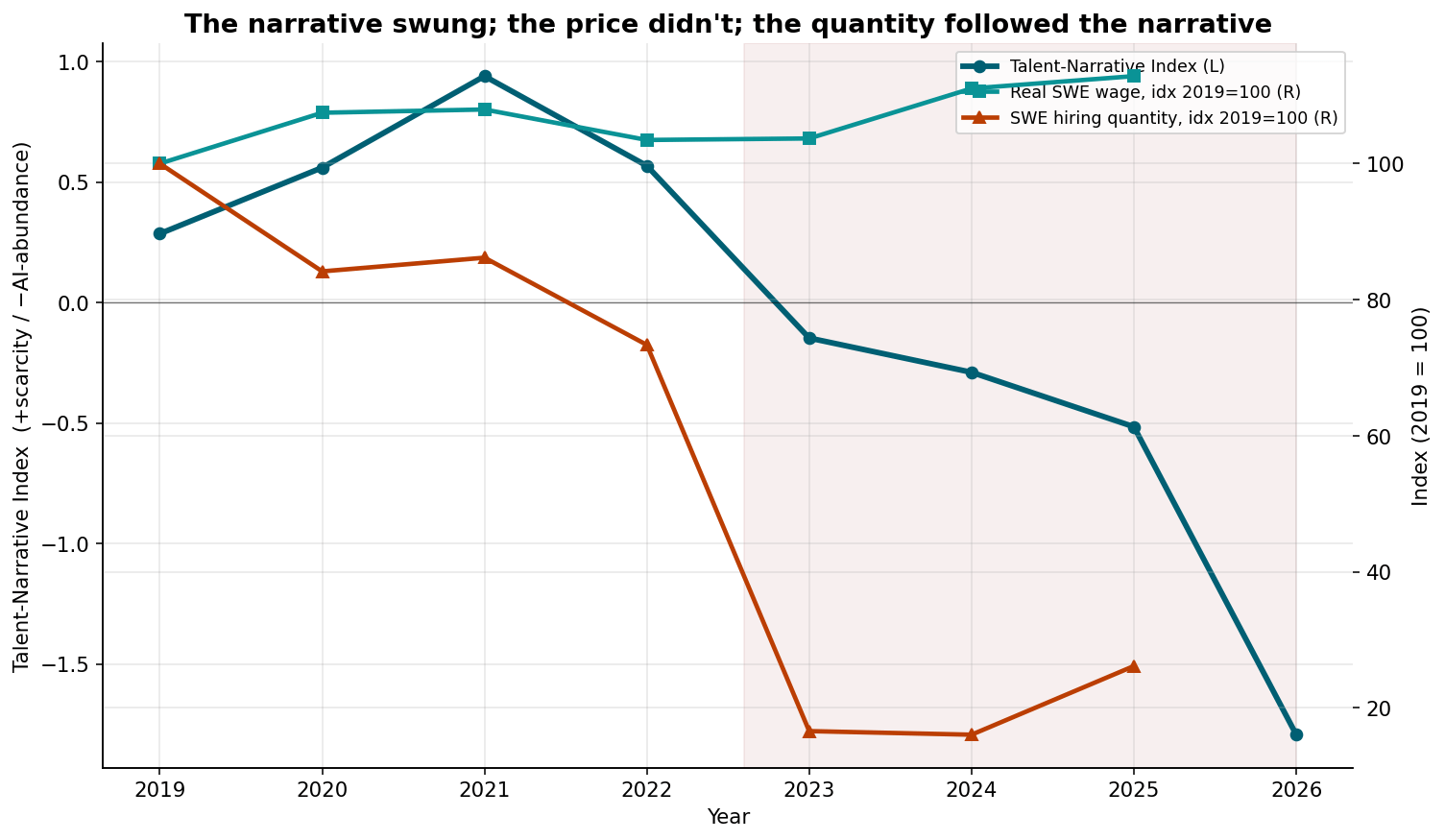
Results up front: tech companies really did hire aggressively during Covid. In my cohort, aggregate tech headcount went from 1.70 million in 2019 to 2.87 million in 2022. Executives really did talk like talent was scarce. The Talent Narrative Index hit +0.94 in 2021.
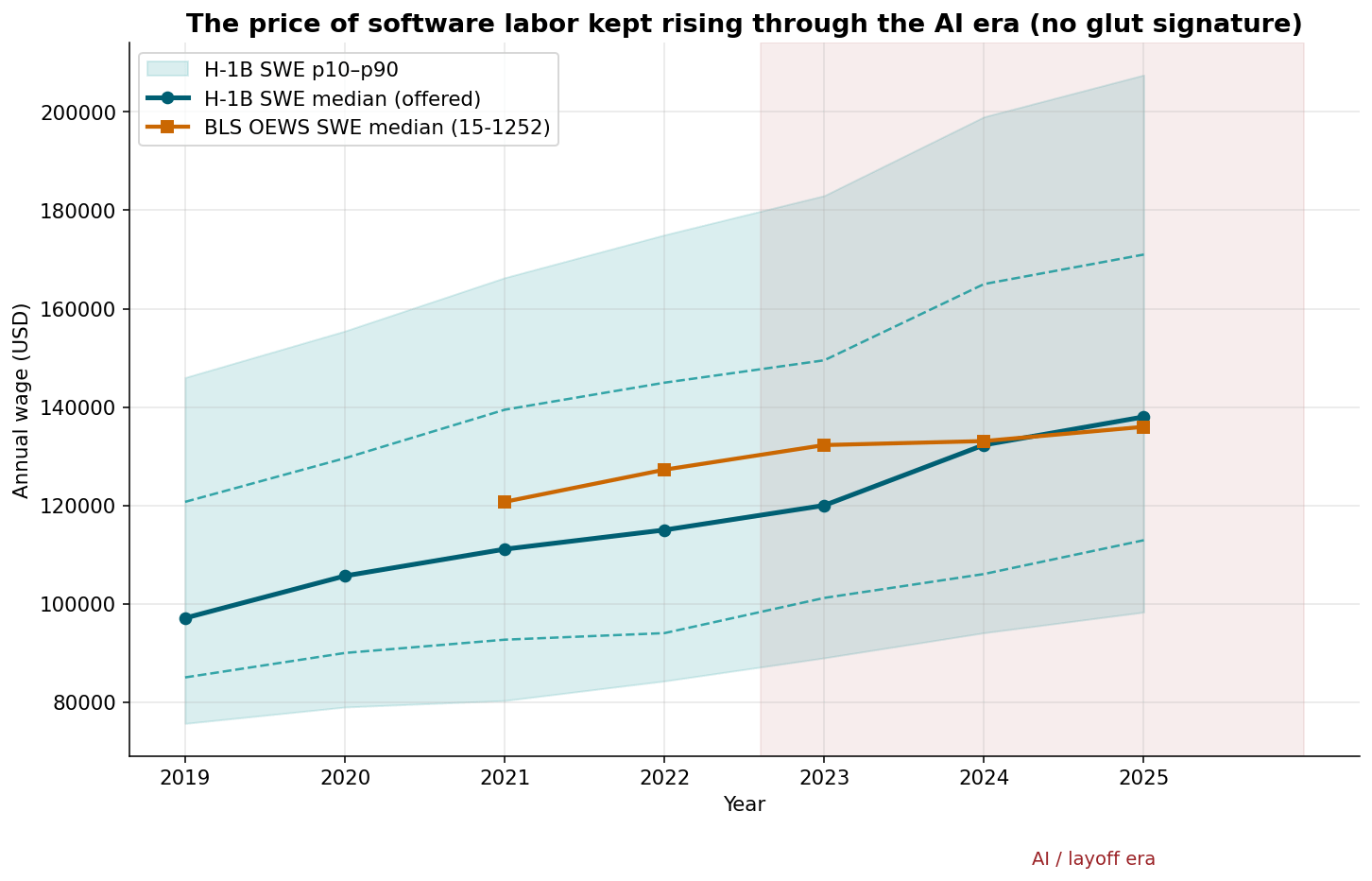
But the wage evidence does not look like an acute software-labor shortage. H-1B software offered wages rose smoothly from about $97,100 in 2019 to $115,000 in 2022, then kept rising to $138,000 in partial 2025. There was no Covid scarcity spike and no post-layoff crash.
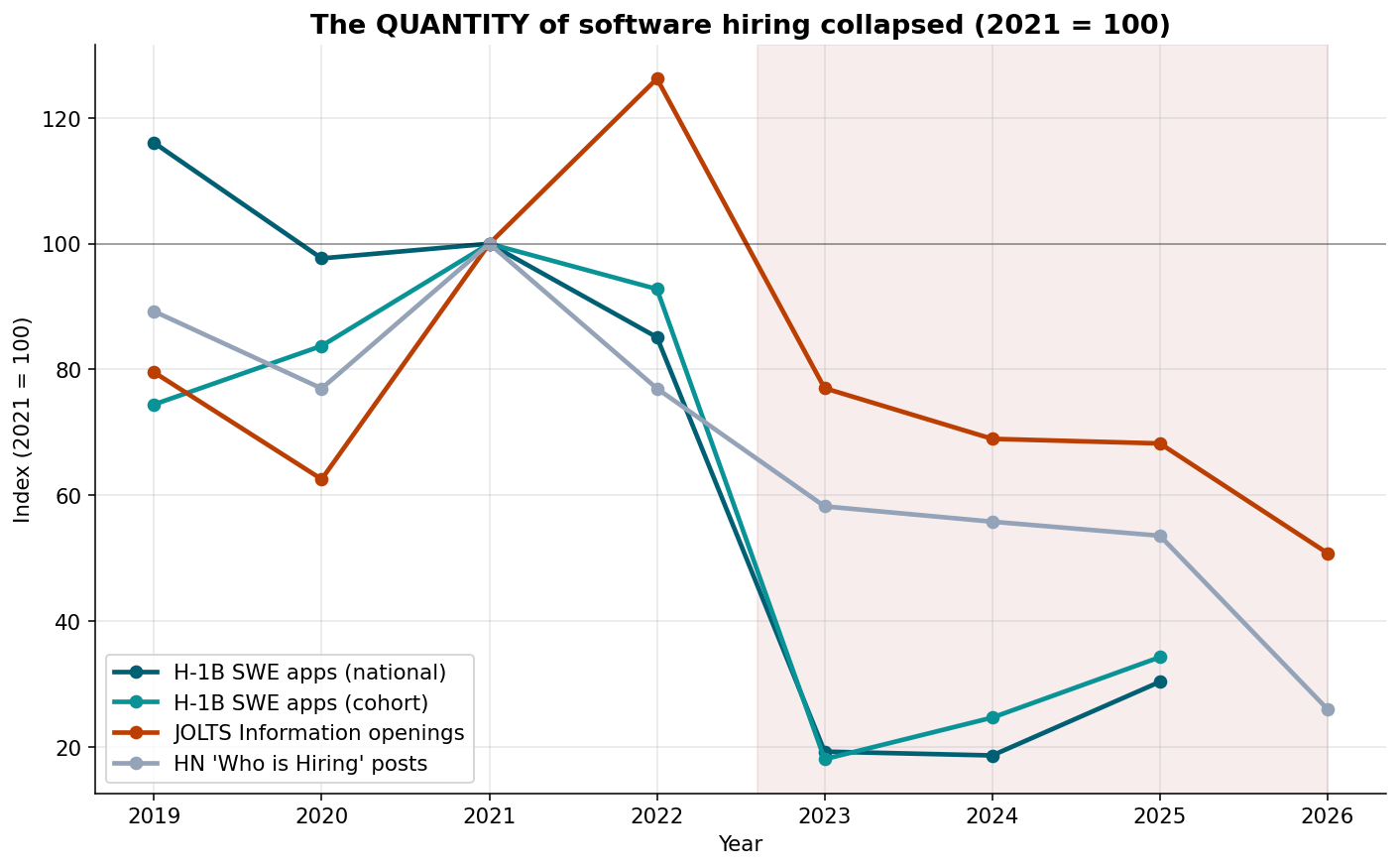
What moved violently was quantity. National software H-1B applications fell from 183,698 in 2022 to 41,534 in 2023, a 77% drop. JOLTS Information openings fell hard. Hacker News “Who is Hiring” volume fell. Companies stopped trying to hire even though the price of software labor did not break.
The AI era is the same pattern with a minus sign. The narrative index crossed zero in 2023, reached -0.52 in 2025, and hit -1.79 in partial 2026. Challenger, Gray & Christmas reported on June 4, 2026 that AI was the leading cited reason for U.S. job cuts for the third straight month. In May 2026, AI was cited in 38,579 announced cuts, 40% of all cuts that month.
But again, the wage evidence does not look like an engineer glut. Software wages kept rising. Entry-level H-1B software wages rose faster than senior wages from 2022 to 2025. The p90/p10 wage band did not compress.
The price of software labor did not validate either story.
The quantity of hiring did.
Then I ran the forecast test that mattered most: train on what we knew before 2024, predict each company’s 2024-2026 layoff depth, and check the result out of sample.
No model beat guessing the average.
Not Covid overhang. Not fundamentals. Not AI-pressure language. Not peer herding. Not all of them combined.
So the inverse is not company-by-company headcount math. Scarcity gave permission to hire. AI-abundance gives permission to cut, freeze, and not backfill.
That permission shows up first in the quantity of openings, in quiet headcount restraint, and in AI-efficiency messaging that tends to rise before a firm’s own layoff. It does not show up as a tidy formula that says “the Covid overhirers cut next.”
What I Measured
I built this as a public-data project, not a sourcing project.
The company cohort was 36 public tech firms plus 8 non-tech controls. It includes hyperscalers, semiconductors, enterprise SaaS, consumer internet, gig marketplaces, fintech, and pandemic darlings. The controls are boring on purpose: Walmart, P&G, JPMorgan, Coca-Cola, Johnson & Johnson, Home Depot, Caterpillar, and UPS.
The first layer was hard company data from SEC EDGAR: headcount, revenue, operating metrics, capital expenditure, and 10-K human-capital language.
The second layer was layoff data, primarily layoffs.fyi, treated as a lower-bound tracker rather than an official census.
The third layer was macro and labor data: Fed funds, JOLTS Information openings from FRED, H-1B Labor Condition Application disclosure files from DOL OFLC, BLS OEWS, information-sector average hourly earnings, and Hacker News “Who is Hiring” volume.
The fourth layer was narrative. I built a 1,051-document corpus: 10-K human-capital sections, AI/workforce MD&A slices, 484 earnings-call transcripts, and 13 CEO memos. The memos include the obvious ones: Mark Zuckerberg’s Year of Efficiency, Andy Jassy’s generative AI workforce memo, and Tobi Lutke’s Shopify AI/headcount memo, which TechCrunch covered with the public X memo link.
Then I classified the documents into talent narratives.
The key metric is the Talent Narrative Index:
TNI = talent scarcity - AI efficiency
Positive means the public story is “we need more people because talent is scarce.”
Negative means the public story is “we need fewer people, or fewer incremental people, because AI makes work more efficient.”
This is not meant to read minds. It measures stated executive narrative. That is the point. I wanted to test whether the public story itself moves with hiring and firing.
The Covid Hiring Boom Was Real
The first question is whether the hiring binge was even real.
It was.
Across the tech cohort, headcount went from 1.70 million in 2019 to 2.87 million in 2022. That is not normal expansion. That is a giant industry deciding, nearly all at once, that the future needed more people immediately.
The segment-level medians make the shape clearer.
Indexed to 2019 = 100:
Hyperscalers reached 160 by 2022.
Enterprise SaaS reached 210.
Pandemic darlings reached 239.
Semiconductors reached 169.
Consumer internet reached 180.
The controls mostly stayed near 100 to 115.
That is the first important fact. This was not just a general post-Covid labor-market recovery. It was a tech-sector boom.
The second important fact is that the boom had a real business trigger. Revenue exploded.
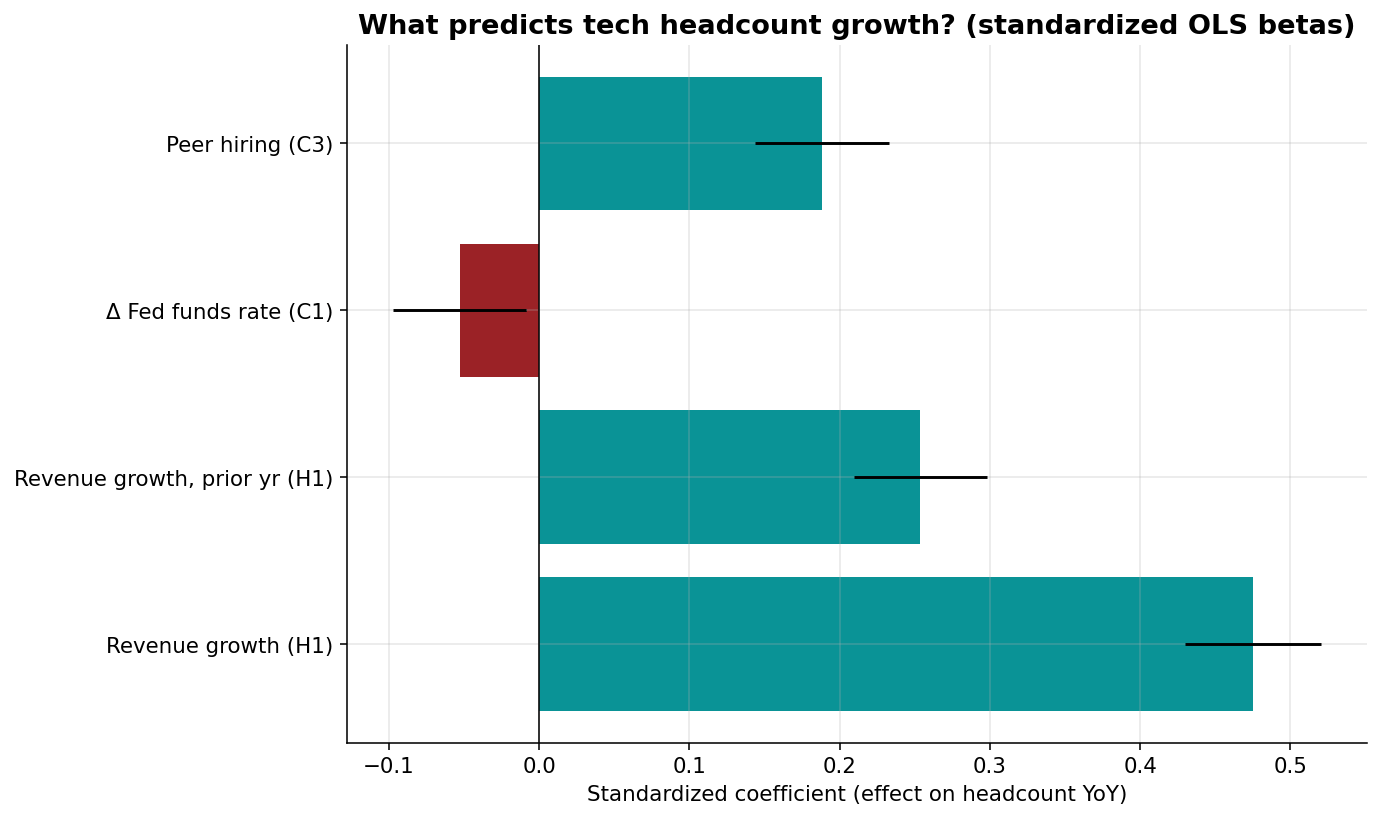
In the hiring regression, a company’s own revenue growth is the strongest predictor of its headcount growth. The revenue coefficient is 0.339 with a t-stat of 10.5. Lagged revenue growth also matters. Companies did not hire randomly. They hired because demand looked real.
That part of the original hypothesis survives.
The problem is that the demand was less durable than executives thought.
E-commerce pulled forward. Cloud pulled forward. Streaming pulled forward. Collaboration software pulled forward. Consumer hardware pulled forward. Crypto pulled forward. Delivery pulled forward. Anything that looked like “digital transformation” pulled forward.
Then the curve bent.
The biggest boomers decelerated hardest. Coinbase’s revenue CAGR went from +283% in the boom to -37% in the bust. Zoom went from +183% to +29%. Peloton went from +110% to -17%. DoorDash and Shopify slowed too. The companies were not crazy to observe growth. They were wrong to treat emergency demand as the new baseline.
That is the Covid mistake.
Not fake demand.
Temporary demand extrapolated as permanent.
The Talent War Was A Real Story, Not A Real Price Signal
Executives also talked like talent was scarce.
In 2021, the Talent Narrative Index was +0.94. Talent-scarcity language rose sharply. War-for-talent phrasing appeared in about a third of filings around the boom. Growth language was even stronger.
So if the question is “did executives say and probably believe there was a talent war?” the answer is yes.
But that is not the same as saying the talent war was the binding economic constraint.
For that, we need price.
If software talent was acutely scarce in 2021, the price of software talent should show a scarcity spike. If layoffs then created a glut in 2023, the price should soften or at least compress.
That is not what happened.
The H-1B software offered-wage median moved like this:
2019: $97,100.
2020: $105,664.
2021: $111,100.
2022: $115,000.
2023: $120,000.
2024: $132,300.
2025 partial: $138,000.
That is a smooth upward path.
There is no obvious war-for-talent spike. There is no layoff-era collapse. There is no p90/p10 compression. The p90/p10 ratio was 1.93 in 2019 and 2.11 in partial 2025. Entry-level offered wages, which should be the most exposed to AI substitution if the simple story is right, rose from $83,397 in 2022 to $99,000 in partial 2025.
Yes, H-1B data has limitations. It is offered wage, not total compensation. It is affected by DOL prevailing-wage floors. It is a sponsored-worker slice of the market.
But this is exactly why I checked it against OEWS and information-sector wage series. The broad pattern survives. The price of software labor did not break.
The quantity did.
National software H-1B applications fell from 183,698 in 2022 to 41,534 in 2023. That is a 77% drop.
JOLTS Information openings averaged 224,000 in 2022 and 122,500 in 2024. The project data shows 98,000 Information openings in April 2026.
Hacker News “Who is Hiring” volume fell too.
That is the core pattern:
Price smooth. Quantity violent.
In Covid, executives said talent was scarce. They hired aggressively. Wages did not show an acute scarcity shock.
In the AI era, executives say AI makes labor less necessary. They cut, freeze, and do not backfill. Wages still do not show a glut.
Read that slowly.
The narrative moved the quantity of labor action. It did not map cleanly to the price of labor.
Cheap Money Set The Clock
Covid demand explains why hiring felt rational.
Zero rates explain why it got so large.
Information-sector job openings peaked around April 2022, right as the Fed began lifting off. The Phase 1 analysis showed openings around 308,000 at the peak and a collapse to roughly 79,000 by December 2022. The Fed funds rate went from effectively zero to above 5% by 2023.
That timing matters.
When capital is free, labor hoarding looks like strategy. When capital has a price again, labor hoarding becomes operating leverage with a bad smell.
The layoff wave lagged the rate shock by a few quarters. That is exactly what you would expect. Boards do not cut the minute the 2-year yield moves. They wait until budgets, margins, valuations, and peer behavior make the new regime impossible to ignore.
There was also herding.
Tech firms’ hiring co-moved at 0.41 across firms. After stripping out each firm’s own revenue relationship, the residual co-movement was still 0.23. In the regression, peer hiring is independently significant. The coefficient is 0.318 with a t-stat of 4.19.
That is not proof that CEOs sat in a room and conspired together.
It is proof that the industry moved together beyond what each firm’s own revenue explained.
The same thing happened on the way down. January 2023 was the layoff cluster. Once a few companies moved, layoffs became normal, then prudent, then expected.
This is how executive narratives become operating plans.
First they are brave.
Then they are consensus.
Then they are hygiene.
The AI Era Flipped The Sign
Now look at the AI era.
The public language changes fast.
In 2021, TNI was +0.94. By 2023, it crossed negative. By 2025, it was -0.52. In partial 2026, from 34 documents, it was -1.79.
The AI-efficiency intensity goes from 0.05 in 2021 to 1.04 in 2025 and 1.91 in partial 2026.
The share of documents where AI is classified as a layoff rationale goes from basically zero to 9.5% in 2025 and 35.3% in partial 2026.
That is not a subtle shift.
It is a sign flip.
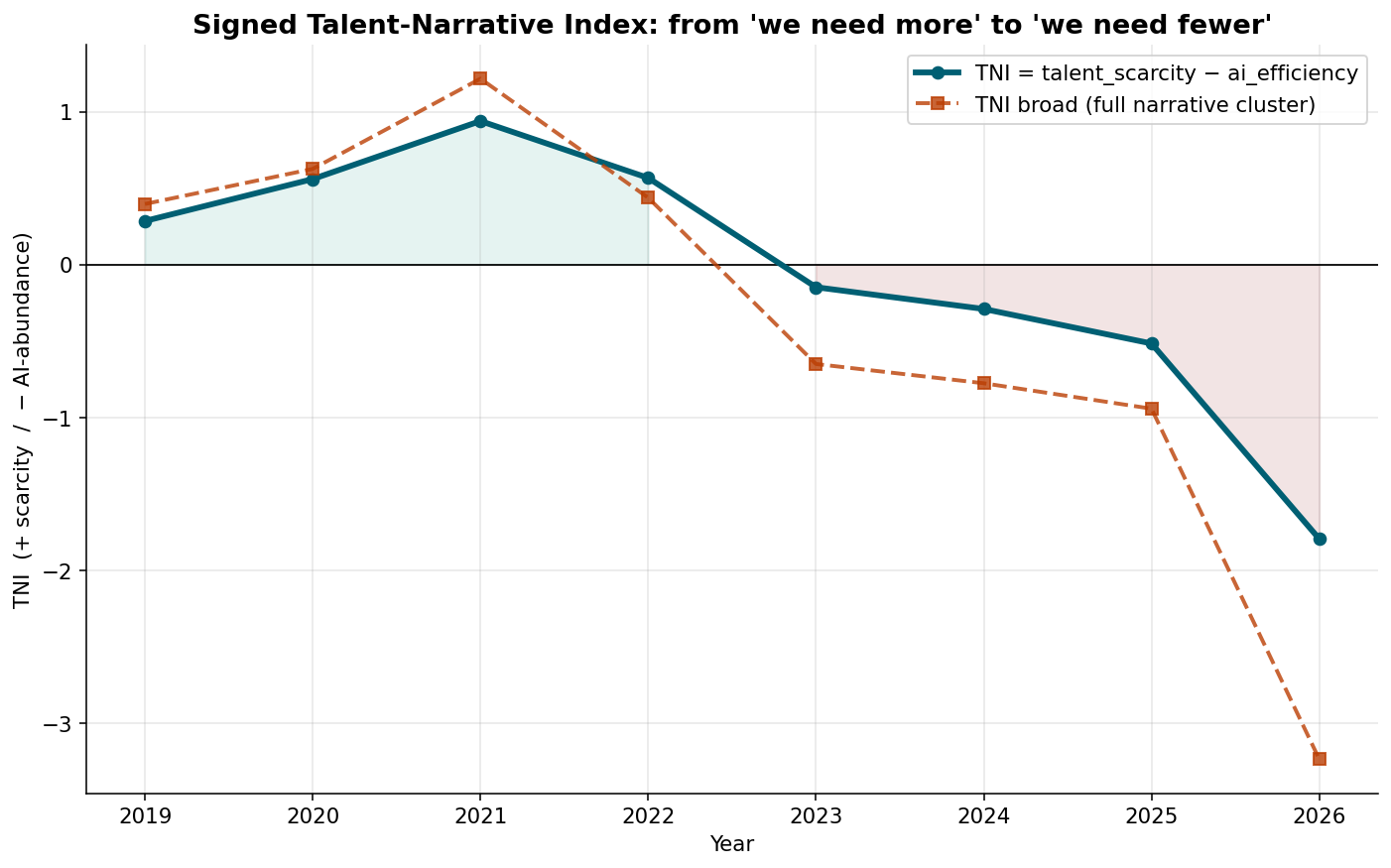
The public examples are not hard to find.
Meta’s Year of Efficiency memo in March 2023 said the company would flatten, reduce hiring rates, and cut around 10,000 people while closing 5,000 open roles. That memo is not purely an AI memo. It is an efficiency memo. But it is the bridge from the Covid correction into the new operating religion: fewer layers, fewer lower-priority projects, more developer productivity, leaner teams.
Shopify sharpened the point in April 2025. Tobi Lutke’s memo made AI usage a baseline expectation and required teams asking for headcount to explain why they could not get the work done with AI first.
Amazon made the labor implication explicit in June 2025. Andy Jassy wrote that as Amazon rolls out more generative AI and agents, the company will need fewer people doing some current jobs, more people doing other jobs, and expects this to reduce the total corporate workforce over the next few years.
By May 2026, this was no longer a few idiosyncratic CEO memos. Challenger reported AI as the leading cited reason for U.S. job cuts for the third straight month.
This is how the new story sounds:
Do more with less.
Do not backfill automatically.
Prove AI cannot do it before asking for headcount.
Flatten management.
Shift from people scale to agent scale.
That is not the Covid story.
It is the Covid story with the sign reversed.
The Money Chart
The key chart overlays three things:
Talent Narrative Index.
Real software wages.
Hiring quantity.
The result is clean enough to be annoying. Not like my 11yr old daughter “I will only eat Chick Fil-A” annoying. More like “this really tastes good” is annoying.
The narrative swings from scarcity to AI-abundance.
The price does not follow it.
The quantity does.
At the year level, the correlation between TNI and real software wage growth is -0.235. That is the wrong sign for a simple scarcity-price model.
The correlation between TNI and hiring quantity is +0.837. That is the right sign for a narrative-action model.
In the firm-year regression, after controlling for revenue and real wage growth, TNI still predicts workforce action. The coefficient is 0.0894, t = 3.52, p = 0.0005.
This is the strongest result in the project.
The narrative is disconnected from price, but connected to action.
That is why sentiment matters.
Not because executives have perfect causal explanations.
Because executives control hiring plans.
The Forecast I Wanted Failed
This is where the cute story breaks.
If the only model were “Covid overhirers are now AI layoff firms,” then Covid hiring intensity should forecast AI-era cuts.
It does not.
Splitting the layoffs into two waves makes the failure obvious.
Wave 1 was the Covid correction. In 2022 and 2023, the cohort had 108,228 layoffs. That was the give-back wave. The companies that hired too far ahead of demand had to unwind some of it.
Wave 2 is the AI/efficiency wave. From 2024 through partial 2026, the cohort had 167,726 layoffs. That wave is larger, later, and differently driven.
Intel is the cleanest example. It had only 19% Covid hiring growth, then cut about 42,000 people in the AI-era window, 32% of peak headcount. That is not a pandemic-darling unwind. That is a foundry, margin, and strategy crisis.
Oracle is the other obvious example. It had only 5% Covid hiring growth and still produced more than 31,000 AI-era cuts in the tracker. PayPal, Intuit, Net, Snap, and others also do not fit the simple overhire-then-fire story.
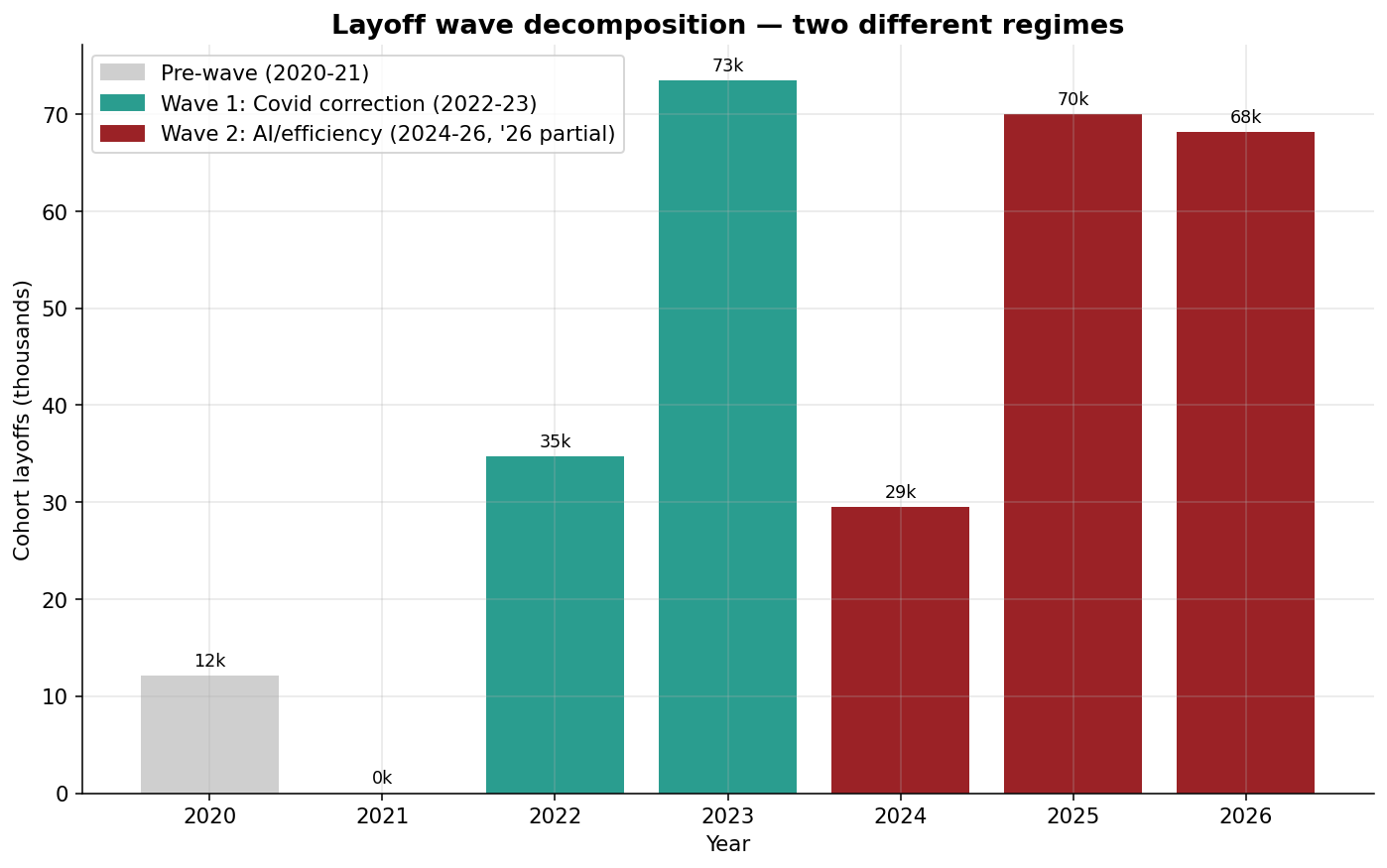
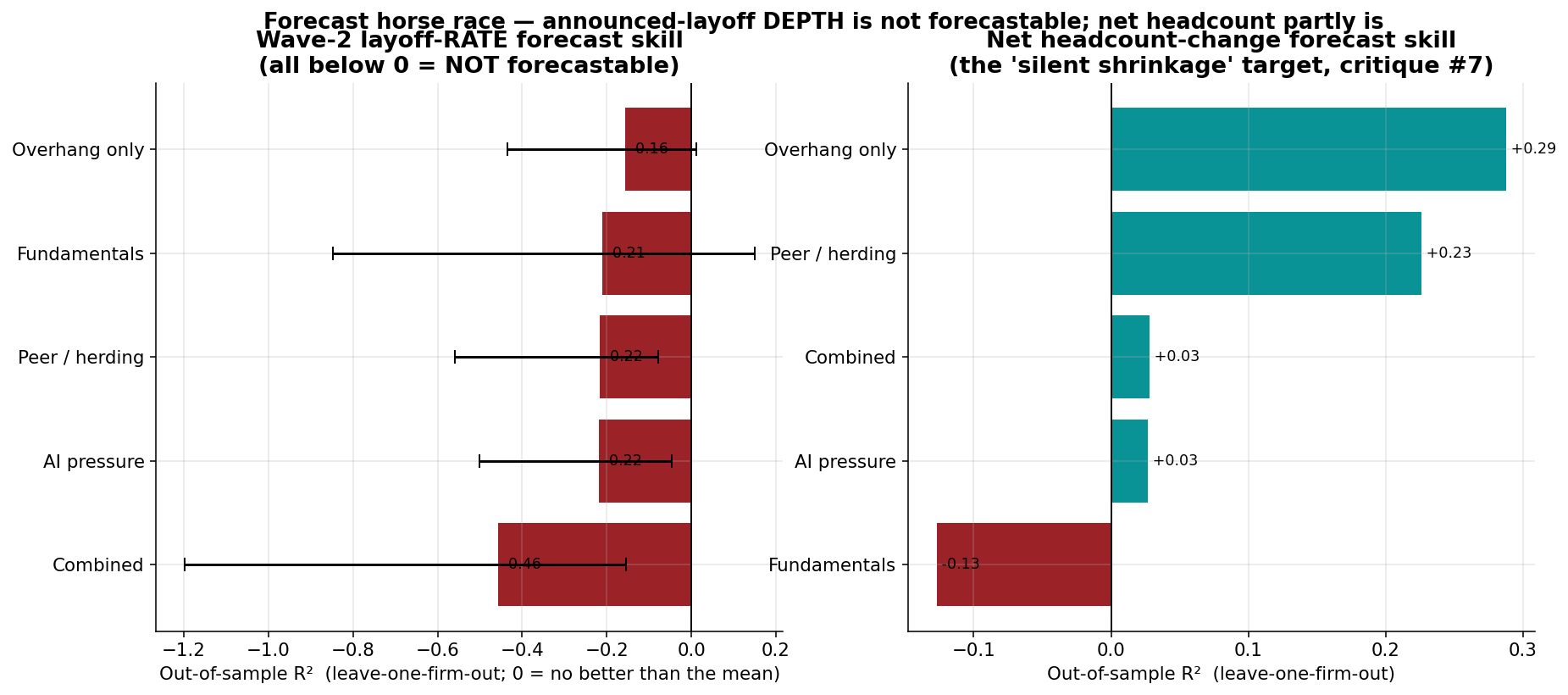
So I ran the forecast horse race. Hey, there is a horse named Emerging Market in the Belmont race tomorrow. That caught my attention apparently.
The target was 2024-2026 layoff rate. The predictors had to be known by the end of 2023. The validation was leave-one-firm-out across 34 tech firms.
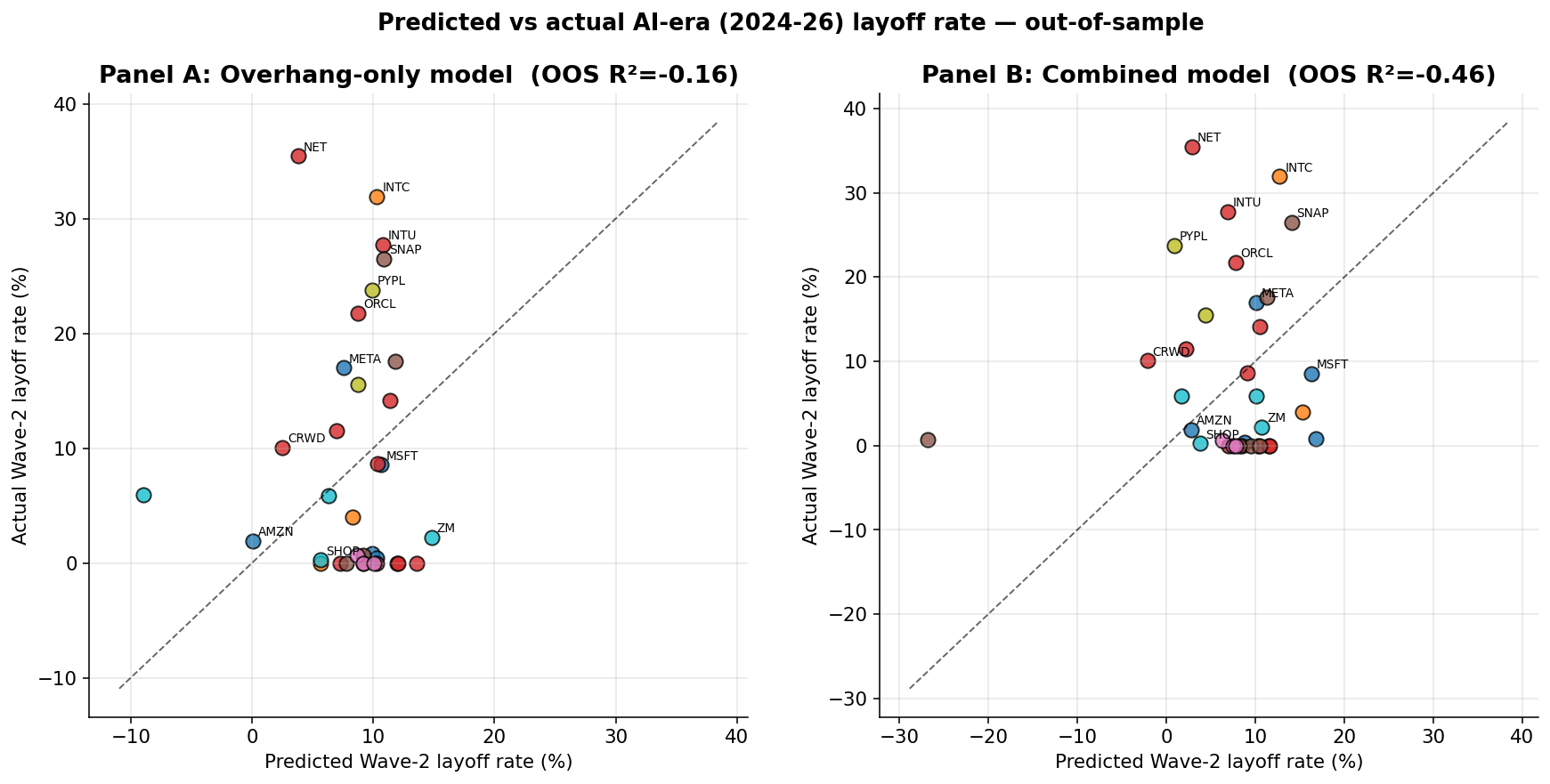
The overhang-only model had out-of-sample R2 of -0.16 for layoff depth.
The fundamentals model: -0.21.
The AI-pressure model: -0.22.
The peer/herding model: -0.22.
The combined model: -0.46.
All below zero.
That means every model was worse than predicting the average company.
That is not a small caveat. That is the result.
Announced-layoff depth is not forecastable here.
The predicted-versus-actual plot is even more useful than the table. It shows the overhang model and the combined model both missing the same kind of firm: Intel, Oracle, PayPal, Intuit, Net, Snap. These are not missed by a few points. They are missed because the reason they cut was not simply “they hired too much in Covid.”
The coefficient plot says the same thing more cleanly.
Covid hiring percentage was the top Wave-1 driver: standardized beta +0.80.
By Wave 2, it was -0.13.
Gone.
Remaining revenue-per-employee overhang survives weakly at +0.23. AI capex intensity moves from negative in Wave 1 to +0.26 in Wave 2. These are not clean forecast variables. They are weak survivors after the simple Covid arithmetic disappears.
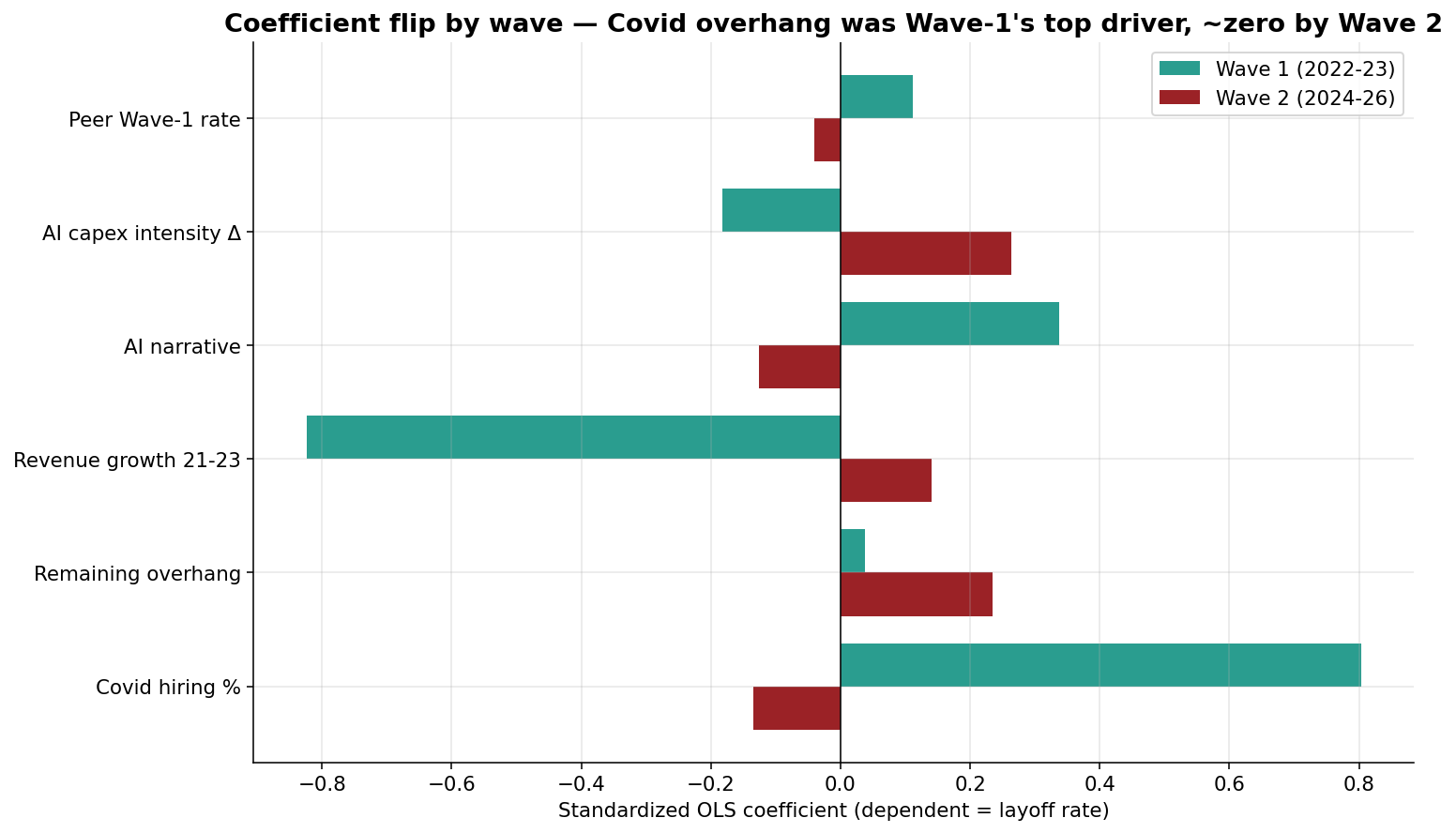
That is the credibility move for the article.
I wanted Covid overhiring to forecast AI layoffs. It mostly did not.
The inverse is narrative, not arithmetic. I won’t be betting on the Emerging Market horse at Belmont apparently.
Remaining Overhang Still Matters, Just Less Than I Wanted
The failure of crude Covid hiring does not mean overhang is useless.
It means “hired a lot in Covid” is the wrong variable.
A company can double headcount and then grow into that headcount. Another company can add fewer people and still carry excess labor because revenue per employee never recovered.
So we built a remaining-overhang metric: peak/latest employees minus revenue-supported employees on each firm’s pre-Covid revenue-per-employee trend.
That is closer to the thing we actually care about.
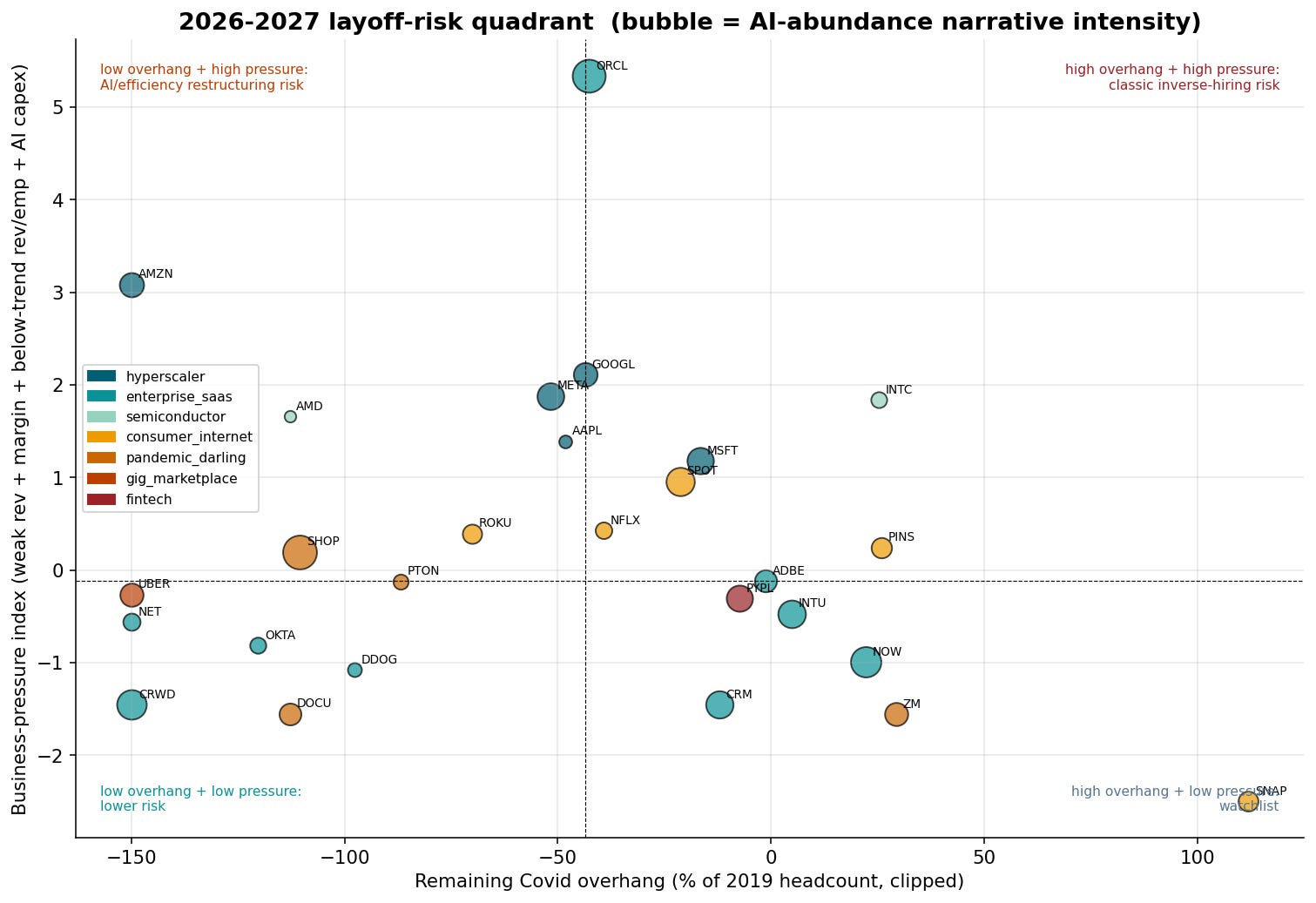
The leaderboard is revealing. Snap still carries about +112% remaining overhang relative to 2019 headcount. Pinterest is about +26%. Intel is about +25%. ServiceNow is about +22%. Zoom is about +29%.
Meanwhile CrowdStrike, Cloudflare, Okta, Amazon, Uber, Shopify, and others show negative remaining overhang because revenue or subsequent correction absorbed the headcount.
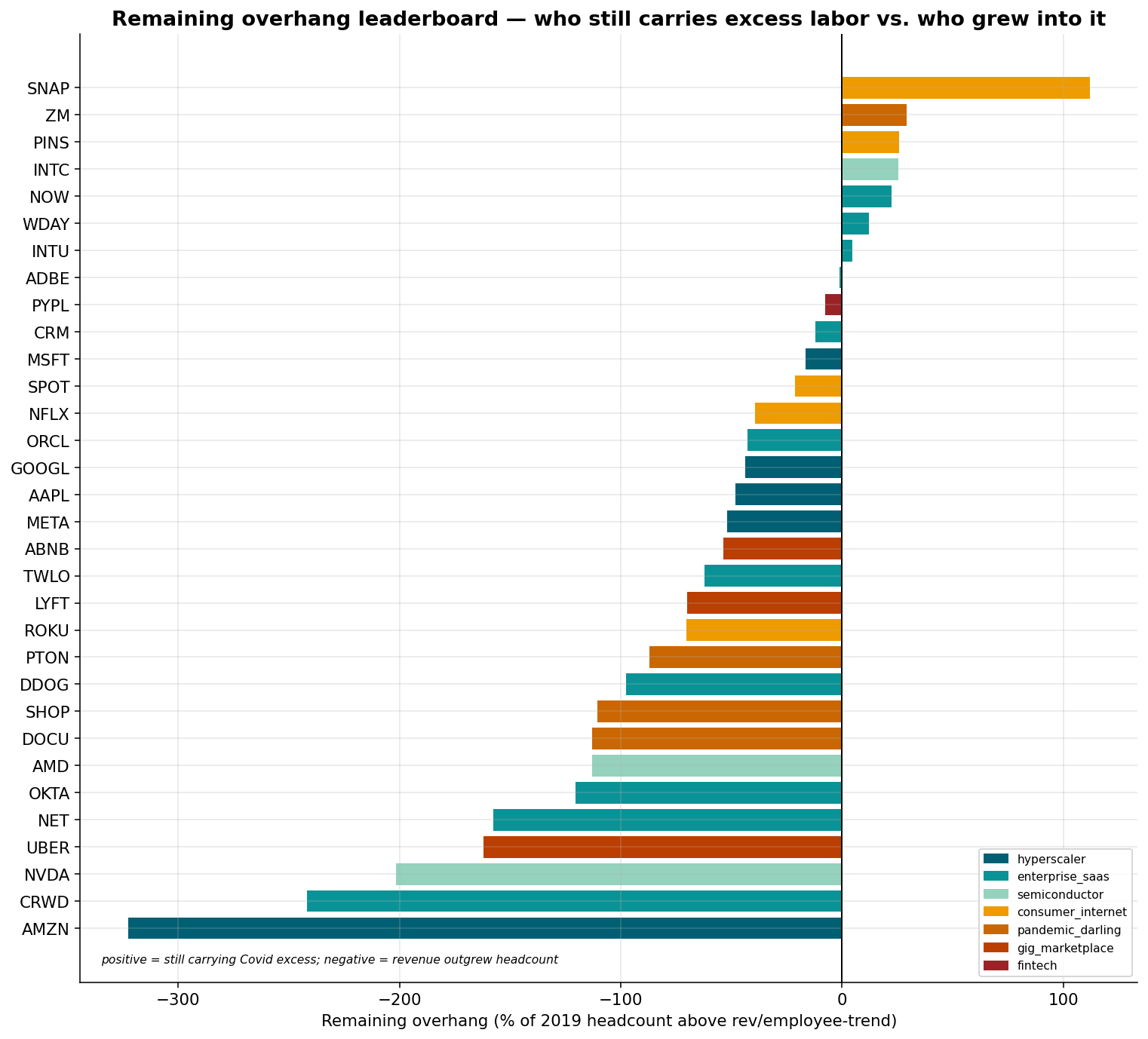
This changes the forward framework.
If a firm has high remaining overhang and high business pressure, the classic inverse-hiring thesis still has mechanical plausibility.
If a firm has low remaining overhang and high business pressure, the likely story is different: AI/efficiency restructuring, capex pressure, margin repair, product mix, or a firm-specific crisis.
That is why a single Covid-hiring variable fails.
There are at least two layoff regimes hiding under the same headline.
AI Capex Became Part Of The Pressure
The AI wave is not just “AI replaces employees.”
It is also “AI is expensive.”
At the hyperscalers, capex intensity roughly doubled. Meta’s capex/revenue went from 0.16 to 0.35. Google went from 0.10 to 0.23. Microsoft went from 0.12 to 0.23. Amazon went from 0.13 to 0.18. Apple stayed roughly flat around 0.03.
The capex-intensity increase correlates +0.26 with Wave-2 layoff rate. That is not a magic coefficient, but it is directionally consistent with the strategic reality: companies are funding data centers, chips, model contracts, internal tooling, and product rewrites. If revenue growth is slowing and the board accepts a large AI capex plan, headcount becomes the flexible budget line.
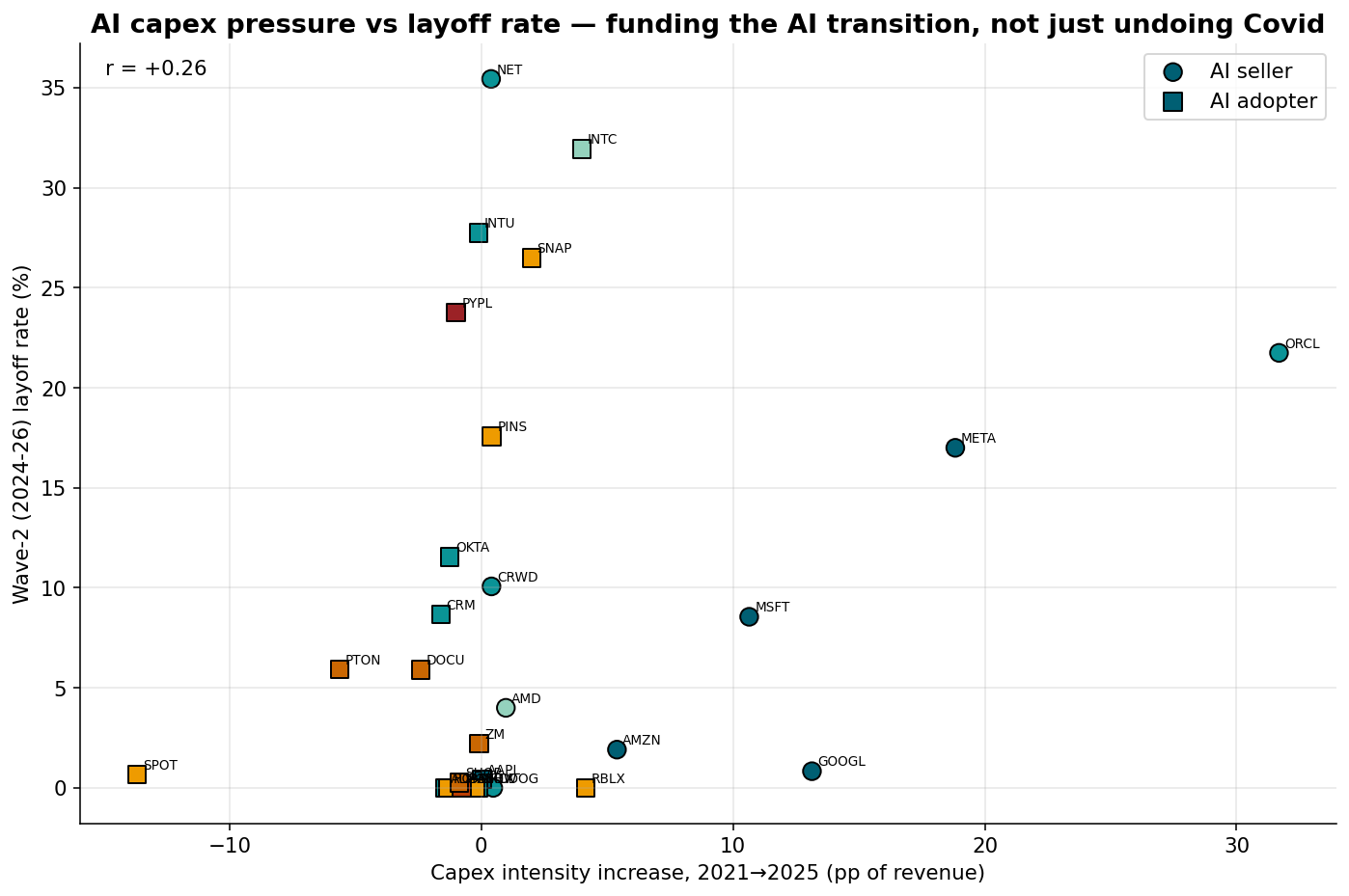
This is one reason AI can be a real force in layoffs without being the literal replacement mechanism for every cut.
Some cuts may be substitution.
Some cuts may be funding.
Some cuts may be margin repair.
Some cuts may be management fashion.
The public AI story can sit on top of all four.
AI Is A Frame, Not A Clean Cause
The AI story is powerful. It is not always causal.
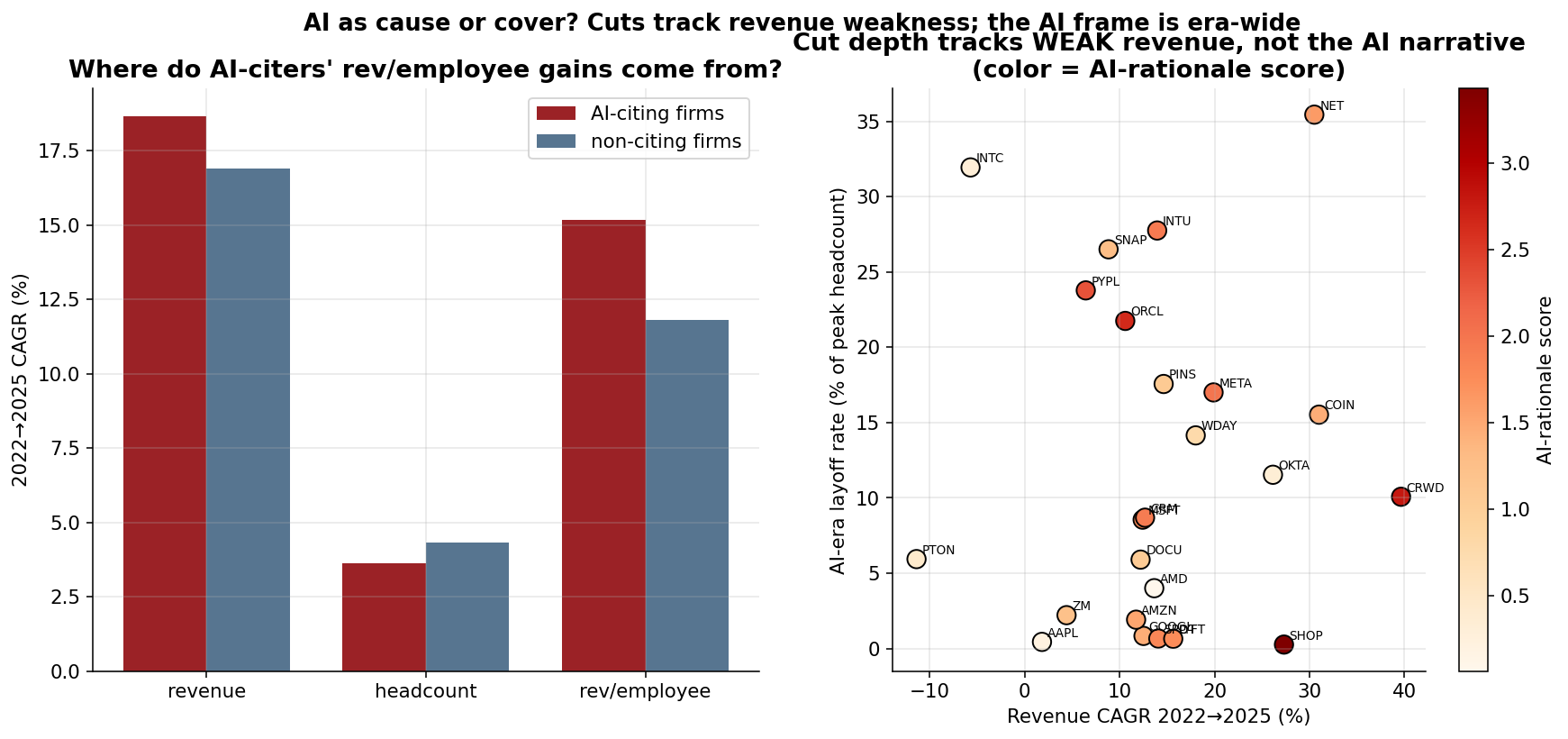
In the cross-firm data, citing AI does not predict cut depth. The correlation between AI rationale and AI-era layoff rate is about +0.04. That is basically nothing.
AI-citing firms split into opposite groups.
Some are high-growth firms barely cutting. Shopify, CrowdStrike, Snowflake, and Roblox talk loudly about AI while still growing revenue quickly.
Some are slower firms cutting deeply. PayPal, Oracle, Intuit, and others use AI language while dealing with very different operating realities.
There is also a major confound in productivity.
AI-citing firms often look like they have stronger revenue-per-employee growth. But when you separate the AI infrastructure sellers from everyone else, the edge largely disappears. Nvidia, Microsoft, Amazon, Oracle, and other AI sellers are not simply becoming more productive because AI replaced internal staff. Many are selling the infrastructure or services other firms use to chase AI.
That is revenue from the AI buildout, not proof of internal labor substitution.
This does not mean AI has no productivity effect.
It means the public AI narrative does not cleanly identify the productivity effect.
The frame is broader than the cause.
That was true in Covid too.
“War for talent” was a real executive belief. It was not the best explanation for the wage data.
“AI makes headcount redundant” is a real executive belief. It is not yet the best explanation for the wage data either.
The Quiet Target Is Headcount, Not Layoff Announcements
There is another reason the layoff forecast fails.
Layoffs are lumpy. They are public. They are legal, political, and reputational events. They reflect timing, disclosure, local labor law, severance windows, and whether a company chooses one big announcement or ten smaller ones.
The AI labor story is probably quieter than that.
It is no-backfill. It is attrition. It is requisitions that never reopen. It is a team that used to ask for six people and now asks for two. It is a manager who learns that the easiest way to look AI-first is to make the next headcount request disappear.
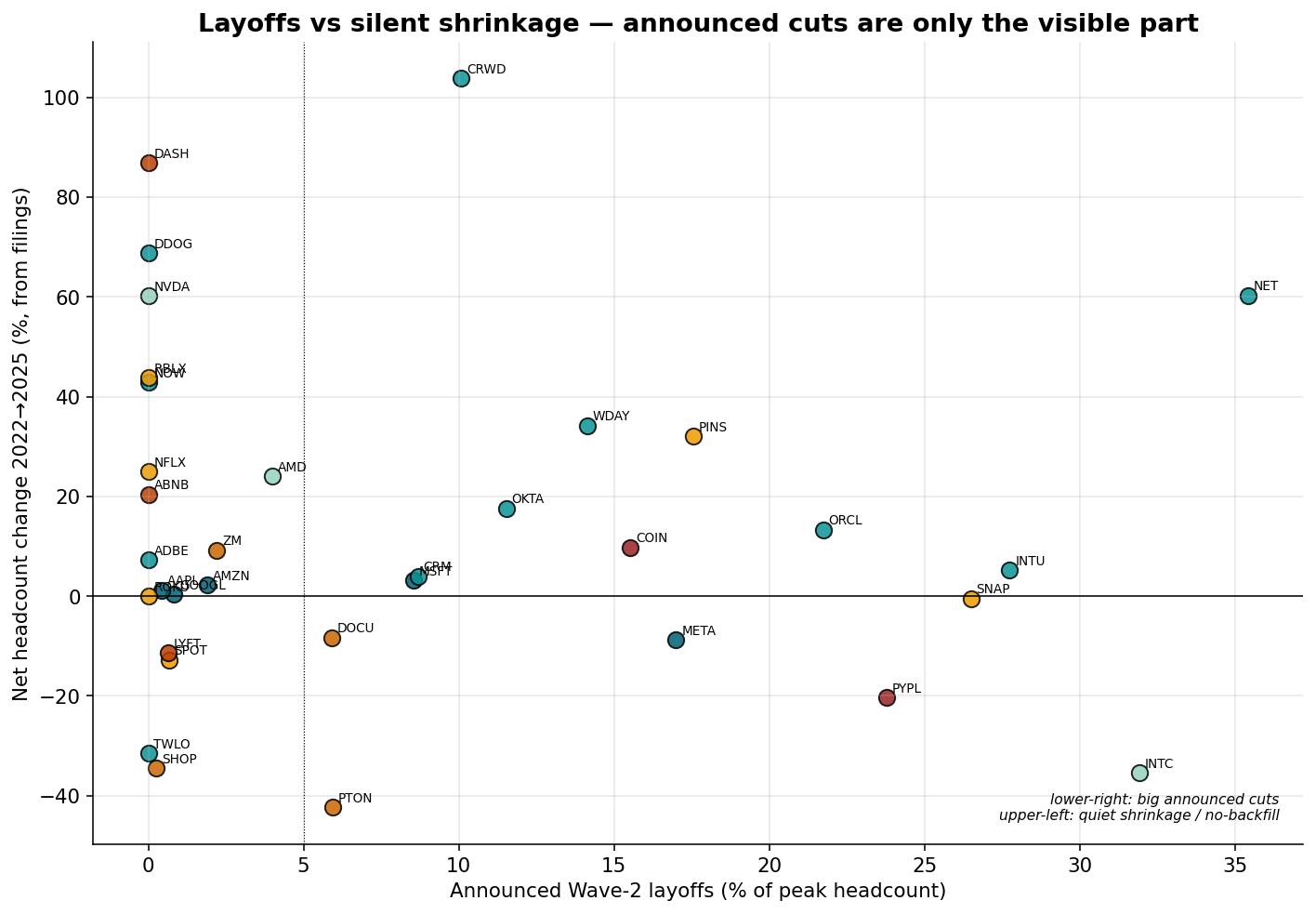
When we modeled net headcount change rather than announced-layoff depth, the signal improved in the retrospective model. The overhang model had positive out-of-sample skill on net headcount change in that setup, unlike announced-layoff depth.
Then we cleaned the forward test to remove look-ahead. The forecast skill collapsed back toward zero. The honest forward headcount model has only about +0.03 out-of-sample R2, and the 80% prediction interval is huge: roughly -29% to +32%.
That sounds disappointing.
It is useful.
It means no not-yet-cut firm can be statistically called to shrink as a point forecast. The error bars swallow the signal.
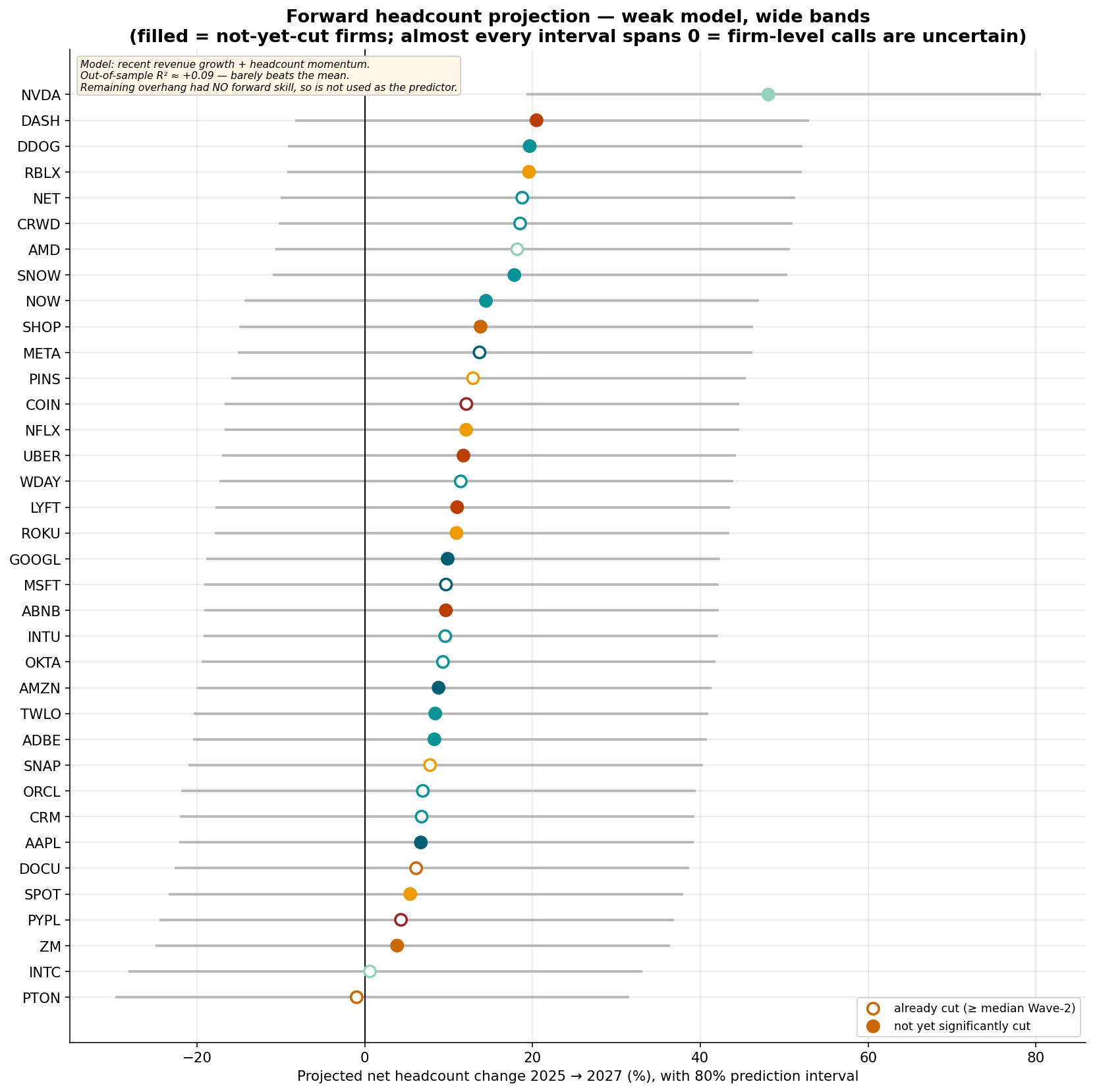
The right claim is not “Company X will cut 12%.”
The right claim is “Company X is in a higher-risk zone because its messaging, overhang, capex pressure, and business pressure line up.”
That is a risk ranking, not a number.
The Best Forward Signal Is Messaging
The strongest forward-looking evidence is not the Covid overhang model.
It is messaging.
At the macro level, the AI-permission narrative leads the decline in Information openings by about two quarters. The correlation is -0.87 at a +2-quarter lead. That does not prove causality. Both series trend through the AI transition. But it is exactly the timing pattern the narrative-permission theory would predict.
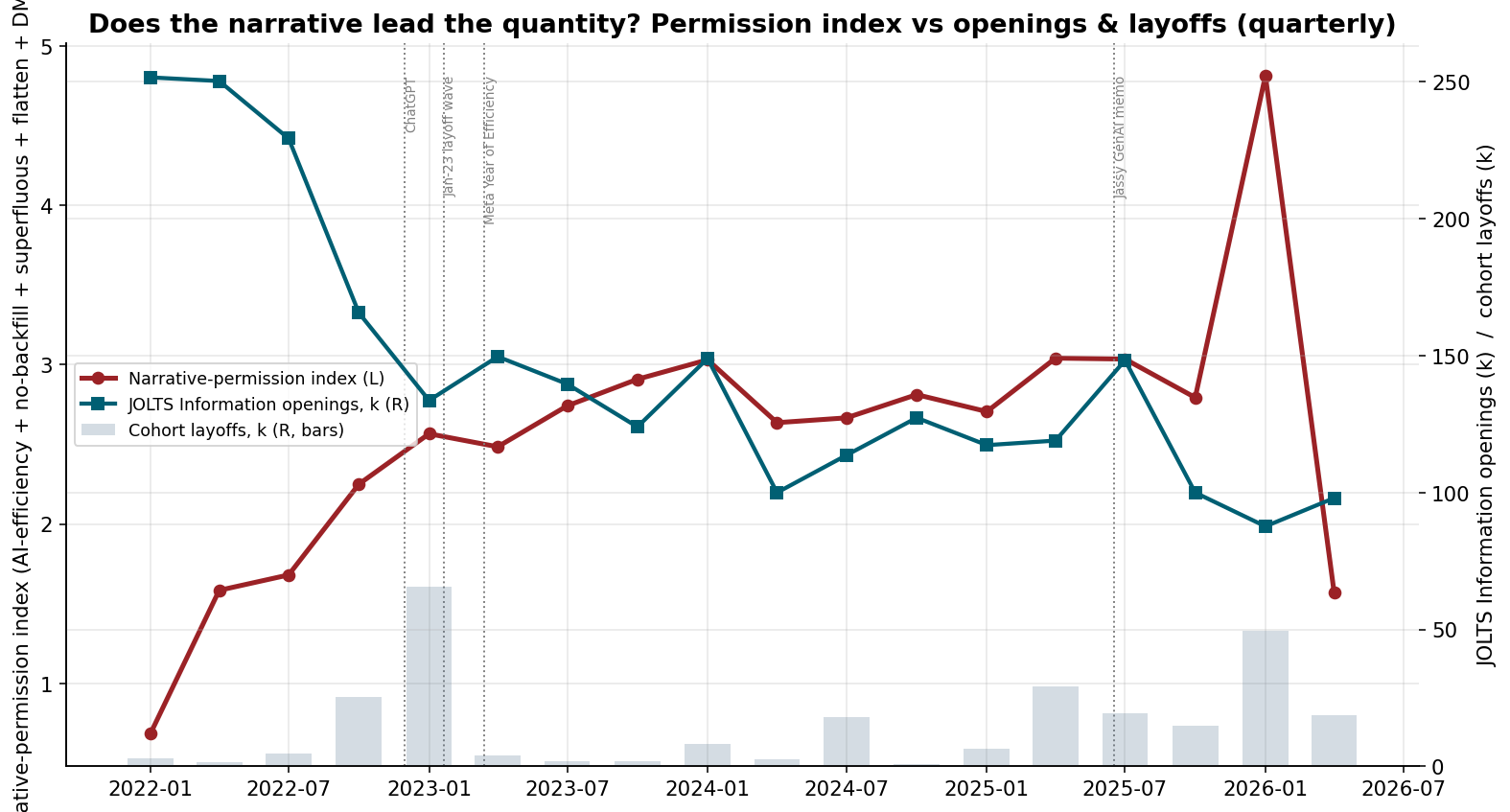
At the firm level, AI-permission messaging also rises before a firm’s own layoff.
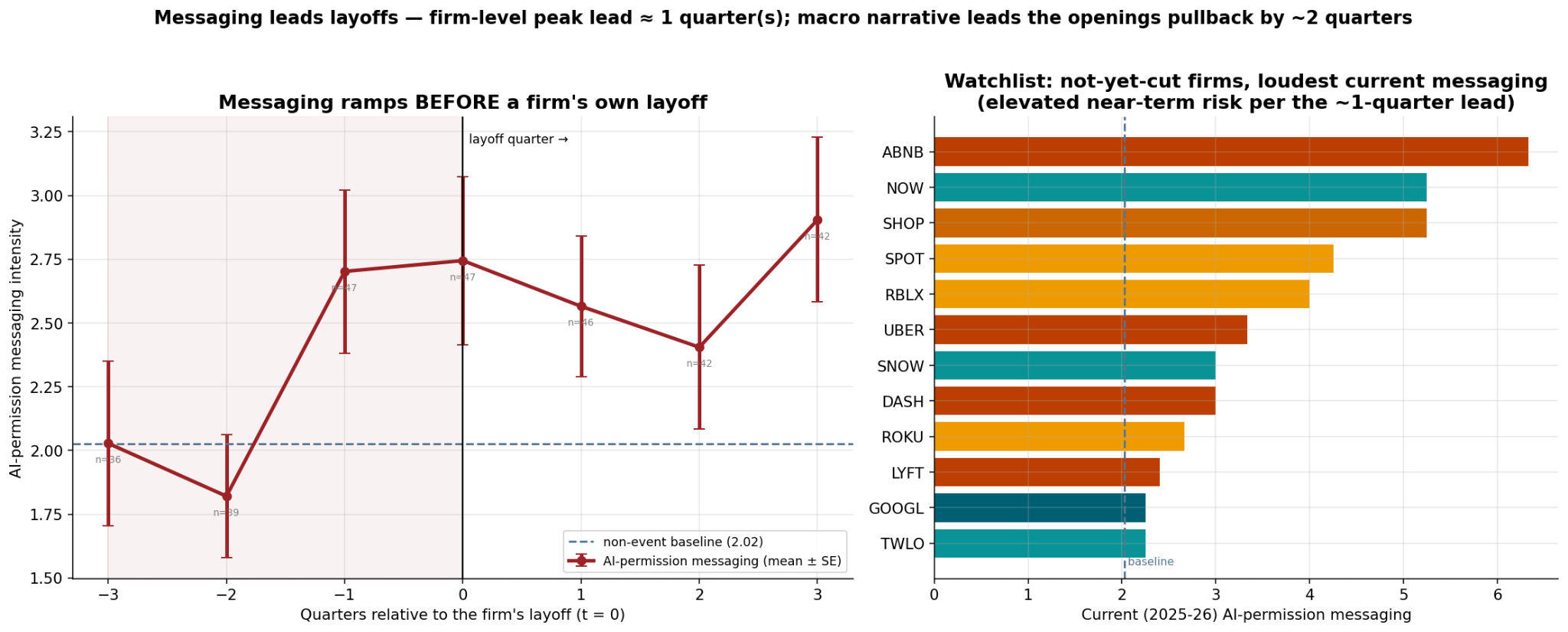
In the event study, messaging sits around 1.82 two quarters before a layoff, jumps to 2.70 one quarter before, and peaks around 2.74 in the layoff quarter. The non-event baseline is about 2.02.
The signal is weak. The standard errors are wide. It is not deterministic.
But it is the most actionable forward evidence in the project.
It says: do not ask which company overhired most in Covid. Ask which not-yet-cut company is now talking most loudly about AI-efficiency, not backfilling, headcount superfluousness, flattening, and doing more with less.
That produces a watchlist.
The loudest not-yet-cut firms in the current messaging data are Airbnb, ServiceNow, Shopify, Spotify, Roblox, Uber, Snowflake, DoorDash, Roku, and Lyft.
Read that list carefully. They might be good ponies to bet on for a brief stock jolt.
Most of those firms do not have positive mechanical Covid overhang. Airbnb has negative overhang. Shopify has deeply negative overhang. Uber has deeply negative overhang. If they cut, the explanation will not be “they are finally undoing the Covid hiring binge.”
It will be the new labor logic.
ServiceNow is the interesting exception: loud AI messaging and real remaining overhang.
The Forecasting Model I Would Actually Use
Can we use these sentiments to predict future divestment?
Yes, but not as a point forecast of layoff depth.
The forecast I would use is a risk framework:
First, separate the regime.
If the company is still working through remaining overhang and business pressure is high, the classic Covid-correction logic still matters.
Second, track AI-permission messaging.
No-backfill language matters more than layoff language. Layoffs are the headline. No-backfill is the operating system.
Third, track hiring quantity, not wage.
Software wages are sticky and secular. Applications, openings, recruiting teams, offer volume, job posts, and internal requisitions move faster. The Covid and AI eras both show that the quantity channel is where the action appears first.
Fourth, track capex pressure.
AI infrastructure has to be funded. If the AI capex bill is rising and revenue growth is not, headcount becomes one of the few large controllable lines.
Fifth, track function and layer.
The AI-divestment story is not evenly distributed. It points hardest at recruiting, HR, support, customer operations, G&A, layers of middle management, low-priority product teams, internal tooling teams that agents can compress, and legacy business units that do not fund the AI story.
It points least at scarce AI researchers, AI infrastructure engineers, top applied AI product teams, power users who can multiply output, and people who turn models into deployed workflows.
That last part is why the aggregate wage result matters.
AI can reduce demand for some work while increasing demand for other people who know how to wield it. A single “software engineer wage” will not catch the reallocation cleanly. The first-order business action can be layoffs. The second-order labor-market result can still be rising pay for the people companies decide they need.
That is exactly what the current evidence looks like.
The New Talent Cycle
Here is the mental model I now believe.
Tech executives do not only manage labor as a cost.
They manage labor as an internalized and external story about the future.
In 2021, the future was demand abundance and talent scarcity. The strategic sin was failing to hire enough. The manager who protected headcount looked timid. The manager who hired looked ambitious.
In 2026, the future is AI abundance and human bottlenecks. The strategic sin is carrying work that a machine, agent, or smaller team might absorb. The manager who protects headcount looks outdated. The manager who gets more done with fewer people looks modern.
That is a brutal incentive shift.
It does not require AI to be fake.
It also does not require AI to be the full cause of every layoff.
New technologies do not need to explain everything to become the language through which everything gets explained.
Covid did not create a permanent digital-demand step function as large as companies thought. But it created enough real demand to justify the story long enough for the hiring boom to happen.
AI does not need to have already replaced millions of white-collar workers to change headcount behavior. It only needs to be credible enough for executives to rewrite the operating bar.
That is where we are.
The labor market is not screaming “engineers are worthless.”
The management system is whispering “every incremental headcount request is now guilty until proven necessary.”
Those are different facts.
They should not be fused into one story.
What I Now Believe
My opener was directionally right and mechanically wrong.
Covid-era hiring and AI-era layoffs are inverses, but not because one was simply too many humans and the other is simply too much AI.
They are inverses because the collective executive talent narrative flipped:
From scarcity to abundance.
From hire ahead to do not backfill.
From people as the bottleneck to people as the cost line AI might compress.
But in both eras, the price of software labor stayed on a smoother path than the story implied. The violent adjustment happened in hiring quantity and headcount decisions.
The forecast result sharpens the point.
Covid overhiring predicted the first correction wave. It did not forecast the AI wave. Once the industry moved from Covid correction to AI-era restructuring, the inverse stopped being arithmetic and became permission.
Scarcity gave permission to hire.
AI-abundance gives permission to cut, freeze, and not backfill.
So yes, the rhymes of the past help forecast the future, but they do not hand you a clean per-company layoff number.
Do not look for the software wage crash first.
Do not look only for the companies that hired hardest in 2021.
Look for the narrative shift. Look for the hiring freeze. Look for the backfill denial. Look for the capex bill. Look for the firm whose management language suddenly makes headcount sound like a legacy constraint.
That is where divestment starts.
The price may follow later.
Or it may not.
Data Notes
The underlying project used public filings, public labor data, and public company memos. Main data sources were SEC EDGAR, DOL OFLC H-1B LCA disclosure files, BLS OEWS, FRED JOLTS, layoffs.fyi, Hacker News “Who is Hiring”, earnings-call transcripts, 10-Ks, CEO memos, and SEC-derived capex disclosures.
The H-1B wage series is a proxy, not the whole software labor market. It is useful because it is large, public, structured, and role-specific. It is also sticky because offered wages are tied to prevailing-wage rules. That is why the study also checked BLS OEWS and information-sector wage series.
Layoffs.fyi is a lower-bound tracker, not an official layoff census. Announced-layoff depth is especially lumpy, which is why the forecast exercise also tested net headcount change.
The forecast horse race is small-n: 34 tech firms in the leave-one-firm-out validation. The robust finding is the absence of out-of-sample skill for announced-layoff depth and the Wave-1 to Wave-2 coefficient flip, not any single coefficient.
The firm-level messaging lead is suggestive, not deterministic. The event-study bands are wide. Treat the watchlist as a risk ranking, not a layoff prediction.
The 2026 narrative data is partial. The 2025 sign flip is the important result; the 2026 magnitude should be treated as early-year evidence.
Public narrative is impression-managed. That is not a bug in this design. The research question is about public executive sentiment and whether that sentiment moves with workforce action.