
Washington is writing new rules for AI agents into policy. But the existing human-centric doctrine, processes, and manuals already work to manage AI agents. I have been running an all-agent workforce continuously for four and a half months. I ran a company for a decade before that. The AI workforce failures were the ones every leader and manager knows. The checks that caught those failures were the ones every leader and manager knows. What was different? The pace was far faster, and I needed a different mechanism to stop some failures.
In July the Army published its new command doctrine. It rests on a simple truism that every commander knows: in combat no single person can keep up with the number of decisions. So decisions flow down to subordinates who act within the commander’s intent, and the commander has the duty to check on them (ADP 6-0, Command and Control, 7 Jul 2026, paras 1-37, p. 7, and 1-76, p. 13). In October three agencies, NIST, NSA and CISA, published the government’s definition of the moment an AI agent goes significantly beyond what its operator told it to do (Key Practices for Incident Readiness and Response in Superintelligence Training and Evaluation, October 2026). One document is about leading thinking people who decide for themselves. The other is about a thinking machine that does the same thing but is treated as a security breach. My data disagrees with the latter.
(N.B. the executive branch now says Super Intelligence and “SI agent”. Super Intelligence was a prescient book and I’ll use AI and SI interchangeably.)
There is a lot of policy being codified today which will shape the future of government SI adoption. Under all of it sits one foundational question: is control of SI agents a new category of law, or an evolution of the command, supervision and oversight that already govern people? The data says to amend what exists, change its cadence, and add one page.
The data comes from four and a half months in 2026 when I ran a small research operation whose whole workforce was SI agents. By small I mean country-scale and about a million successful cyberspace activities per hour, managed from my laptop while sitting in my recliner, and my phone while driving the tractor. Under plans I approved, they (my agents) collected government documents at scale. No hacking, just downloading the public data that web search engines can’t find, because it takes a reasoning person with a web browser, or a reasoning SI, to find it. The agents built the systems that stored and searched those documents, and analyzed them for published research. I set direction, approved plans, read the product, corrected the agents and stopped them. And I still have my instructions and AI management, as well as the agents’ own notes on which to analyze what worked, and what needed fixing.
SI agents are just a workforce
Agents are a workforce. Lead, manage and oversee them as you would people, and adjust for speed and scale. Putting my old CEO hat on for a second, there is only one new lesson to manage an SI workforce, and we’ll get to it soon.
That sentence is the series of five articles, wearing one hat. The debate in Washington treats SI agents as a new category of risk and reaches for new categories of control. General Rudd, at his hearing to lead NSA in January, gave the line that both sides of the autonomy fight accept: “The guardrail is the human on the loop or in the loop” (S. Hrg. 119-280, Senate Select Committee on Intelligence, 29 Jan 2026, p. 11). Both sides argue about whether the AI kill switch exists; neither says what the human on the loop does all day, or what it costs. That is the job of leading a large organization. So this series of articles asks the question the public argument has not yet asked: where does existing doctrine break at agent speed and scale? In the last four and a half months of leading an “SI workforce”, I found that the doctrine mostly just bends.
One standard for people and for agents
In October 2026, NIST, NSA and CISA defined an “SI control incident” as “an occurrence in which one or more SI agents takes significant uninstructed actions that compromise explicit or implicit policies, controls, or security measures imposed by the operator to define the intended task scope or to ensure human oversight” (Key Practices, October 2026, p. 3).
Now how does the intelligence community manage its human analysts? When an analyst goes beyond what the procedures allow, the error is logged, the analyst is reminded of the rules, and the overseers look for patterns that point to a cause they need to fix. The Attorney General and the Director of National Intelligence (DNI) wrote that “human errors caused some of the identified compliance incidents” and that “some categories of human errors are unlikely to be entirely eliminated” (19th Joint Assessment of Section 702 Compliance, Dec 2019, p. 46). We supervise humans with a record, grade incidents by severity, and build in corrections. It has run for years on people, and nobody calls it a new category of risk.
If we manage SI as part of the existing workforce, with its grades and its corrections, then we just have to change how fast the current management system works.
Government has already seen how things fail, and built the checks for them
The failures of an SI workforce are the same failures of a human workforce. We have decades of experience, policy, and training to deal with them.
Simon Sinek says “Start with the why.” So let’s talk about forgetting the why. In the 2000s the nuclear weapons community needed to make a classified material called Fogbank again to extend a warhead’s life. We found that we no longer knew how. We had kept few records when we last made the material in the 1980s, and nearly everyone who knew the process had retired or left. GAO named Fogbank one of the program’s highest risks, and a year’s slip in building the facility had halved the time left to relearn the process (GAO-09-385, Mar 2009, pp. 15 and 17). There were no SI agents anywhere in that building. A human workforce forgot why, because the people who knew were gone and we couldn’t find it written down anywhere. That’s institutional memory, and it degrades.
There are others on the record too. The WMD Commission found that analysts “are often rewarded for the number of pieces they produce, rather than the substantive depth or quality of their production” (31 Mar 2005, p. 402). The failure was being busy, and drifting from their commander’s intent.
The Defense Department’s Inspector General found US Cyber Command (USCYBERCOM) cyber teams declared ready that “did not meet all IOC requirements” (Initial Operating Capability), because officials “did not validate” the teams before asking for the declaration (DODIG-2015-117, 30 Apr 2015, p. 5). The failure was a status report that had outrun the reality.
The Attorney General and the DNI found analysts working outside their procedures because of misunderstanding and human error, and they were caught and corrected by their oversight (19th Joint Assessment, pp. 3 and 45-46). The failure was people not following procedure, followed by supervision that caught it. That case is the electrified third rail of the Foreign Intelligence Surveillance Act (FISA, aka Section 702): legal authorities over intelligence collection on US citizens.
Let’s be clear, my SI agent failures were far lower stakes than any of these. Downloading and saving telescopes’ space imagery and raw seismic data was stretching the project’s mandate but just wasted disk space and probably does not warrant a constitutional debate. But the failure pattern rhymes, and so do the supervision processes that caught it and cleaned up after it.
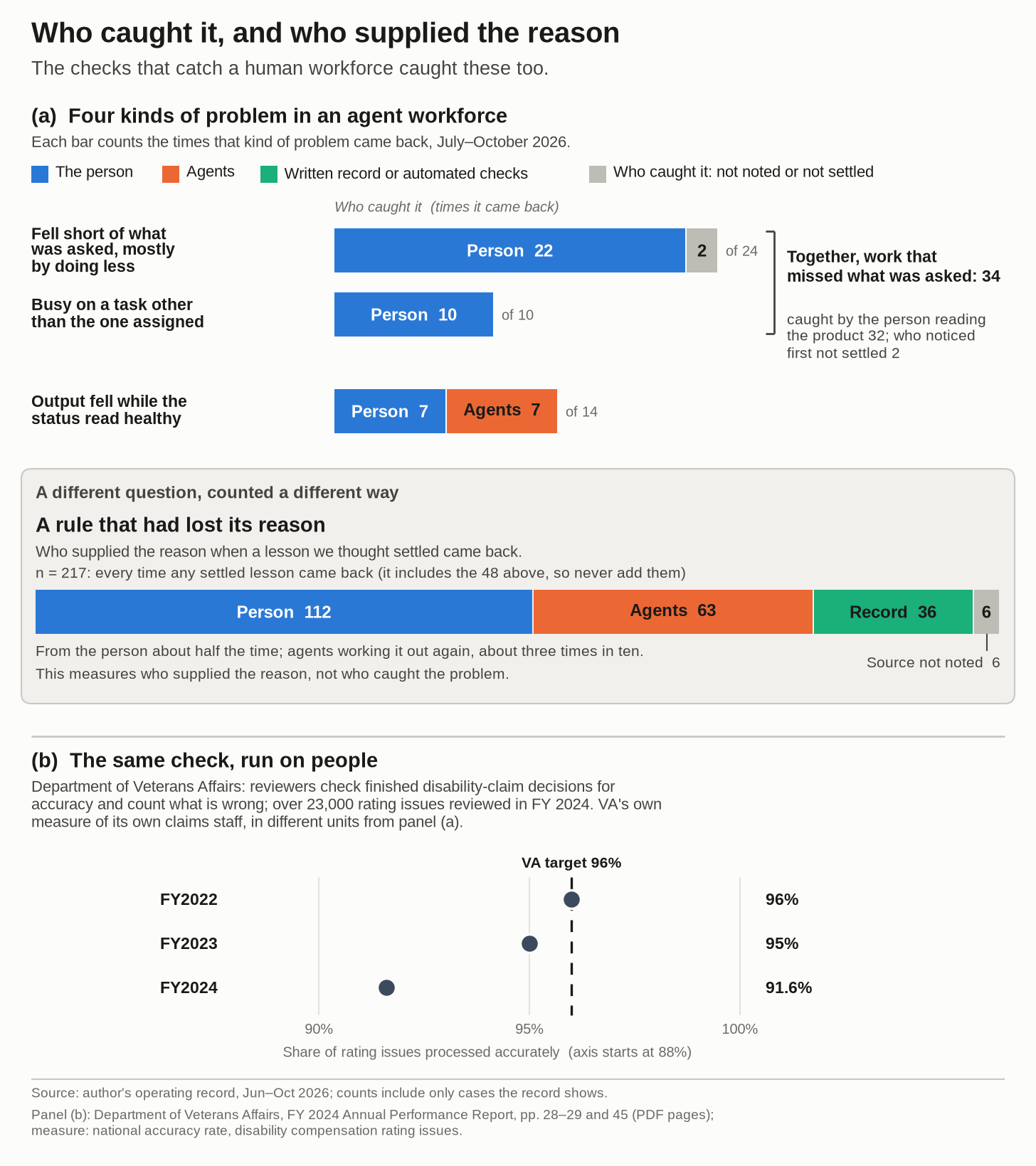
The same four things came up again and again through every decision I made, plan I approved, analysis I read, course correction I typed, and kill switch that I pulled:
Tasking that drifted from what I asked. Typically this was the SI agent doing less than I asked. Experienced managers reading this are now laughing maniacally. The irony is not lost on me either. The joke is that poor human performers hear tasking differently than the manager thinks they communicated tasking, so mid-level management will perceive these lower performers as underdelivering when in reality they usually heard a very different definition of done.
Tasking that wandered into side jobs. This often showed up when different agent families collaborated. When a research and analysis agent tasked the supervisory collection agent to go get data, the collection agent often started focusing on the analysis of what it collected. And the research and analysis agents would instruct the collection agent exactly what to do and how to do it. I wish I was joking when I said they would argue with each other for hours, and complain about each other to me. I managed it just like I managed a company that went through that growth phase, by instituting cross-organizational authorities and constraints. Then I just encoded those into the SI agents’ safety hooks to block them every time they tried to cross out of their lane.
Falling output while the status reporting said everything was fine. My SI agent acting as the middle-level manager caught about half of these. Eventually I just encoded these into a dashboard that I occasionally glance at and prod the middle-level manager into action when necessary. As far as oversight goes, this is simple but I need to do it every few hours, first thing in the morning, and right before I go to bed. I’m going to go glance at it right now before writing the next bullet point.
Rules that lost their reasons. In government work you typically manage projects in sprint reviews every few weeks, or monthly status reports, or quarterly progress reviews/reports, or... I had that level of interaction with my SI workforce on average 240 times per week. That’s somewhere between 13 and 60 years of US Government-style management. So I frequently found the SI agents applying very old rulings to new information and I needed to 1) notice, 2) fix it, and 3) explain why. An SI workforce moves so fast that some of these old rulings were only a few days old. For instance, in one project I had to treat Taiwan as a province of China because the Chinese Communist Party (CCP) quite literally assigns it a province. But I needed to remind the collector that Taiwan is not actually governed by China.
Those failures are all classic management and leadership problems.
Here are the breakdowns of the failures, and whether I or the SI oversight caught them. I don’t have access to the Intelligence Community’s or Department of War’s oversight statistics, but the Department of Veterans Affairs publishes theirs for an apples-to-oranges comparison. My management style is to teach people to fix the underlying problem so they resolve the symptom and prevent future problems before they happen; and I don’t yet know how that impacts the SI failure rate.
What changes with an SI workforce is speed and scale, and I measured both
What changes with agents is mostly speed and scale, and both can be measured.
I have a clean comparison. In June and July the operation ran with one agent at my keyboard. From mid-August it ran as a swarm of many agents. Same operation, same plans I approved, same person manning the kill switch. Data collection started as part of specific research: I had a hypothesis, I approved the research plan, the work stopped when the experiment ended, and we wrote up the Substack article. Then it switched to the downloading of public documents. Collection has no natural stopping point. It runs day and night hoovering up haystacks and needles alike.
That forced the decision a watch officer would make: what runs through the night, and what waits for the morning. In the first week of September I made it for agents. On September 2nd I took collection off an explicit human “you may proceed” at every stage and put it on milestone checkpoints, with the limits already written into the code and my standing authority for the supervisor SI agent to stop itself and any other agent. Before bed on the 3rd I told the agents to keep collection running through the night within those limits and to check its output as it went. In the morning I asked for an account of the night and the decisions it needed from me, and I made them. A shift supervisor does the same thing with people. It’s been a long time since I worked the ops floor at night, or listened to the night shift’s debrief in the morning.
That’s still subjective; if you can’t measure something then you don’t understand it. So here is the measured pace. From mid-August to mid-October the record holds about a thousand changes a week to the code and the written instructions guiding the agents’ reasoning. And they happened 24 hours a day because the agents, operating inside of the instructions I gave them, had authority to change the code to adapt to the inevitable externalities. In June and July it was about 230 a week but only during my waking day. That’s just a measurement of management pace, not work output.
My job moved to the decision points. I sized the operation to what I could read in a day, not to how many agents I could run. That output check I mentioned above: in mid-September I had the agent rebuild the status dashboard so I could recognize changes at a glance, and it would automatically act on any change it recognized as a performance drop. In October that dashboard got too large for me to use. So we built a more strategic dashboard for me to read at a glance. And the agent’s own dashboard looks more like a 1960s Soviet wall of gauges. The agent checks it every 20 to 30 minutes, and it’s really effective at running the virtual ops floor. I typed about 330 instructions a week through that September/October stretch (the 240 a week earlier in this article is the average over the whole four and a half months). By October the agents, and the check-ins running on a schedule inside them, were issuing about three instructions for each one I typed. When I said stop, the agents stopped. But some tasks restart automatically on a timer, and after a stop that doesn’t cancel the timers, the work just gets restarted. I learned that on the morning of 12 September. It was just an annoyance at the time, but from then on my stop cancelled the schedules too. The next article tells that morning.
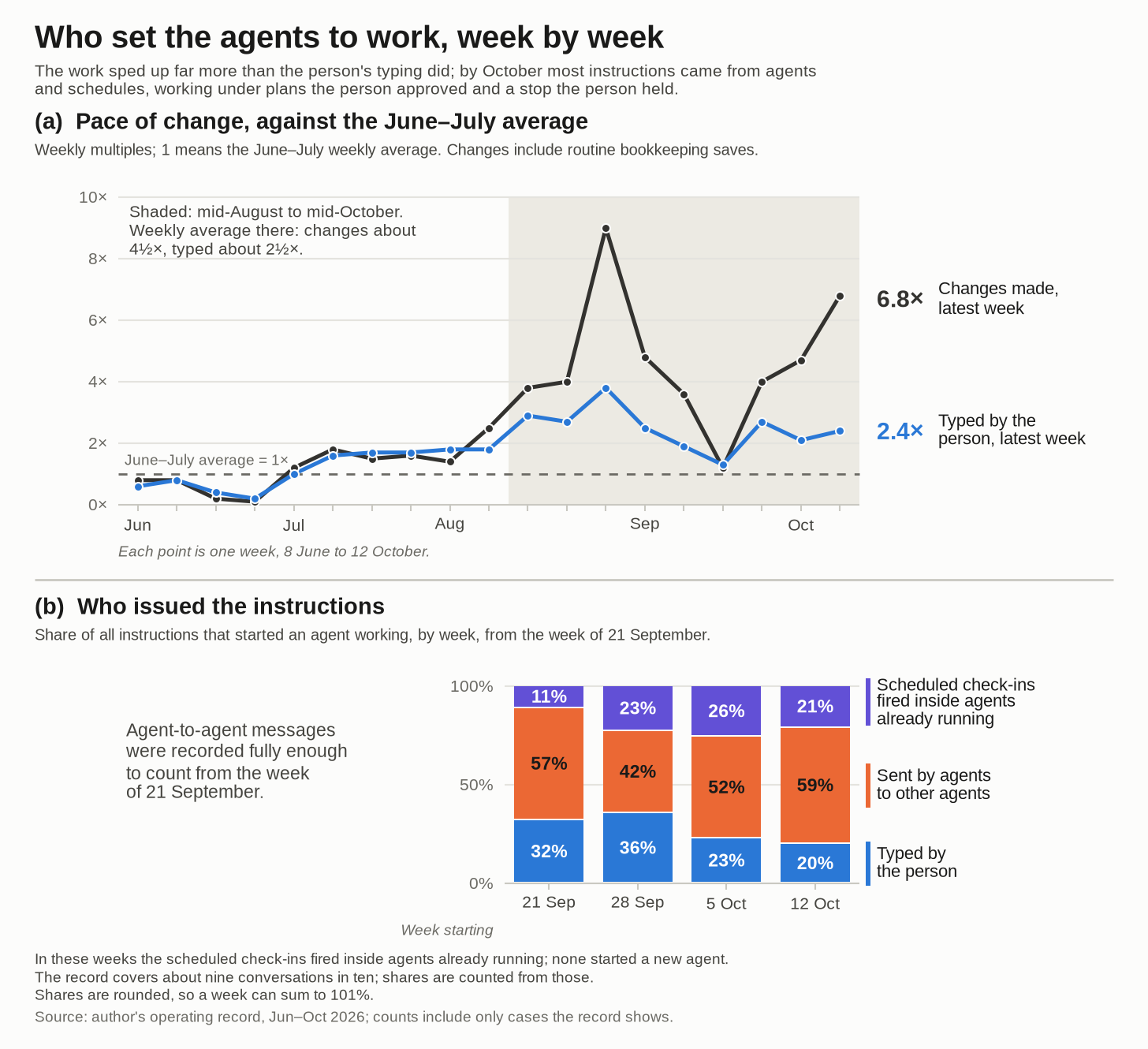
Figure 2. The pace of change and the pace of human intervention on the top pane. The big drop in September was a maintenance window where I upgraded hardware. And the bottom pane is the source of tasking: regularly scheduled tasks, AIs tasking AIs, and humans tasking AIs.
One of the most valuable things an organization of humans (or SIs) has is its institutional memory. Business leaders often name it their competitive advantage. But just like humans, SIs forget too. And it’s often the job of the organizational leadership to tell them to go read the policy/procedures/secret-sauce. And at the pace the SIs are moving I had to do this a lot. I measured this by counting repetitions. How many times did an agent make and write down a fix, and then make the same mistake, fix it, and write down the lesson again? I counted those as instances of losing institutional memory. Two percent of changes were those failures during the seven weeks of buildout. There were twenty-two a week in the busiest five weeks. Call it three a day. People forget as they work too. The SI workforce just forgets in greater volume. I’ll admit it, I got just as frustrated managing the SIs as I did managing those employees who just never could get anything right. The SIs got tons of stuff right, but they were working at a scale that taxed my emotional capacity to deal with repeated screw-ups.
The closest data that I have to measuring the pace of institutional memory loss is contrasting the system when I ran it myself versus when I managed the agents managing the swarm. I gave 2.5x as many instructions in the latter case, but the work rose 4x. That’s a force multiplier. And of the 2.5x more instructions, 2% of those were reinforcing institional memory into the swarm.
The manual exists. Add one page and it covers managing SIs too.
Existing doctrine of command, supervision and inspection covers most of these lessons. What changes is predominantly the cadence, not the category. With one exception.
The Army’s doctrine rests on “no single person” being able to “keep up with the number of decisions”, pushes decisions down to subordinates inside the commander’s intent, and keeps the commander’s “responsibility to check on their subordinates” (ADP 6-0, paras 1-37 and 1-76). That describes the job of directing agents pretty well. Where it mentions artificial intelligence at all, it is a tool for the commander’s analysis but not a subordinate to be commanded (para 2-27, p. 24). The page on commanding SI subordinates is the missing one.
The manual already says to adjust the pace but it does not yet size the pace in an SI world. “The level and application of control is constantly evolving. It is continuously assessed and adjusted to ensure the level of control is appropriate to the situation” (ADP 6-0, para 1-47, p. 8). The federal internal-control standards say how often to evaluate depends on the “rate of change within the entity and its environment”, that managers may increase the frequency “when management rapidly implements a new program”, and that ongoing checks “may include automated tools” (GAO-25-107721, Standards for Internal Control in the Federal Government, May 2025, paras 16.05 and 16.06, p. 92). The rate of change is the thousand changes a week above. I find an internal mental alarm going off if I haven’t checked in the last three hours, and frustratingly, I unconsciously wake up about three hours after going to bed with that mental “check on your SIs” alarm going off.
The four articles that follow carry twelve lessons from the operation. A leader will recognize each as leadership, management or oversight. Four of the twelve show no difference in kind from leading people. Seven need an adjustment of pace, scale or instrument. One is new in kind, the exception: a share of an agent workforce is started by timers and not by people, so the authority to stop has to include the schedules as well as the SIs. By October about three hundred instructions a week in my operation fired on a schedule, nearly all of them one regular check-in I had ordered in early September that told the SI to figure out if anything was broken and to fix it. A supervisor who fires a team does not also have to cancel the calendar invite that brings them back. Eleven of twelve the manual already covers, seven of them at a pace or scale it has not yet sized. The missing page, on commanding SI subordinates, carries that pace and the one new line: the stop reaches the scheduled reasoning tasks.
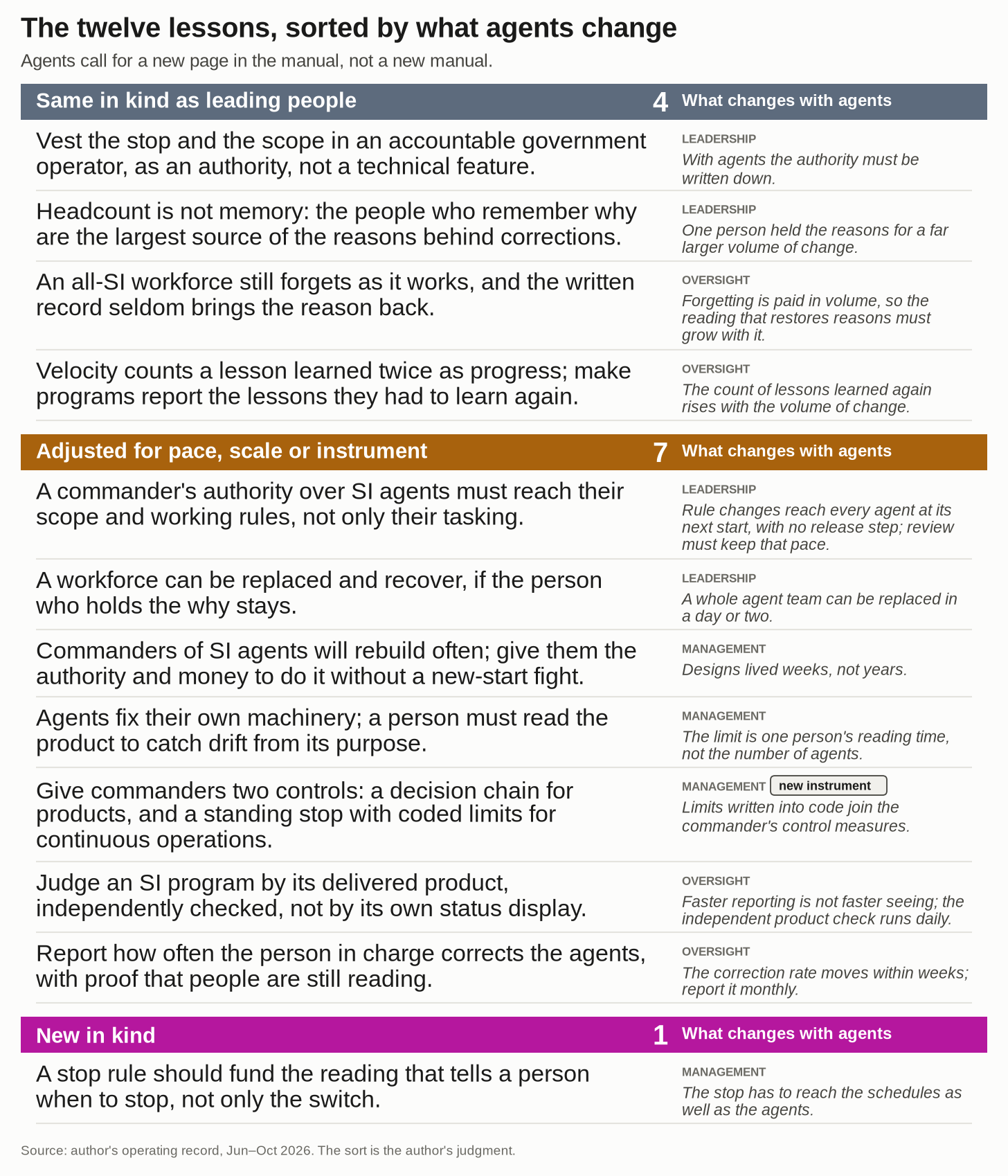
Figure 3. Twelve lessons from one operation, sorted by my judgment of what agents change. Four apply as they do to people; seven need the pace, scale or instrument adjusted. One is new: don’t let scheduled tasks resurrect what the person chose to stop.
I founded and led one of the largest security research companies in the field, about two hundred security researchers and engineers. Most of my job as chief executive was keeping very capable people aligned enough to meet our objectives without wandering off on their own. Directing this operation’s agents has been uncannily similar: the same approvals, corrections and stops that kept human organizations effective are what held SI agents to the task. I give them roughly the autonomy and oversight I gave people, and they fail in the ways people fail and are caught the way people are caught. What differs is speed and scale: a swarm is easier to stand up than a hiring wave, and the sheer quantity and quality of agents move faster than any team I ever had the honor of leading. The doctrine that guides the mission already covers most of what follows in this series. The data shows where it needs adjusting.
Exeunt
As I think about AI, SI, AGI and agent policy, I will be asking two questions. Which existing authority does this amend: command, supervision, internal control, intelligence oversight? And where does it change the cadence: how often the check runs, who reads it, how far does a stop need to reach? A provision with no answer to the first is inventing a category. The only new category the data supports is that the human- or SI-initiated stop must reach into the scheduled reasoning tasks. A policy provision with no answer to the cadence or scale is doctrine that will never operate at machine speed.
Lead SIs the way you led people. Check them at the pace they change, with tools where a person cannot keep up. Write down which people and agents can press the stop button, and make sure it reaches into the scheduled reasoning tasks.