
I read the FT’s article saying Anthropic’s business is in trouble because their customers only spend 11% of their AI budget on the frontier Fable model. My number is 10.38%. I am that customer the FT talks about. I also have the scar tissue of wearing the CEO hat for 12 years. FT totally missed how that 11% Frontier spend means the AI product-market fit is maturing in a good way for Anthropic’s business. I’ll bring my own data to the discussion.
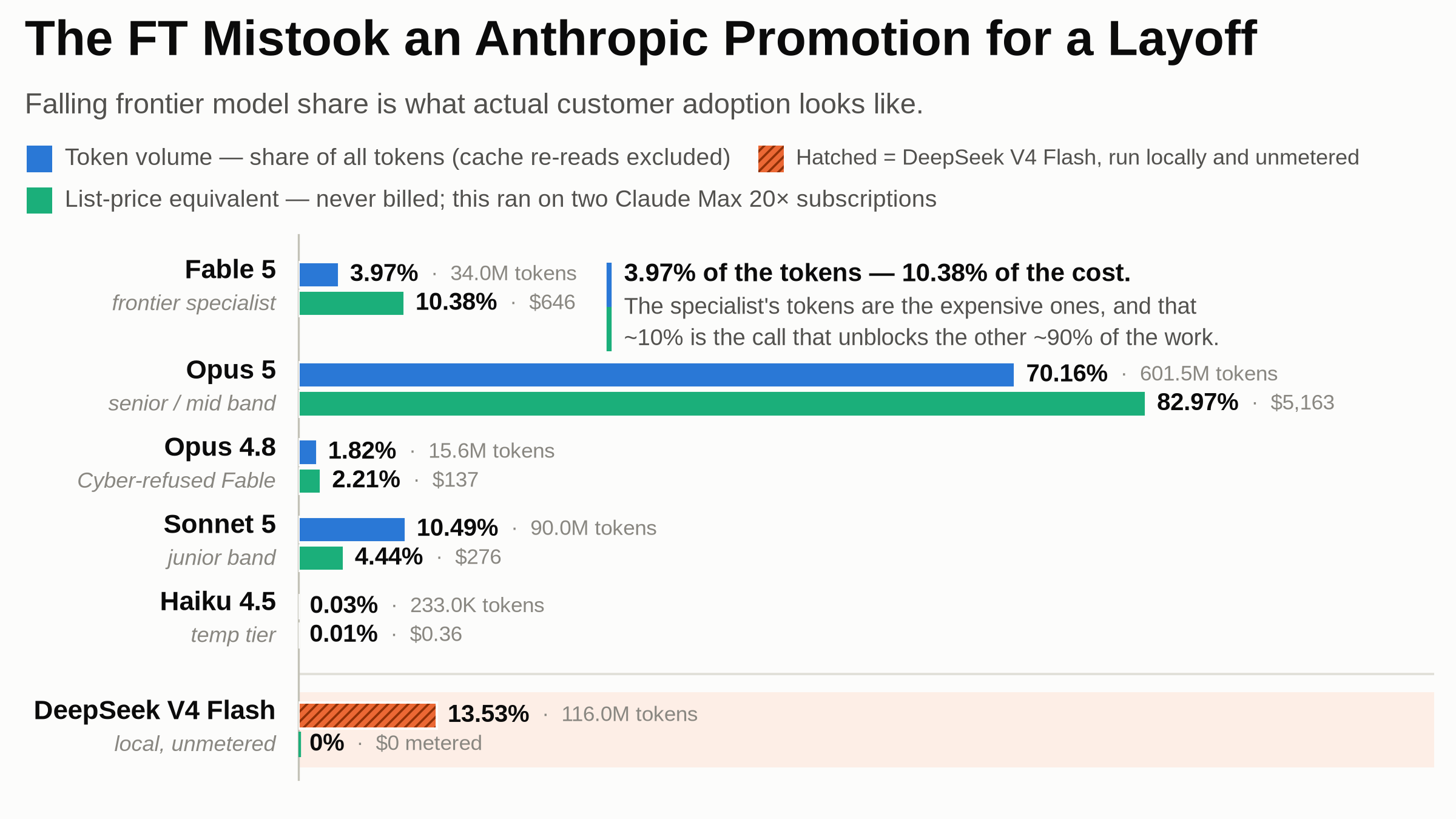
The Bottom Line Up Front (BLUF) is that a sophisticated AI workflow uses the expensive frontier models like a higher-salaried supervisor to manage lower-cost models performing the work. A services/consulting business selling labor hours doesn’t make its money on the supervisor; it makes its money on the workers. A frontier AI company is not going to make its money on the supervisory model; it’s going to make its money on the worker models.
Let’s keep my entrepreneur and recovering-CEO hat on for this discussion instead of my hacker hat. In the last week I delegated tasks to 754 sub-agents, which is like delegating tasks to employees who actually do the work. I even say please when delegating tasking to my agents and sub-agents. Those workers moved 21.3 billion tokens through Anthropic’s models, which would cost $16,029 at the API list prices. I’m running with two organizations’ Claude Max 20x subscriptions so my actual amortized cost is closer to $50 for the week. I’m pricing the tokens here just so I can point out that it would make good business sense, with an embarrassingly high profit margin, to spend $16k on tokens given what I could sell the outputs for.
The below graph shows the breakdown of which Anthropic model I delegated tasking to (or a higher level model further delegated tasking to). The frontier Fable model (think architect and manager) got 30 tasks, Opus 5 (think senior employee) got 498 tasks, Sonnet 5 (think junior employee) got 204 tasks, Haiku (think temp worker) got 1 task. If you read the graph you’ll see Opus 4.8 got 21 tasks, which were Anthropic’s cyber-safety systems moving work to a safer model. No organization builds a team entirely out of rockstar principal engineers. Someone has to do the less-exciting work that holds everything together, and if everyone is incredibly expensive you have no profit margin, and no talent pipeline. The analogy is the argument and predicts something confirmed by the data: 65% of my Fable usage is direct work with the model planning out tasking for the worker agents, and managing those workers. Fable builds the tasking; it does not execute the tasking because that would be a waste of money.
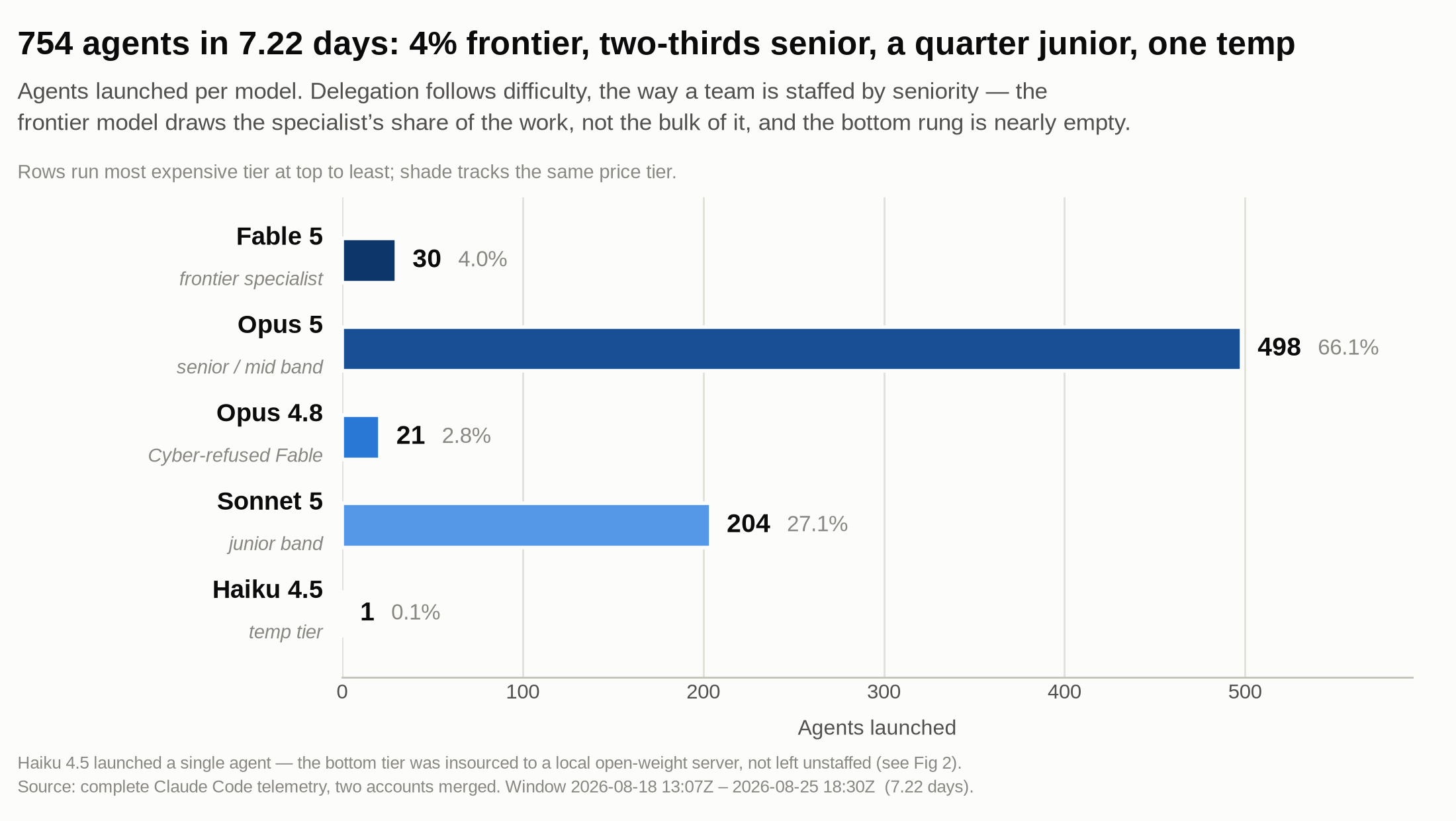
The distribution of labor is not a discovery. It is how I manage organizations and how I manage AI. My own CLAUDE.md configuration file codifies how I want tasking to be delegated to different models with different levels of reasoning (and price). The pure mechanical bulk work goes to the cheap tier, judgment goes to the mid/senior grade Opus, hard reasoning about hard problems is only done by Fable. The FT’s analysts say price is pushing customers away from frontier AI. They are right. That’s a business 101 staffing decision.
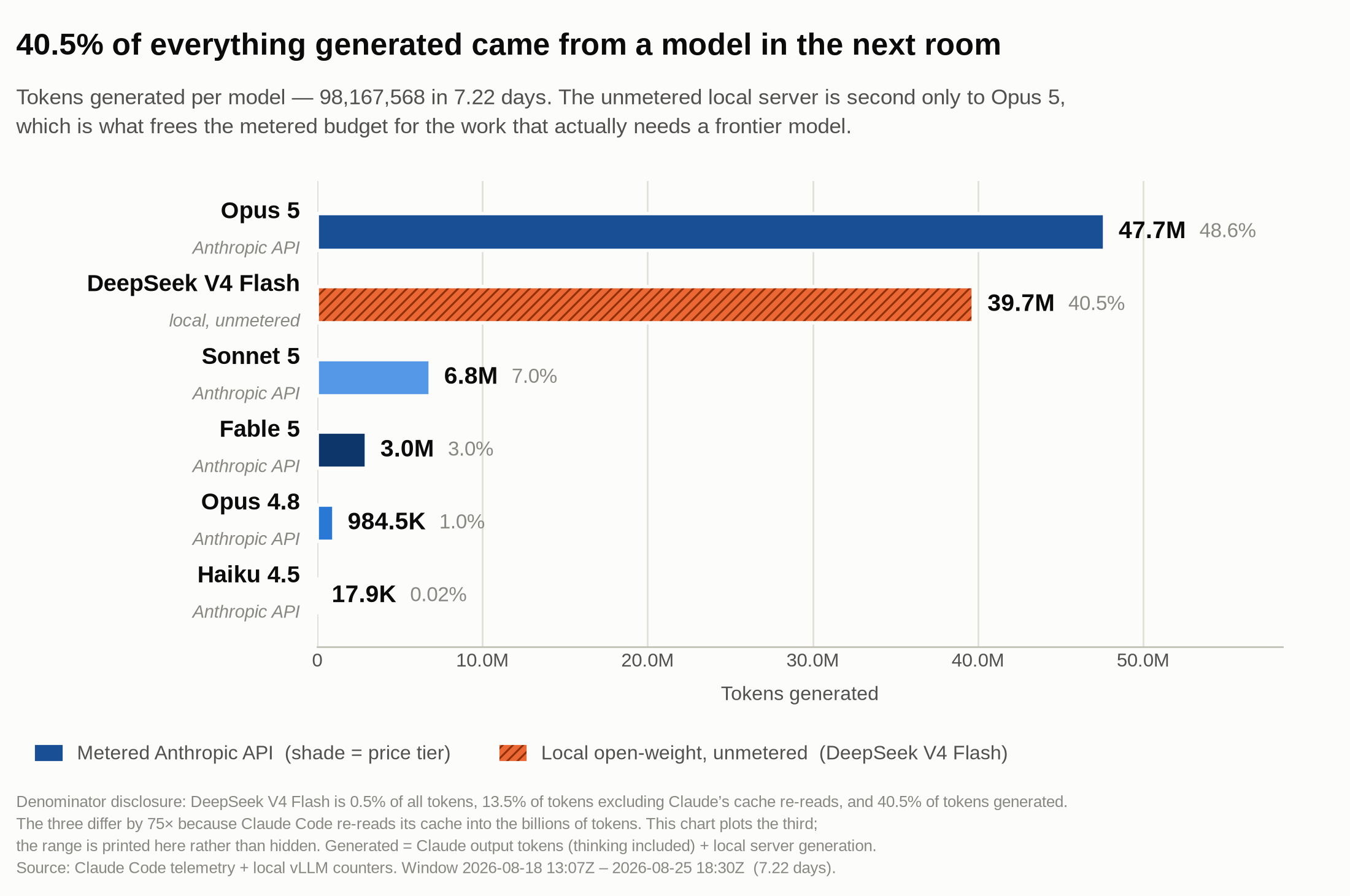
The bottom tier is the sharpest part of this argument. Anthropic’s lowest tier Haiku model ran one agent for me all week. I ran a local Chinese DeepSeek V4 Flash model in my office which generated 39.7M tokens in the same window. That’s 40.5% of every token my AI generated, second only to the mid-grade Opus 5 workhorse model. The FT cites cheap open-weight models from China as a threat to the frontier US AI labs. In my data, those cheap open-weight models are what churn through bulk data so I don’t have to wait for gigabytes to be sent up into the Cloud for processing. Those cheap open-weight models are critical to me being able to use the more expensive frontier models to solve hard problems. DeepSeek is my temp worker that I can train to do repetitive tasks, and it’s managed by the frontier model that plans the work and manages the quality of the result.
Don’t take my word for it. The FT’s own sources describe the same thing. It reports analysts and investors saying “older models are capable of handling the bulk of business demands.” Accel’s Miles Clements says “Most people don’t need to operate at the frontier,” and that the frontier-default period “was not a durable era.” The FT writes that businesses are “using models more efficiently rather than always going with the most sophisticated option.” That resource-appropriate staffing is good business! And it’s described by the people the FT interviewed, printed under a headline that says the opposite.
The FT’s own chart implies that Fable’s absolute spending grew about a third across the period the FT calls a struggle. The article then reports revenue up nearly sevenfold this year ($65bn annualized in July) which resulted in a first adjusted operating profit. Selling tokens is effectively selling labor like a consulting/services business. They don’t make their money selling supervisors’ labor; they make it selling workers’ labor.
The FT completely missed the strategic business implications. Anthropic’s customers are becoming sophisticated enough to manage their AI use like they manage their people. That means those customers have measurably moved past dipping their toes into chatbots, away from the tokenmaxxing fad, and into managing and staffing AI agents in workflows. That means Anthropic’s customers have matured. But we should see measurable business productivity gains in the next few quarters. And it has the potential to accelerate if and when those businesses learn to manage teams of agents as part of their actual work force. We live in some interesting times.