
We took apart twenty-one of the personnel programs the Chinese Communist Party (CCP) and the Chinese state run (fifty packages, nine vendors, 2004 to 2026, including 144 databases, and their documentation). This is one of eight articles on how the CCP and the Chinese state are actually organized, extracted from their own enterprise software systems.
I couldn’t find the People’s Republic of China (PRC) government employee or CCP pay tables reported anywhere. So I extracted their pay tables from the software and local budget documentation. To be fair, one thing that I never could figure out after 12yrs as CEO was how to be transparent about salaries without creating more cultural damage than it healed. So I understand why they’re not transparent about it. But that’s a different conversation. Let’s get to the amusing stuff. If you want to skip straight to the comparison of CCP and PRC compensation against US government comp then the graph is below. If you want three takeaways: the Party actually controls the pay of the government civil servants, the PRC and CCP have a far more capitalistic performance based pay philosophy than the USG, but the USG does pay its people a lot more.
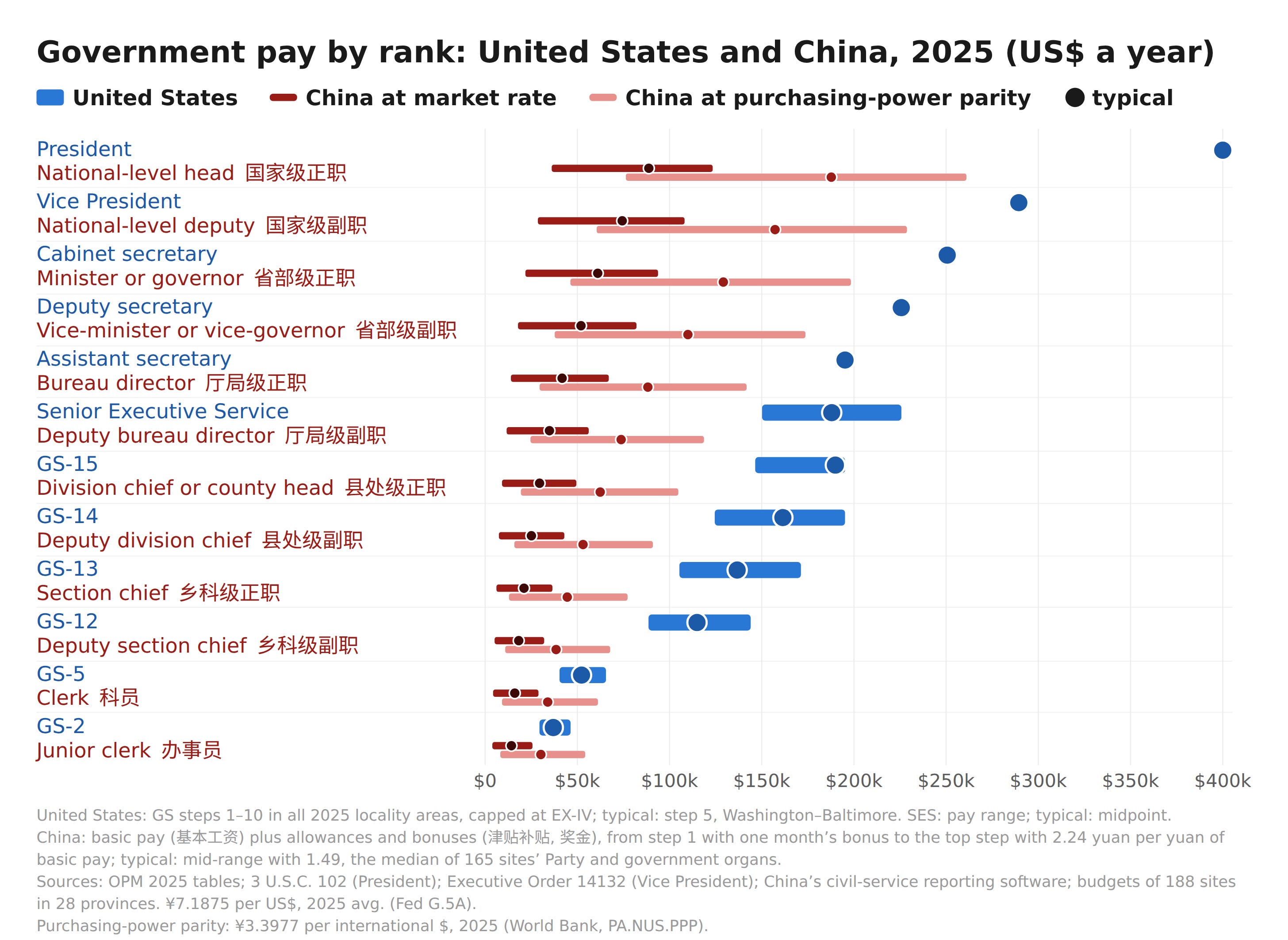
Annual pay ranges for 2025 for matched Chinese/US ranks. The Chinese range, at both the market rate and at purchasing-power parity, runs from basic pay plus the one-month year-end bonus up to the top step plus allowances and bonuses at 2.24 times basic pay. That Chinese high end is a best guess based on county and bureau budget data. But note that I didn’t find any budget data on ministers and above; so it’s probably a little higher than reality because I extrapolated performance-based compensation ratios from lower ranks.
How did I get here? I extracted base pay from the PRC and CCP’s own HR software tables, which check to make sure people are paid according to their rank. That’s base salary pay. It turns out that China does performance-based compensation. Think end-of-year performance bonuses that are more common in corporate work. We’ll go far deeper into how those actually work. For now, I analyzed government and party budgets where allowances and bonuses come to roughly 1.5x base pay. Those cover the year-end bonus of one month’s pay, hardship allowances, high-altitude (as in mountainous region postings) allowances, special-post allowances, commendations, etc.
The gap with the United States is smallest at the bottom of the career ladder. At purchasing-power parity, a junior Chinese clerk’s pay is near a GS-2’s; a minister’s is about half a cabinet secretary’s; and the middle ranks sit at a third of their US peers. The two rows above the minister are the leaders’ grades. Their basic pay from 2025 is about 20,000 yuan a month for a president or premier (~$33,000 USD a year before performance comp). Caveat lector: I have not yet found any budget documentation about their senior leaders’ compensation on top of base salary. But I wrote about Chinese bribeflation in July as extracted from their court records.
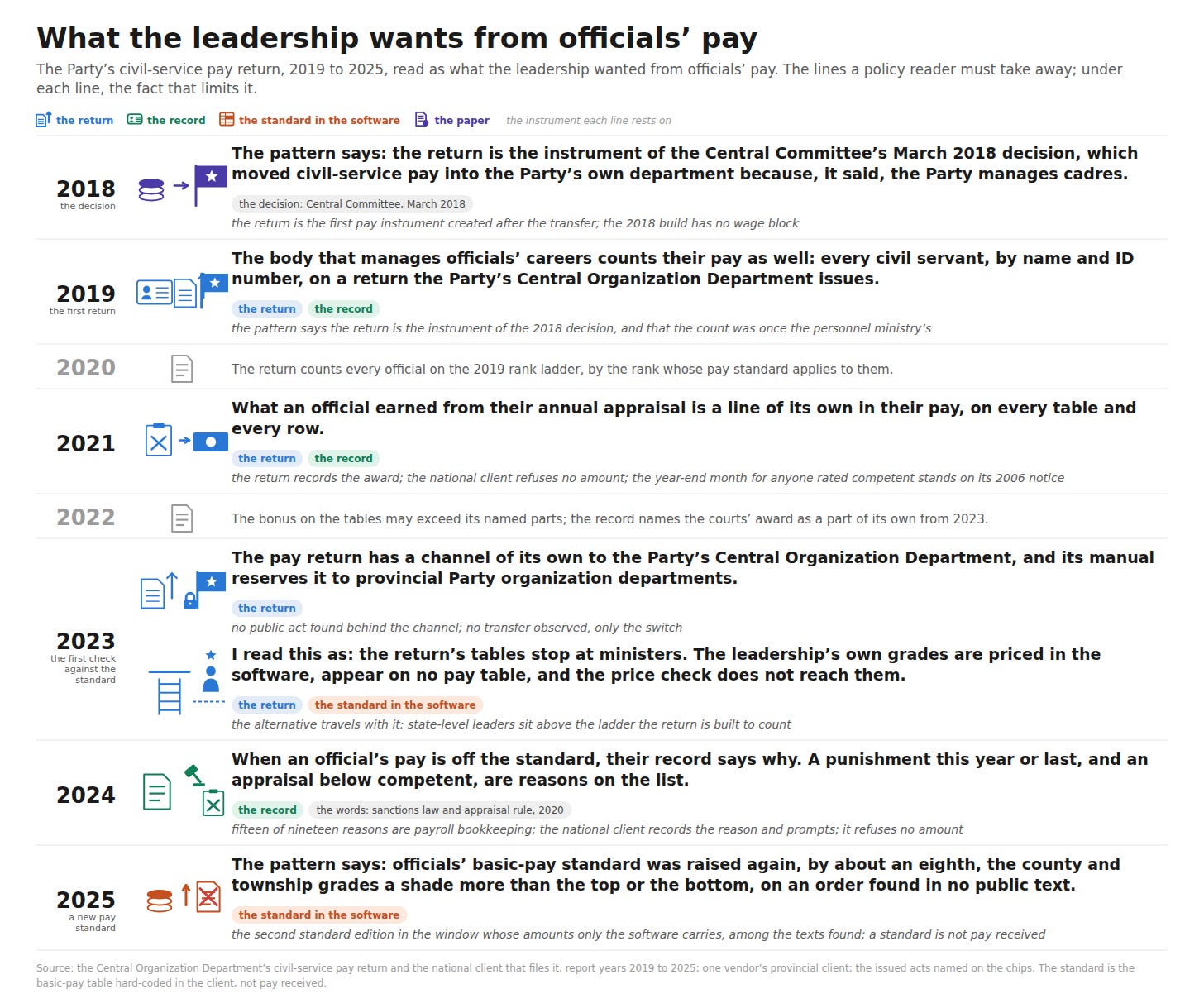
This is all more significant than just pay asymmetries. In March 2018 the Central Committee moved civil-service pay and the state’s civil-service bureau into the Party’s Central Organization Department (中共中央组织部), which is a Politburo-led department. Let me translate that for non-China watchers: the Chinese government gave control of government employees’ pay to the political Party. And since 2019, the Party asks the government for one record per civil servant including their name and National ID Card number (Americans can think of that like a Social Security Number) categorized by rank and pay. From 2021 the record included what each person received from his annual appraisal. From 2024, if the person’s pay was not in line with the standard then the form asked for the reason. For every person. The software includes reasons like punishment, and a line for what a person under criminal coercive measures was paid. The Party’s own software doesn’t actually refuse any pay imbalance, it just flags those records before they’re sent up to the Party.
The HR software is the reporting structure from the lowest levels of the Party and government up to the Party department. By analyzing year-to-year software changes I was expecting to see the Party exert more control over pay, and to use it as a lever to align the civil servants with the needs of the Party. As you can see below, it looks a lot more like the Party has been trying to figure out how to get a handle on compensation structures.
That’s it for the executive summary level. Now we dig deeper for those who like to understand the details and “the why”. I admit, this project has turned from me trying to understand how the CCP really works to learning how to run a 100,000,000-member organization and a ~1,400,000,000-person country.
How salaries have changed over 19yrs
We have the CCP HR software going back almost 20yrs so we can understand how their pay structure has changed over time. And we can graph it against a consumer price index.
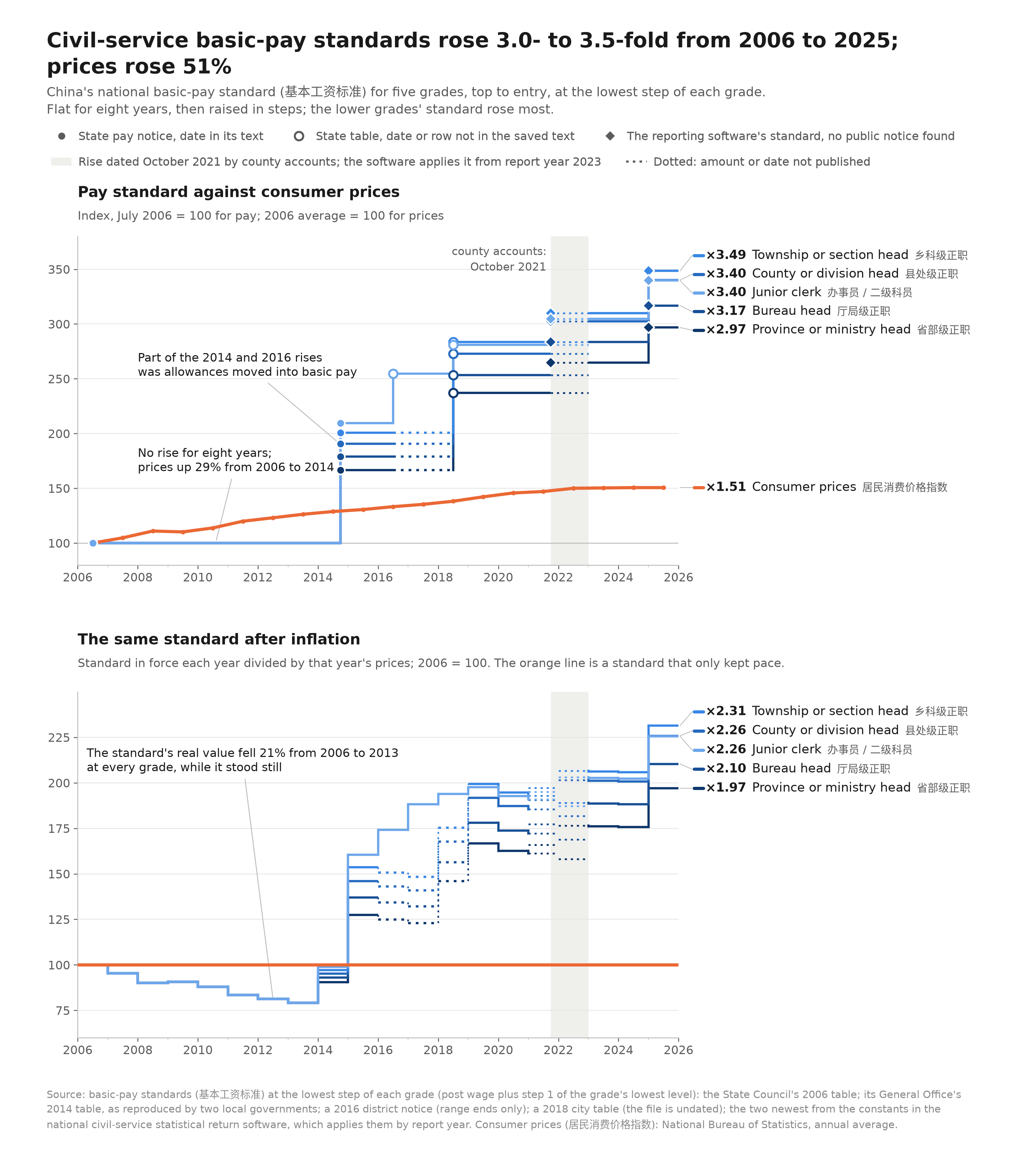
A Chinese civil servant’s basic pay is a national table, one amount for the post and one for the grade and step. Math the two together and get basic salary. Include all of the performance and special compensation and you get total comp. Some of that is set by national policy: a year-end bonus of one month of his own basic pay for anyone rated competent, and the hardship and special-post allowances, each a table of amounts by zone or by post. The rest is local policy. The regularized allowances are the monthly local allowance his province, city or county pays its own officials. Then come the subsidies for housing and transport, and the performance bonus.
For eight years it did not move for inflation or cost of living. The State Council set the table in 2006 and left it alone until 2014, while consumer prices rose by more than a quarter. Then three raises came in four years, in 2014, 2016, and 2018, each under a state notice cited by local governments. Part of the 2014 and 2016 rises was allowances folded into basic pay, so the table’s jump overstates what anyone’s pay actually rose by.
After 2018 the raises continued but they stopped talking about it in public. This is when the Party took over the pay structure for the government.
They don’t publish performance bonus information, but they publish the budgets that tell us about performance bonuses
In October 2016 a Beijing newspaper printed one civil servant’s pay. He was a section member in a Haidian street office with six years’ service. His basic salary came to 1,666 yuan a month. What the paper called his fixed monthly pay came to 6,184. The basic salary was about a quarter of it; the paper did not itemize the rest. A former vice-minister of the human-resources ministry is quoted in the same report saying that basic pay ought to be 60 to 70 percent of the whole. It was not, for this man, and the Party’s software only tells us basic salary.
The national software gives us hints about the rest. We know the maximum of several regular allowances: subsidies for housing and transport, and the performance bonus with its appraisal award. The regularized allowances’ limit was 100,000 yuan (~$14k USD) a year until 2025 and is 200,000 since; the performance bonus’s is 400,000 (~$56k USD). To help frame that in Chinese terms, two hundred thousand yuan is about a year of basic salary pay at the top of a minister’s grade.
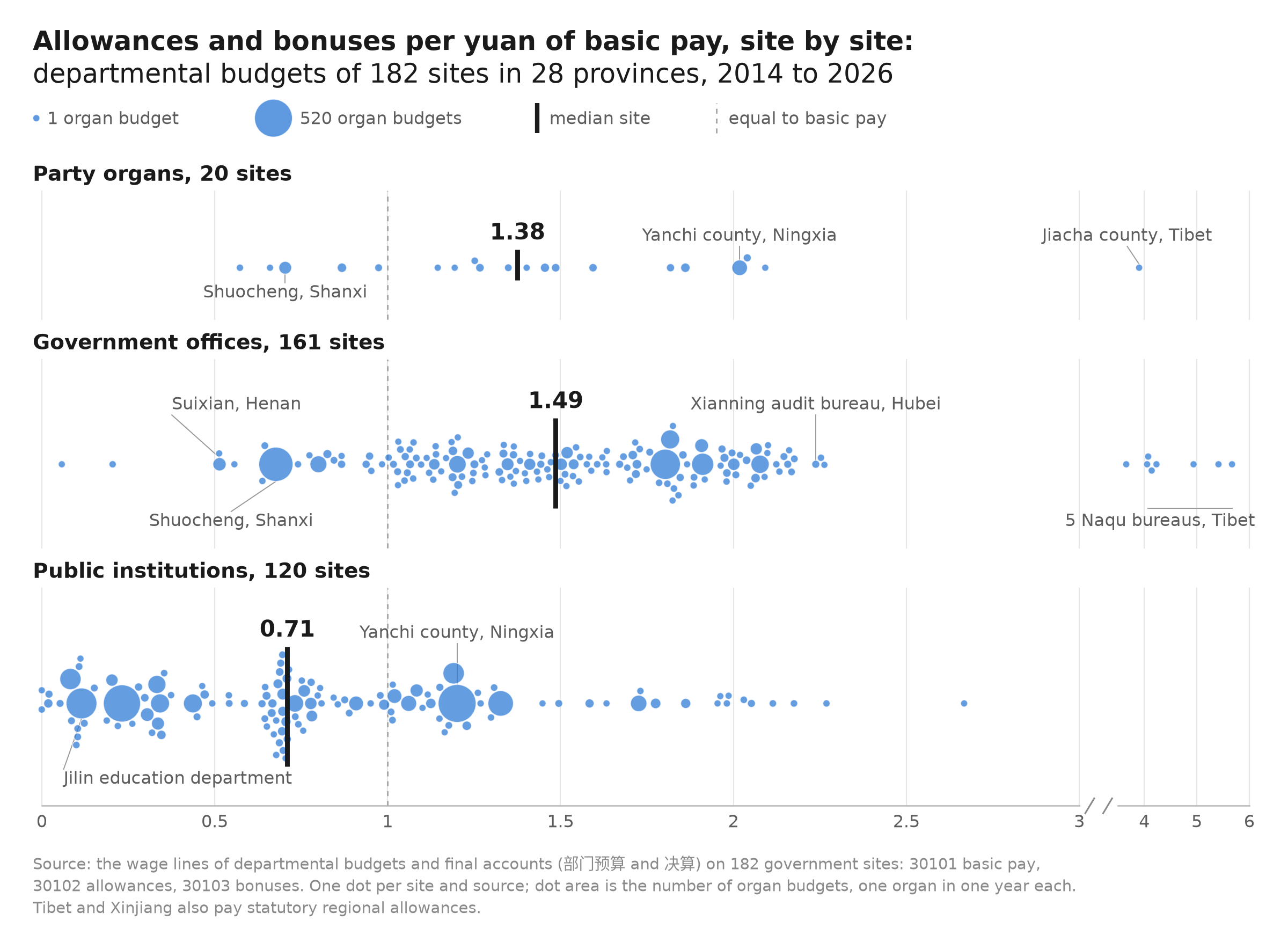
So the size of the rest has to be read somewhere else, and the somewhere else is the budget. It’s always the financial statements that tell you... Chinese government organs publish departmental budgets which include the Party committee departments. The budget wage lines name basic pay, allowances and bonuses, and sometimes a performance-pay line. We currently have data from 182 local government websites from 28 of the 34 provinces (this includes the autonomous regions, mega-cities, and special administrative regions). The below graphs them all out. You’ll see that different areas budget very differently for bonuses and allowances. When you include performance bonuses, the budget for bonuses and allowances together is 160% of salary. The bonuses and allowances are more than basic salary.
How policy was executed
On 21 March 2018 the Central Committee’s plan for reforming Party and state institutions merged the state’s civil-service bureau into the Party’s Organization Department. It explicitly listed pay and welfare among the functions that moved. It said why. To carry out the principle that the Party manages cadres, and to strengthen the Party’s centralized, unified leadership of the civil service. In December the national legislature revised the civil-service law: the central civil-service authority now manages the whole service, and appraisal results are the basis for pay. That was the policy.
Policy became execution in December 2019. The return is the yearly filing every Party and government organ makes to the Department. Its tables are sums of pay by organ, by level of government, and by grade. The record beneath the tables has one row per civil servant: his name, his national ID number, his months paid, and every component of his pay. This is the software we’ve been analyzing. The 2018 software has no wage block at all. The 2019 one does.
I assumed that the Party would have taken over the pay rulebooks too, and that I would see the documents reissued under the Department’s letterhead. I was more than half wrong. Two of the five documents moved to the Department: the commendation award in 2021, and the high-altitude allowance in 2023, which it co-signs. They only move when they need to be revised.
The Party getting a handle on pay
The below is an eye chart of how the Party changed what they required to be reported about individuals’ pay over time. I thought about not writing up this section. But... The Party has been remaking itself and the state. It may just be part of the anti-corruption campaign. But if I put my CEO hat on, it looks like there is a greater guided organizational evolution happening over a long time horizon and this is a vantage into their carrots where I’m typically only seeing the sticks.
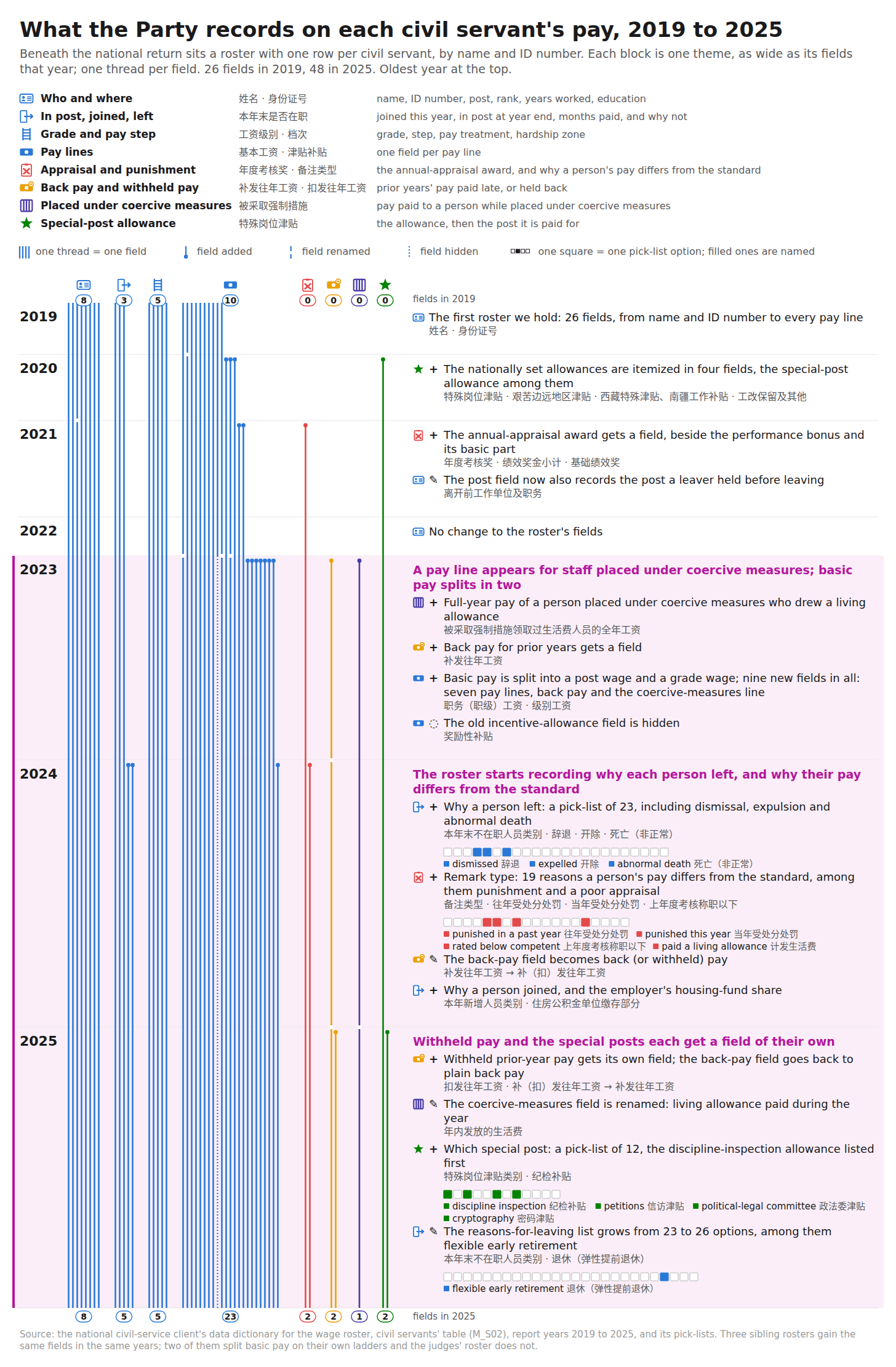
The named-person wage roster beneath the return, civil servants’ table: one row per civil servant, by name and ID number, with the fields and pick-lists the national client’s data dictionary gives it for each report year.
The record is where the leadership’s wishes show, because every field on it is something the center’s own client asks about one named person. In 2019 it had the person, his grade and step, his months paid, and ten pay lines. In 2025 it has nearly fifty fields. No field has been deleted from it; one, the old incentive allowance, was hidden in 2023. What was added is of two kinds, finer lines of the same money and facts about the person.
The money came first. In 2020 the record began itemizing the nationally set allowances in four lines: the special-post allowance, the hardship allowance, the Tibet and southern-Xinjiang allowances, and what was kept over from the pay reform together with the rest. In 2023 basic pay was split into its post wage and grade wage, and every part of pay became a named line with a range the software prompts on.
The facts about the person came next, and each uses the words of policy that the Party had already issued. In 2021 the annual appraisal award became a line of its own in every official’s pay, on every organ table and every row. The Department’s 2020 appraisal rule limits the year-end bonus to those rated competent or above. The rule names that bonus by a term no national text defines. One city, Quanzhou, spells it out in its notice on the 2021 appraisal: the year-end one-off bonus, the one month of basic pay. For the new award line, the grade gate is in a county’s plan, below. The 2018 law had already made appraisal the basis for pay, so from 2021 the record carries, per person, what the appraisal paid.
As I’m writing this up, I can’t tell if the localities are allowed to set their own base bonuses and performance-based appraisal awards, or if the national level of the Party is trying to figure out how all of the localities pay bonuses. I’m starting to lean towards the latter. The Shandong provincial software asks each unit for its performance award standard where the national level software puts a limit on it. If you’ve ever run an organization then you probably understand that anyone whose pay is lowered is at risk of leaving; and you’ll lose your top performers first. The Department is behaving as if they’re trying to figure out how to standardize pay, without losing their top performers due to a pay cut. That’s especially risky since the Party may lose members as well as the government losing civil servants. That creates undue risk to a one-party system.
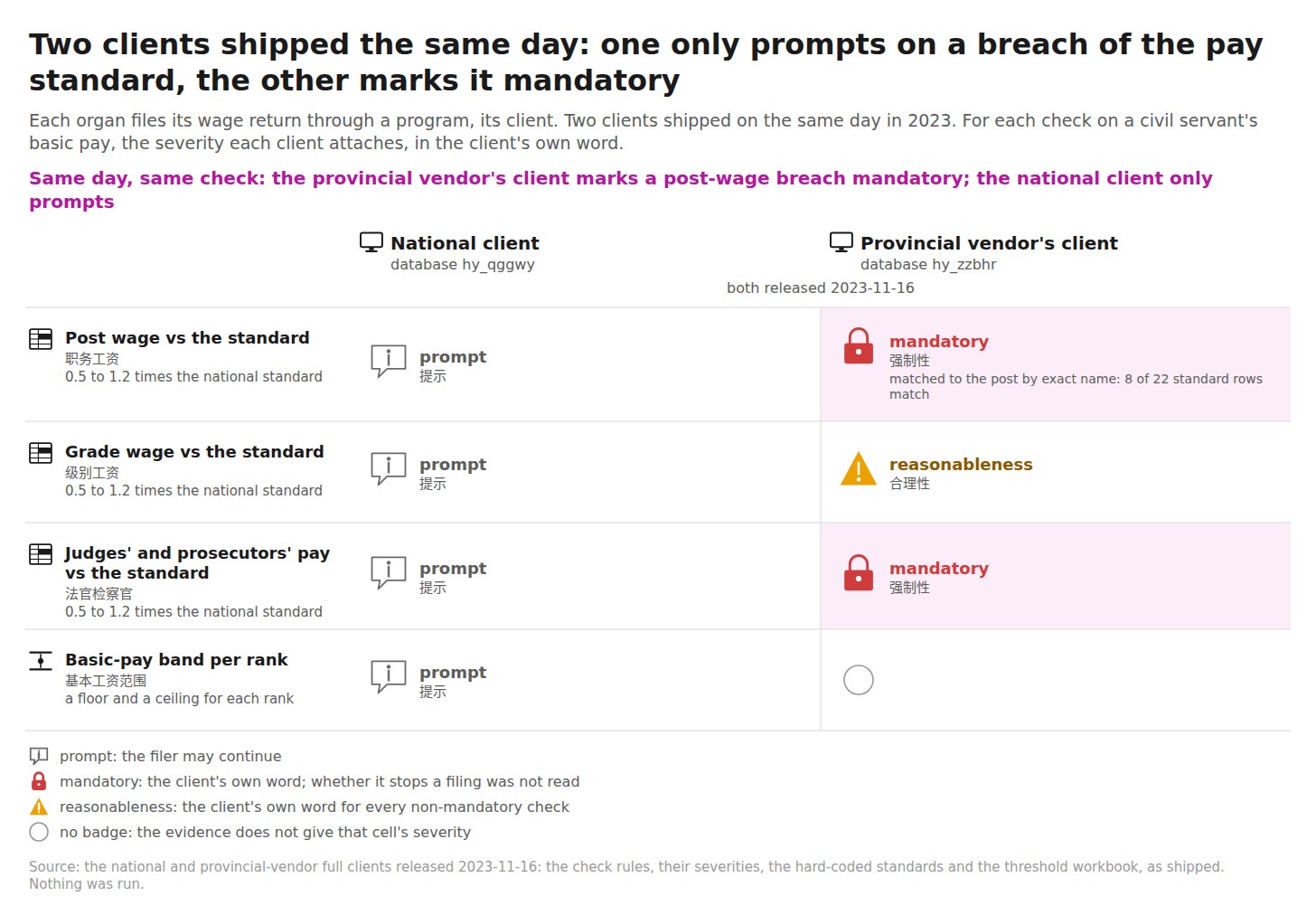
Look at the table below contrasting the national-level software against the provincial-level software. They both check if an individual’s pay is out of line. “Out of line” changes by the year and has been getting tighter. In the national software, the clerk can choose to explain the people who are paid too much or too little. They’ll see a list of those people, and can choose to submit their annual return to the Department anyway with or without explanations.
But explanations for over-pay and under-pay are mandatory in the provincial software.
The hidden salaries above the ministers
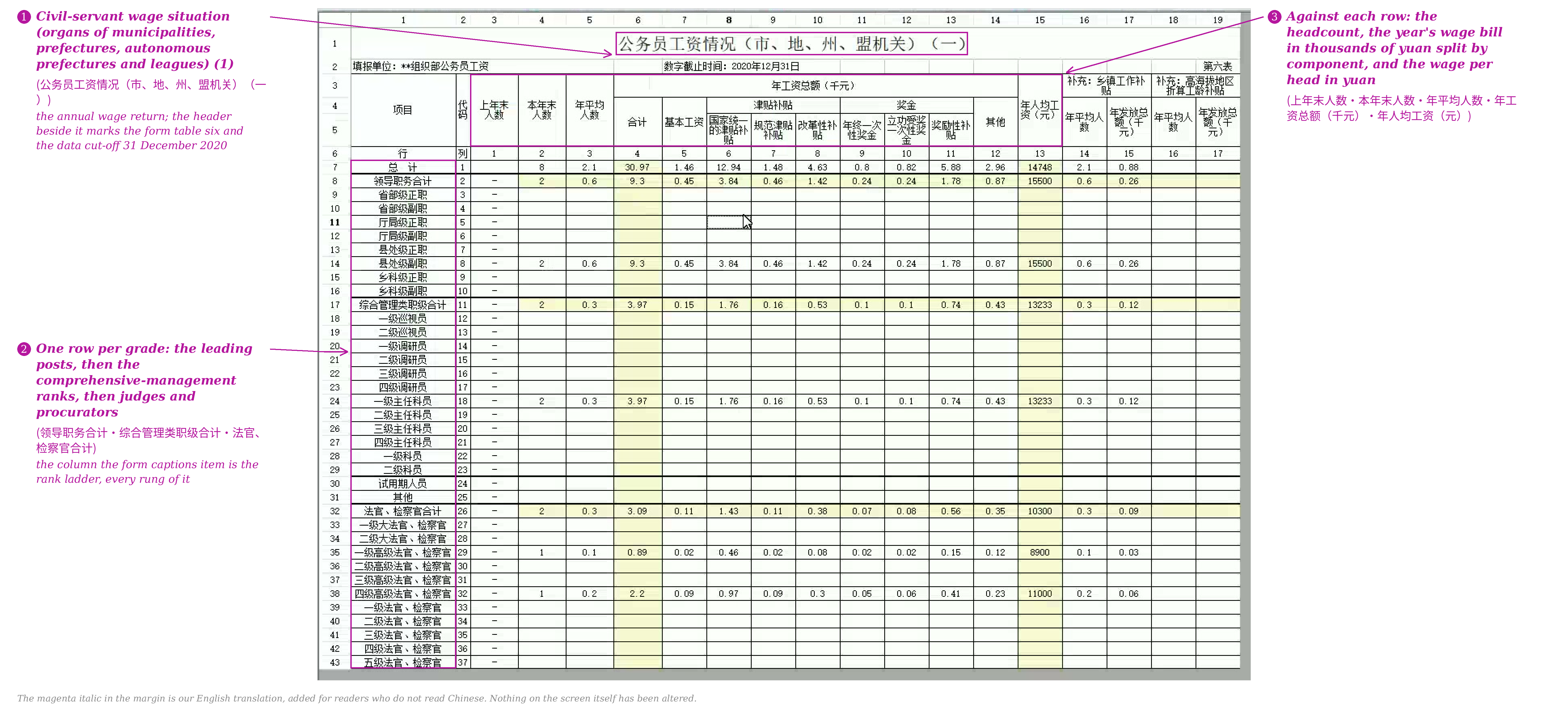
The Shandong cadre system’s annual wage table for the 2020 reporting period, organs of cities and prefectures. The top row of the ladder is the province-or-ministry head.
The wage tables in the manuals and videos stop at the minister level. Above minister are the Politburo’s own grades. But the 2025 software itself includes a pay table for them of 11,690 yuan a month wages for the post, and about 20,000 a month with the grade wage added (at the first step). Combined that’s about $2,800 USD per month. Their deputies get about 4/5ths of that. If you go all the way back to the 2006 pay tables, then you see it calls that top grade for the President, Vice-President, and Premier; which implies it is for the Party General Secretary as well. The deputy grade is the Vice Premiers’ and State Councilors’. Regardless, the software never checks their salaries. I couldn’t find any budget data anywhere on what they get for special compensation or performance bonuses. I’ll tell you what, though, the CCP has a more coherent integration of policy and execution than I see in most major corporations. I’d give the Politburo high marks for performance. I am genuinely impressed by their organizational management.