
E.O. 14209 paused enforcement of the Foreign Corrupt Practices Act. But how much does it actually cost to bribe a Chinese official? Asking, for a friend.
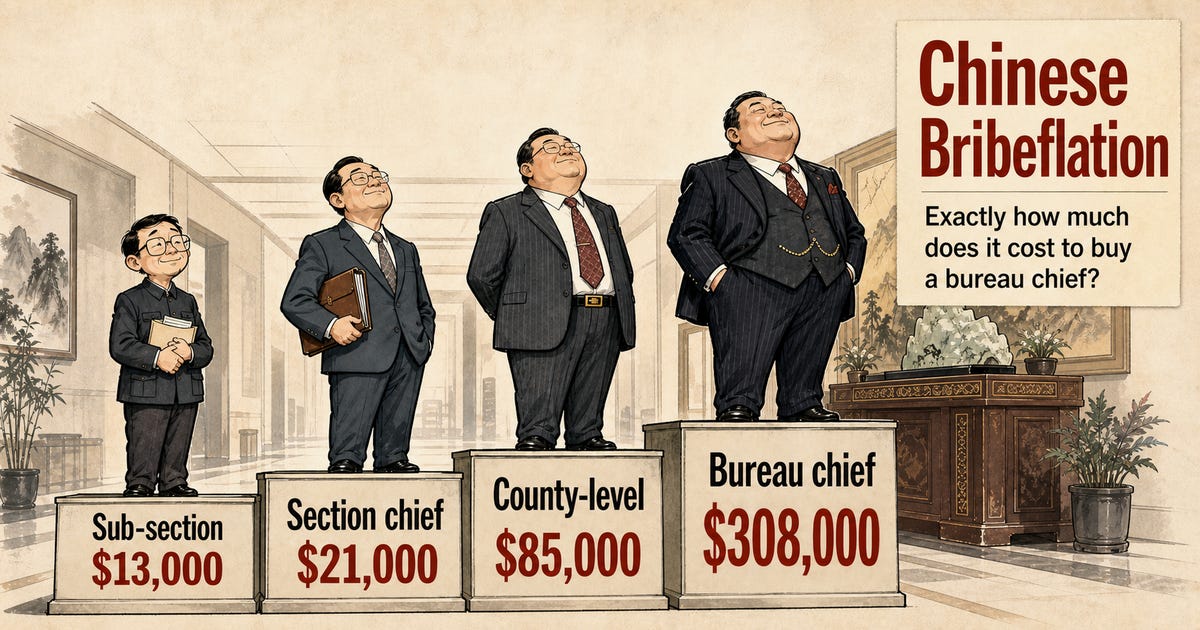
China published its corruption verdicts, in bulk, until it did not. Fortunately, there is a leaked copy of the 2013 to 2021 court records floating around that lets us calculate the standard bribe per government seniority level, bribeflation per year, what gifts officials received, and even the most common watches used as a bribe (Omegas).
The chart shows both facts at once: the going rate by rank, year by year. How to read it: each line is one tier of official, from sub-section clerk to bureau chief, and each point is the median disclosed bribe for that rank in that year, in US dollars on a log scale. What to see: the lines never cross, so the rank ladder holds every single year, and every line tilts upward, so the whole schedule inflates together. The price of an official is both ordered by his rank and rising with the calendar. The dotted line at the floor is where the lowest tier would sit if bribes had merely tracked consumer prices. Nothing on the chart stays near it.
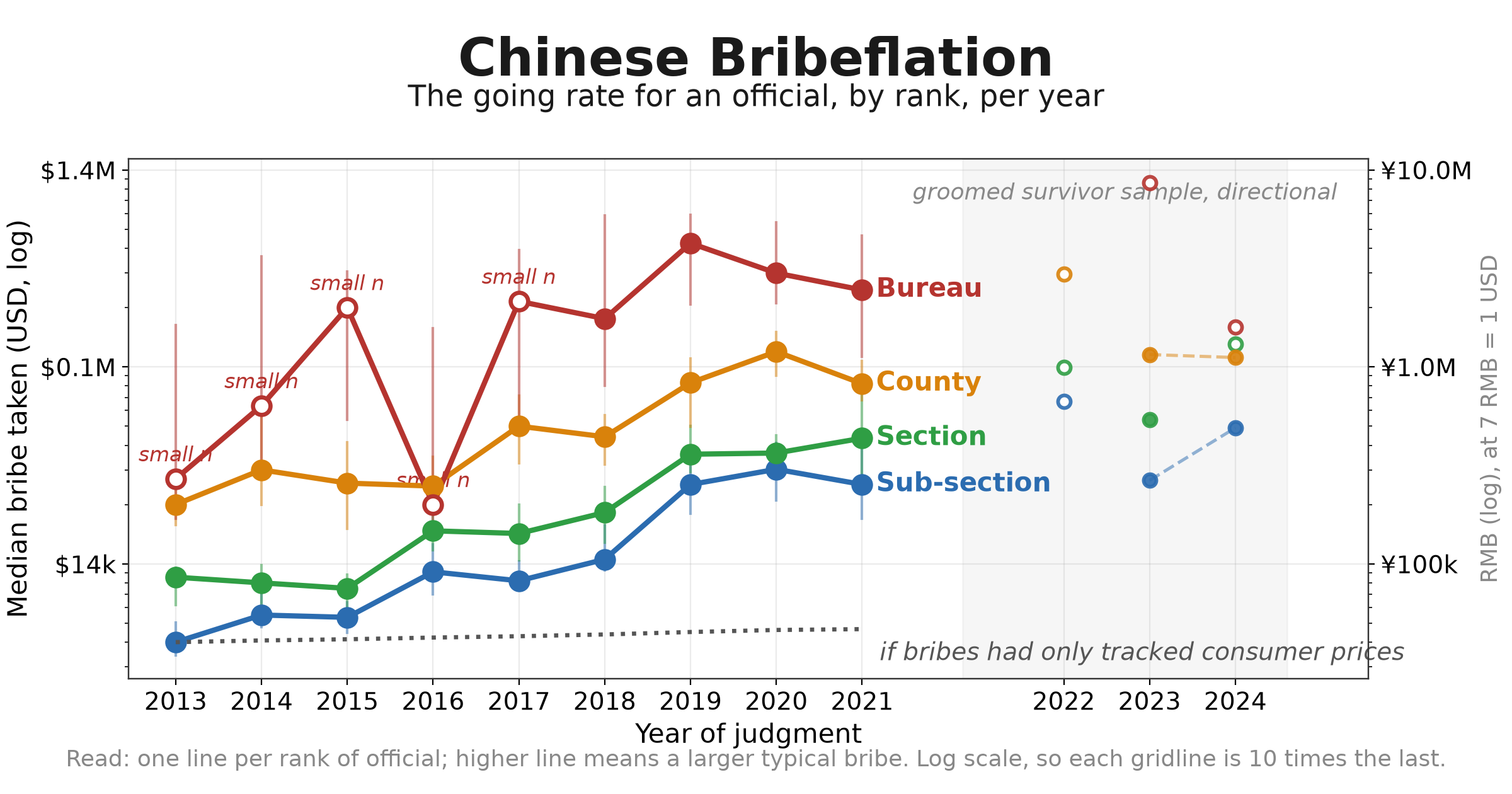
How to read it: each colored line is one rank of official, from sub-section at the bottom to bureau chief at the top; vertical position is the median bribe taken by that rank in that year, log scale in US dollars. Solid lines cover the bulk pre-deletion record, 2013 to 2021; the shaded band holds the directional survivor tail. What to see: the rank ladder never inverts, and every rank’s going rate rises across the span, with the lowest tier climbing roughly fivefold.
The findings
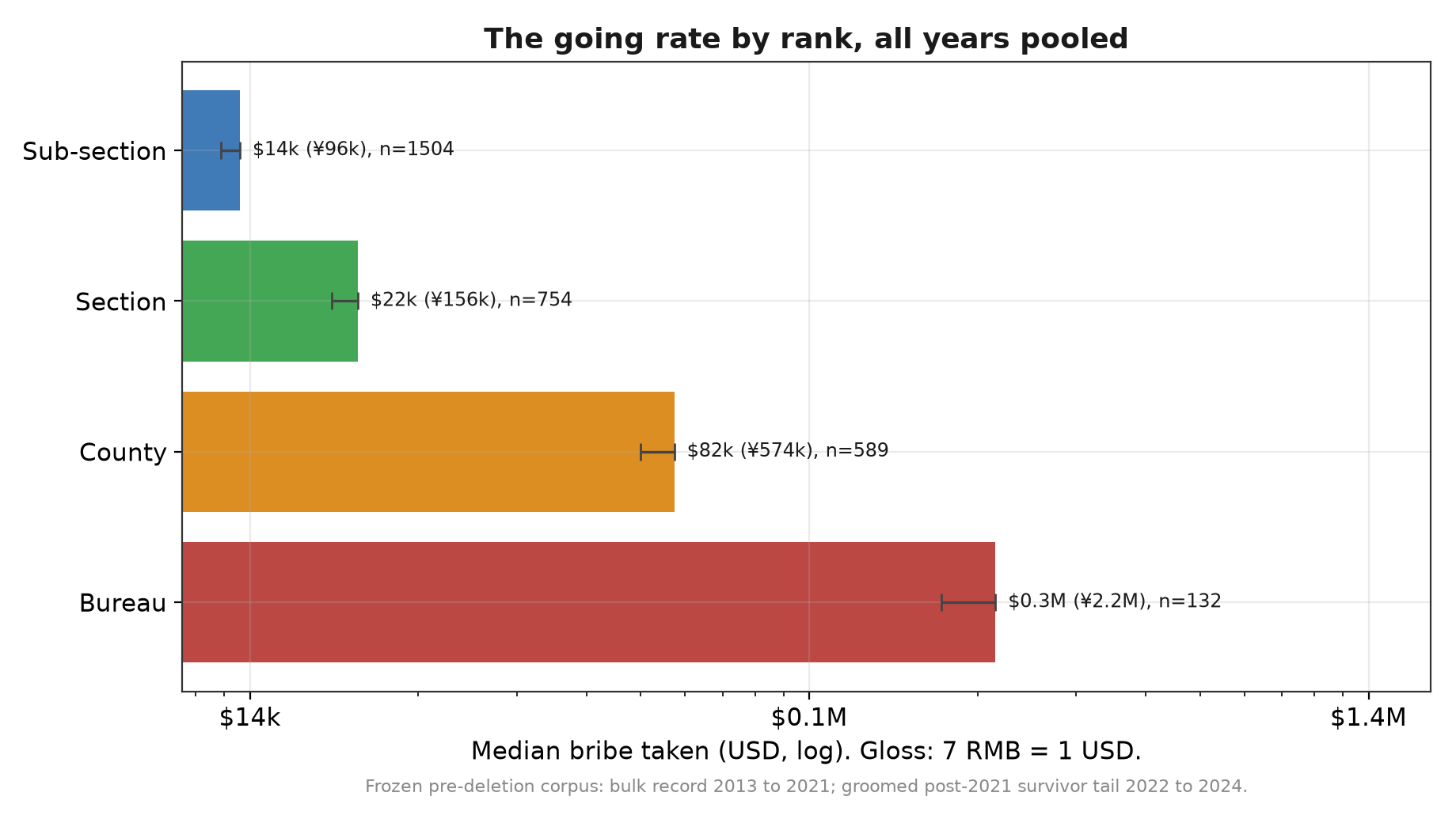
How to read it: one bar per rank, all bulk years pooled, median bribe with a 95 percent confidence interval, log scale in US dollars. What to see: the price of an official climbs steeply with rank, from about 13,000 dollars at the bottom to about 308,000 dollars for a bureau chief, a roughly twenty-two-fold spread.
The menu is real, and it is steep. The rank ordering is the sturdiest thing in this dataset. Sub-section, section, county, bureau: the median bribe climbs at every step and never reverses. That monotonicity matters more than any single number, because it survives every way the data is sliced. A county-level official commands roughly four times a section chief. A bureau chief commands more than three times a county official again, and more than thirteen times a section chief. The confidence bands on the four tiers do not overlap. It’s quite literally a priced Chinese menu of corruption.
The high end is confirmed from the outside. The court corpus is thick with low and middle ranks and thin at the top, because tigers are tried in a handful of courts and the corpus samples them sparsely. So the top rung was checked against a separate source: the anti-graft agency’s own public register of senior officials placed under investigation. That register runs the other way, heavy at the top, with about three quarters of its named officials at bureau level and roughly a fifth at provincial or ministerial rank. Where the two sources describe the charge, bribery is named in about ninety-six percent of them. The court record prices the bottom of the ladder with large numbers, the disciplinary register confirms the top of it, and both agree the dominant transaction is a bribe. One aside worth keeping: those disciplinary notices never state a sum. The number surfaces only at trial. Even the state’s public accounting of its own tigers withholds the price until the courtroom.
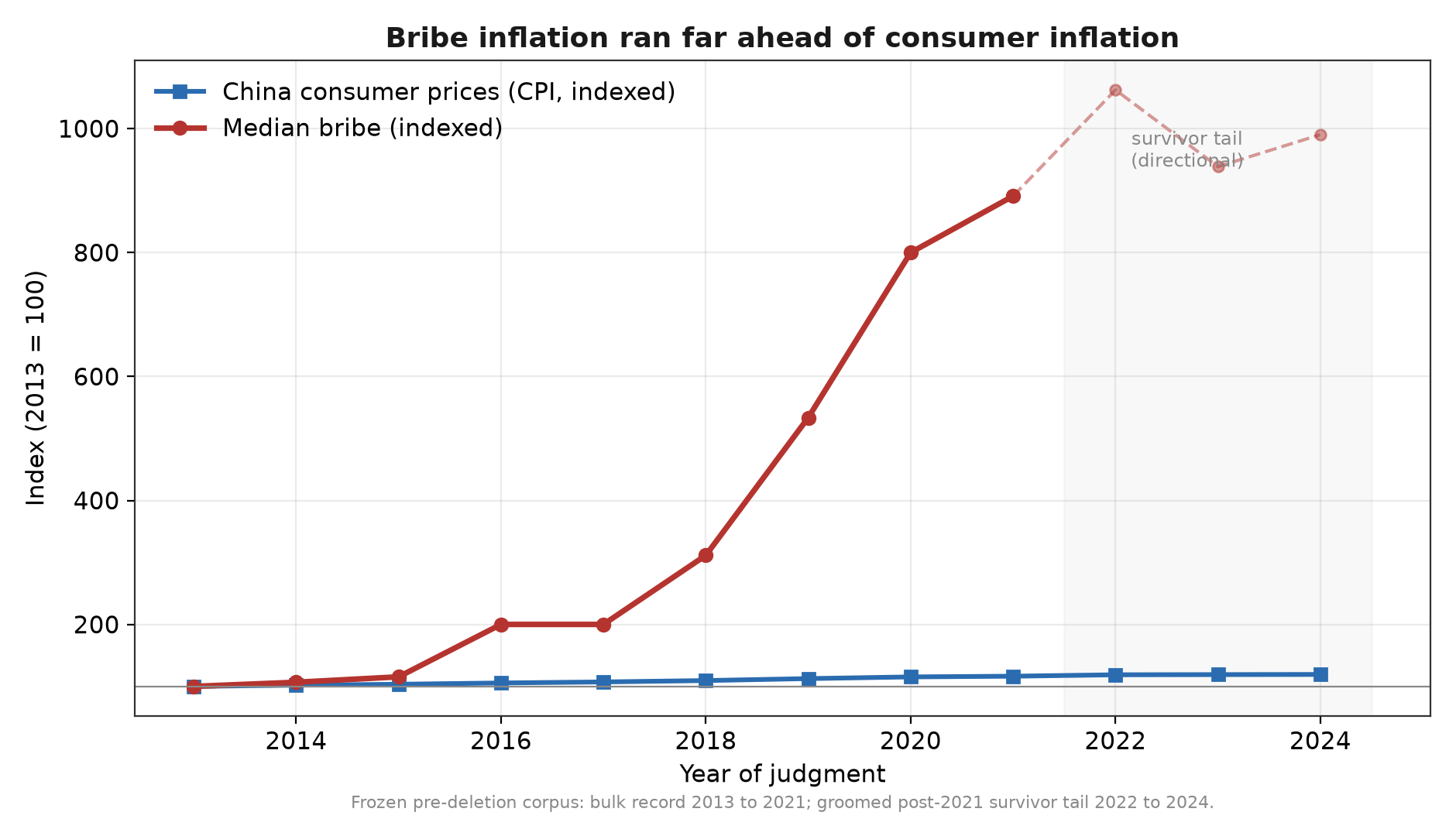
How to read it: two indexed lines, both set to 100 in 2013; blue is China’s consumer price index, red is the median bribe, solid through the bulk record and faded dashed for the survivor tail. What to see: consumer prices barely move while the median bribe rises almost ninefold by 2021.
Bribeflation. Between 2013 and 2021, the years the record is published in bulk, the median disclosed bribe grew about 790 percent while the official consumer price index grew about 16 percent. That is a gap of roughly fifty to one. And it is not one giant case dragging a mean. The ninetieth-percentile bribe climbed in step, from about 73,000 dollars in 2013 to about 520,000 in 2021, a sevenfold move. The whole distribution shifted up, year after year. Two honest readings compete. Either the bribes themselves got bigger, or a lengthening anti-corruption campaign moved up-market and kept landing bigger fish. The court record cannot fully separate those. But under either reading, the last near-decade the public docket shows before it goes dark is corruption getting steadily more expensive, not less.
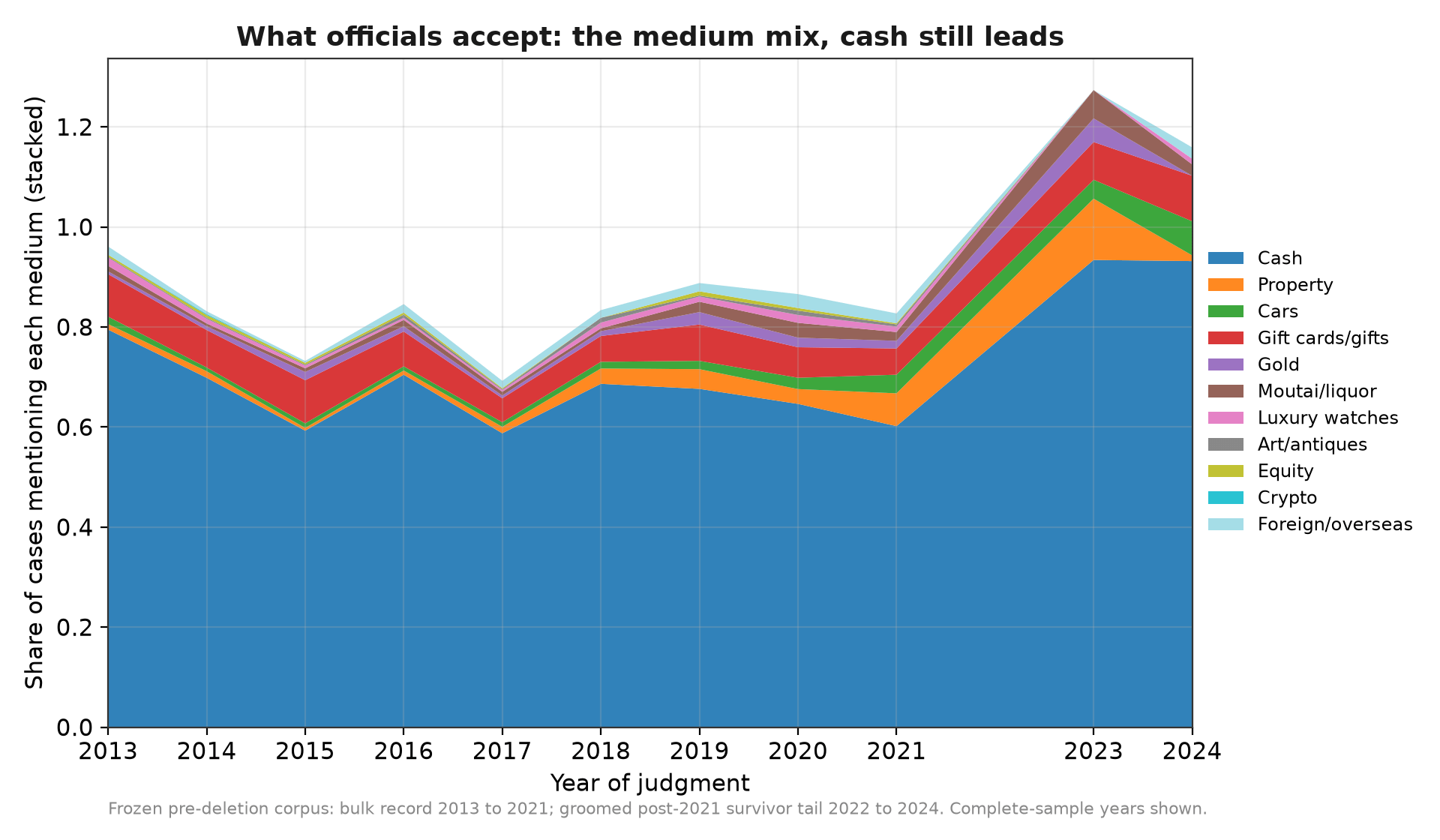
How to read it: a stacked area over the bulk years showing the share of cases that mention each medium of payment, cash at the base with property, cars, gift cards, gold, liquor, watches and other forms above. What to see: cash dominates every year, with a steady minority in property, gifts, gold and luxury goods.
They take cash, mostly and stubbornly. The tradecraft would imply that sophisticated graft migrates from cash to property to crypto. The data refutes it. Cash is named in a majority of cases every year, ranging from roughly 59 percent to more than 90 percent, and it never yields the lead. Cryptocurrency appears in essentially zero percent of bribery convictions in every single year across the whole span. Property, cars, gift cards, gold, liquor, and watches all show up, but as the garnish on a cash meal, and the non-cash forms are undercounted here because judgments list them unevenly. The clean finding is the boring one, which is the most useful kind: prosecuted Chinese corruption is a cash business, start to finish.
There is a floor effect worth stating plainly. The classic low-end gift, a single bottle of Moutai or a carton of cigarettes, mostly sits below the roughly 4,000-dollar threshold for criminal prosecution and gets handled inside the Party as a discipline matter. It never reaches a court. So this record captures the going rate for prosecuted corruption, not the full gift culture. The watches and the liquor that do appear are riding inside bribes large enough to charge.
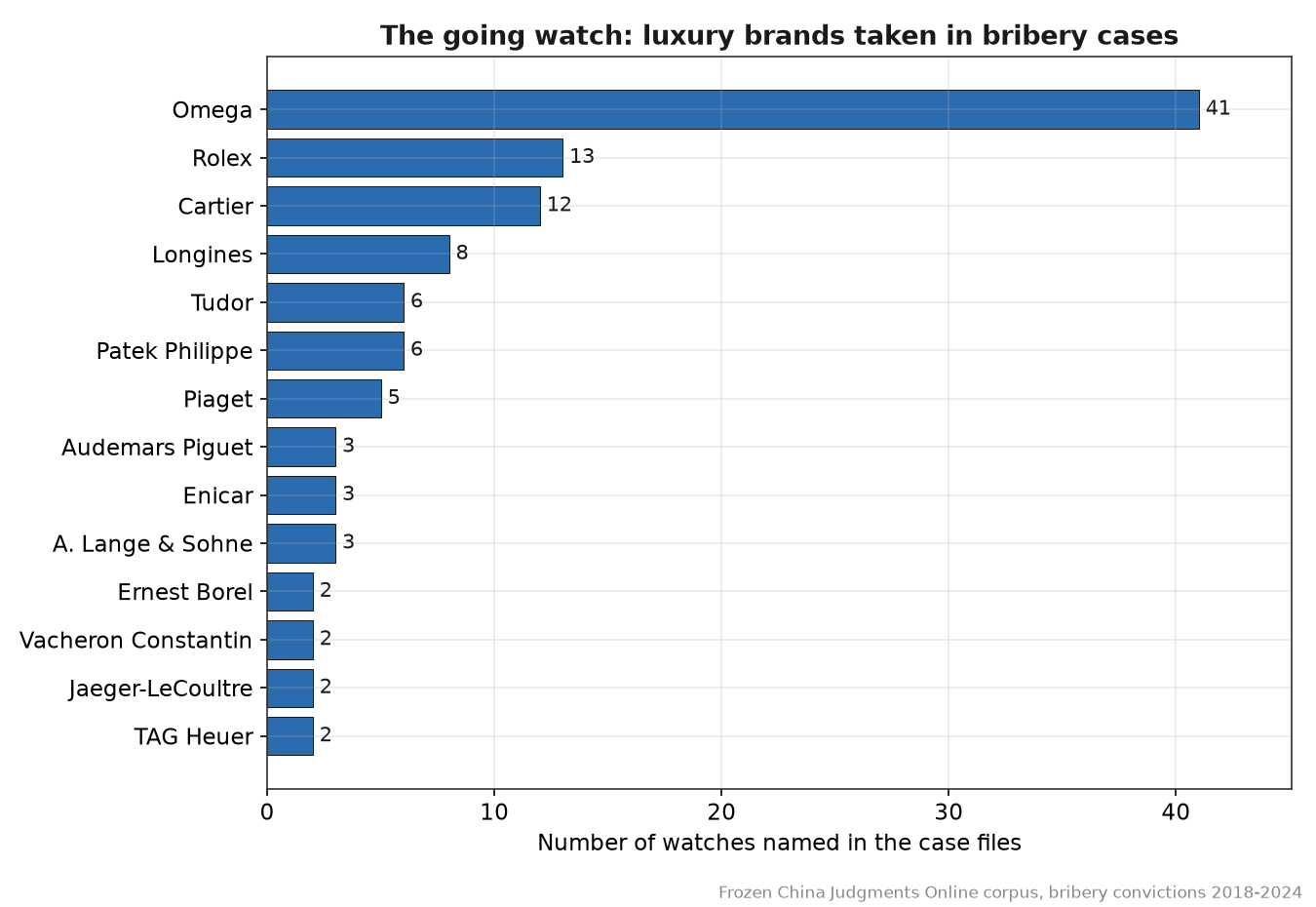
How to read it: the luxury-watch brands named in bribery and graft judgments, ranked by how often they appear. What to see: a short list of prestige Swiss brands accounts for most named watches, and the workhorse is the Omega, not the Rolex.
And when the in-kind items appear, they are a comedy of taste. The workhorse bribe watch is not the trophy piece you would guess. It is the Omega, which turns up more than three times as often as the Rolex, with Cartier, Longines, and Tudor filling out the wrist. The genuinely rich watches, the Patek Philippes and the Vacherons, sit in the long tail by count but at the top by value, a Patek running a median around 49,000 dollars. One state-bank investment chief took six watches in a single relationship, two Pateks, two Piagets, a Lange, and a TAG, appraised together at about 166,000 dollars. Liquor means Moutai in about 13 percent of the gift cases, and when the bottle is old the price climbs: fifteen-year is the common pour, but fifty-year and even eighty-year bottles surface in cases valued in the tens of thousands of dollars. The single fanciest object in the whole record is not a watch at all. It is 11.84 kilograms of gold bars, appraised at about 631,000 dollars, taken by an assistant general manager at a state steel group. Pine timber, an apartment, a villa, six ivory carvings, a tiger painted by a famous calligrapher: the in-kind ledger reads like an estate sale for a taste no one would admit to having. The cash is the meal. The Omega is the mint on the pillow. (This in-kind detail is drawn from the disclosed gift cases across the record and is illustrative, not a year-by-year series.)
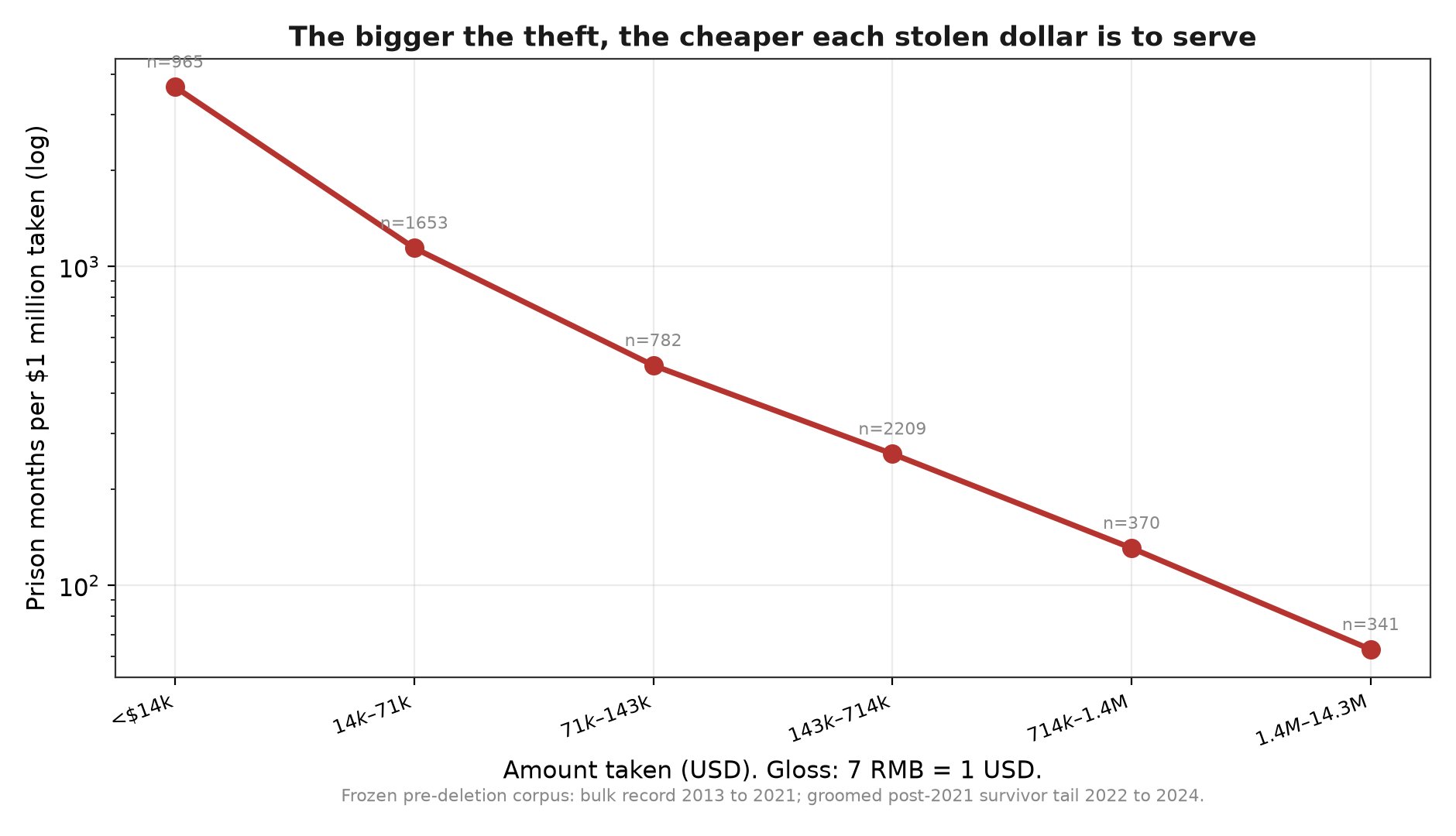
How to read it: the curve plots prison months served per one million dollars taken against the size of the theft, log vertical scale, each point labeled with the number of sentenced cases behind it. What to see: the marginal punishment per stolen dollar falls sharply as the amount grows, so the largest thefts are, per dollar, the most lightly punished.
Does money buy leniency? Per dollar, yes. Ask it crudely and the answer is no: a bigger bribe draws a longer sentence and kills the odds of a suspended one. The suspension rate falls from about 44 percent at the small end toward almost nothing at the large end. Ask it per dollar and the answer flips. Sentence length does not scale with the bribe, because prison time hits a ceiling at life and death while money does not. Measured as months of prison per million dollars taken, the effective price of corruption collapses from roughly 3,700 months per million at the small end to around 60 months per million at the large end, a discount of nearly sixty to one. Steal a little and every dollar is expensive in years. Steal an empire and the marginal dollar is nearly free.
Geography has a price gradient too, faintly. With the usual small-sample caution, the priciest disclosed corruption sits in the far west and the capital, with Xinjiang around 93,000 dollars and Beijing around 69,000 at the median, while the cheapest sits inland, with Shanxi around 13,000, Guangxi around 16,000 and Shaanxi around 9,000. Do not hang a thesis on the provincial ranks. They earn a mention because the spread is wide enough to be interesting and narrow enough to be honest about.
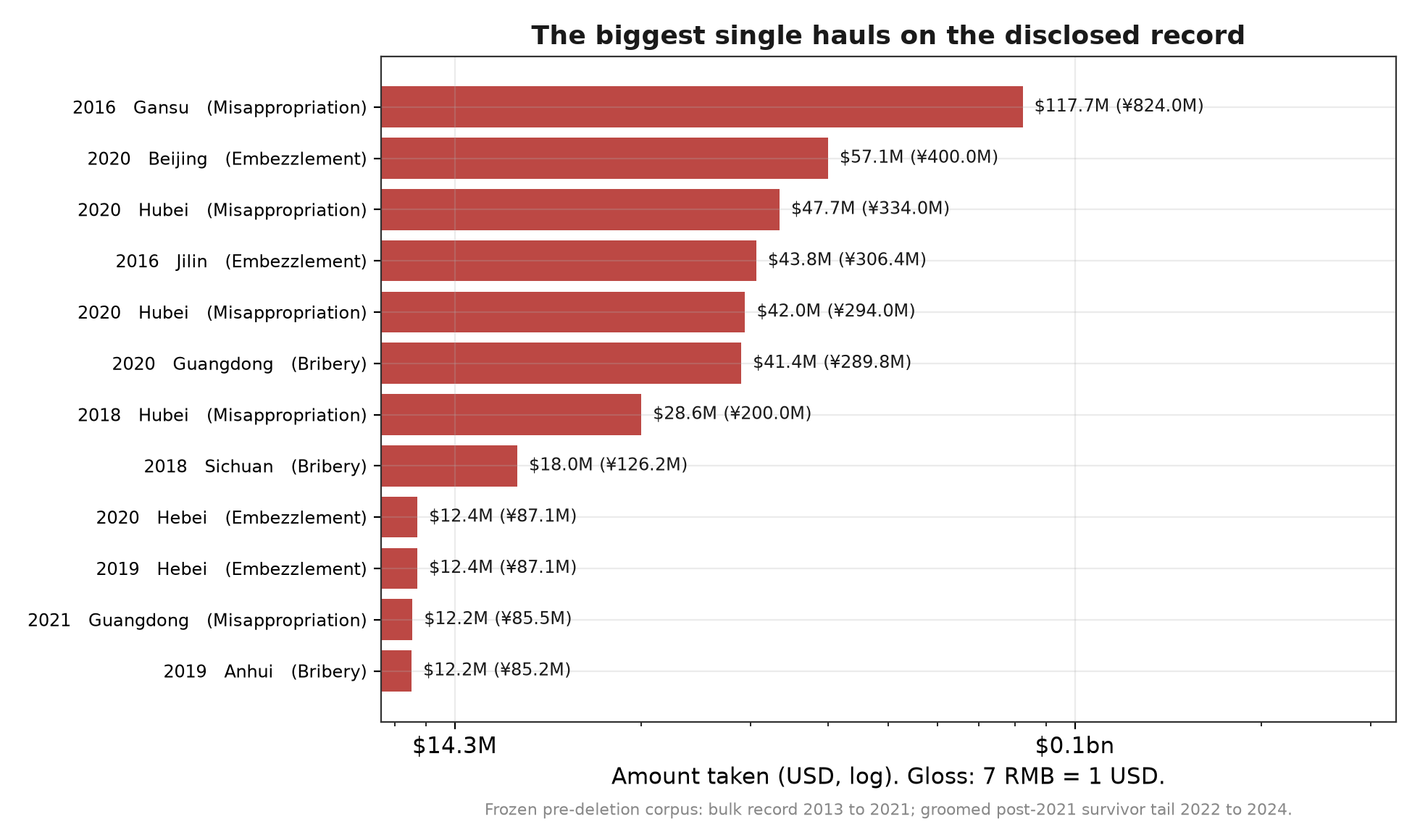
How to read it: the largest single amounts on the disclosed record, one bar each, labeled by year, province and charge type, log scale in US dollars, no individuals named. What to see: the top cases reach into the tens and hundreds of millions of US dollars, clustered in the 2016 and 2020 filings.
The ceiling. After a plausibility screen that throws out impossibly large figures as source-document typos rather than launder them into a headline, the largest credible single cases run to roughly 118 million dollars for a public-funds misappropriation that drew a life sentence, and about 57 million dollars for an embezzlement. The largest pure bribery case is a city deputy mayor who took about 41 million dollars and drew a life sentence. The point of the ceiling is not the single number but that the disclosed distribution had a very long, very real tail, and the state was still publishing that tail, in detail, until it was not.
Best Arguments Against This
The strongest objection is selection, and it is real. A court record is not a census of corruption. It is a census of prosecuted, disclosed corruption, and both filters move over time. The whole 2013 to 2021 window sits inside a single, intensifying anti-corruption campaign, so the rising median could reflect enforcement that spent its early years on small fry and its later years on bigger targets, rather than any real inflation in the graft itself. I concede that the level of the trend is not clean. What I do not concede is the direction and the ladder. The direction now runs eight years without a single reversal, which is far harder to wave away than a two-year jump. The rank schedule is a cross-sectional fact, immune to the time-selection worry, and it is overwhelming, with non-overlapping confidence bands across four tiers and independent confirmation of the top rung from the disciplinary register.
The second objection used to be the salvage. One bulk year, 2019, was for a while held only as a partial salvage from a source-corrupt archive, which made its counts a lower bound. That year has since been recovered in full (and the article updated on 2026-7-16), and the complete record lands exactly where the salvage put it: the 2019 median sits on the staircase between 2018 and 2020, and its medium mix is unchanged, so nothing turns on it. And after 2021 the public court record thinned dramatically and non-randomly, so any figure drawn from the surviving cases is a groomed sample and is treated here as directional at most. That is why the load-bearing numbers live in 2013 through 2021, where the frozen copy is published in bulk.
What Would Change My Mind
If a fuller or earlier slice of the same corpus showed the rank ladder inverting or flattening, the schedule claim weakens. The ordering is the spine of this piece.
If procuratorate or court yearbook totals for those years showed disclosed bribe medians flat while mine rise, I would suspect an extraction artifact and re-audit the amount parsing. The current re-derivation audit agrees with the model on about 96 percent of stated amounts.
If the non-cash forms, properly valued, turned out to carry a third or more of total bribe value in later years, the cash-business claim needs qualifying.
If the discarded mega-cases turn out to be real rather than typos, the tail is even longer and the ceiling section understates the point.
If independent reporting establishes that the low-end gift economy is being criminalized rather than handled as Party discipline, the threshold caveat changes.
Close
The price of bribing a Chinese official climbed almost ninefold while the price of groceries barely moved. Then the court records list went dark. And in Feb 2026, the U.S. suspended enforcement of bribing foreign officals. How long before we see the first GoFundMe?
Correction and update, 2026-07-20.
First, what does not change: everything this piece stands on. Bribeflation of +791 percent from 2013 to 2021 against consumer inflation of +16.4 percent, a gap of roughly fifty to one. The rank ladder that never inverts. The cash business. The per-dollar leniency discount. The ceiling. All unchanged, and for a simple reason: those numbers live at the 2013 and 2021 endpoints and in the pooled cross-section, and this update touches neither endpoint.
What happened is that the one weak year got fixed. When this ran, 2019 existed only as an 11.36 percent salvage of a corrupted archive, and I flagged it as such. The complete 2019 archive has since been recovered, all 10,750,409 records, and it turns out the salvage under-sampled large-amount corruption cases badly: 20 big-amount cases in the salvage, 1,105 in the full year. I re-ran the exact same pipeline over the full year. Four secondary printed figures moved:
The bureau-chief pooled going rate rises from about $286,000 to about $308,000, crossing the $300k mark. Xinjiang’s provincial median falls from about $120,000 to about $93,000. Hainan falls from about $75,000 to about $46,000, so Hainan is no longer the high-end standout; the high end is now Xinjiang at about $93k and Beijing at about $69k. Guangxi rises from about $13,000 to about $16,000. The rank ladder and the province paragraph’s caveats stand as written.
One caveat is now obsolete, and retiring it strengthens the piece. The Best Arguments Against This section conceded that 2019 survives only as a partial salvage, a lower bound. No longer. The complete year lands exactly where the salvage put it on the staircase: the 2019 representative-base median moves from about $54k to about $57k, still cleanly between 2018 at about $33k and 2020 at about $86k. The trend line held when the missing 89 percent of the data arrived.
These numbers are generated from the aggregated data, not hand-typed, so when the data improves, the numbers get re-run and the changes get dated and posted. Math