
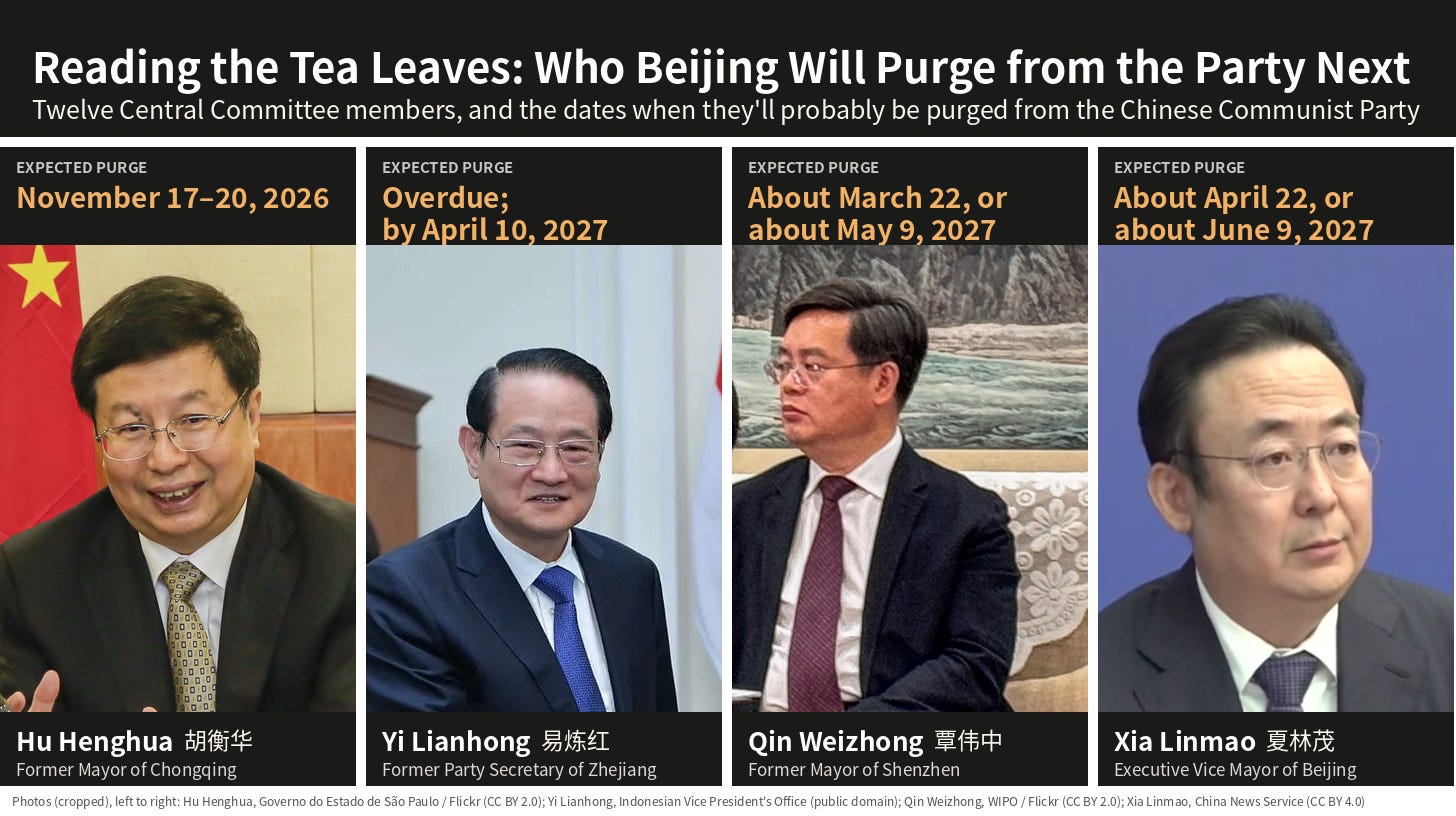
Hu Henghua (胡衡华), the former mayor of Chongqing, will probably be expelled from the Chinese Communist Party (CCP) this week. It is the first test of the calls below, and readers will see the result within days.
Eleven more members of the Party’s Central Committee fit the patterns which let us predict when they’ll be expelled from the CCP: five more civilians, and five generals likely to fall at the next plenum in October 2027.
Civilians get purged according to the law. Unless there are new charges, a civilian will be purged within eight months of a CCDI investigation notice. Find the notice, add eight months, purged. It’s more complicated than that, but barely.
Generals are subject to different laws and more secretive justice. But in China, many senior generals also have a seat in the legislature. All 17 generals who lost their legislative seat, and whose investigations completed, were then expelled from the Party. Watch them lose a seat, and wait for the next plenum to vote on their Party expulsion.
Expect little explanation why someone was expelled from the party. The civilians will almost certainly be charged with bribery. The generals will most likely be expelled with nothing beyond the communique’s phrase, or maybe one line about money.
On March 20 the Party’s anti-corruption agency published one sentence about the mayor of Chongqing. Hu Henghua was “suspected of serious violations of discipline and law” (CCDI, March 20). CCDI did not publish what he was charged with. The next day, a listed chipmaker announced, the National Supervisory Commission detained the chairman of its parent group (The Paper, March 22). Hu had launched the group’s Changsha plant in 2020 and met the chairman in Chongqing in 2023 and 2025.
Hu had survived worse. In 2014, as mayor of Changsha, he took a demerit from the State Council for an expressway fire that killed 58 (State Council decision, court-site repost). In 2023 the CCDI gave him a Party warning for the collapse of a self-built house in Changsha that killed 54 (CCDI, May 21, 2023). Between the collapse and the warning, the Party made him a full member of its Central Committee. The system disciplined him twice over 112 deaths and kept promoting him. Yeah, I don’t get it either.
Hu Henghua will probably be expelled by November 20. The Supervision Law lets investigators hold a suspect for eight calendar months at most, and eight of the nine Central Committee cases that have come due under that limit ended in an expulsion notice inside the legal time limit. His eight months run out today if counted from March 17, the day investigators took him from Chongqing by the Economic Observer’s account (Economic Observer via ifeng, March 20), and on November 20 if we start counting days from the notice. That is his window: November 17 to November 20. Odds are that he falls this week, or we find out later that he had more charges tacked on in order to reset the legal clock. And if his clock is reset, the law says that the Party has until May 20, 2027.
He is the first of twelve that I can see. Beijing’s purges look arbitrary from outside, and the Fifth Plenum of October 26 to 29 (the Central Committee’s latest full meeting) looked more arbitrary than most. It removed 34 members at one sitting (Xinhua via People’s Daily Online, October 29). So I went hunting to make sense of how they’re purging Party members.
They’re just following their own rules
Every predicted fall here comes from one of two rules, and I checked both rules against what really happened in their official texts: discipline notices, legislature notices, plenum communiques and the military’s newspaper, laid over a dated record of all 865 full and alternate members of the last three Central Committees. First, once the CCDI announces that a civilian member is under investigation, then the Supervision Law lets investigators hold him for eight months at most. And his expulsion has almost always been announced inside that limit. Nine Central Committee cases have come due under the law as amended in 2025. Eight cases closed inside the limit and one ran past it. The tenth comes due this week. That’s Hu Henghua.
Second, a general does not get a CCDI notice. But he loses his seat in the National People’s Congress (NPC) and that is something we can observe. Then a plenum (the full meeting of the Central Committee) will later expel him from the Party. All 17 generals who lost a seat and whose cases have ended were expelled. Six months after they lose their seat, the next plenum will finish expelling the general. That was true for seven generals at three plenums.
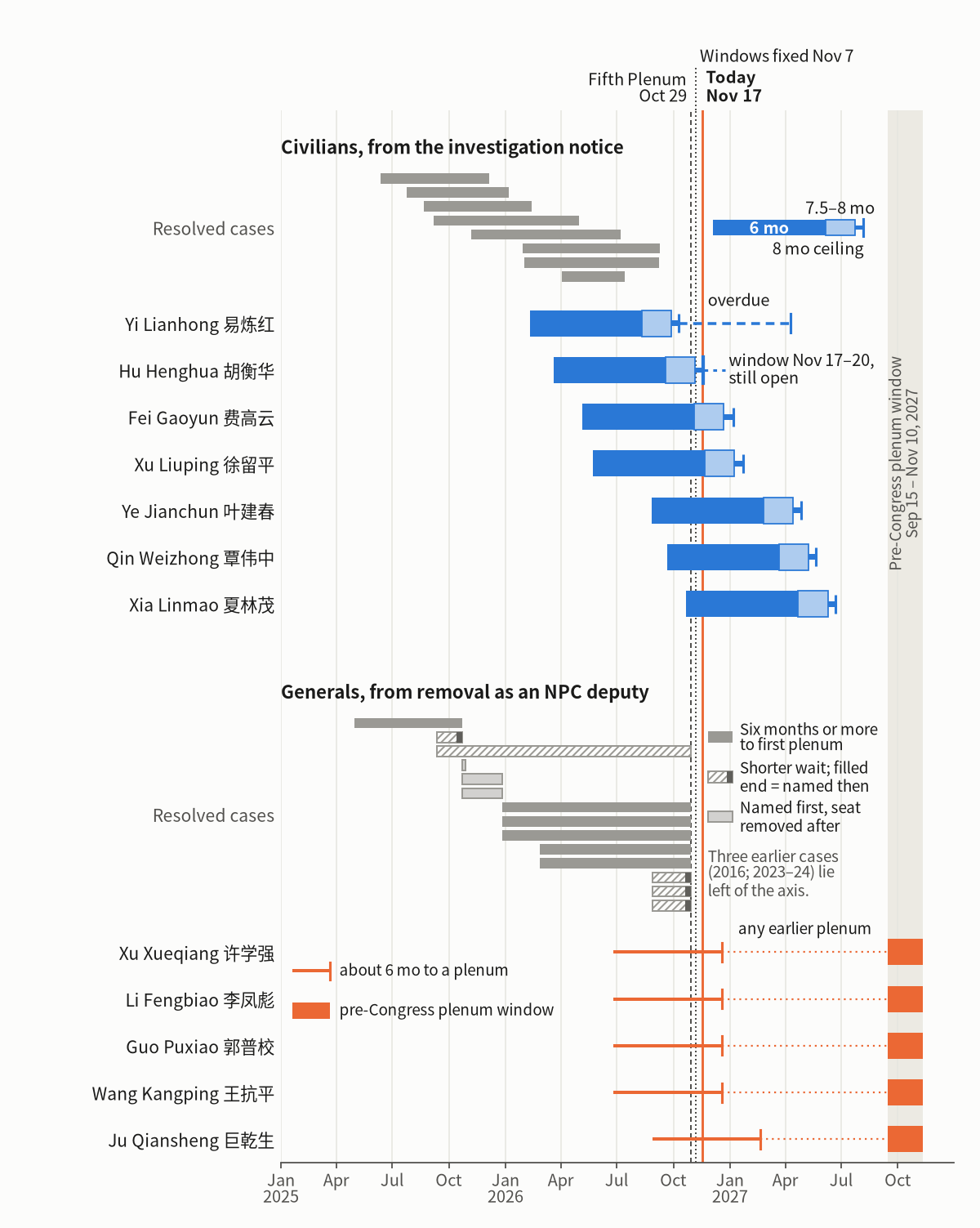
Figure 1: The twelve predictions on one graph with the closed cases. (Source: Compiled by the author from CCDI notices, NPC Standing Committee notices, and plenum communiques.)
Twelve members and the day they’re expected to fall
First let’s set expectations before we look at the individuals. CCDI does not state a reason when they open a case on a civilian. They publish one sentence that all seven civilians below share: the man “涉嫌严重违纪违法,目前正接受中央纪委国家监委纪律审查和监察调查” (“is suspected of serious violations of discipline and law and is under disciplinary review and supervisory investigation by the CCDI and the National Supervisory Commission”). The expulsion notice months later will state the actual charges. Of the 129 published charges on Central Committee members and senior generals, 122 charged bribery. So you can expect bribery.
There will be even less information on generals. Their cases belong to the Central Military Commission (CMC), which is the Party body in charge of the armed forces. CCDI does not open a public case on them so we don’t see any notices. The legislature prints one sentence saying that the servicemen’s congress of the general’s unit “决定罢免” (“decided to remove”) him as a deputy to the 14th NPC, with no reason. Of the 16 generals expelled at the Fifth Plenum in October, 14 were explained only with the phrase “serious violations of discipline and law.”
Hu Henghua (胡衡华), mayor of Chongqing: expect an expulsion notice by November 20

Photo: Governo do Estado de São Paulo / Flickr, CC BY 2.0 (cropped)
Hu Henghua, born in 1963 in Hengnan, Hunan, is a full member of the Central Committee. He spent 22 years at the Hengyang steel tube works, rising from technician to general manager. He was mayor of Changsha from 2013 under Party secretary Yi Lianhong, succeeded him in 2017, and became mayor of Chongqing in December 2021.
The CCDI’s notice of March 20 reads: “重庆市委副书记、市长胡衡华涉嫌严重违纪违法,目前正接受中央纪委国家监委纪律审查和监察调查。” (CCDI). It does not state a charge. Chongqing’s legislature then removed him as an NPC deputy (People’s Daily, June 27). For the non-China watchers, an NPC deputy is just what they call someone with a seat in the National People’s Congress.
The record includes the two sanctions described above; the 2023 warning held him to “leadership responsibility” for the collapse of a house that killed 54. The record shows the detention of the chairman of a chip group the day after Hu’s investigation notice. In September police held the chairman on suspicion of embezzling company funds, not of bribery (company announcement via 163.com, September 29). Caixin Global reported on April 30, citing unnamed sources, that the chairman’s son-in-law gave Hu cryptocurrency worth about 210 million yuan, which is about $31 million USD (Caixin Global).
The model predicts he will be expelled from the Party by November 20th, 2026. It is the first test of the model. If we’re wrong, then he is likely to be expelled around May 20, 2027, which is the last day they can detain him.
Yi Lianhong (易炼红), former Party secretary of Zhejiang: overdue, and by April 10, 2027

Photo: Office of the Vice President of Indonesia (public domain)
Yi Lianhong, born in 1959 in Lianyuan, Hunan, is a full Party member of the Central Committee. He taught for 17 years at the Hunan Party School, then ran Yueyang and, from 2013, ran Changsha, with Hu Henghua as his mayor. He was governor and then Party secretary of Jiangxi, with Ye Jianchun as his governor, and Party secretary of Zhejiang from 2022 to 2024. In 2024 he was moved to a vice chairmanship of the National People’s Congress’s Financial and Economic Affairs Committee.
The CCDI’s notice of February 10 reads: “十四届全国人大财政经济委员会副主任委员易炼红涉嫌严重违纪违法,目前正接受中央纪委国家监委纪律审查和监察调查。” (CCDI). It does not state a charge. Zhejiang’s legislature removed him as an NPC deputy (NPC Standing Committee notice No. 17, April 30).
He has no earlier Party sanctions on record. Four days before his notice the CCDI expelled Gao Xingfu (高兴夫), a former vice governor who was vice chairman of Zhejiang’s legislature while Yi ran the province, for “befriending political swindlers” and taking huge bribes over construction, land and stock listings (CCDI, February 6). The Economic Observer, as carried by Taiwan’s Central News Agency, quoted an unnamed source saying Yi “promoted cronies wholesale, indulged his family, shut out colleagues and struck at rivals” (CNA, March 18).
His eight months ran out on October 10, and the Fifth Plenum did not expel him. We will likely see an expulsion notice by April 10, 2027, the latest date if investigators restarted the clock. We are wrong if that date passes with no notice. His successors in Changsha and in the Jiangxi governor’s office are both on this list.
Fei Gaoyun (费高云), Party secretary of Hefei: an expulsion notice by January 6, 2027

Photo: State Council Information Office (SCIO)
Fei Gaoyun, born in 1971 in Huai’an, Jiangsu, is an alternate Central Committee member, one of the ranked reserves who move up when a full seat opens. He rose through Jiangsu’s chemical belt, running the Yangzhou chemical industry park and then the city of Changzhou. He became a Jiangsu vice governor in 2018, moved to Anhui in 2022, and took over Hefei in April 2025.
The CCDI’s notice of May 6 reads: “安徽省委常委、合肥市委书记费高云涉嫌严重违纪违法,目前正接受中央纪委国家监委纪律审查和监察调查。” (CCDI). It does not state a charge. Anhui’s legislature removed him as an NPC deputy in June.
His record holds one earlier Party sanction. In 2019 the National Supervisory Commission gave him a demerit over the Xiangshui chemical explosion, which killed 78, holding him to “重要领导责任” (“important leadership responsibility”) as the vice governor in charge of work safety (Xinhua, November 15, 2019). He was promoted 14 months later. Five weeks after his CCDI notice, Anhui opened a case on a former Hefei vice mayor, He Fengyang (何逢阳), and in September expelled him for “befriending political swindlers” and taking huge bribes over project contracts (Anhui discipline commission via e23.cn, September 11). No reputable outlet has reported what his own case is about.
His six-month mark passed on November 4 with no notice as of November 17. I expect him to be expelled from the Party between late December and January 6, 2027. Hefei has been hard on its Party chiefs. His predecessor was removed in March 2025 with no reason published. Wu Cunrong (吴存荣), who ran the city a decade ago, was just sentenced in March to life in prison for bribery.
Xu Liuping (徐留平), Party chief of the official trade union: an expulsion notice by January 23, 2027

Photo: China FAW (via Gasgoo)
Xu Liuping, born in 1964 in Yangzhong, Jiangsu, is an alternate Central Committee member. He spent about 30 years in the ordnance industry. He ran Changan Automobile, then its parent, China South Industries Group, and from 2017 to 2023 he chaired the state carmaker FAW, where he relaunched Hongqi, the Party’s own limousine brand. In 2023 he was moved to run the All-China Federation of Trade Unions, which is a ministerial post.
The CCDI’s notice of May 23 reads: “中华全国总工会党组书记、副主席、书记处第一书记徐留平涉嫌严重违纪违法,目前正接受中央纪委国家监委纪律审查和监察调查。” (CCDI). It does not state a charge. Official texts had last named him on March 18, 66 days earlier (People’s Court Daily, court-site copy, March 19).
He has no earlier Party sanction on record. A central inspection team examined the union’s Party leadership from November 2024 to January 2025, and I could not find its findings (Xinhua, July 3, 2025). Caixin Global reported on May 27, from a single source, that several close associates were detained in late 2025 and that investigators were looking at his family’s assets (Caixin Global).
He reaches his six-month mark on November 21. The call is an expulsion notice by January 23, 2027.
Ye Jianchun (叶建春), governor of Jiangxi: an expulsion notice by April 27, 2027

Photo: HKSAR Government
Ye Jianchun, born in 1965 in Zhouning, Fujian, is a full Central Committee member and a hydraulic engineer. He spent 21 years at a Shanghai water design institute and 11 running the Taihu Basin Authority, then served as a vice minister of water resources. He went to Jiangxi in 2021 and succeeded Yi Lianhong as governor in 2022.
The CCDI’s notice of August 27 reads: “江西省委副书记、省长叶建春涉嫌严重违纪违法,目前正接受中央纪委国家监委纪律审查和监察调查。” (CCDI via Xinhua Jiangxi). It does not state a charge. Jiangxi’s legislature removed him as an NPC deputy 27 days later (Jiangxi People’s Congress, September 23).
He has no earlier Party sanction on record. Five months before his notice, Jiangxi’s discipline commission named his former chief of staff, with an unusual addition: the man had “主动向组织交代问题” (“come forward and confessed his problems to the Party organization”) (CCDI, March 24). HK01 reported on August 29, citing unnamed Jiangxi insiders, that Ye was taken on August 25 with his wife and that his family had gone into the rare-earth business (HK01). On the evening of the notice, by the same report, the province’s leaders met and vowed to end “family-style corruption.”
The call is an expulsion notice in late February or mid-April 2027. Three months before his notice he told a safety meeting that “政府不要带血的GDP” (“the government wants no GDP with blood on it”) (jx.cri.cn, May 9).
Qin Weizhong (覃伟中), former mayor of Shenzhen: an expulsion notice by May 21, 2027

Photo: WIPO / Samar Shamoon, CC BY 2.0 (cropped)
Qin Weizhong, born in 1971 in Jilin City, is an alternate Central Committee member and a Tsinghua-trained chemical engineer. He spent 14 years in planning at the oil company Sinopec and ran its Jiujiang refinery. He became a vice governor of Guangdong in 2019 under governor Ma Xingrui (马兴瑞), and mayor of Shenzhen in 2021.
He left the mayor’s office on August 24 for a seat in the Party group of Guangdong’s legislature (Nanfang Daily via People’s Daily Online, August 25). Four weeks later the CCDI’s notice read: “广东省人大常委会党组成员覃伟中涉嫌严重违纪违法,目前正接受中央纪委国家监委纪律审查和监察调查。” (CCDI via People’s Daily Online, September 21). It does not state a charge. He still holds his NPC seat.
He has no earlier Party sanction on record. Five Guangdong and Shenzhen officials around him have been expelled with published charges, and all five were charged with bribery. Ma Xingrui’s notice opens with a serious breach of political discipline and says he “大搞家族腐败” (“engaged in large-scale family corruption”) (CCDI, July 14). Prosecutors indicted him for bribery on November 5. The notice on Chen Rugui (陈如桂), Qin’s predecessor as mayor, says he was “对党不忠诚不老实” (“disloyal and dishonest to the Party”) (CCDI, December 30, 2022). An HK01 columnist wrote on October 7 that inspectors had received signed complaints about Qin.
The call is an expulsion notice in late March or mid-May 2027. Chen Rugui took the same road: from the mayor’s office to the same legislature, then expelled in June 2022.
Xia Linmao (夏林茂), executive vice mayor of Beijing: an expulsion notice by June 22, 2027

Photo: China News Service, CC BY 4.0, via Wikimedia Commons (cropped)
Xia Linmao, born in 1970 in Jianhu, Jiangsu, is an alternate Central Committee member and a Tsinghua-trained urban planner. After about 15 years in Beijing’s planning bureau he ran three of the city’s districts in turn, Shijingshan, Miyun and Dongcheng, and joined the city’s Party leadership in 2021. He became executive vice mayor in January 2023.
The CCDI’s notice of October 22 reads: “北京市委常委、副市长夏林茂涉嫌严重违纪违法,目前正接受中央纪委国家监委纪律审查和监察调查。” (…suspected of serious violations of discipline and law…) (CCDI). It does not state a charge. It came four days before the Fifth Plenum opened. A case four days old did not have a verdict for the plenum to confirm and he still holds his NPC seat.
That sentence is all the record holds: no earlier sanction, no official around him expelled with a published charge, and no reputable report of what the case is about. Rumors of his fall in March 2026 were wrong, and he kept appearing in public for seven more months. Taiwan’s United Daily News, citing Caixin, put his last public appearance on October 14, at a meeting between Beijing’s Party secretary and the chief executive of Walmart (UDN, October 22).
By the numbers, the call is an expulsion notice in late April or early June 2027. In August 2023 he was the official who briefed the press on the Beijing floods that killed 33. Maybe it’s related?? I was expecting to see a lot more reporting around him.
Xu Xueqiang (许学强), head of the military’s equipment department: expelled at the next plenum

Photo: China News Service, CC BY 4.0, via Wikimedia Commons (cropped)
Xu Xueqiang, born in 1962, is an Air Force general and a full Central Committee member. He commanded the Northern Theater’s air force and was president of the National Defense University before taking over the CMC Equipment Development Department in October 2022. The post made him commander-in-chief of the manned space program. He was promoted to full general in September 2021.
The legislature’s notice of June 26 reads: “中央军委装备发展部军人代表大会决定罢免许学强的第十四届全国人民代表大会代表职务。” (The Servicemen’s Congress of the Central Military Commission’s Equipment Development Department has decided to remove Xu Xueqiang from his post as a deputy to the 14th National People’s Congress.) (People’s Daily, June 27).
His two predecessors in the post were both expelled. Li Shangfu (李尚福) was charged with taking and offering bribes. Zhang Youxia (张又侠), the department’s first director, was charged on September 21 with “搞团团伙伙,对党不忠诚不老实” (“forming cliques, disloyal and dishonest to the Party”) and with taking huge sums for help with promotions (Xinhua via People’s Daily Online). Lianhe Zaobao reported that in December 2025 the military’s procurement site called for public tips on Air Force procurement violations, the first such call aimed at one service.
The call: the next plenum (most likely in October 2027) will expel him. The official taikonaut launch reports say he gave the Shenzhou crews the order “出发” (“set out”) (China Manned Space Engineering Office, April 24, 2025). The report on Shenzhou-21, in November 2025, just stated the role without the name (China Youth Daily, November 1, 2025). So did the report on Shenzhou-23 in May (Beijing News, May 24). His legislative seat was gone 33 days after that.
Li Fengbiao (李凤彪), political commissar of the Western Theater: expelled at the next plenum
Li Fengbiao, born in 1959, is a general and a full member of two Central Committees. He enlisted in 1978 and rose through the airborne troops to command the 15th Airborne Corps. He commanded the Strategic Support Force from 2019 to 2021, then made a rare switch from the command track to the political one as commissar of the Western Theater.
The legislature’s notice of June 26 reads: “西部战区军人代表大会决定罢免李凤彪的第十四届全国人民代表大会代表职务。” (The Servicemen’s Congress of the Western Theater Command has decided to remove Li Fengbiao from his post as a deputy to the 14th National People’s Congress.) (People’s Daily, June 27). The Western Theater’s congress removed him. No reason given.
No official Chinese text states the charges against him. His partner at the head of the theater, its commander Wang Haijiang (汪海江), was expelled at the Fifth Plenum with no published charge. He Weidong (何卫东), promoted to full general in the same 2019 class, was expelled in October 2025 in a batch announcement that said only “涉嫌严重职务犯罪,数额特别巨大” (“suspected of serious duty crimes, the amounts especially huge”) (Ministry of National Defense via China Ningbo Net, October 17, 2025). Lianhe Zaobao reported on June 29 that Li took no part in the military delegation’s activity at the March 2026 NPC session. The absence rule described below flagged him 25 days before he was removed from his legislative seat.
The call: the next plenum (most likely in October 2027) will expel him. A Sichuan paper listed him at the province’s military-civil New Year meeting in 2025 (Sichuan Online, January 26, 2025). But the 2026 list names a deputy in his place (Sichuan Online, February 12). His seat went four months later.
Guo Puxiao (郭普校), political commissar of the Air Force: expelled at the next plenum
Guo Puxiao, born in 1964, is an Air Force general, a career political officer, and a full Central Committee member. He rose in the 15th Airborne Corps, first as political chief under Li Fengbiao and then as its commissar. He was commissar of the CMC’s logistics department from 2019 to 2022, and of the Air Force from 2022. When he was promoted in December 2020 he was the youngest serving full general, by Lianhe Zaobao’s count.
The legislature’s notice of June 26 reads: “空军军人代表大会决定罢免郭普校的第十四届全国人民代表大会代表职务。” (The Servicemen’s Congress of the Air Force has decided to remove Guo Puxiao from his post as a deputy to the 14th National People’s Congress.) (People’s Daily, June 27). The Air Force’s congress removed him. No reason given.
No official Chinese text gives the charges against him. Zhang Lin (张林), who later headed the same logistics department, was expelled at the Fifth Plenum with no published charge. Two of the three men promoted to full general with Guo in 2020 have been expelled. The December 2025 call for tips on procurement violations was aimed at his service. A week after it, Lianhe Zaobao reported, he was missing from the CMC’s promotion ceremony (Lianhe Zaobao, December 24, 2025).
The call: the next plenum (most likely in October 2027) expels him. He opened the Air Force’s open day in Changchun in September 2025 (Changchun government, September 20, 2025) and attended the Fourth Plenum that October, by Lianhe Zaobao’s account. He missed the December ceremony. He lost his legislative seat in June.
Wang Kangping (王抗平), Air Force lieutenant general: expelled at the next plenum
Wang Kangping, born in 1965, is an Air Force lieutenant general and an alternate Central Committee member, ranked 11th on the list. Official texts show him commanding an Air Force base at Jiuquan, in Gansu, in 2018 and 2019. Lianhe Zaobao reports that he became a deputy commander of the Eastern Theater in 2021 and commander of the Joint Logistic Support Force in 2024. I can’t confirm either posting from any official document. He has the thinnest record of the five generals.
At the Fourth Plenum, on October 23, 2025, alternates ranked below him were promoted to full Central Committee membership and he was not (Fourth Plenum communique, Xinhua text). Then the legislature’s notice of June 26: “东部战区军人代表大会决定罢免王抗平的第十四届全国人民代表大会代表职务。” (The Servicemen’s Congress of the Eastern Theater Command has decided to remove Wang Kangping from his post as a deputy to the 14th National People’s Congress.) (People’s Daily, June 27). The Eastern Theater’s congress removed him. No reason given.
Like the rest of the generals, there is no documented charge against him. The Eastern Theater’s former commanders He Weidong and Lin Xiangyang (林向阳) were expelled in the October 2025 batch, with its one line about “especially huge” amounts. Jamestown’s China Brief noted that Wang commanded the Jiuquan base, a weapons test site, while Li Shangfu ran the equipment department (China Brief, July 6).
The call: the next plenum (most likely in October 2027) expels him. He was passed over for promotion to full Central Committee membership eight months before he lost his legislative seat. Being passed over for promotion alone usually means little here, but losing the legislative seat is the trigger here. And the removal came from the Eastern Theater, not from the force he is reported to lead.
Ju Qiansheng (巨乾生), last commander of the Strategic Support Force: expelled at the next plenum
Ju Qiansheng, born in 1962, is a general and a full Central Committee member. By Lianhe Zaobao’s account he is a signals-intelligence and network-operations officer who ran the Strategic Support Force’s network department. He took command of the whole force in 2021, its third commander and its last. The force was abolished in April 2024, and he was never announced to have a new posting.
The legislature’s notice of August 28 reads: “信息支援部队军人代表大会决定罢免巨乾生的第十四届全国人民代表大会代表职务。” (The Servicemen’s Congress of the Information Support Force has decided to remove Ju Qiansheng from his post as a deputy to the 14th National People’s Congress.) (China Economic Net, August 28). The congress of the Information Support Force removed him. No reason. The same notice removed Zhang Youxia, Liu Zhenli (刘振立) and one more general. The Fifth Plenum expelled those three 62 days later. But it did not expel him.
As usual, there is no public charge against him. Liu Zhenli, promoted to full general with him in July 2021, was expelled on September 21 on the same charges as Zhang Youxia: cliques, disloyalty and huge sums of money. Lianhe Zaobao reported in 2023 that Ju missed the Army Day reception amid reports (never confirmed) that he was caught up in the graft cases (Lianhe Zaobao, August 3, 2023).
The call: the next plenum (most likely in October 2027) expels him. He vanished in 2023 and came back in uniform in January 2024 (Lianhe Zaobao, February 1, 2024). His force was abolished that April. His seat was removed 861 days after that, by the congress of a force created when his own was dissolved.
Predicting the expulsions: eight months by law for civilians, and a plenum for generals
The civilian expulsion clock is pretty simple since it’s written into the law. The 2018 Supervision Law (监察法) let investigators hold a suspect in detention (留置) for three months, extendable once by three more months. The amendment that took effect on June 1, 2025 added two more months of detention for those cases whose sentence could be ten years or longer. It also let a provincial or higher commission restart the detention clock once if it finds a further serious crime (Supervision Law, Art. 48 of the amended text). Let me footstomp the subtext there: the Party can detain a Party member without going through the courts.
The clock itself runs from the day the detention is announced to the detainee (Implementation Regulations, Arts. 129 and 327). The CCDI does not publish when the detainee is notified so we don’t know the exact timeline. The Party’s rules require a Party verdict before the case and the detainee are handed over to the state’s legal system (Mike Frantzen, “Crime and Punishment,” October 20).
No statute says an expulsion notice must be published when the Party detention ends. But it does anyway. Before 2018, a CCDI case against a civilian Party member took anywhere from a month to almost two years. After the 2018 law, 17 cases in a row closed within the detention limits. Under the amended law, cases close at about six months, or at seven to eight if they run long. Lately, running long has been the rule for Central Committee members. Only one case closed sooner, and that was in about three months. The published dates behave as if detention began at about the date of the investigation notice. That is why each civilian call above has an early date, a late date, and a last date eight calendar months after the notice. [1]
Hu Henghua’s case is the tenth Central Committee case to reach the eight-month line under the amended law. Eight of the nine before it closed inside the eight-month window. The one that ran past it is Yi Lianhong’s. The Fifth Plenum did not name him, and I could find no record of a plenum holding back voting on an expulsion: all 41 announced decisions were confirmed at the next one. So the likelier reading is that there had been no decision on him by the plenum. The law offers two potential delays: a restarted clock or a lesser measure. Published dates have also overrun the legal time limit before: under the 2018 law’s six-month limit, 21 of the 54 2024 cases ran long by at most a few weeks.
Generals have no public clock. The law leaves military supervision to the CMC’s rules. All we know about those rules is that there are ten chapters and 62 articles but I haven’t found the rules themselves yet (Xinhua via China Court Net, January 20, 2020). But we can often see the general when he has a seat in the legislature. Every general removed at this Central Committee’s plenums who held an NPC seat lost his seat. Three in four of them lost their seat before the plenum expelled them. Of the Central Committee generals removed as NPC deputies since 2016 (whose cases have ended), all 17 were expelled. None was cleared. If they lost their seat then they were later expelled from the Party.
The plenum timing around generals’ expulsions is a little tricky. If a general was removed from the legislature more than six months before the plenum, then the plenum expels him every time: seven generals at three plenums. A plenum that came sooner expelled a general only when his case was already moving: four of six. In the case of the above generals, the Fifth Plenum came 125 days after four of these removals and 62 days after the fifth. Presumably the investigations were not complete enough for the plenum to vote to expel the general (or not). The two generals passed over that way before were both expelled at the next plenum. The next plenum has not been announced yet but the last two both met in October. So best guess is that they fall in October 2027.
How well would this work on those expelled by the plenum
There were 34 members removed at the Fifth Plenum. Let’s walk them backwards. We could have predicted twenty-eight of them from the data we hold today. We could have called eighteen a year out, but only two of the members were visible two years out. [2] The civilians were predictable because the law requires the state to publish the opening of a serious case (Supervision Law, Art. 42). There is no such requirement for generals. Of the 16 generals, we could have called 12 six months before they fell, four at a year, and none at two years.
Three tippers carry almost all of the predictive value: the CCDI notice, the seat removal, and a general’s absence from the record. Of the 45 civilian members whose investigation the CCDI announced since 2012 and whose cases have closed, 44 were expelled and one was demoted.
The absence tipper is valuable but not completely reliable so I use it more to watch generals than predict their fall. It compares how often dated official texts name a general each month compared with the previous twelve months. What you’ll see is that official records, press releases, etc. talk about the person by name and by title. Then they either get replaced by a deputy by name or the general in question is only described by the position they hold without ever being named. I watch when a general disappears from the record for two months. It flagged 12 of the 33 generals who have fallen or lost their seats. [3] Eleven of the 12 fell, and the twelfth lost his seat 25 days later: Li Fengbiao, above. It misses more falls than it finds. Its one false alarm lies outside those 33: Zhang Shengmin (张升民), now a vice chairman of the CMC, went unnamed for 101 days in 2023, came back, and has since been promoted twice. Eight flags are still open. Five serving generals carry the rule’s full flag, and none of them is named here. It also triggered on the Chinese Defense Minister, who was then reported to have been taken from his home, only to reappear in the audience filmed by CCTV, and then he reappeared in official texts today. I spent this last week trying to figure out if the Defense Minister was falling only for him to reappear.
My bets on which Chinese Central Committee members and generals fall, and when they fall
November 17 to 20: Hu Henghua, the first test. Readers will see the result within days. If it misses, his next last date is May 20, 2027. I wrote this on November 7th, then spent the last week focused on the Defense Minister.
Late December and late February: the NPC Standing Committee meets. A seat removal for Qin Weizhong or Xia Linmao would come at one of these sessions. So would the removal of any other general from the legislature. This is when we can predict the next to fall.
January 6, 2027: the last date for Fei Gaoyun.
January 23, 2027: the last date for Xu Liuping.
Spring 2027: Yi Lianhong by April 10, Ye Jianchun by April 27, Qin Weizhong by May 21, Xia Linmao by June 22.
Autumn 2027: the plenum before the 21st Party Congress, most likely in October. I think it expels the five generals.
The Party does not say why these men fall. But we can guess when they’ll fall.
Notes
[1] The civilian clock has three dates. The early date is the investigation notice plus 182 days, the typical length of 178 centrally managed cases noticed since 2018. The late date is the notice plus about 230 days, the typical length of the four Central Committee cases that ran long (220, 223, 236 and 242 days). The last date is eight calendar months from the notice, the period the amended law allows before a restart. The CCDI publishes no detention date, so each count here runs from the notice; Hu Henghua’s window also counted from March 17, the day he was taken from Chongqing by the Economic Observer’s account (Economic Observer via ifeng, March 20). The twelve windows were fixed on November 7. A check before publication recounted the seven last dates by calendar month, as the implementing regulations count, in place of a flat 243 days; five moved by one or two days (the dates as first fixed were November 18 for Hu Henghua, October 11 for Yi Lianhong, January 4 for Fei Gaoyun, January 21 for Xu Liuping, and May 22 for Qin Weizhong). Yi Lianhong’s April 10, 2027 is 14 months from his notice, the longest a single restart allows. Hu Henghua’s May 20, 2027 in the event of a miss is the same count from his notice. The generals’ rule rests on 18 cases across the 18th to 20th Central Committees, each measured at the first plenum after the seat removal; the six-month figure is about 176 days, the shortest gap in the group that was named, and no case falls between 125 and 176 days.
[2] “Could be named” means a public act about the person or his unit, dated at least that long before October 29. The fall of an associate does not count.
[3] The rule flagged 14 of the 33 before the Party announced a case against them, but in two of those the state had already acted: one man had been removed as minister, and another stripped of his seat in the legislature, before the rule declared. That leaves 12 flagged before any official act. Eleven fell, and one lost his seat 25 days after the flag and awaits the plenum. One general’s flag falls at the edge of the window; without him it is 11 of 33. One flag proved wrong: Zhang Shengmin came back in 2023. Eight flags on serving generals are still open: five at full strength, two weaker, and one on a general who seemed to come back, but the later texts name a namesake, and a hand check found him replaced in his post with no announcement. One of the five has been open for more than two years with no act; we count it as open, because the rule calls a flag wrong only when the man is named in office again. Five serving generals, counted by person, carry the full flag in the current monthly series.
[4] The two figures take the number of public falls per month among members still on the Committee and run it forward twelve months, once at the rate of the last twelve months and once at the rate of the whole term. Neither is a limit.