
We took apart twenty-one of the personnel programs the Chinese Communist Party (CCP) and the Chinese state run (fifty packages, nine vendors, 2004 to 2026, including 144 databases, and their documentation). This is one of eight articles on how the CCP and the Chinese state are actually organized, extracted from their own enterprise software systems.
One of those subtle little quirks of leadership is that you can never ever joke about firing people. You can never do it. So imagine my surprise when reverse engineering the Chinese Communist Party’s HR software and it records when a Party member was sentenced to the death penalty. We’re not in Kansas anymore... I’m still constantly surprised by what I learn when studying how the Party really operates as opposed to what the West thinks. That just means I have more learning to do.
Without further ado, let me introduce Bai Xiangqun. He had been a vice chairman of Inner Mongolia. And in October 2018 the Party’s discipline inspectors filmed him accepting his punishment: “I accept the Centre expelling me from the Party.” Then they posted the film. Thirty seconds in he says 罪有应得, I got what my crimes deserve. The Communist Party does not just punish its officials. It publishes the videos. I’ll attach the video at the end.
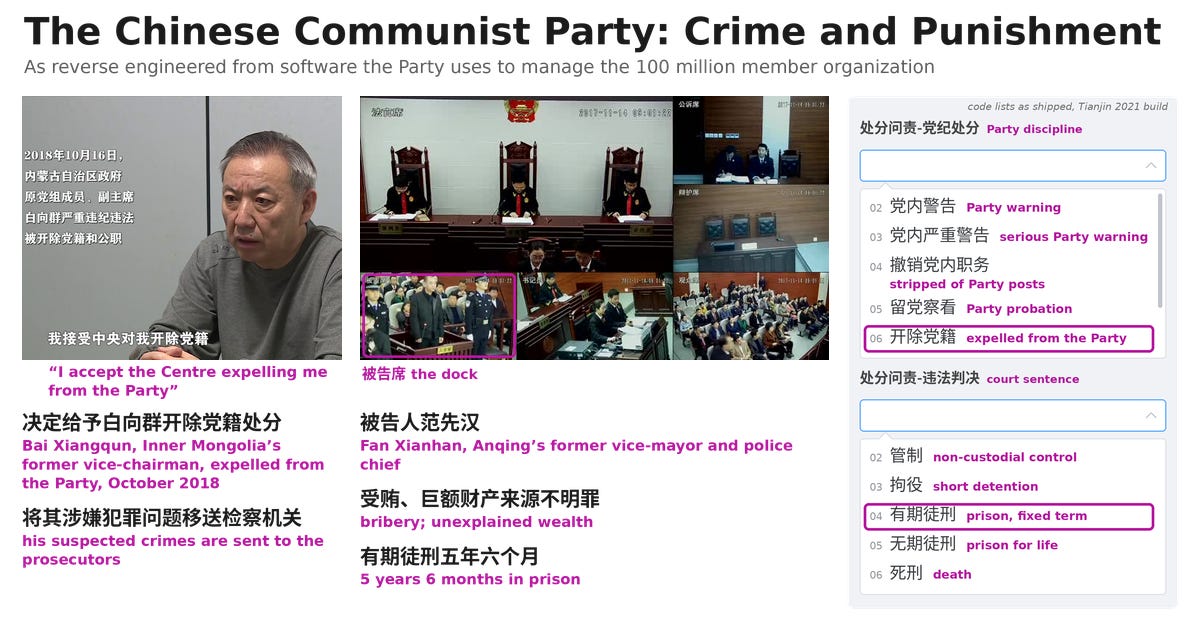
Tianjin’s HR personnel software has a drop-down choice for the Party’s sanctions of a member from warning to expulsion. It has another for the court’s sentence, from a control order to the death penalty. The two men are examples of each outcome. BAI was filmed accepting his expulsion. And FAN was sentenced for Bribery (受贿罪) and Huge property of unexplained origin (巨额财产来源不明罪).
What do you need to know about the numbers:
in 2025 the discipline commissions sanctioned 983,000 people. 727,000 of those were Party sanctions on members. That’s less than 1% of the 100 million Party members.
686,000 of the 983,000 were lower ranks (not cadres)
69 were at provincial or ministerial rank (!?!?!?)
One more surprise about how the Party really works. When the Party investigates one of its officials, they print the Party verdict first and the court verdict second. That’s been written into their rulebook since 2018. Any guess who is in charge?
Tigers and flies
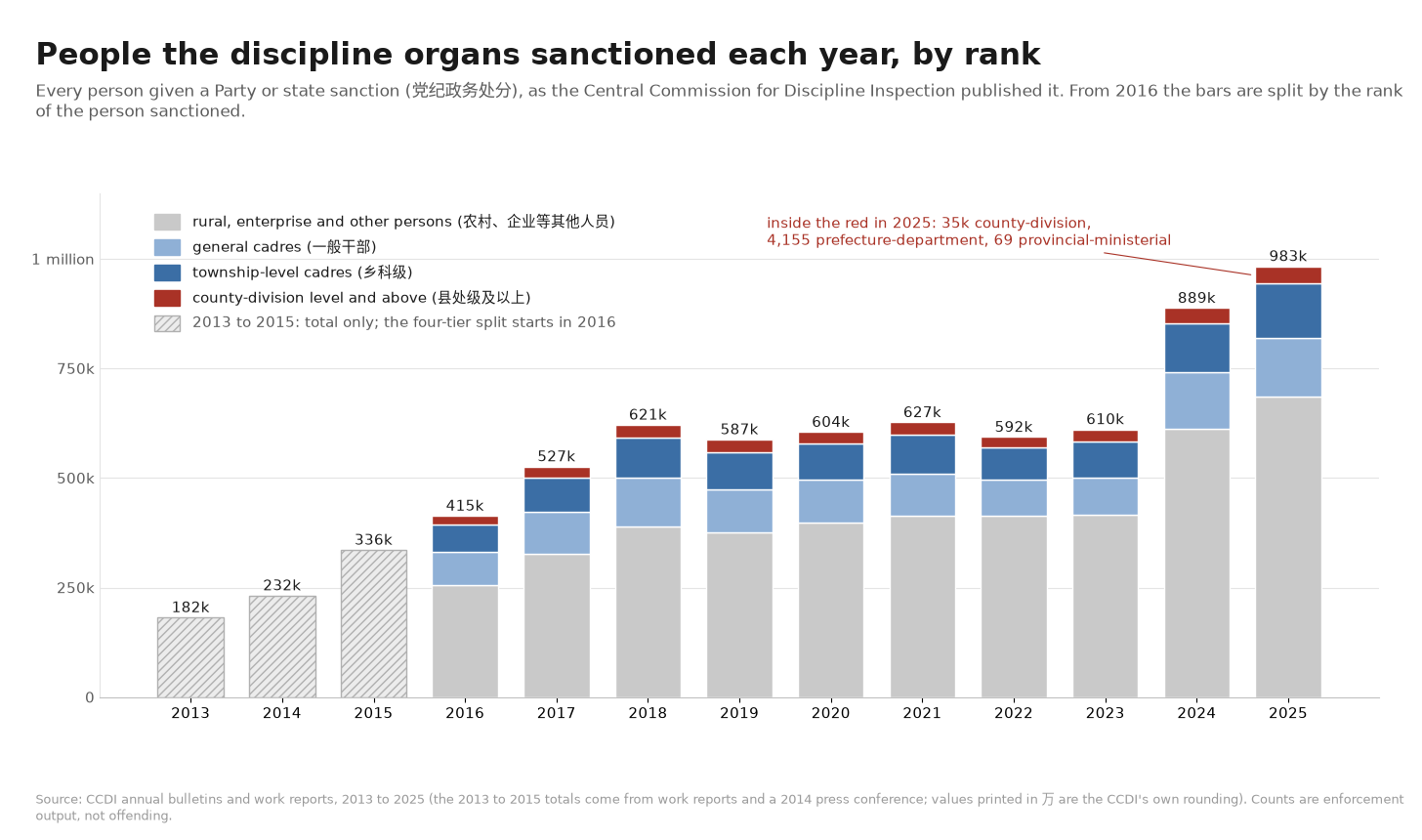
The Party publishes the actions of its discipline organization every year and look at that jump in 2024. The gray band in the graph is “rural, enterprise and other persons”. That’s the Party’s own proletariat level and it has been 60-70% of everyone sanctioned since they started breaking out the numbers in 2016. General and township-level cadres make up most of the rest. County-division level is where a Chinese official starts to matter outside his own town and they’re 4-5% of the discipline cases every year.
In 2025 the discipline organs sanctioned 69 provincial-ministerial officials and opened cases on 115. The Central Commission for Discipline Inspection (CCDI, the Party’s top discipline body) itself opened cases on 181 cadres the Party Centre manages. That is twice the year before, and the most in any year on which we have data. Those are the people whose expulsion gets a notice on the CCDI’s website and a story in the foreign press. Several hundred a year.
What the Party says they did to the Tigers
When the CCDI expels a senior official it publishes a notice that lists his charges. We have those notices for provincially managed officials, the tier a province’s Party committee appoints. One set runs from 2013 to March of 2017, and another from June 2024 to July 2026. The figure below graphs the 2024-26 punishments against the 2016-17 set, which uses the same Party offenses. Bribery was on nine in ten of the 289 notices in the 2016-17 set and is on nearly all of the recent ones. American national security practitioners will have not-so-fond memories of their polygrapher telling them that any disclosure of crimes during the polygraph may be referred to prosecutors. The Party definitely refers offenses to prosecutors.
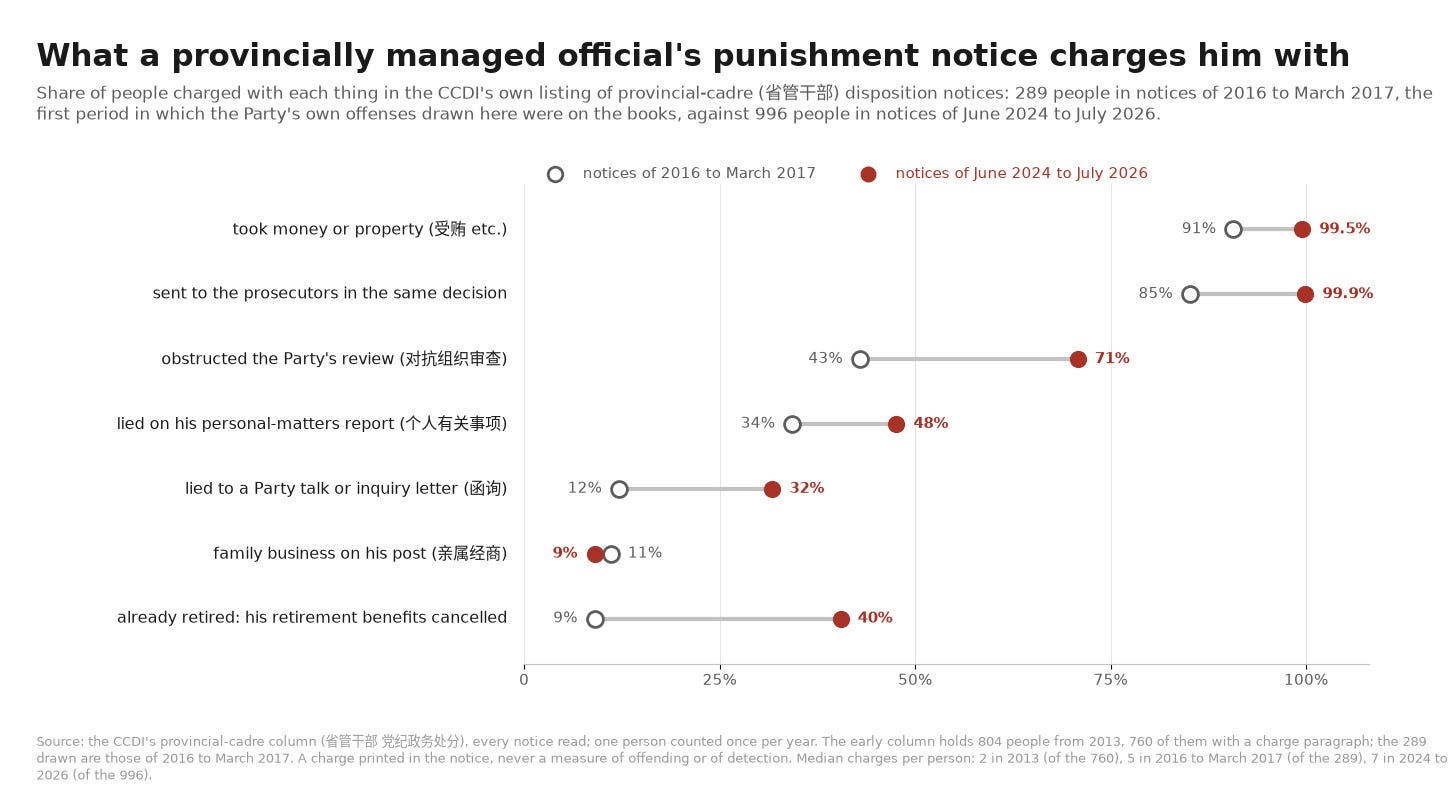
Obstructing the Party’s review is charged for 71 percent of provincially managed officials in the 2024 to 2026 notices. Lying on the personal-matters report rose from 34 to 48 percent, lying to an inquiry letter from 12 to 32. Four in ten of the recent group are retirees whose retirement benefits the notice cancels.
By 2024 a discipline notice about a provincially managed official reads like an indictment for offenses against the Party’s own process. The bribery is the predicate underneath. The state has no general crime of lying to the Party. The Party does.
The clearest view of the difference between Party Crime and State Crime is a state prosecutor’s math. Fan Xianhan was vice-mayor of Anqing, in Anhui, and chief of its police until the provincial discipline commission took him away in June 2016. At trial the prosecution added up all of the money that his household held or had spent. It was about thirteen million yuan (~$2m USD).
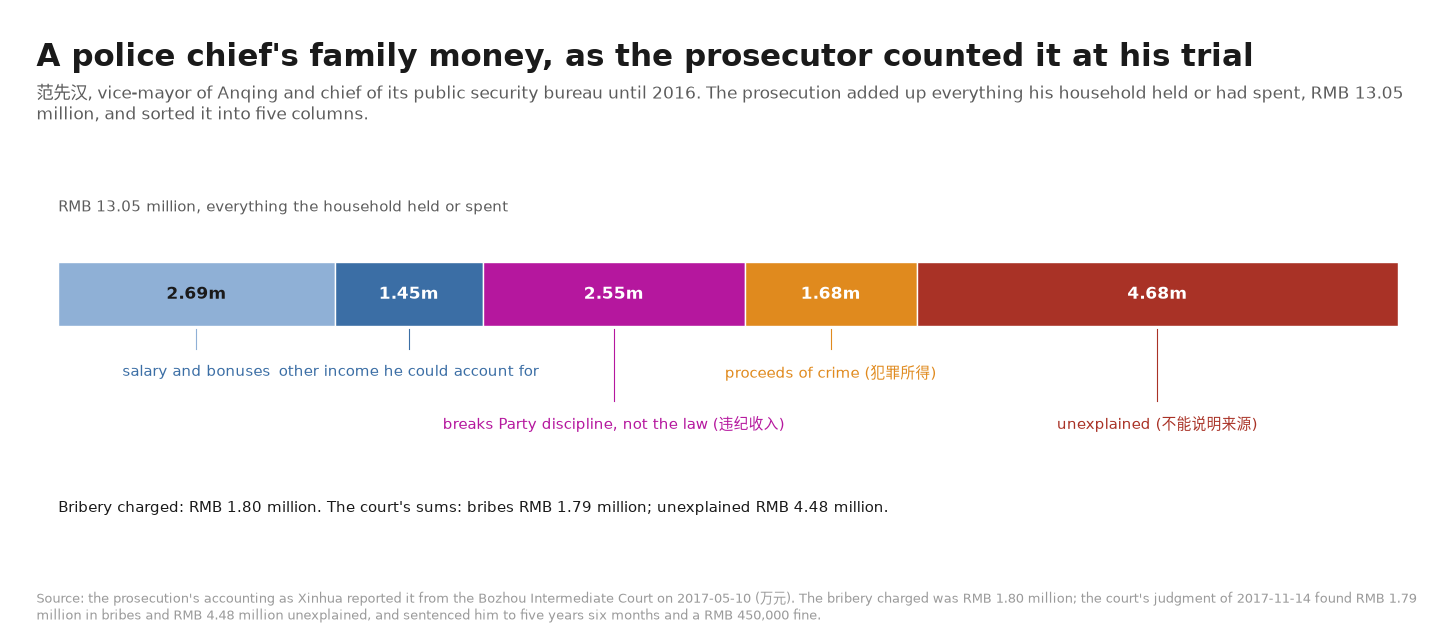
The prosecution’s accounting of a police chief’s family money, as Xinhua reported it from the Bozhou court in May 2017.
Look at the middle pink “breaks Party discipline, not the law” column. That’s RMB 2.55m that was not salary, but not a state crime. It was income that the Party’s rules forbid. The state’s prosecutor booked it under the heading 违纪收入 and left it out of the two criminal columns. The court sentenced him on the bribes and on the four and a half million he could not account for. This prosecutor, in this trial, kept a column for money that is no crime and is still punishable. This state prosecutor sorted a man’s money by the Party’s rules. The court sentenced FAN to five years and six months.
XI’s austerity code and the flies
Since 2013 the CCDI has published monthly how many people it punished under Xi Jinping’s eight-point rules of the December 2012 austerity code. Gifts and cash in envelopes, banquets, weddings and funerals done too grandly, allowances handed out against the rules, trips on public money, and until 2019 official cars. Since December 2019 the count also takes in formalism and bureaucratism. Nine in ten of those cases are at township level and below. In 2025 they numbered about a quarter as many as the 983,000 sanctioned by Party or state.
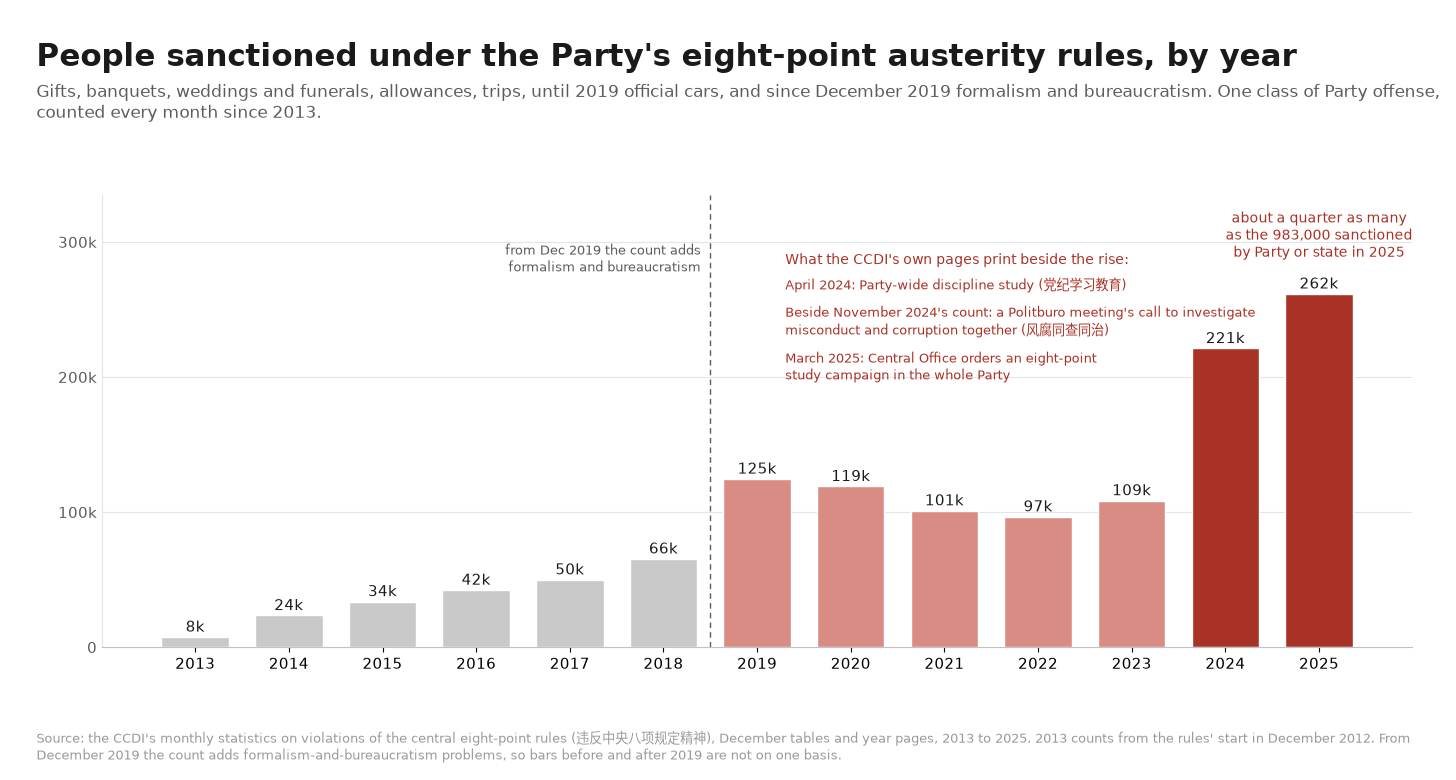
People sanctioned under the eight-point rules went from 109,000 in 2023 to 262,000 in 2025. The CCDI’s monthly pages print three things beside the rise. A Party-wide discipline study in April 2024. Beside November’s count, a Politburo meeting’s call to investigate misconduct and corruption together. In March 2025, a Central Office order for an eight-point study campaign across the whole Party.
The doubling of eight-point sanctions from 2023 to 2024 is the thing to watch. CCDI’s reporting explains it. The eight-point rules themselves did not change. The Party’s discipline regulation did: a revised edition took effect on 1 January 2024. The figure measures enforcement, not offending. The count rose when a revised regulation took effect and a study of it began in April 2024. Within the gifts, banquets, weddings and allowances class of infraction, gifts alone went from a third of the cases in 2021 to more than half in 2025.
The five Party sanctions it can use as punishments
Whatever the offense, the Party has five formal sanctions with which to punish a member. The Party constitution says it in one line: expulsion is the Party’s highest punishment.
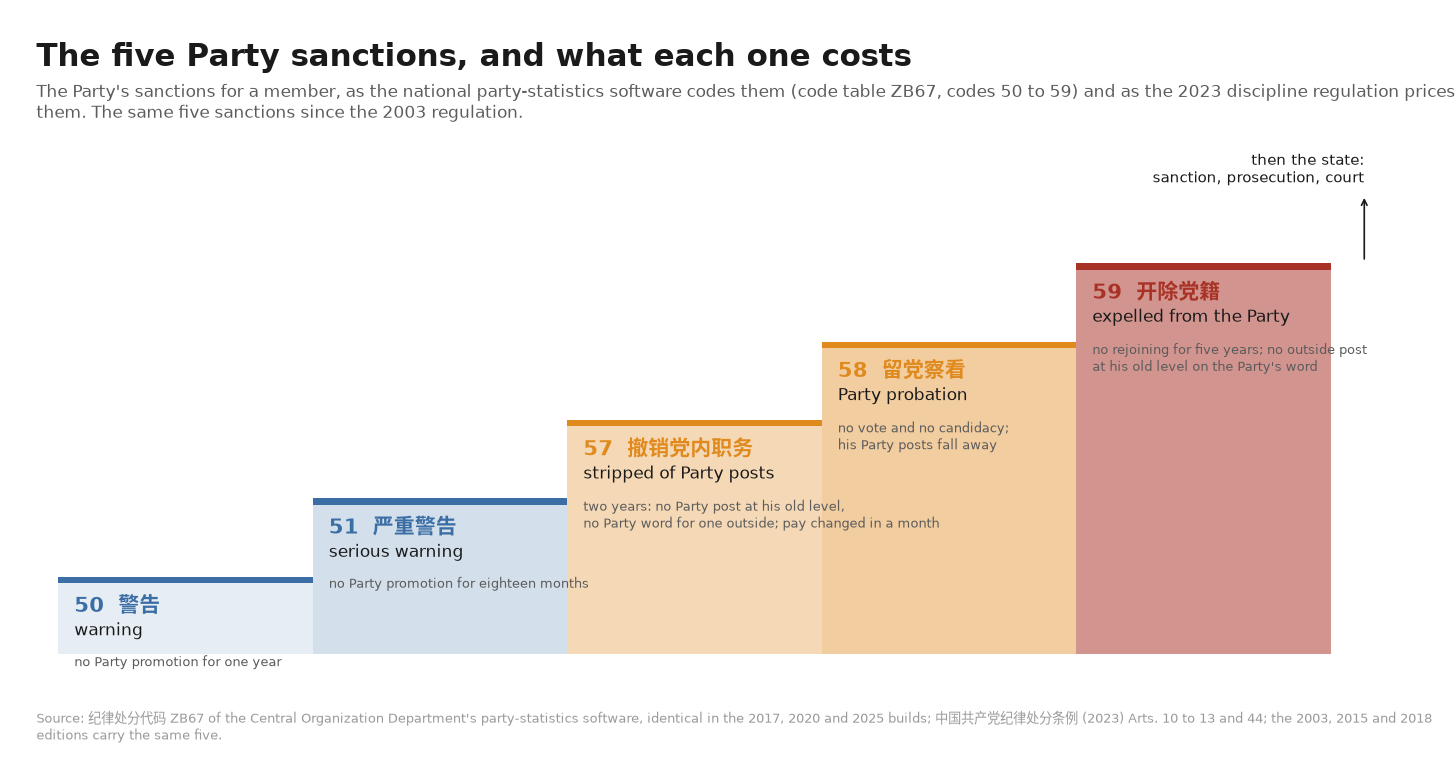
The five sanctions as the national party-statistics software codes them, priced by the 2023 discipline regulation.
Each punishment comes from the regulation and is measured in career impact. A warned official cannot be promoted inside the Party for a year. An official stripped of his Party posts cannot hold a post at his old level for two years. The Party may not recommend him for one outside either. His pay and post are adjusted within a month. An expelled one cannot rejoin the Party for five years. The regulation also closes the back door. Those responsible for letting a member under investigation resign, travel abroad or retire are themselves punished by the Party.
The higher the member, the higher the body that decides the punishment. A branch meeting sanctions an ordinary member, and an expulsion needs a county-level or higher discipline commission. A Central Committee member is ordinarily stripped of posts or expelled by two thirds of the full committee. Between plenums the Politburo decides and the plenum ratifies later. For a member who has seriously broken the criminal law, the Politburo alone decides. The CCDI can also go the other way and lighten a sanction below the range the regulation sets, in a case it decides is special. Leniency below the range is the CCDI’s.
There was something else funny that I can’t explain. The national party-statistics software has a code for each punishment: 50, 51, 57, 58, and 59. What happened to 52 through 56?
Punishments and sanctions per year
The Party appears to lump their Warnings and Serious Warnings into one for statistics purposes; and they publish how many times punishments were handed out to a person per year.
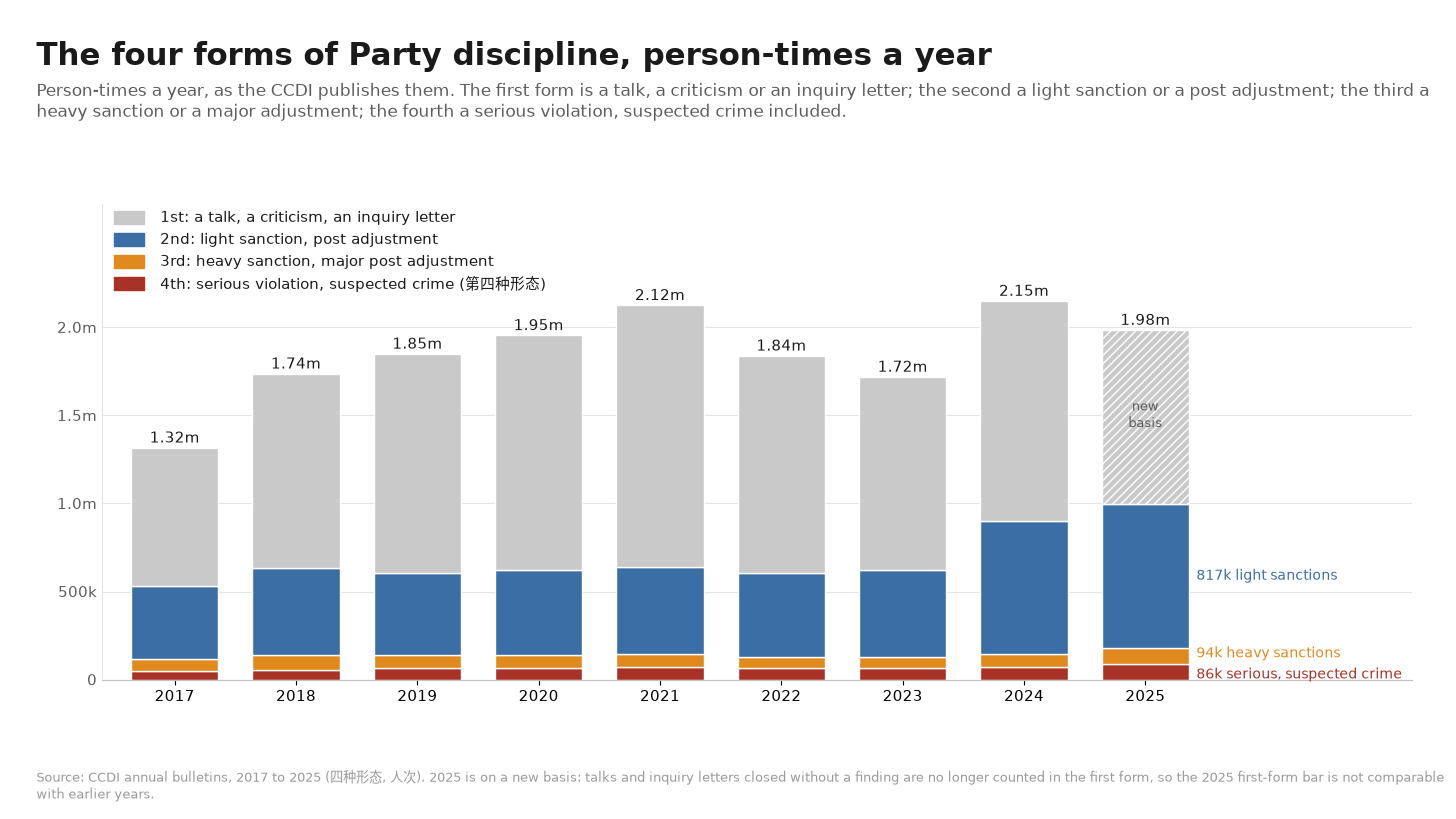
About two million punishments a year from a verbal ass chewing up through being expelled from the Party.
What I didn’t expect here is that so many of the Party expulsions were not from breaking Party rules. Their 2003 regulation says that a member convicted of an intentional [state] crime is expelled from the Party. The party-statistics software calls this class of reason conduct involving the law. It runs from embezzlement and abuse of power to drunk driving, gambling and prostitution. In 2021 the Party expelled 56,000 members after their convictions. In the same year it sent 18,000 people to prosecutors. In those years, for the ordinary member who committed an ordinary crime, the court went first and the Party followed the verdict. For the official the Party investigates itself, the Party comes first and the court follows.
The Party before the State
The 2003 discipline regulation said that a member suspected of a crime should be transferred to the judicial system. Then in 2018, it said that for a member the Party itself investigates, the Party makes its disciplinary decision first. Then the Party member is handed to the prosecutors. And that’s what the data shows. In 995 of the 996 recent notices the decision hands the man to the prosecutors as part of the Party’s discipline decision. It expels him in only 982.
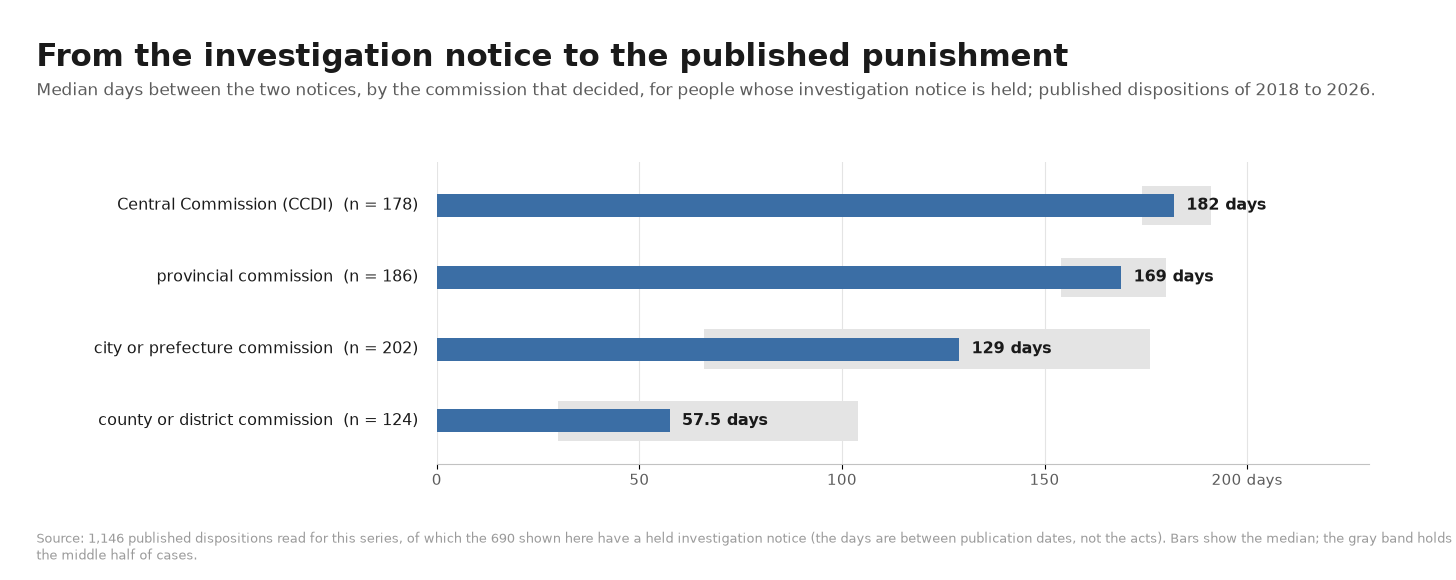
How long it takes the Party levels to investigate a case.
The 2018 Supervision Law gave the state’s supervision commissions a power called 留置, detention: three months that can be extended once with no court involvement. Look up at that graph again. See how the Central Commission’s cases take about 180 days? That’s about six months, which is the longest detention the law allows. The commissions detained 47,000 people in 2025, up from 26,000 in 2023. Another 26,000 came in and surrendered to them. The detention is the state’s and the verdict is the Party’s, and the court sees the man after both.
Once the state gets their turn at prosecution the verdict will come back to the Party. The regulation requires the Party to sanction according to the court’s verdict. An official the state has removed from office must lose at least his Party posts. That rule governs the ordinary member the court reaches first, and the few who were not already expelled by the Party.
The Party’s jurisdiction does not end at retirement. Four in ten of the provincially managed officials in the 2024 to 2026 notices were retirees. The notice that expels them also cancels their retirement benefits. A member can also keep his Party card and lose part of his pension. Four retired cadres that the Party Centre manages were put on Party probation and had their retirement benefits cut. Since 2024 the regulation prohibits a retiree from using his old office’s influence for his family. The retiree who takes a job in his old jurisdiction has been prohibited (and punished) since 2016. The next article in this series is about the exits the Party does give.
Office and wealth are two roads, and they make all the difference
The film of Bai Xiangqun runs a minute. After the acceptance, after “I got what my crimes deserve”, he turns to every cadre who will watch the Party’s film and says: 当官发财两条道, 当官就不要发财, 发财就不要当官. Office and wealth are two roads. If you hold office, do not get rich. If you get rich, do not hold office. He is reciting a line of Xi Jinping’s.