
I still use pleasantries when tasking an AI and today it’s time to visualize the science of how a simple “please” subtly alters the output tokens.
Large language models do not read text like humans. They process token sequences and repeatedly mathematically query: how much do earlier tokens matter for predicting the next one? That mechanism is attention and it’s all you need to understand pleasantries matter to an AI.
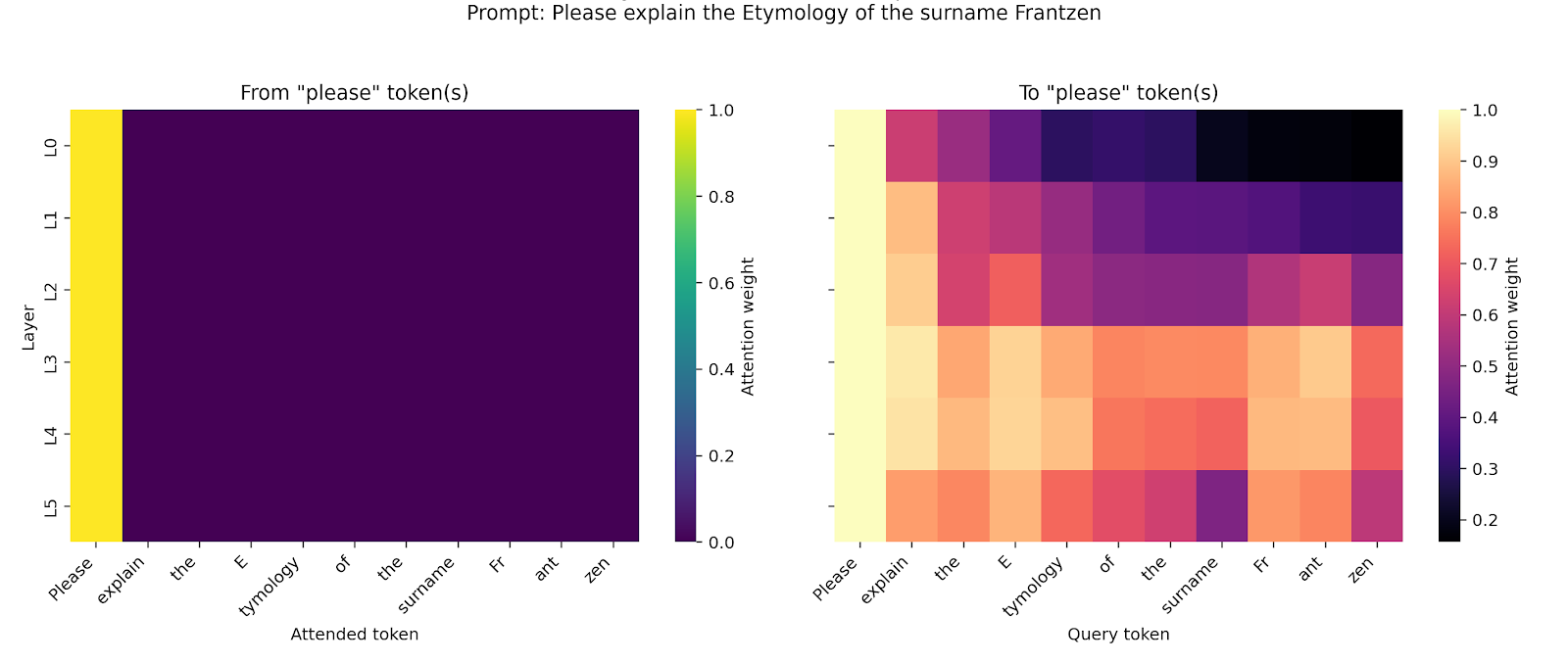
I recently visualized attention for this prompt:
Please explain the Etymology of the surname Frantzen
with a focus on the token “please”. The resulting plot gives a useful, concrete way to explain how attention works and how a polite word can shape output.
“Attention” simplified into two paragraphs
In a transformer, each token creates three vectors: query (Q), key (K), and value (V). For a given token, the model compares its query to earlier keys, turns those similarity scores into weights, and builds a weighted sum of values. That weighted sum becomes part of the token’s updated representation.
This happens in many heads and many layers, so the model can track syntax, topic, tone, and instruction structure at the same time. Watch Stanford’s CME295 youtube videos for a deeper dive than my two paragraphs.
Why the left heatmap looks “boring”
In the visualization, the left panel (“From ‘please’ token(s)”) is mostly self-attention on the first user token (because I’m ignoring the hidden system prompt for simplicity).
That is expected. In a causal language model, tokens cannot attend to future tokens. Since “Please” is the first token, its attention options are basically just itself. So from that direction, the map is simple.
This is not evidence that “please” is unimportant. It only tells us the first token has no past context to look at.
Where the influence appears: attention to “please”
The interesting signal is in the right panel (“To ‘please’ token(s)”). Later tokens often assign non-trivial attention weight to the first token across layers. You can see “please” has a higher attention weight on the “explain” and “E-tymology” tokens than the “surname” token.
That means when the model computes hidden states for words like “explain,” “etymology,” and “surname,” it is still pulling information from the “please” position. In practice, that can influence:
Tone and register: slightly more courteous, less abrupt phrasing.
Instruction framing: can nudge the model towards an ‘assistant’ framing.
Decoding trajectory: small shifts in hidden states can alter top token probabilities, which can cascade over many generated tokens.
How can one token affect many outputs?
At generation step (t), the model probabilistically predicts token (t+1) from the current hidden state. That hidden state is the result of many layers of attention and feed- forward transformations over all previous tokens. If many query positions keep attending back to “please,” its signal gets repeatedly mixed into the residual stream.
So “please” does not act like a hard rule. It acts like a soft bias that nudges probability mass toward certain continuations.
What if “please” is at the End?
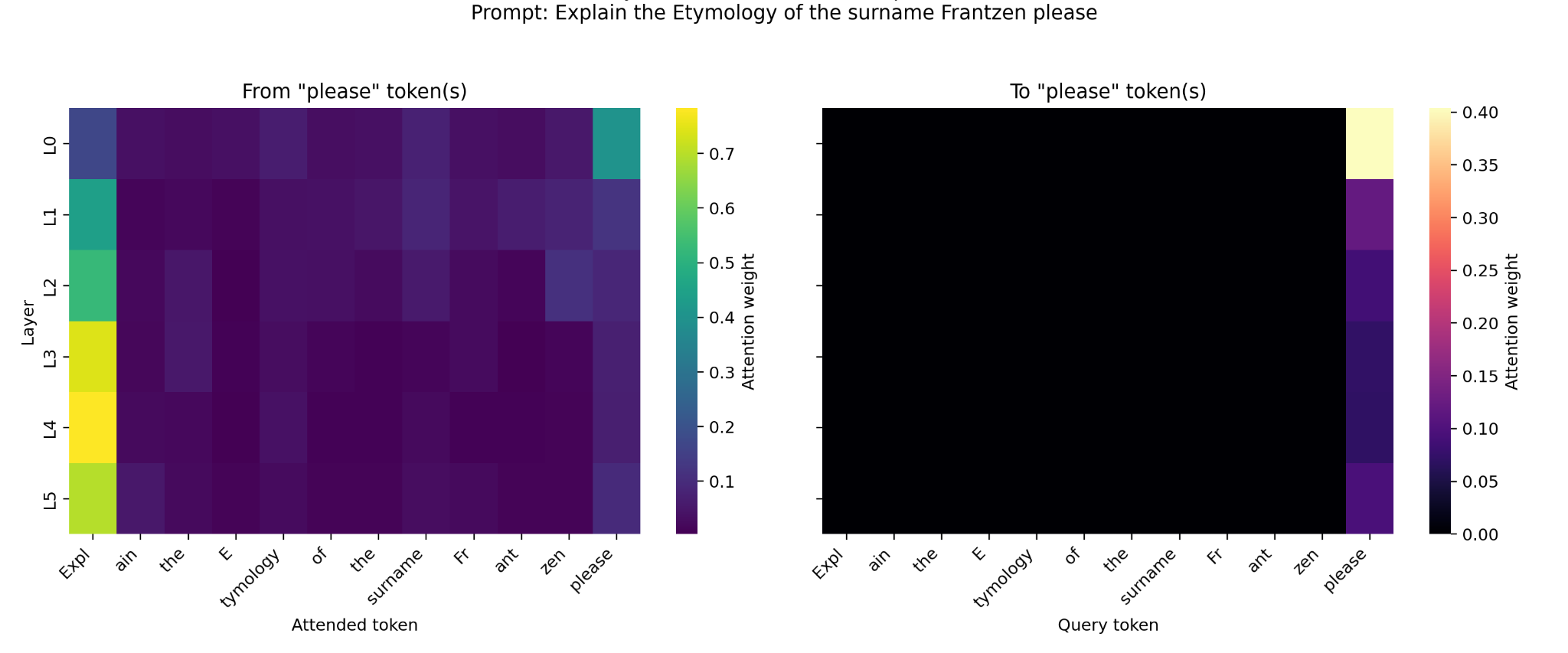
When the word “please” appears at the end of a prompt, it behaves differently than most people expect. In a causal transformer, each token can only attend to tokens that come before it. That means earlier words like “Explain,” “Etymology,” and “Frantzen” cannot use the final “please” when building their own representations. By the time the model reads that closing token, most of the prompt’s semantic structure is already set. If you look at the left pane you can see how “please” can attend to all previous tokens but places the most weight on “Expl[ain]” as the anchoring command verb.
This shifts “please” from a global framing cue into a late-stage style nudge. Instead of influencing the whole prompt interpretation, it primarily shapes the model’s final internal state just before output generation begins. In practical terms, you often see the biggest effect in the first few generated tokens: a softer opener, a more courteous transition, or slightly more deferential wording.
What usually does not change much is the core factual path of the answer. If the task is clear and specific, the model still tends to produce similar substantive content regardless of whether “please” is first or last. The difference is often in tone, pacing, and how the response is introduced, not in whether the model understands the request.
For prompting, this is a useful pattern: put “please” first when you want politeness to color the whole instruction, and put it last when you only want a light stylistic polish at response time. Same word, different position, different influence profile. I say “please” first.
Important nuance: attention is not everything you need
I’ve deliberately over-simplified this to focus on Attention in transformer LLMs. There are a lot more things which also shape output:
Attention patterns
Feed-forward layers and nonlinearities
Positional encoding
Training data statistics
Alignment and instruction tuning
Please treat the attention maps as a means of information flow, not a full causal proof by themselves.
Huh, I wonder?
One of the reasons I write up these side quests are because they help spark more “I wonder” thoughts. In this case, I wonder how pleasantries affect models’ safety alignments. Do pleasantries reduce or delay models’ safeguards?