
There is a line going around Washington that the only thing still uniting Americans is hatred of data centers. It’s funny until you think that the AI capital expenditure is currently a significant part of the American economy. I kept hearing rumors that a Chinese influence operation was behind the sentiment. So I figured I would pull on the data and see if anything fell out.
Bottom Line Up Front
The belief that China fomented the data-center hatred is real and it runs to the top. Members of Congress alleged, implied, or asked whether a foreign power is behind American data-center opposition sixteen times between 3 June and 24 July 2026, in letters, press releases, hearing statements and interviews, after seventeen months of silence on the topic. A sitting cabinet secretary told a crowd in May 2026 that the opposition is “not organic and local, some of this is foreign-sourced dark money coming in.” That’s a hair’s breadth away from being the official policy of the United States.
The Chinese influence operation is real too. The data certainly didn’t debunk it. In June 2026 OpenAI disclosed a covert influence operation against the American data-center debate, named it, published it, and banned the Chinese accounts. I’m not going to rehash what others have published. Whether the Chinese state tasked it is not established with open source data. But an operation ran. And they got caught.
The Chinese influence operation reached almost nobody. Fail. The Chinese-attributed posts that OpenAI published drew between three and twelve views each. Not three to twelve thousand. You can count them on your fingers and toes. The operation’s best recovered post showed 89,000 views with zero reposts, zero replies and zero quotes. Its payload was an accurate story from a Maryland newspaper about a real electricity auction. The Chinese influence or amplification operation failed.
What actually happened to American opinion is their power bill. PJM’s (the big east coast power grid operator) independent market monitor re-ran the 2025/26 electricity capacity auction with data-center load removed from the load forecast to see what would happen to consumers’ power bills without data centers. Their revenue fell from $14.69 billion to $5.35 billion (63.5%).
The data does not say that no foreign power amplified the data-center backlash. The US government agencies with that purview and mission have been dissolved. I’ll write more about this later. One potential measure is EU-style researcher access to social media data to crowd source detecting and responding to foreign information operations.
The research data was current as of 4 August 2026. Everything below cites its evidence.
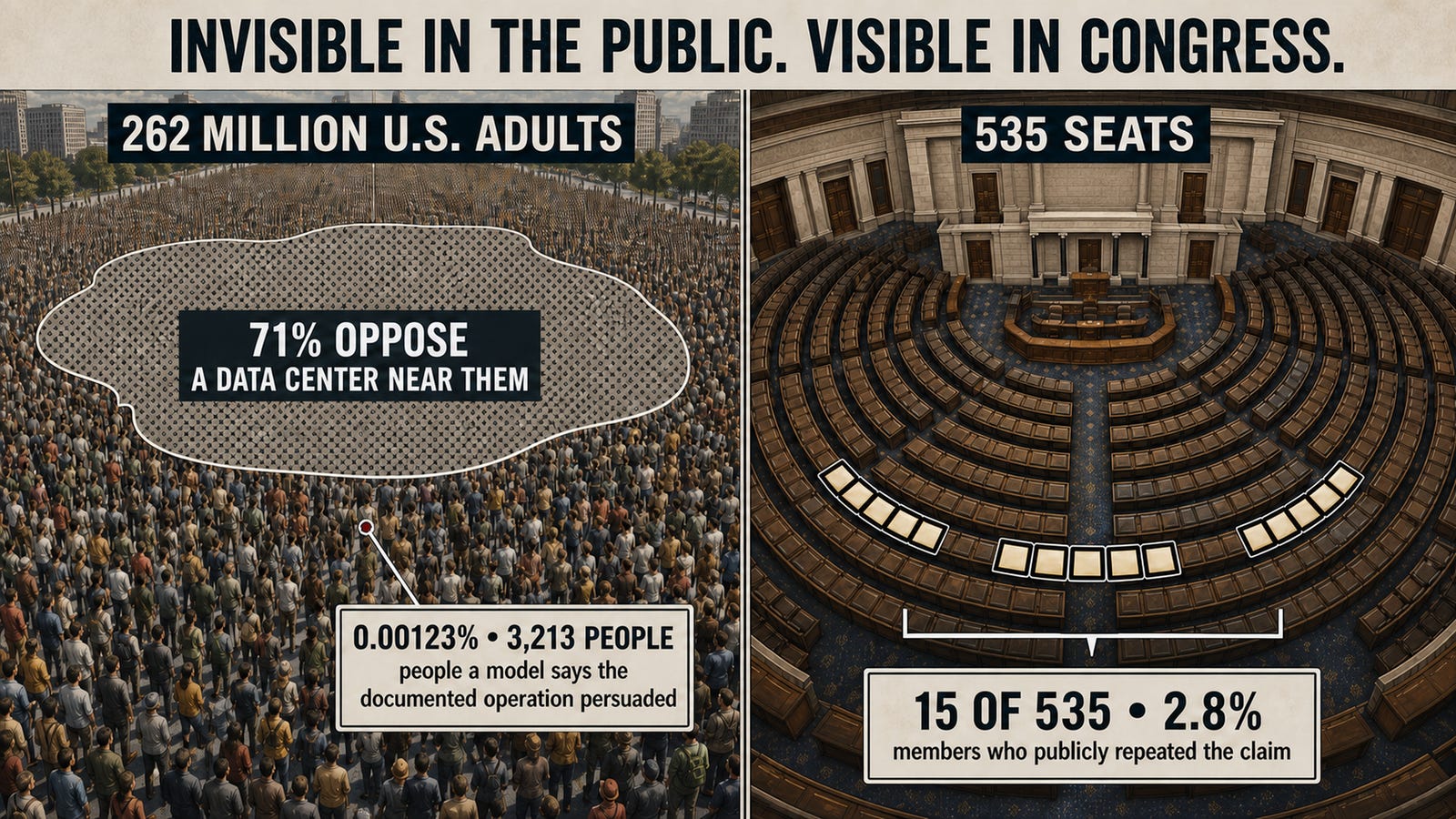
Caption: On the left, the share of Americans who oppose a data center near them, and the share the documented operation is modelled to have persuaded: 3,213 people, or 0.00123 percent of adults. On the right, the 15 members of Congress, 2.8 percent of 535, who publicly repeated the claim that a foreign power is behind the backlash. The two shares measure different things, one modelled persuasion and one public repetition, and the crowd is drawn for illustration rather than to scale.
What the influence op was and what it was not
It got caught, and OpenAI made it public. OpenAI’s 10 June 2026 disclosure named the operation under two names, banned the ChatGPT accounts behind it, and published samples; the X accounts behind it were torn down too. The last dated post is 6 January 2026, so the June action was disclosure, not the interruption of a live operation. The awkward (true) part should be said first: the influence operation was posting during the months that American search interest took off. Every Chinese post falls between October 2025 and January 2026. American search interest climbs in November 2025, one month after the Op started. The timing lines up. Now, was the Chinese influence operation coincidental or causal?
Math to check causality. Give the Chinese influence Op the benefit of every doubt: credit every one of their 119 accounts with a thousand views per day for nine months (double the known 123-day window), and assume one view in a hundred changes someone’s mind. That is about 32 million views and roughly 321,000 new anti-data center crusaders. Depending which public opinion polls you use the measured shift in American sentiment was 50 to 81 million people. If we’re generous, the known China Op influenced less than 1% of the Americans who changed their minds. There just isn’t a trail you would expect to see in a successful influence Op. Their best post wasn’t amplified by anyone, none of the posts appear anywhere in the [public] citations that reached Congress, and the content the Chinese posts pushed was already circulating American journalism.
Caveat lector: I am checking what has been made public about the Chinese influence operation. The US Government agencies normally chartered with publishing more information have been dismantled. And EU-style researcher access to social media platforms is not available to crowdsource a societal immune system.
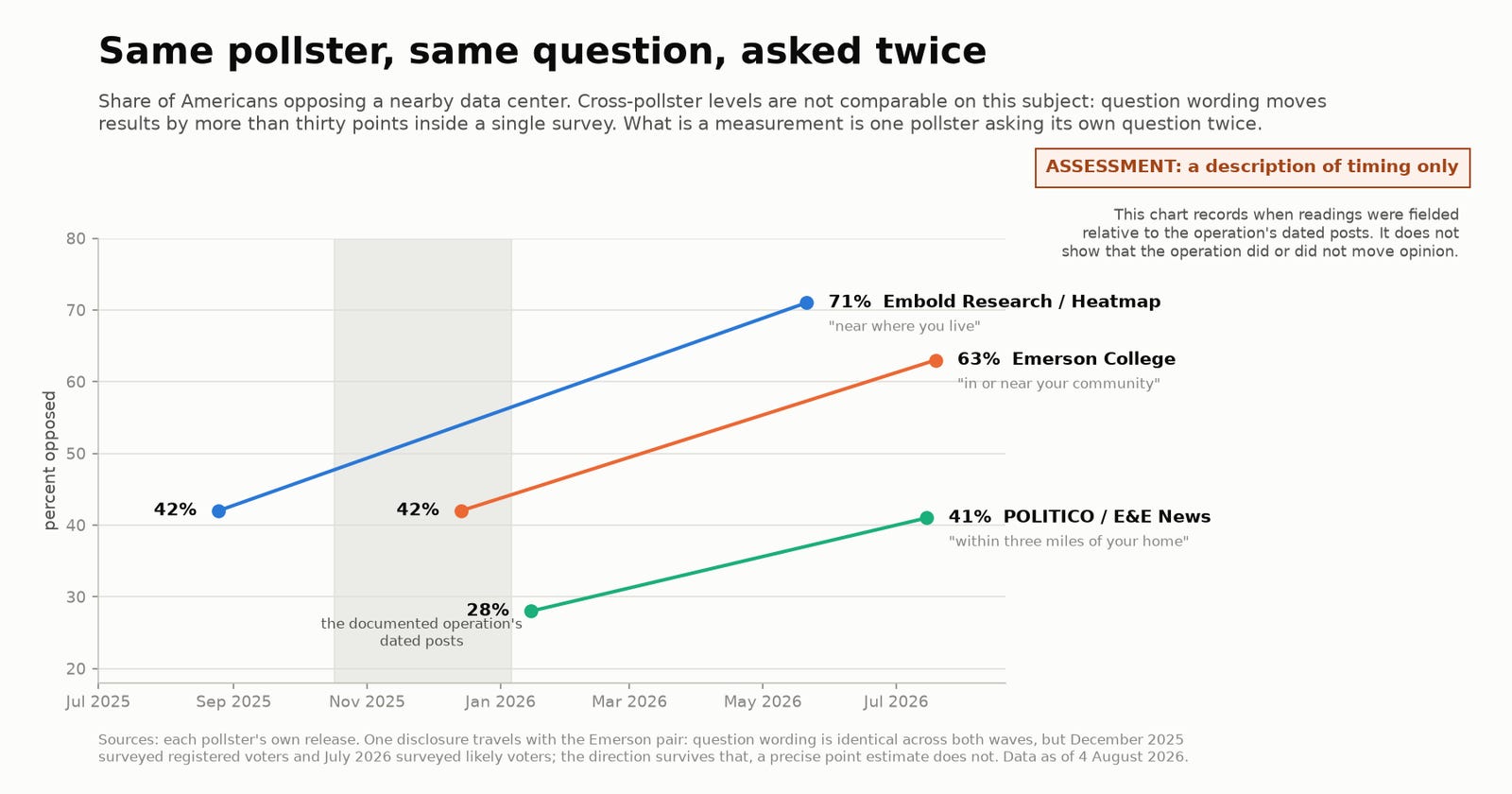
Caption: Each line is one pollster asking its own question twice; the shaded band is when the operation’s dated posts ran, and the chart describes timing only. The American popular sentiment really did change.
The grievance of the power bill
Power is genuinely really expensive now. PJM operates the grid across thirteen states and the District of Columbia. They’re the largest American grid. Its capacity auction cleared at $28.92 per megawatt-day for the 2024/25 delivery year and $329.17 for 2026/27. That’s a roughly 11x increase in two years, and it has held around that price for three consecutive auctions. The average US residential electricity price is up 46 percent since January 2021. At least 176 local siting fights are documented since late 2022, in 35 states. Things have changed.
An independent measurement of the data-center share. Monitoring Analytics is PJM’s independent market monitor (they police the market). It re-ran the 2025/26 auction with data-center load removed from the peak load forecast and they held everything else the same. Auction revenue comes out 63.5 percent lower. Its stated conclusion goes further than mine: data-center load growth is “the primary reason” for recent capacity market conditions, including the high prices. So sayeth the market’s own referee. Capacity is one line item on a bill that averages about $1,806 a year nationally. That line item runs about $211 a year for a PJM household, and in the monitor’s re-run it comes out about $133 lower.
Count the official foreign government channels. The press coverage has leaned on a vendor’s count of roughly 700 data-center mentions across Chinese, Russian and Iranian official state media in the first half of 2026. If I reproduce the method in the same time window I find 1,391 pieces that mention a data center. Of those, 418 have data centers as their subject, 108 of those mention the United States, and 25 are specifically critical of the American data center buildout. The official Chinese publications have 216 pieces that promote China’s own buildout vs. 12 against the American buildout. No country’s official publications reached more people than usual based on the counters their platforms exported: the flagship Russian Telegram channel’s data-center posts didn’t have more readers, the two big Chinese news portals drew almost no comments, and the Chinese state YouTube videos on the American buildout draw a median of 643 views. If a foreign influence operation falls in the forest, and no one is around to hear it, does it make a sound?
The timeline
I’m not seeing the effects I would expect from a successful foreign influence operation. So let’s pivot to trying to understand when things happened.
The first letter came before the evidence. The first congressional letter alleging foreign involvement is dated June 4, 2026. The first public evidence was published by OpenAI on June 10th. The letter asking the Justice Department to open an investigation is dated that same June 10th. It cites: an article by a Bitcoin policy think tank and a New York Times story from 2023. The reporters who covered these letters printed the caveat that there was no direct evidence. The letters did not.
The evidence arrived but the claims did not change. That is the test worth applying to any belief: when the facts finally show up, does what people say change? Forensic evidence of the Chinese influence operation existed on 10 June. Eight of the twelve distinct allegation events came afterwards, and six of those eight do not cite OpenAI’s analysis. Across all sixteen instances the record holds 43 citations. Ten cite a domestic advocacy report, and another ten do not cite anything. One member pointed to a classified briefing, which nobody outside a secure room can inspect. The chairman of the House’s China committee wrote on the day the forensics appeared, cited them, quoted their finding of no authentic engagement, and declined to say the movement was manufactured. That is what contact with the evidence looked like: a narrower claim than the one everyone else was making. The rest said the same thing after the evidence that they had said before it. A belief that does not move when the evidence lands is really about something else.
The parties agree. A Senate investigations subcommittee inquiry into data-center costs and grid strain that runs about 200 pages of letters containing zero occurrences of “foreign,” “China” or “influence campaign.” The allegation was also contested on the spot, in the same committee markup that carried its strongest assertion: the panel’s ranking member said of the towns in his own district that had rejected or paused data centers, “They are not being influenced by China and Russia... This is coming from the people themselves... This is not Beijing.” And the polling above says the grievance itself belongs to both parties.
Nothing here is unusual. A second advocacy push ran the same month from data-center industry trade groups by press accounts at the time. Secondhand sourcing dressed as independent corroboration is ordinary practice in this town. I keep running into a building echo effect between the policy community and the press that I need to figure out how to measure; or a control case so I can measure the contrast. Until then, what I can show is what this particular flow of Chinese influence operations against American data center claims rested on and what happened to it in transit: the confidence rose at every hop and the caveats fell off. That’s Washington. It’s effectively a domestic influence operation.
The most prominent public version was withdrawn on air. Beginning on May 11th, 2026, a developer asserted that opponents of his Utah project had ties to the Chinese government. He is being sued, and the court complaint counts at least ten media appearances. On June 25th he posted that he had no evidence for it, and he said it on three platforms at once. On June 26th Fox stated on air that it is “aware of no evidence” and that “Fox News Media apologizes for the error.” That is where the strongest public version of this belief currently stands: retracted by its speaker, apologized for by its broadcaster, and in litigation.
The other half of the problem
First, between January 2025 and March 2026 the United States shut down or let go dark five of the organizations whose job it was to detect, prove, and mitigate an operation like this one: the FBI’s Foreign Influence Task Force, CISA’s disinformation teams, the State Department’s Global Engagement Center, ODNI’s Foreign Malign Influence Center, and the China malign-influence section of the Annual Threat Assessment itself. There could be evidence that would fully support the claims that foreign governments are behind the data-center discontent.
Second, the crowd sourced analysis cannot see this content. I ran my own template-reuse detector against the recovered Chinese operation’s posts. It matched none of them: zero of 91 pairs cleared my bar. That is a measured power result on ground truth, and it generalizes: coordination detectors built for the copy-paste era cannot see machine-written text. My blind instrument is everyone’s blind instrument. I need a lot more data and would need to build an LLM-based detector. That’s something we’re better off tasking a government agency to do (or outsource) using classified tippers about the influence operations’ content to provide a lot more ground truth training data.
Third, without being able to issue NSLs I could not measure the surfaces that matter. I could not see X, where 54 of the operation’s 62 artifacts lived. I could not see TikTok. I could go on. And the public record now holds two statements that cannot be reconciled from outside: on 20 July 2026 a member told a committee markup to “go to a SCIF, get a classified briefing on this. It is very eye-opening.” So we have a strong indication that there are things worth measuring, there are no longer government organizations chartered with it, and the platforms do not support crowd-sourced evidence collection. The EU is attempting to fix this at least with X and researcher access; time will tell if it works.
Best Arguments Against This
An influence operation designed to stay hidden would not be in my evidence if I don’t have bulk access to the social media platforms. Let’s be even more uncharitable. I measured the Chinese influence operation that got caught and detection selects for incompetence. I agree. A hidden amplifier of a real grievance is a live possibility. The data shows the grievance was not manufactured by a foreign influence operation.
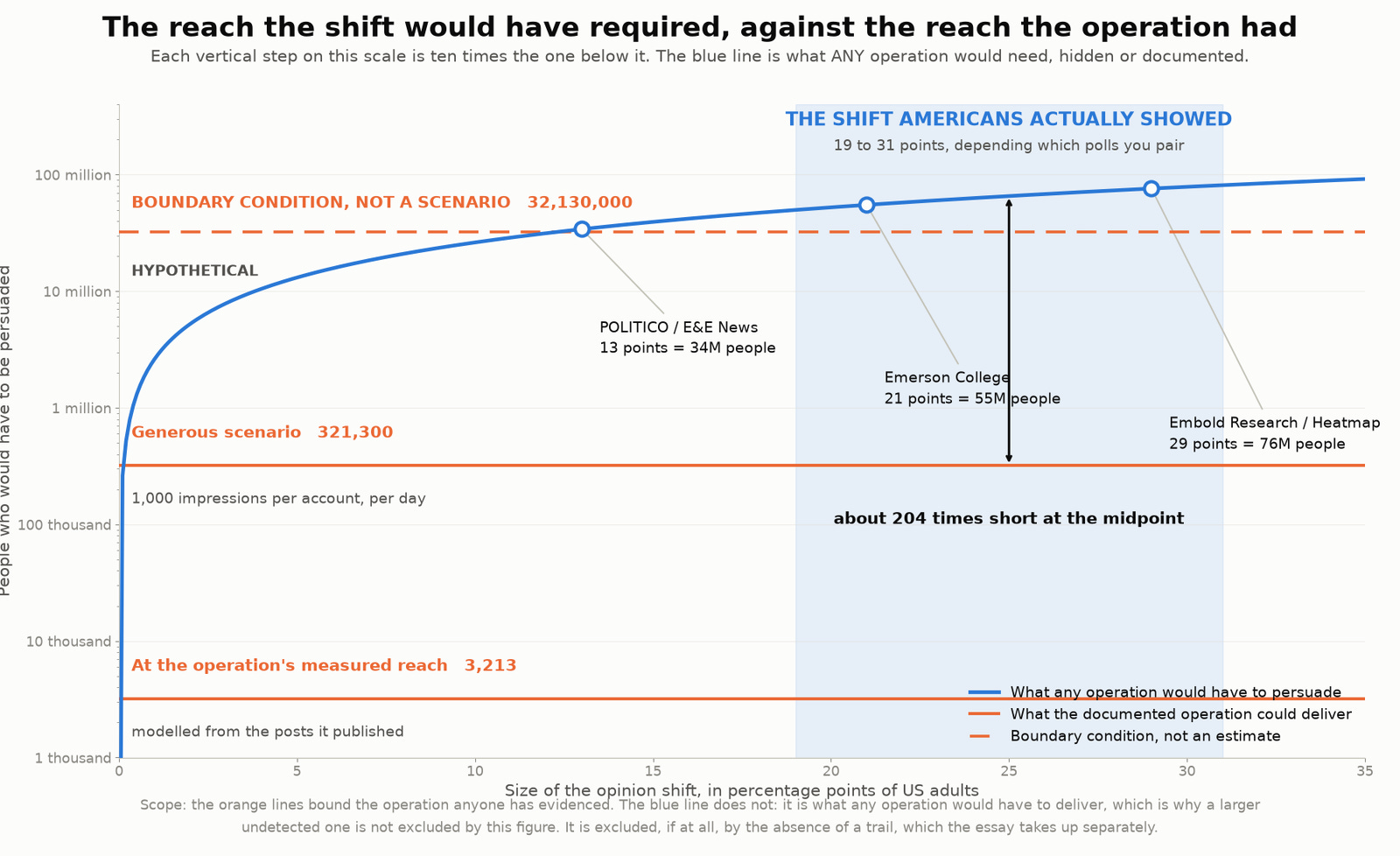
Caption: The blue curve is what any operation would have to persuade, hidden or documented, for a shift of a given size. The orange lines are what the one that got caught could deliver: 3,213 people at its measured reach, 321,300 crediting every account with a thousand impressions a day for nine months. The dashed line is a boundary condition rather than an estimate, and it holds only if every account reached a major news site’s daily audience every day for nine months. Note what this figure does not do: the blue curve is indifferent to who is doing the persuading, so a larger undetected operation is not ruled out here. It is ruled out, if at all, by the missing trail.
What would change my conclusions, dated and checkable:
X Corp’s records on the suspended accounts. If they show a network orders of magnitude beyond the 119-account estimate published in June 2026, or organic provenance and onward transmission behind the 89,000-view post, the arithmetic recomputation will be large.
Meta’s records on the state-themed page network. If an operator or client bought reach for the on-topic pages at material US volume, the unmeasured band closes in the direction that I could not close.
OpenAI’s account count and selection criteria. If the fifteen published posts are the low tail rather than typical, the reach figures here are going to be way off.
A (declassified) intelligence product. If the classified briefing invoked on 20 July 2026 contains an attribution with measured reach then this piece is overtaken. Just because China ran a foreign influence operation does not mean they caused the public discontent. The reach I measured was miniscule.
The shape of the thing
Hold three facts at once and the story tells itself:
A real American grievance about electricity costs and polling as a majority in both parties.
A real foreign influence operation, caught, published, and measured as completely ineffective.
And between them a belief that travelled from a news article, to an advocacy report, to official Government statements in weeks. It gained authority at every hop, and it shed the caveats that every reporter who covered it kept.
A former ODNI official who tracked foreign influence efforts described this in one sentence to the New York Times in July: foreign actors “aren’t manufacturing American debates over the future of A.I., they are exploiting them.” Exploiting and amplifying a debate is the effective influence playbook. The data shows the growth in that sentiment was orders of magnitude larger than the foreign amplification anyone has documented.