
I will be honest: I miss Fable.
Not because I need another AI model to feed my agents. I miss it because there is a specific kind of innovative tasking where the frontier model matters. You have an “I wonder if” hypothesis. You ask the model to help you build the code, analyze the data, test the bounds, and characterize the result. If the thing you are discovering was not already publicly known in the model’s training data, weaker models keep trying to pull you back toward what they already know. The best models do not just answer. They help you hold onto the new thing long enough to prove it.
That is the productivity gain people miss when they talk about frontier AI as if it is just a better chat box.
So I wondered what the cost is of delaying the next frontier-model generation in the United States.
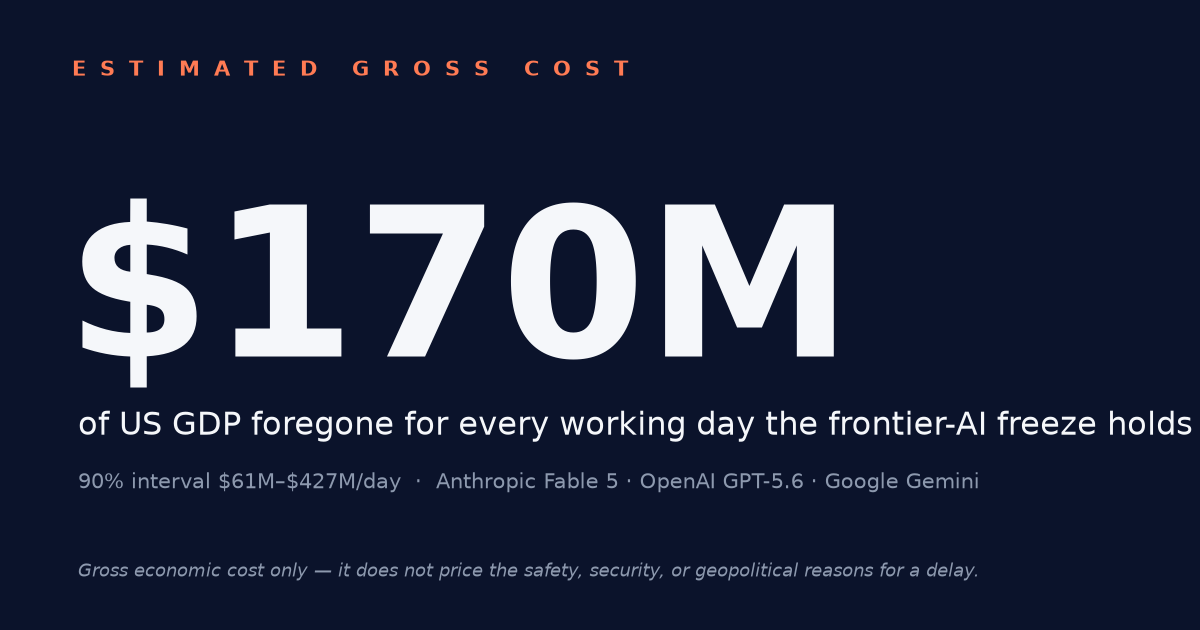
The answer: about $170 million in gross US GDP per working day. That’s about $43 billion per year at today’s adoption in a $31.9 trillion US GDP. That’s only 0.13% of GDP if delayed a full year.
This is not a net-welfare claim. I am not pricing national security, safety, adversary access, diplomatic leverage, or the political value of slowing a technology that scares Washington. This is one side of the ledger: the economic output the country gives up when it holds back the next frontier generation.
The public story is not the operative story
If you read the press straight, you will get the wrong model.
The press story will always be professionally spun. Companies preserve optionality. Public companies and pre-IPO companies avoid saying they are in a political fight with the US government because share prices and offering windows are real constraints. The legal theory is not the relevant. The point is leverage.
When the government signals that broad rollout of a frontier model will create a conflict, the lab does not need to receive a clean, durable, court-tested order before it pauses. Boards understand the risk. Investors understand the risk. A CEO who wants an IPO, a stable market cap, government contracts, and regulatory goodwill understands the risk.
That is the mechanism I model here.
Anthropic, OpenAI, and Google are all operating under the same political constraint: Washington currently wants control over the release of frontier models. The public explanations differ. Export control, limited preview, commercial delay, safety review, customer-by-customer access. Those are the surface forms. The economic effect is the same: the US economy keeps using the current generation while the next generation is withheld from broad productive use.
That delay has a meter running.
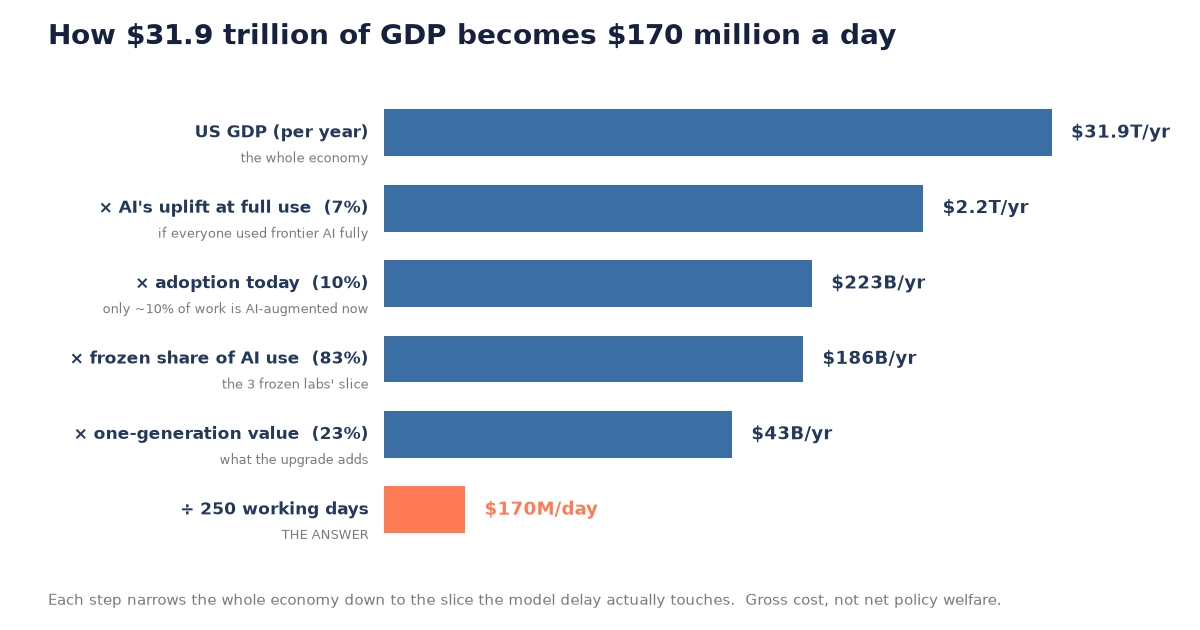
How $31.9 trillion becomes $170 million a day
The model is deliberately simple:
Daily cost = GDP x AI productivity uplift x adoption today x restricted frontier share
             x one-generation gain / working days
Start with US gross domestic product: about $31.9 trillion annualized.
Then ask how much frontier AI could add at full adoption. The literature is all over the place. A skeptical read is low-single-digit GDP impact. Goldman/McKinsey/Merali-style central estimates land around 7%. More aggressive views go higher. I use 7% central, with a wide band.
Then apply today’s adoption. Not everyone uses AI all day. A lot of workers never touch it. A lot of companies have “AI adoption” that doesn’t go further than a powerpoint deck. I use 10% effective labor augmentation today, with sensitivity from 6% to 20%.
Then apply the restricted frontier share. In the central case, Anthropic, OpenAI, and Google account for about 83% restricted-weighted frontier use after accounting for OpenAI’s current limited preview.
Then apply the value of one model generation. The clean Anthropic Fable benchmark delta is about +12% on the strict within-harness coding comparisons. The central transfer method maps that to about a 23% increase in the value of the AI-using slice, not a 23% productivity gain for the whole workforce.
Divide by 250 working days.
That gets you to $170 million per working day.
The important thing is not false precision. The important thing is scale.
Even if you reject the central capability-to-productivity bridge and use the conservative benchmark-proportional method, the all-three estimate is about $89 million per working day. If you only count the measured Anthropic case and ignore OpenAI and Google, it is still about $62 million per working day.
That is the floor I would want a policy team to look at before pretending delay is free.
The uncertainty is not where people think it is
The easiest critique is to argue about benchmarks. That is not where the model mostly lives or dies.
I re-audited the benchmark data and used a strict subset for the headline capability delta: SWE-bench Pro and SWE-bench Verified. That gives a clean +11.5% Fable-over-Opus gain, which supports the rounded +12% input. Other benchmark sets move around, and some are noisy, but the central result is not driven by cherry-picking a leaderboard.
The real uncertainty is macro:
How much productivity frontier AI ultimately adds at full adoption.
How much of the economy is actually using it today.
Those two numbers dominate the sensitivity analysis.
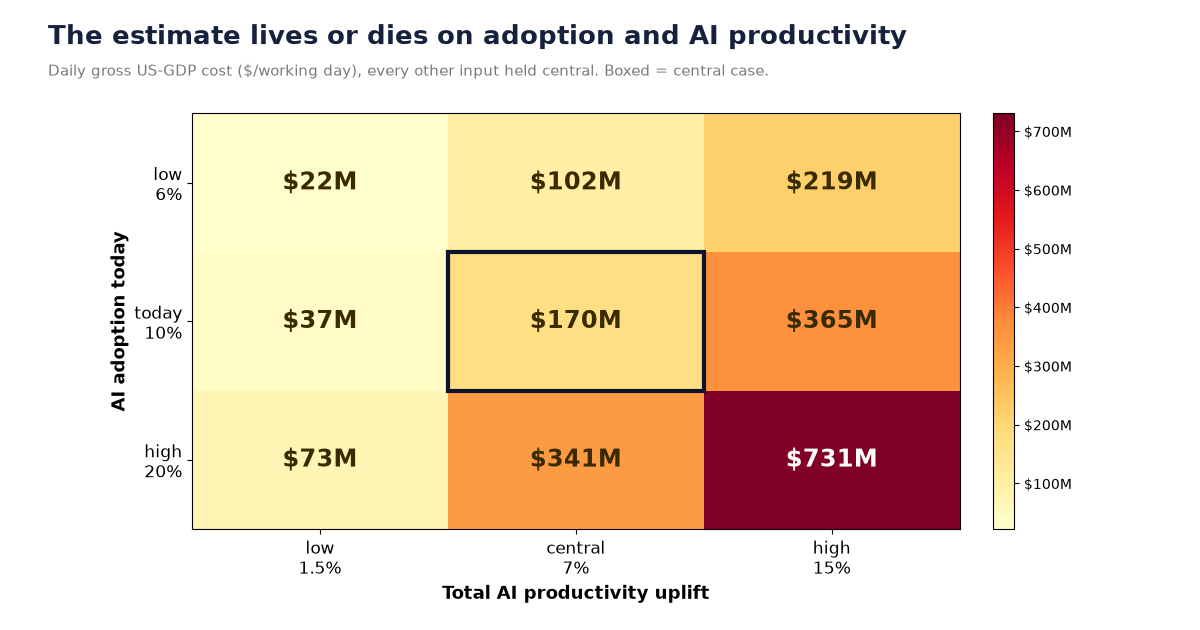
If today’s AI adoption is only the St. Louis Fed’s hours-share floor, the estimate falls. If adoption is closer to worker breadth with meaningful intensity, it rises. If AI’s full-adoption GDP impact is Acemoglu-low, the number is smaller. If the Goldman/McKinsey/IMF-style estimates are closer, the number gets large quickly.
But across the plausible range, the daily cost is not zero. It is tens to hundreds of millions of dollars per working day. You’re welcome to pick the assumptions you believe, and pick one of the nine boxes above to get the GDP cost which fits your personal mental baseline.
What I would tell the government
If you are going to control frontier model rollout, price the control honestly.
Maybe you think the safety case is worth it. Maybe you think the national-security case is worth it. Maybe you think the United States should slow the commercial frontier until the government has a better grip on evaluation, exportability, cyber risk, bio risk, or strategic alignment with allies.
Fine. Make that argument. But do not make it while implicitly assuming there is no economic cost.
The current generation of models is not a static consumer product. It is an input into software development, research, analysis, operations, finance, engineering, security, medicine, law, and management. A better model does not merely answer faster. It expands the set of tasks where a person can successfully delegate part of the work. It changes how many tasks someone can run in a day. It changes how quickly a small team can test an idea. It changes the throughput of knowledge work.
Holding back a generation means the country runs those workflows on worse tools.
That is a GDP cost.
And because adoption is rising, the daily cost rises too. If the freeze persists for months, the linear bill is already large. If the US keeps missing successive frontier generations while other paths advance, the compounding scenario becomes ugly fast.
I am not saying every model should be released the moment a lab wants to release it. I am saying the policy conversation should make sure the ledger shows a net gain to the country. My central estimate is that delaying Frontier AI rollout costs the US GDP $170 million per working day of delay. The benefit of delays should outweigh the cost of delay.
making order of magnitude estimates to justify going faster to a time/place we don’t know is better or worse
are we lost? idk but go faster
reminds me of the parable of the Chinese farmer