
We took apart twenty-one of the personnel programs the Chinese Communist Party (CCP) and the Chinese state run (fifty packages, nine vendors, 2004 to 2026, including 144 databases, and their documentation). This is one of eight articles on how the CCP and the Chinese state are actually organized, extracted from their own enterprise software systems.
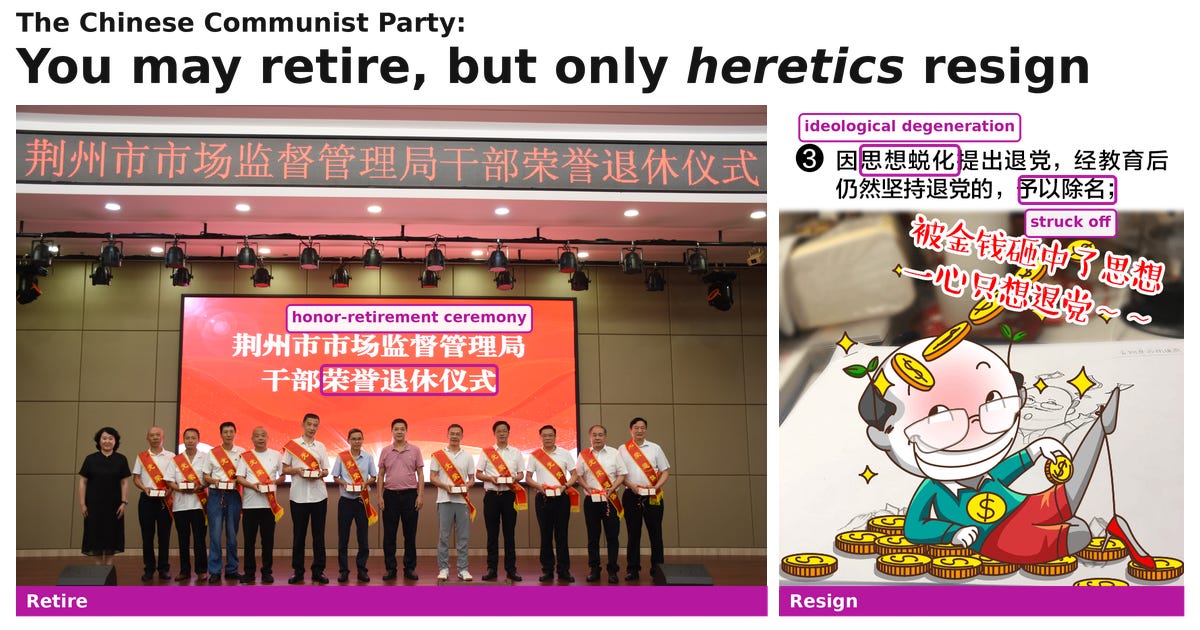
Two pictures the Party-state took of itself: Jingzhou’s market regulator sending off eleven retiring officials, and the Central Commission for Discipline Inspection (CCDI) caricaturing the Party member who asks to resign as a man hit on the head by money.
Get your Hotel California jokes ready so we can talk about how people leave the Chinese Communist Party.
Let’s start with the left side of the picture above. In September 2023 the market regulator of Jingzhou, a city on the Yangtze River, celebrated the retirement of eleven cadre officials on stage, each in a red sash that says 光荣退休 (retired with honor). They were leaving their jobs, not the Party.
The Chinese Communist Party has about a hundred million members and their HR system has no way to honorably resign Party membership. A member may retire from their post, with a ceremony the organization pays for, a certificate, and sometimes a sash and a medal. Then their Party membership takes them to a Party branch of retirees still subject to Party discipline. Some retake the Party oath at the ceremony. The one way they can hand that membership back is to ask, be re-educated, and then be struck off the rolls.
So you think they can just ask to leave the Party. Since 2019, the Party’s central regulation gives only one reason a member can ask to leave the Party: their thinking has degenerated (思想蜕化). Since 2024, the Party’s HR software counts them as unfit members who were disposed of. Choosing to leave the Party is itself a heresy.
I want a red sash too
To summarize the 270 retirement ceremonies we analyzed: the leader speaks, the retirees speak, a certificate and a gift are handed over, sometimes flowers, then the group photograph. Some screen a film of the retirees’ careers. Some pin sashes. Some have the retirees stand and retake the oath. Other than the sash and retaking the oath this could be just about any retirement ceremony. Although... on my last day on the job after selling a company, I did have to read aloud the national security debrief non-disclosure oath. I didn’t get a sash though. I want a sash now.
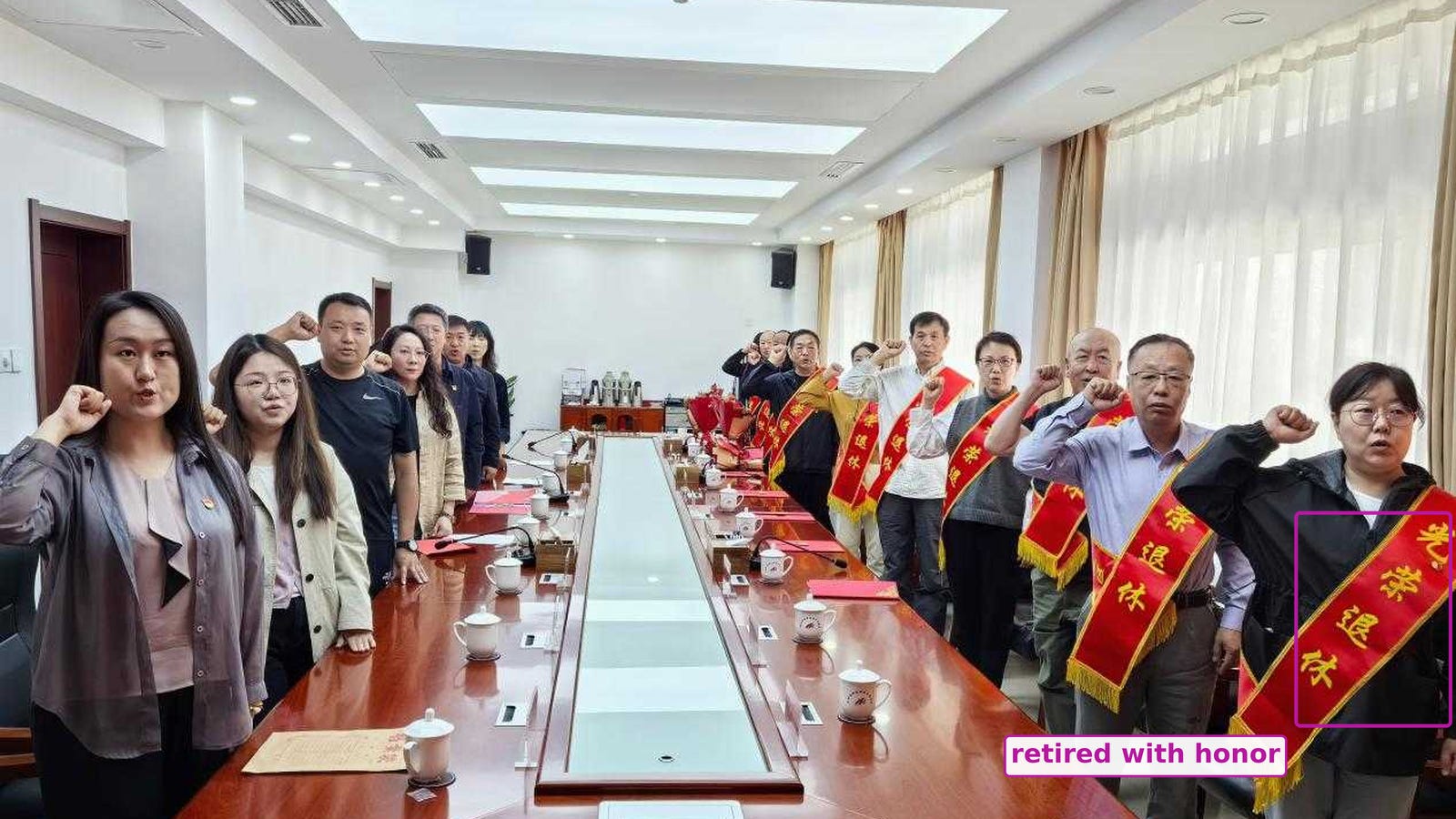
Eighteen Hohhot retirees retake the Party oath at the honor-retirement ceremony that their development zone’s Party and mass-work department held for them. The page says the ceremony also handed the retirees commemorative retirement certificates and flowers.
The Party pays for it. A Beijing district’s Party Organization Department budgeted about ninety thousand yuan in 2024 for 182 plaques and medals reading 光荣退休. That was one for every senior cadre who had retired since the district’s 2021 leadership turnover. Nantong put its 2026 ceremony for city-managed cadres out to sole-source procurement. It’s systemic because the Central Committee General Office’s 2022 opinion tells the Party to explore and standardize an honor-retirement system for cadres. The Central Organization Department’s explainer lists what localities already do: praise the retiree’s work, explain the rules that apply to them after retirement, connect them to the veteran-cadre service, and give them discipline education. It also says why the rules got stricter: individual cadres “relaxed their self-demands after retirement” and broke the rules.
So the ceremony is where they get the talk. In Jinxian county, Jiangxi, three 2024 retirement ceremonies began by reading the new retirees ten do’s and ten don’ts. In Binzhou, Shaanxi, the head of each unit sits down with every retiring section chief in their last month to go over their Party faith, obedience to the organization, travel abroad, and online speech. In one Beijing district bureau the head of discipline inspection hands each retiree a letter on clean living at the retirement farewell. The Party secretary asks them to report to the organization when something comes up. Changzhou sends its retirees out with three slogans:
leave the post, not the Party.
retire without fading.
step down without shedding responsibility.
The Party’s retiree groups and their pension plus-up
That Central Committee opinion says a retired member of a state enterprise moves his membership to the Party organization of his street or community. Retirees of Party and government organs sit in retirees’ branches run by their old units or by the veteran-cadre bureaus. Guangxi requires a retirees’ Party committee inside every Party committee from county level up. Those branches are graded by their Party committees, which publish a list of the best retiree branches, and current (not retired) Party members are assigned to those branches as guidance officers. Guiyang counts 89,000 retired members to be covered by these groups. In one Fuzhou town, an inspection found a single retired member outside his branch’s management, and the branch reported that it had since brought him back in. Hotel Chinafornia.
The branches whose pages I read all run on WeChat. I thought for a second about trying to join a Party retiree group. But of course the retiree bureaus set rules for the groups: real names on entry, a fixed group name, the group owner answerable for what is posted, and the Party guidance officers are placed in the groups to supervise.
These branches are where retirees are taught the Party’s 2024 discipline regulation. Amusingly, they disseminated the instruction “not to believe or forward rumors” during the Covid years. The Organization Department’s explainer spells out exactly what a retired member may not do: they may not make irresponsible comments on the Center’s major policies; they may not spread negative political speech; they may not take part in illegal social organizations; they may not use their former office for gain. And their old unit’s Party committee or the veteran office talks to them if they show “budding tendencies”.
Where PRC and CCP units budget a stipend for their retirees, it comes to about seven thousand yuan a year per retiree (about US$1,000). That’s the median of the budgets I read, so don’t treat it as a constant. The notes call it heating money, a living allowance, a one-child bonus, a base performance award. It is a top-up on a pension that the social-insurance office pays.
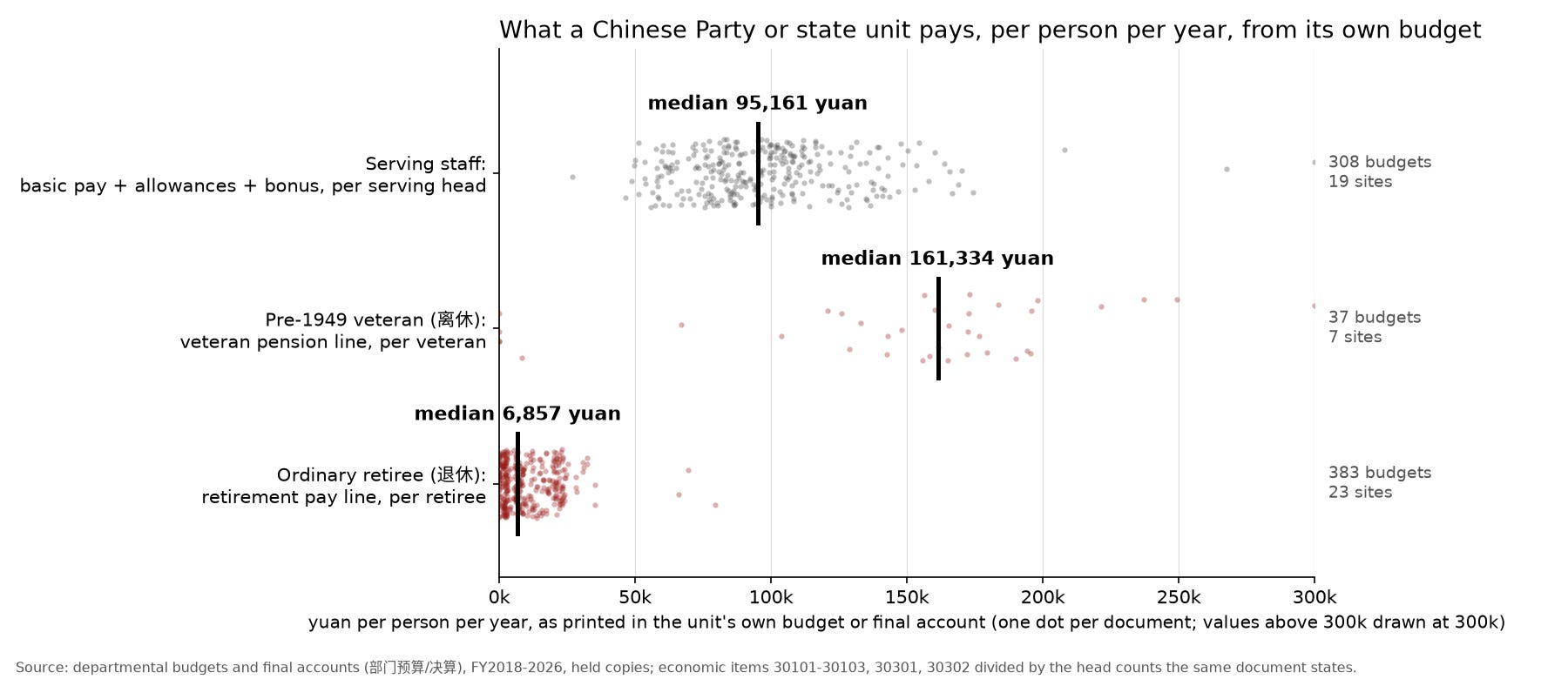
What a Party or state unit still pays its retirees per year to plus up their pensions.
Resigning from the job vs. resigning from the Party
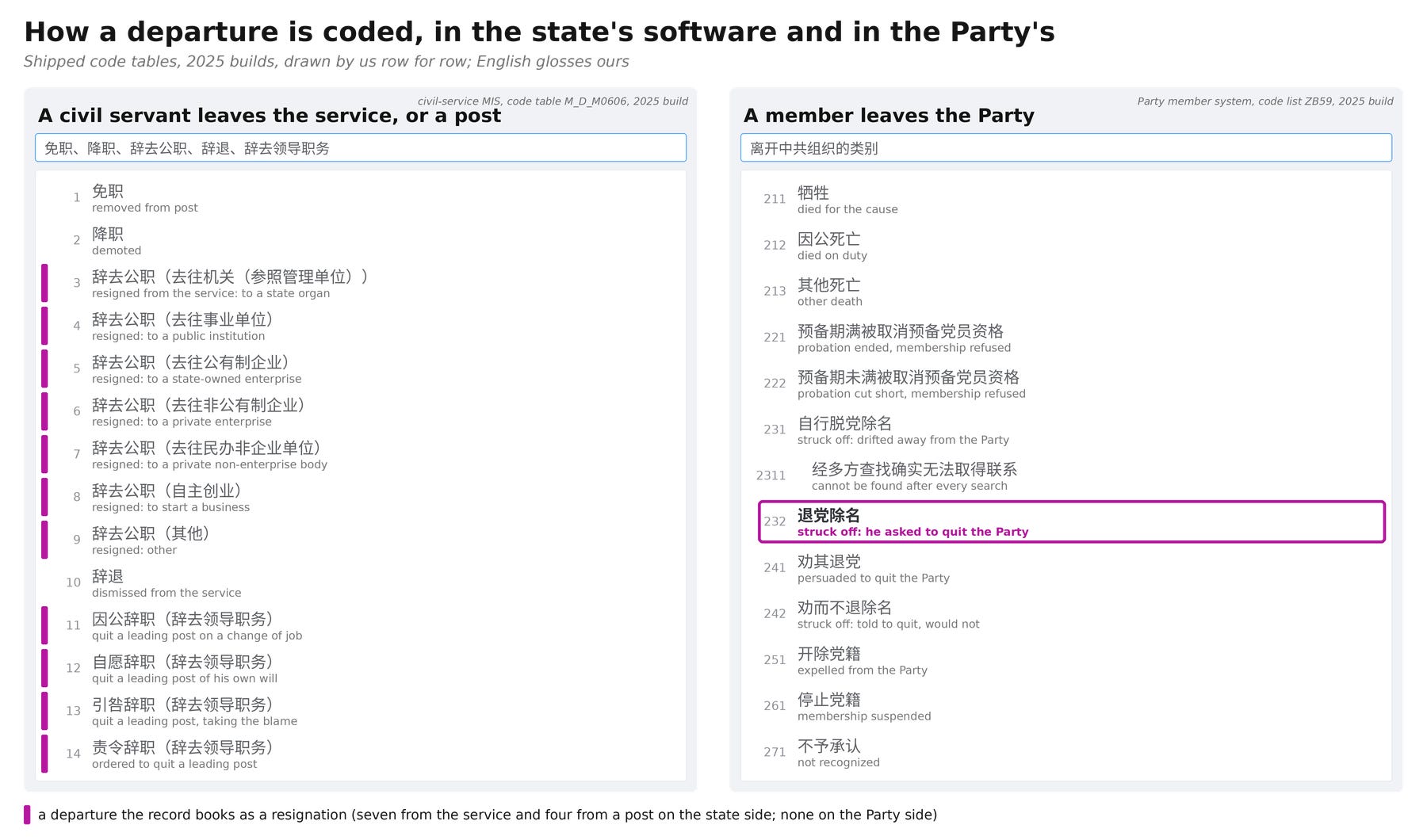
The state’s HR software on the left accepts a multitude of reasons for leaving the job. The Party’s HR software on the right has only one for a member who asks to leave: struck off.
The Party Constitution is generous on paper. Article 9: a member is free to quit; a member who asks to quit is announced struck off after the branch meeting discusses it, and the fact is filed with the level above.
The Central Committee’s 2019 regulation on member management is less generous. It’s easiest to understand in the figure below, which shows the process the 2024 measures put a resigning member through. They get re-educated. Then, if they still insist, their resignation has to be approved by the branch and filed up the chain of command. And what part of the HR software processes resignations? I’m glad you asked. It’s the part about the disposal of unfit members. Its definition comes from the regulation: a member who quit for ideological degeneration, still insisted after education, and was struck off. Ideological degeneration. I think that’s the textbook definition of heresy. They probably don’t get a red sash.
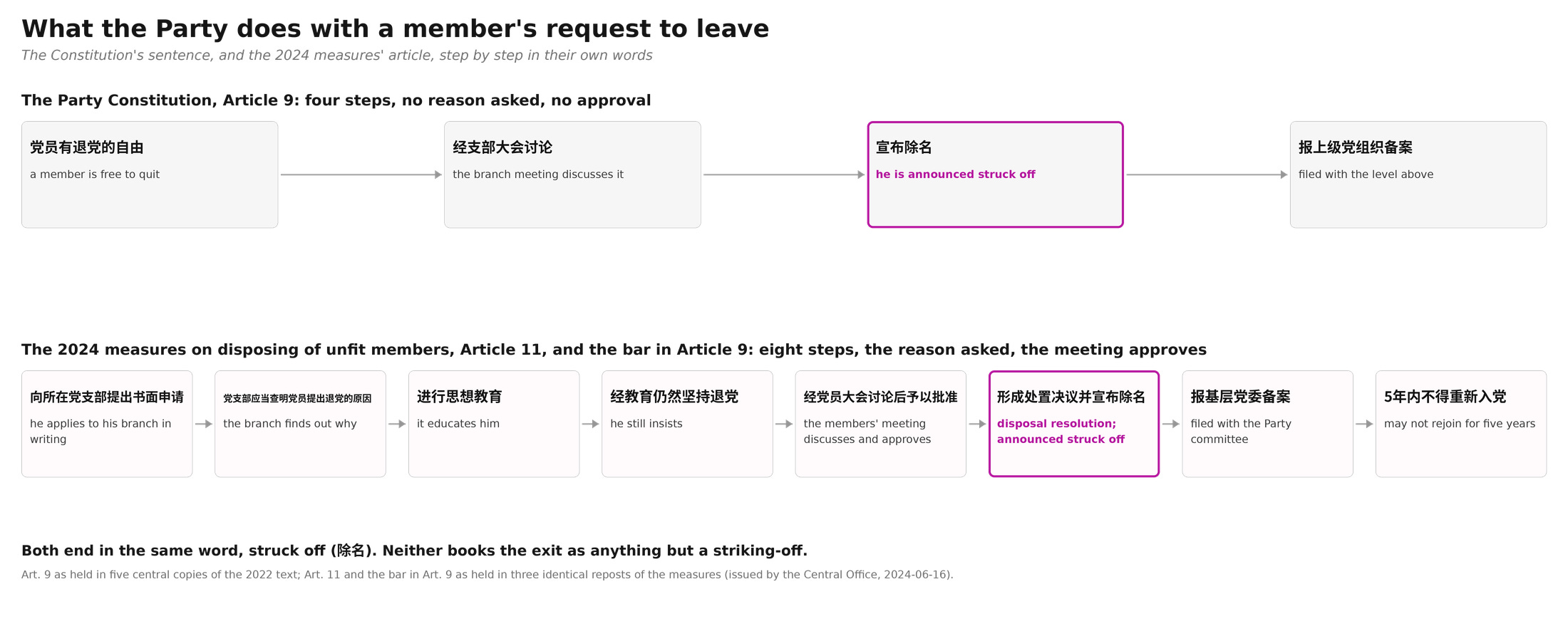
The Party’s picture of the heretic
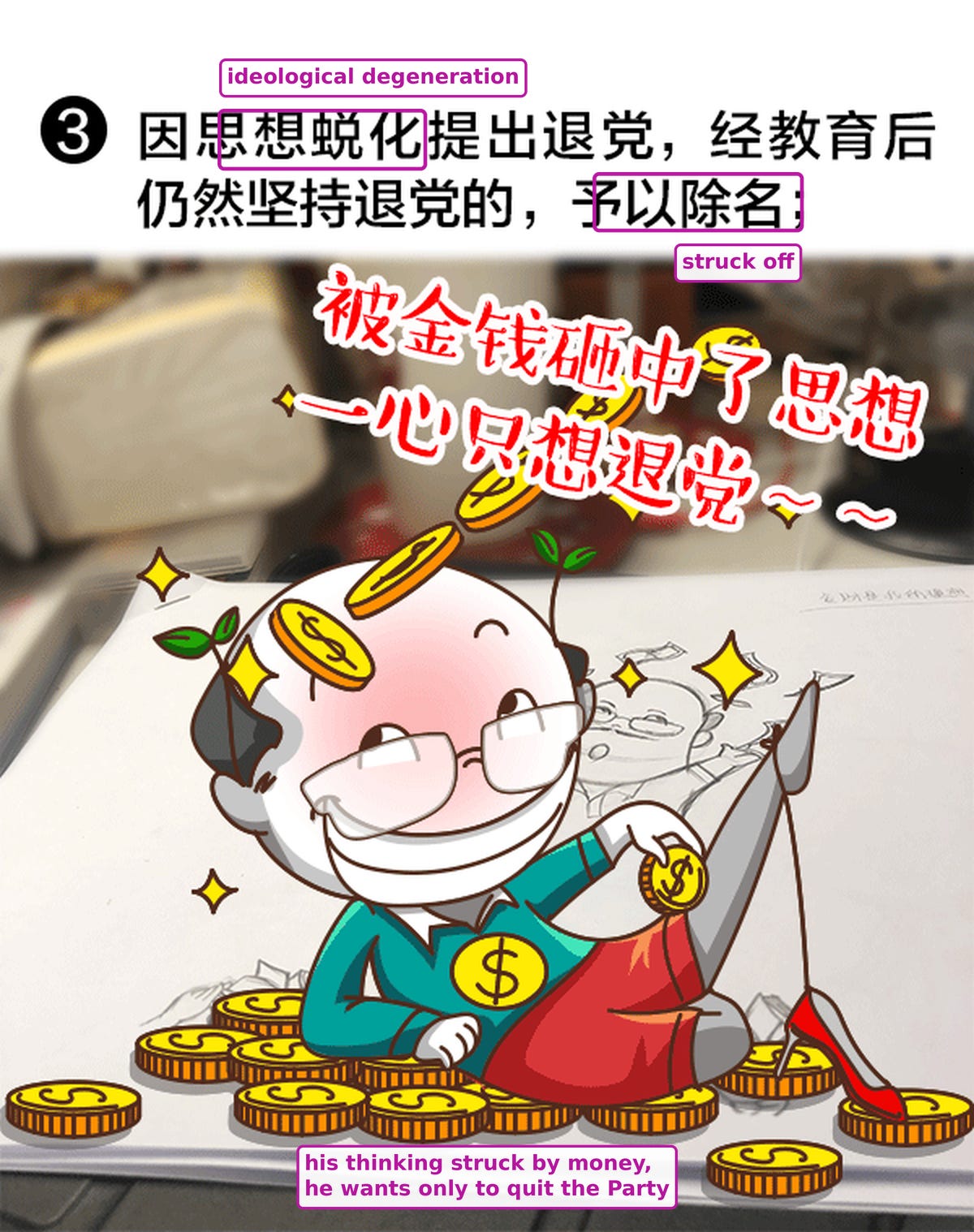
The CCDI’s 2019 cartoon of heretics who want to quit the Party.
The discipline commission published cartoons about the regulation a few weeks after it was published. Where the Party’s texts talk about a request to leave, they treat it as something that went wrong. A 2022 city inspection in Jiangmen, Guangdong, faulted a development zone’s Party working committee because two retired officials applied to quit and the committee “let it be”. The committee’s report on rectifying the issues promised to hold more heart-to-heart talks. On the Party’s own website, a probationary member who asks to quit is listed with those “low in ideological consciousness” or who do not do a member’s duties. In 2016 a member of Hunan’s provincial Party standing committee, the commander of its military district, spoke to a university branch. He said he had heard of a few teachers at one university asking to leave because the dues were not worth it. And he called it a chilling loss of Party consciousness.
The Party’s regulation gives three specific reasons to strike off a heretic:
Lost their ideals and convictions, and taken a wavering political stand. These people are struck off outright.
Hold a religious faith. They are re-educated, then persuaded to leave, then struck off if they will not go. The 2024 measures give them a correction period first.
Ask to leave [out of ideological degeneration]. These people are struck off after re-education.
The first two are pushed out by the Party.
I went looking for a loophole where the Party treats a resignation as just a resignation. The nearest is a handbook rule that lets a member who is leaving the country quit without giving a reason. Since 2024, the Party’s HR software lets someone be struck off the rolls for other reasons. The Party’s older handbooks had already said that a member who has changed his communist belief “or for other reasons” no longer wishes to be one is struck off, so I don’t think it’s a loophole. To get out of Hotel Chinafornia honorably you need to leave the country.
The other ways out
The rest of the list, quickly, because I need a break from looking at Chinese HR software.
A member who misses six months of branch life, dues, or assigned work without good reason is struck off as having left on his own.
A member nobody can find is suspended, and struck off two years later.
A member who moves out of the country but does not ask to quit first has his membership stopped when he leaves the country.
An unfit member gets a correction period, then persuasion, then is booted out.
An offender is expelled, which is another article in this series.
There are three ways of dying to get out of the Party: dying in the line of duty (a martyr), dying on duty (think heart attack at the desk), and the catch-all other ways of dying.
Leaving the Party is a heresy
The 18th Party Congress report of 2012 promised a mechanism by which members “can enter and can leave”. But what they built was a Party where only the unfit and the heretics can leave, after re-education of course. And they found that retirees relaxed their discipline and broke the rules, so the Party holds on to them as well.
Every way to exit the Party except death and emigration is a verdict the Party passes on the member. If the Party just let them go, then the member would have passed a judgment on the Party. The Party judges people, people do not judge the Party. The ceremony is what it costs to keep him: a stage a unit budgets for, sometimes a medal with his name on it, a red sash that I’m jealous of, then a seat in a retirees’ branch and a WeChat group with a chaperone in it.
When you read that the Chinese Communist Party has over a hundred million members, remember that they’re Hotel Chinafornia. They can declare themselves a heretic any time they like, but otherwise they can never leave.