
We took apart twenty-one of the personnel programs the Chinese Communist Party (CCP) and the Chinese state run (fifty packages, nine vendors, 2004 to 2026, including 144 databases, and their documentation). This is one of eight articles on how the CCP and the Chinese state are actually organized, extracted from their own enterprise software systems.
John Doerr wrote a most amazing book, Measure What Matters, that has become the guide for Technocrats running large technical organizations. While we may not know the actual strategic objectives as defined by the Technocratic Politburo, we can make inferences about those objectives by analyzing what they measure. Because a good Technocrat leader does two things: they define metrics to actually gauge progress towards their objectives, and they create metrics that they want their organization to cheat because it moves the more recalcitrant members in the direction they need them to move. The Chinese Communist Party does this at the Party level by demanding a report from every level of its departments once a year. They published the software that they use to ask the questions, including the ones which demand confidential reporting. Let’s see what we can learn.
Picture a Party statistics clerk in a county organization department. He opens this year’s annual Party statistics return that he needs to fill out. It’s much the same as last year: the change in the number of Party members, the basic situation of its members, and on down the list. Then there is the special-topic section at the end. Some of last year’s topics are no longer there: the direct election of grassroots leaderships, members’ appraisal of their leadership, and members who have lost contact. And new topics are in: villages, cities, universities, state enterprises, private enterprises, internet companies and social organizations. Paperwork, the lingua franca of our age.
This article reads the annual Party statistical return the way the branch-level Party clerk cannot. Technocratic organizations think in terms of Objectives and Key Results. The organization has two or three strategic objectives for the year (or the quarter), and the leadership defines the Key Results to track progress towards those objectives. Since we know the Key Results metrics that the Party wants returned by all subordinate branches, we can infer the strategic objectives of the Party leadership. For every year from 2004 to 2025.
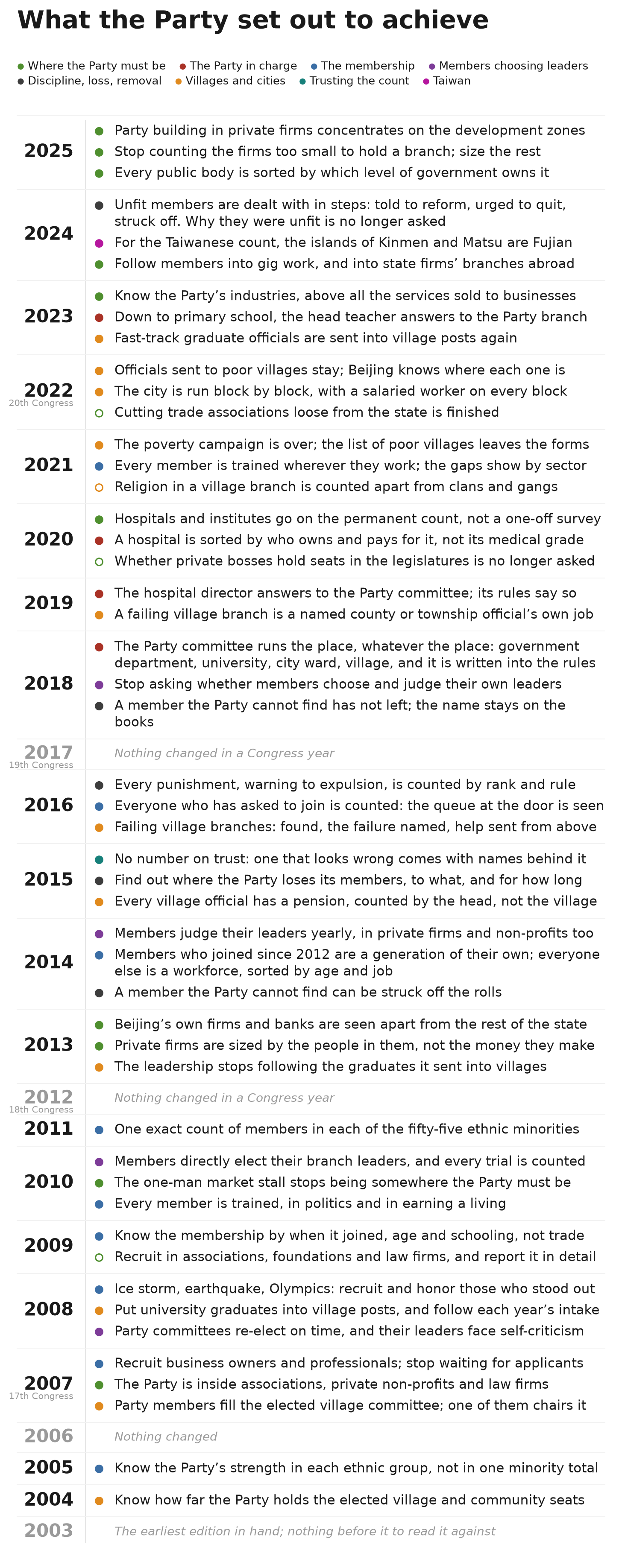
Inferred yearly strategic objectives of the CCP leadership, based on how they changed what they measure about the Party.
The list is fascinating. The Party spent the mid-2000s understanding where it was throughout society. Then in the late 2000s they started deliberately spreading across local governments, organizations and companies. As they were spreading in the 2010s, they were deliberately maturing the Party and the Party members. By the mid 2010s they were cleaning up the parts and members who were not performing to expectations. In the late 2010s the Party members took control of the local governments, organizations and companies. And the 2020s have been the consolidation of Party power over all things Chinese.
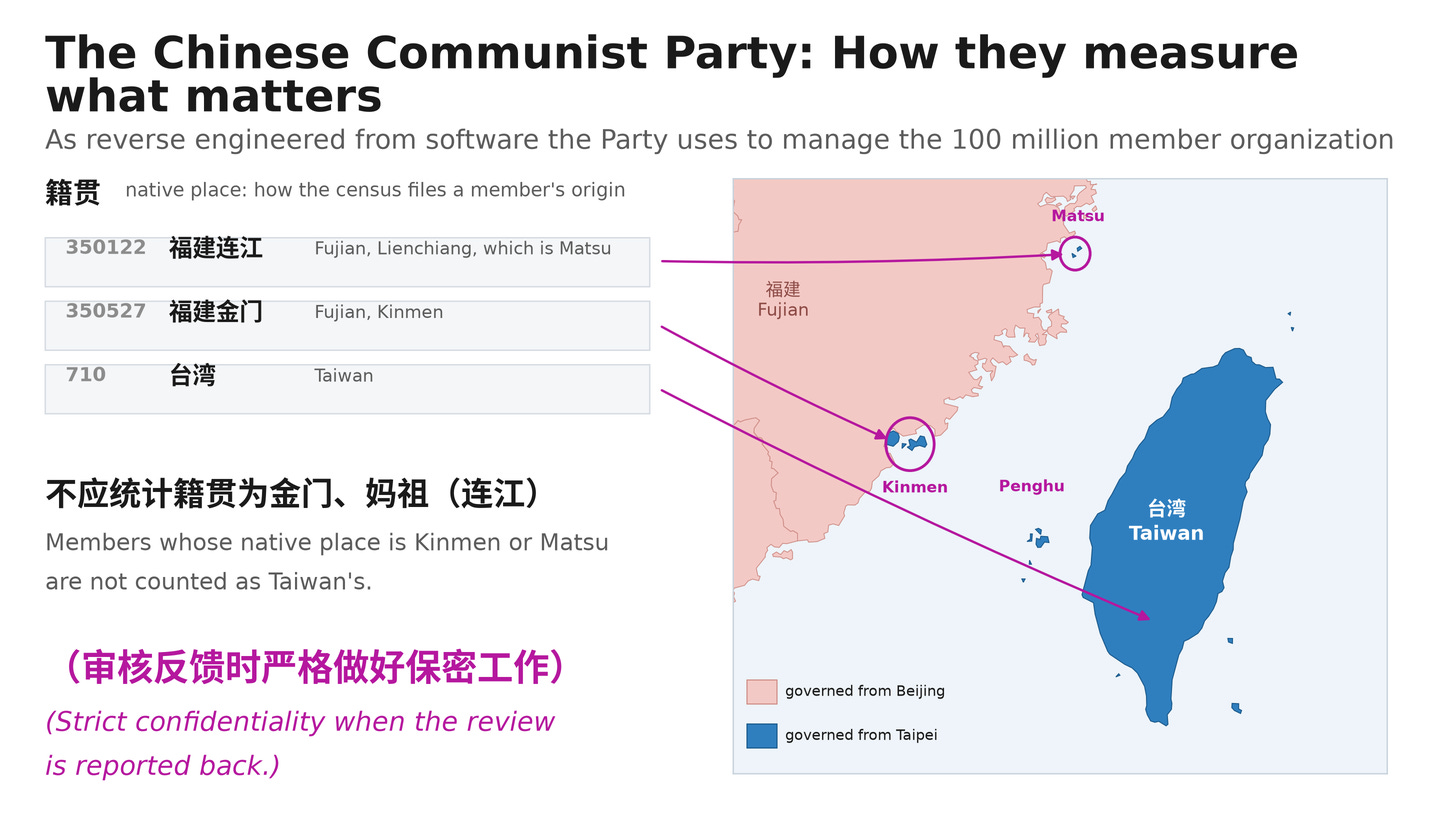
The 2024 understanding of where the Party was across Taiwan was the outlier in the flow of strategic objectives. If the Party follows their mainland pattern, then they will spread over Taiwan and its islands next. Something to watch for in 2026 and beyond.
Back to the clerk
Now that we have the important strategic insights documented, let’s build from the bottom up. Every year the branches of the Party load that year’s survey package into the Party software. You can see the 2025 annual statistical return’s report window below. The category tree node reads the 2025 annual intra-Party statistical return (二〇二五年中国共产党党内统计年报表). The package of explanatory sheets sits under it, and below that the year’s forms, numbered, each with a tick-box beside it: 1: change in the number of members (党员数量变化情况); 2: basic situation of members (党员基本情况); on down past 5: members by distribution across industries (党员按行业分布情况) to the special-topic forms at the foot, among them 48: upgrading the corps of village Party organization heads (村党组织带头人队伍整体优化提升情况). Yes, it’s old Windows software that could probably use an update.
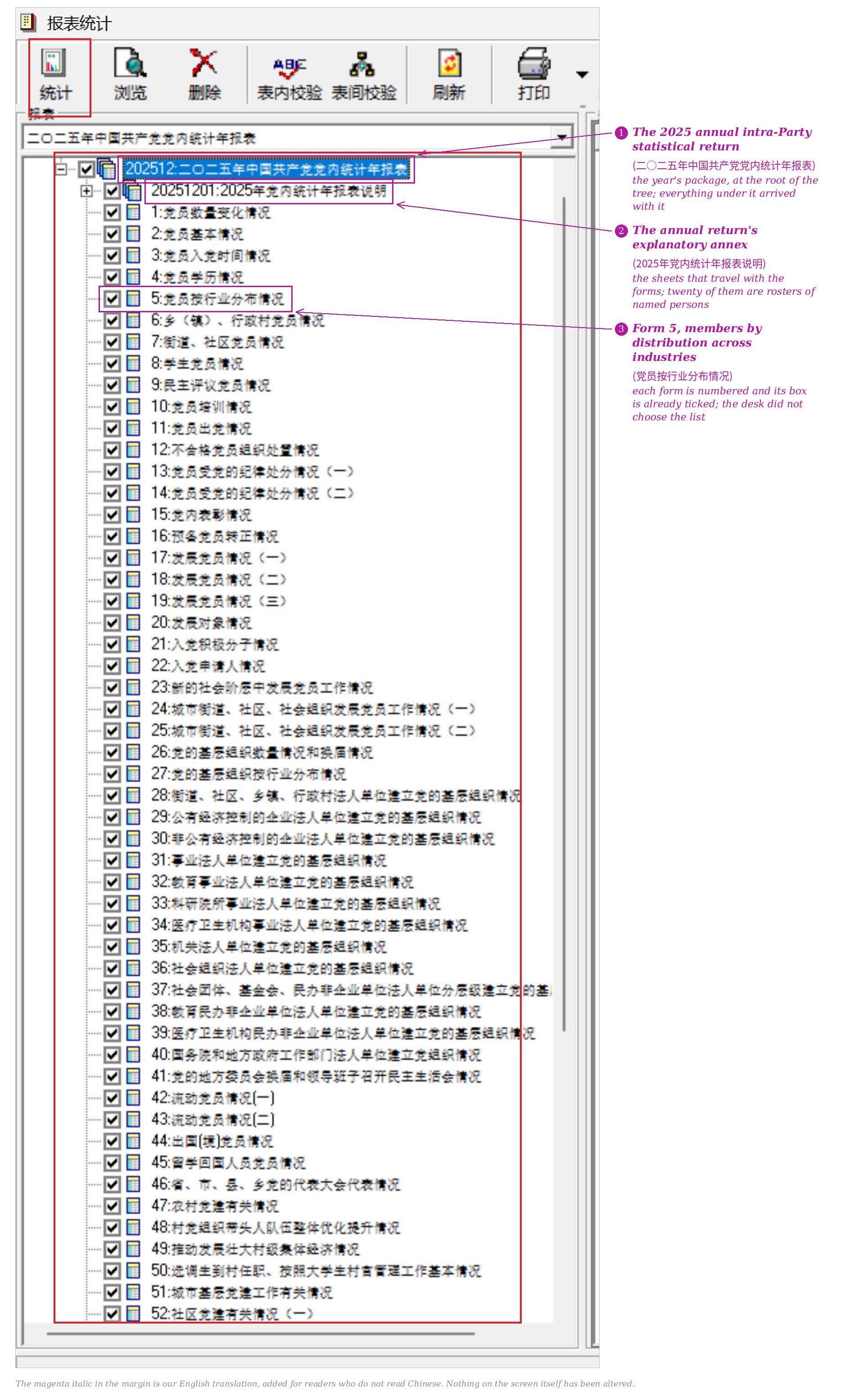
Filling out the annual statistical return
You can think of filling out the annual Party statistical return like filling out a tax return. The software walks the clerk through a long list of numbered forms. As the 2025 return lists them: the change in the number of members, the basic situation of members, when they joined, their education, their industry, and on down through the branch’s democratic appraisal of its members, discipline sanctions, admissions, and the forms on grassroots organizations, floating members and members abroad. Each form is a grid of lettered columns and numbered rows.
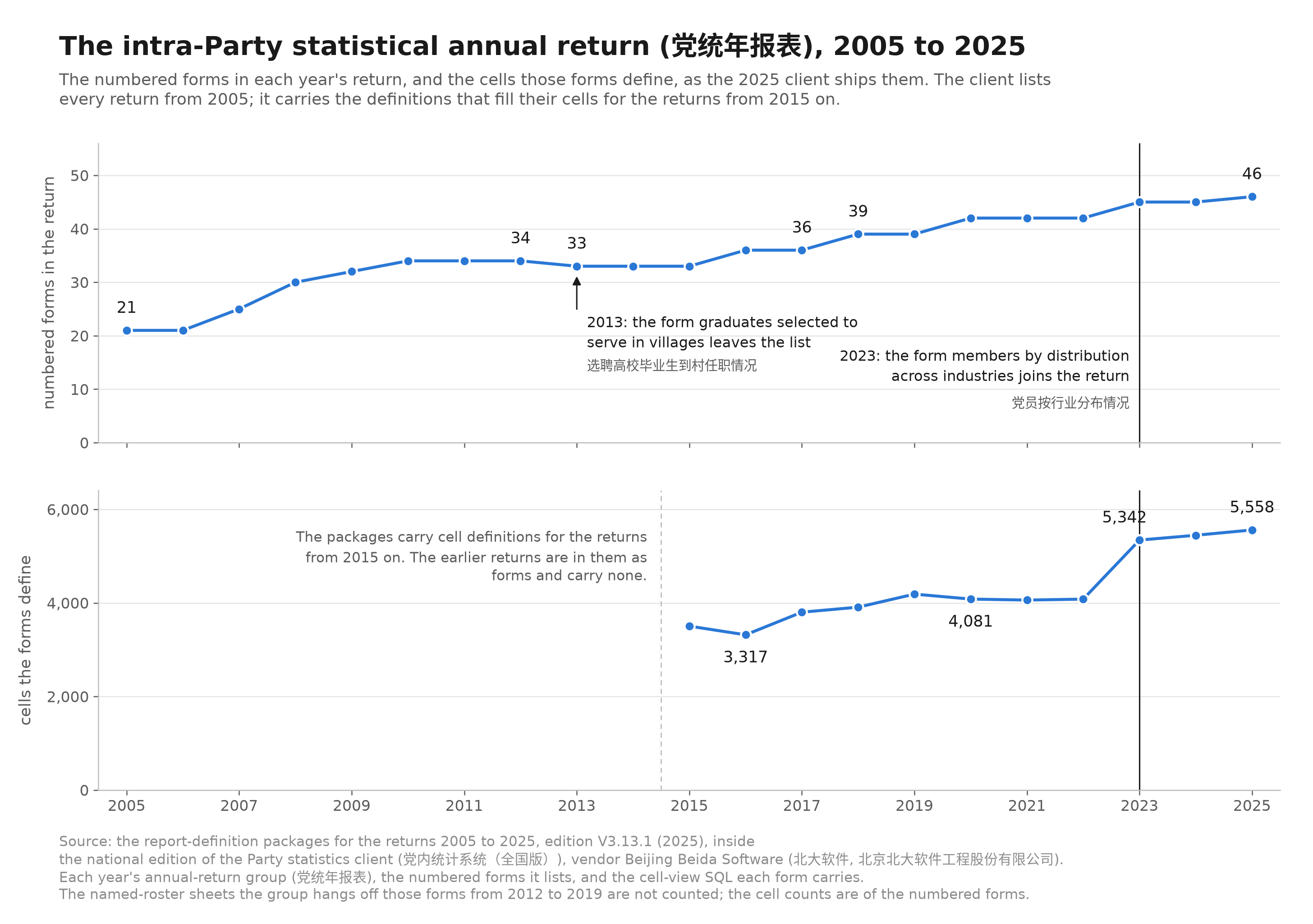
Fortunately for this analysis, the 2025 Party software included all of the previous years’ forms, so we could analyze them over time. As one would expect, the paperwork increases year to year as graphed below.
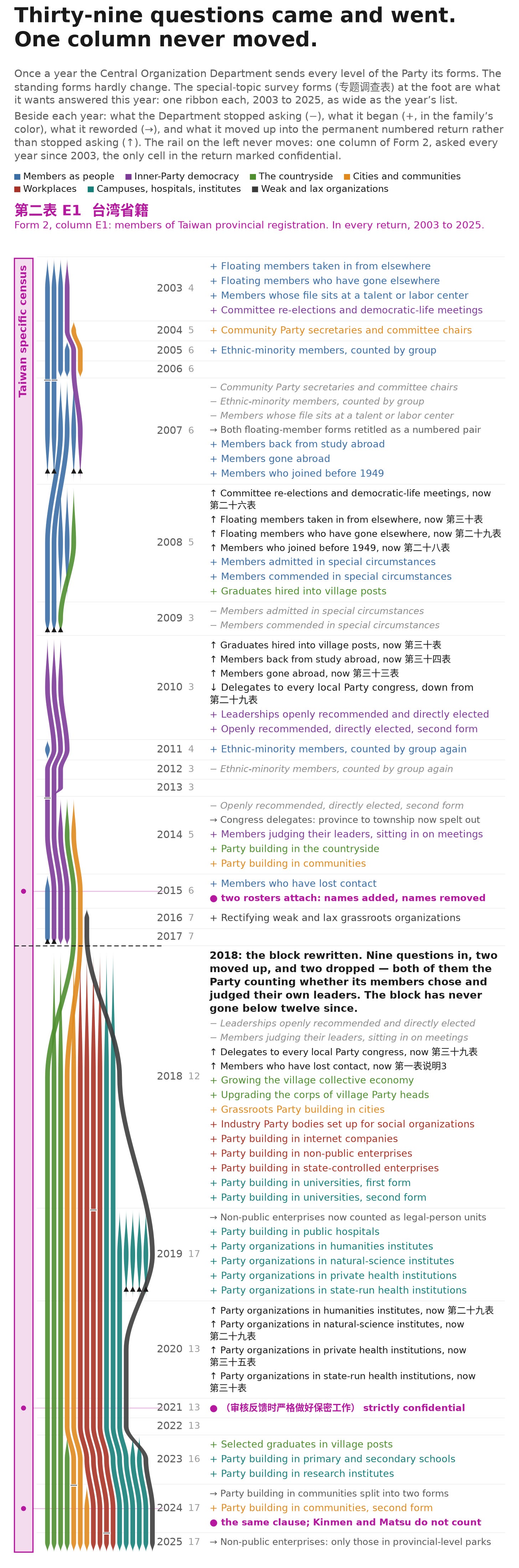
It might help to visualize what those annual changes actually are. The figure below shows just the Taiwan topics and the special topics section. The notable outlier was that in 2021 the Party declared that Taiwan provincial registration was to be kept confidential.
Checking the return before it is sent
Before a filled return goes up the reporting chain, the national Party statistics client runs the check rulebook the Department ships with each year’s package. In some respects it is just like your tax return software, where it checks for known errors in fields and between fields. The surprise here, at least for me, was that the Party statistics client forces the clerk to name certain people. For instance, if the branch reports that it restored or stopped Party membership for individuals then the clerk must list their names in the annual return. More notably, if members of Taiwan provincial registration are gained or lost, then they must be named and their identities kept confidential. I do not know what the Politburo-run Central Organization Department (中共中央组织部) does with the names of the Taiwanese Party members, just that they ask.
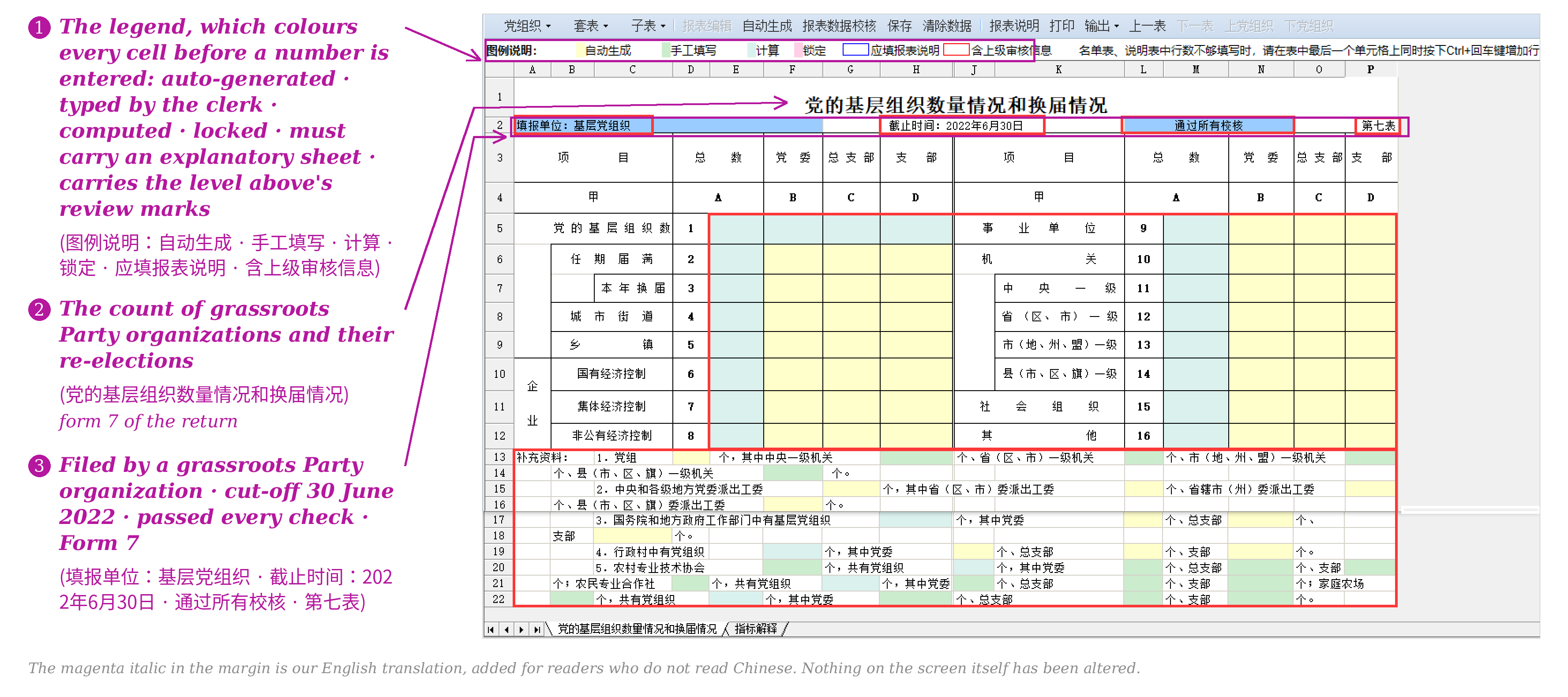
Form seven (第七表), the count of grassroots Party organizations and their re-elections, the 2022 half-year return’s form open in the national Party statistics client.
The half-year count
The Party does not count itself only once a year. The web edition of the internal statistics system has records going back to 2003 and includes four half-year rounds in 2007, 2012, 2017 and 2022. In every National Congress year the Party counts its statistics twice. There was also a mid-year statistics return in 2021 called a “special return”. Its window opened on New Year’s Day and closed on 5 June, twenty-six days before the Party’s hundredth anniversary on 1 July. I don’t know why.
The national review
The web edition of the Party internal statistics software includes a table of how the national Party level reviews the lower-level annual statistical returns.
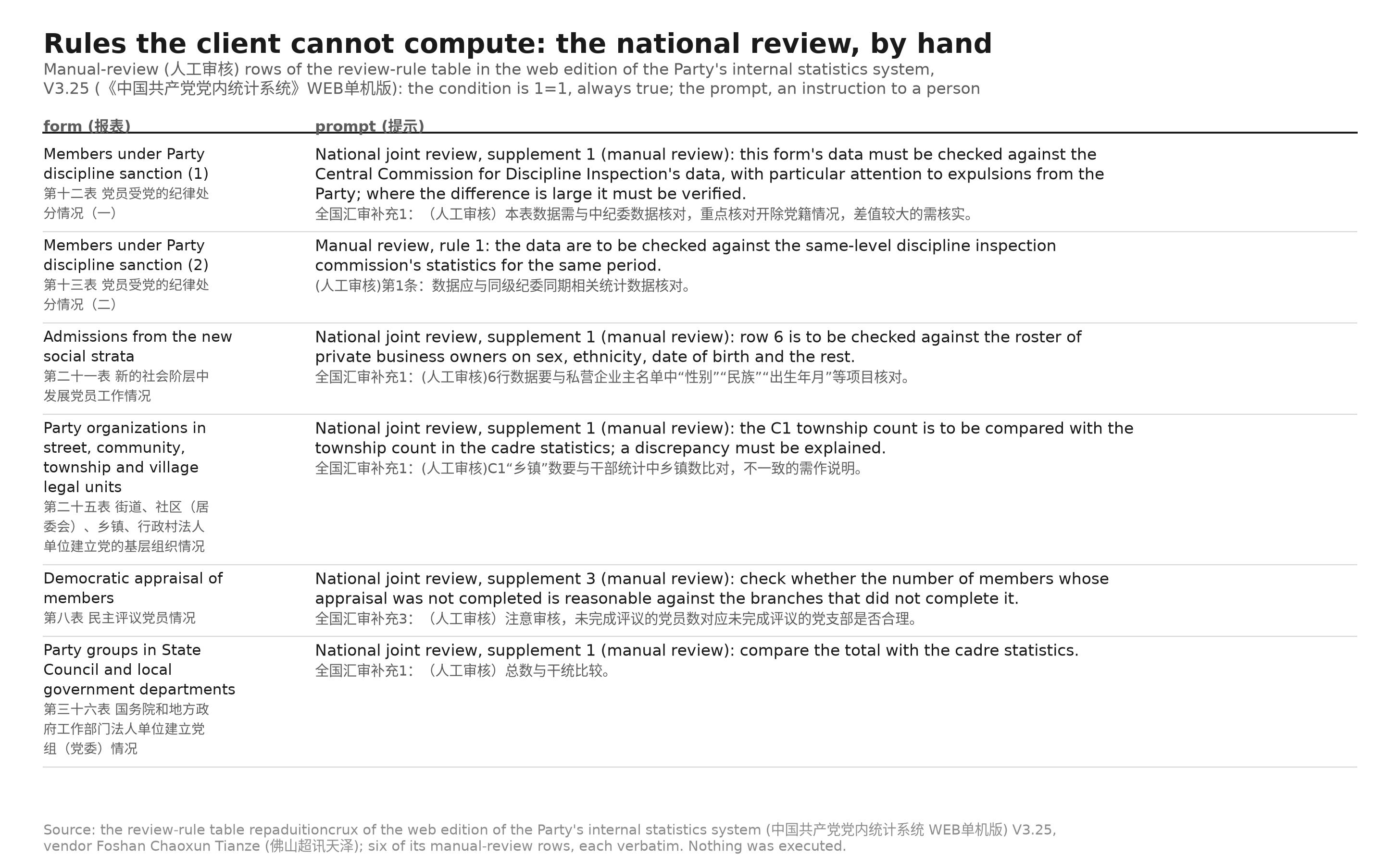
When the returns reach the top they are reviewed, and part of that review is written for a person to do by hand. The same web edition carries a review-rule table, one row per rule for one form in one round, each with its condition in the form’s own row-and-column words and a prompt naming what to check.
Some rows are marked manual review (人工审核), with an instruction to a person as national joint review (全国汇审). For instance, the discipline-sanction instruction reads: (manual review) this form’s data must be checked against the Central Commission for Discipline Inspection’s data, with particular attention to expulsions from the Party; where the difference is large, verify ((人工审核)本表数据需与中纪委数据核对,重点核对开除党籍情况,差值较大的需核实。). Two Party organs count the same people, and the reviewer is told to check that they match.
Measuring what matters
When I first saw that Party’s annual statistical return I honestly ignored it because much of it read like the information you track for the sake of tracking information. And yes, a lot of it is pure bureaucracy which I’ve mostly glossed over in this writeup. It’s also obvious that these returns include deliberate metrics that the Politburo-run Central Organization Department (中共中央组织部) uses to gauge how the Party is meeting its strategic objectives. That is the tool of a technocratic organization.
The next article in the series will be on how the Party members evaluate their own local leadership. 360-degree feedback with Chinese characteristics.