
We reverse engineered twenty-one pieces of the software the Chinese Communist Party (CCP) and the Chinese state run their personnel systems on (fifty packages from nine vendors released between 2004 and 2026, including 144 databases, and their documentation). What follows is a series of eight articles on how the CCP and the Chinese state are actually organized, extracted from their own enterprise software systems.
Run a large organization long enough and you learn that the enterprise software systems are the unvarnished manifestation of what the organization really is, how it works, and what it values. Look at your own employer’s systems: timekeeping, training, CRM, purchasing, payroll, etc. Some are polished and streamlined, some are clunky. You immediately know what the organization values. And if you understand those systems you understand how the organization really works. It turns out China’s ardent anti-corruption transparency extends to making the CCP’s and PRC’s enterprise software public. So let’s start with how the Party really admits a new member.
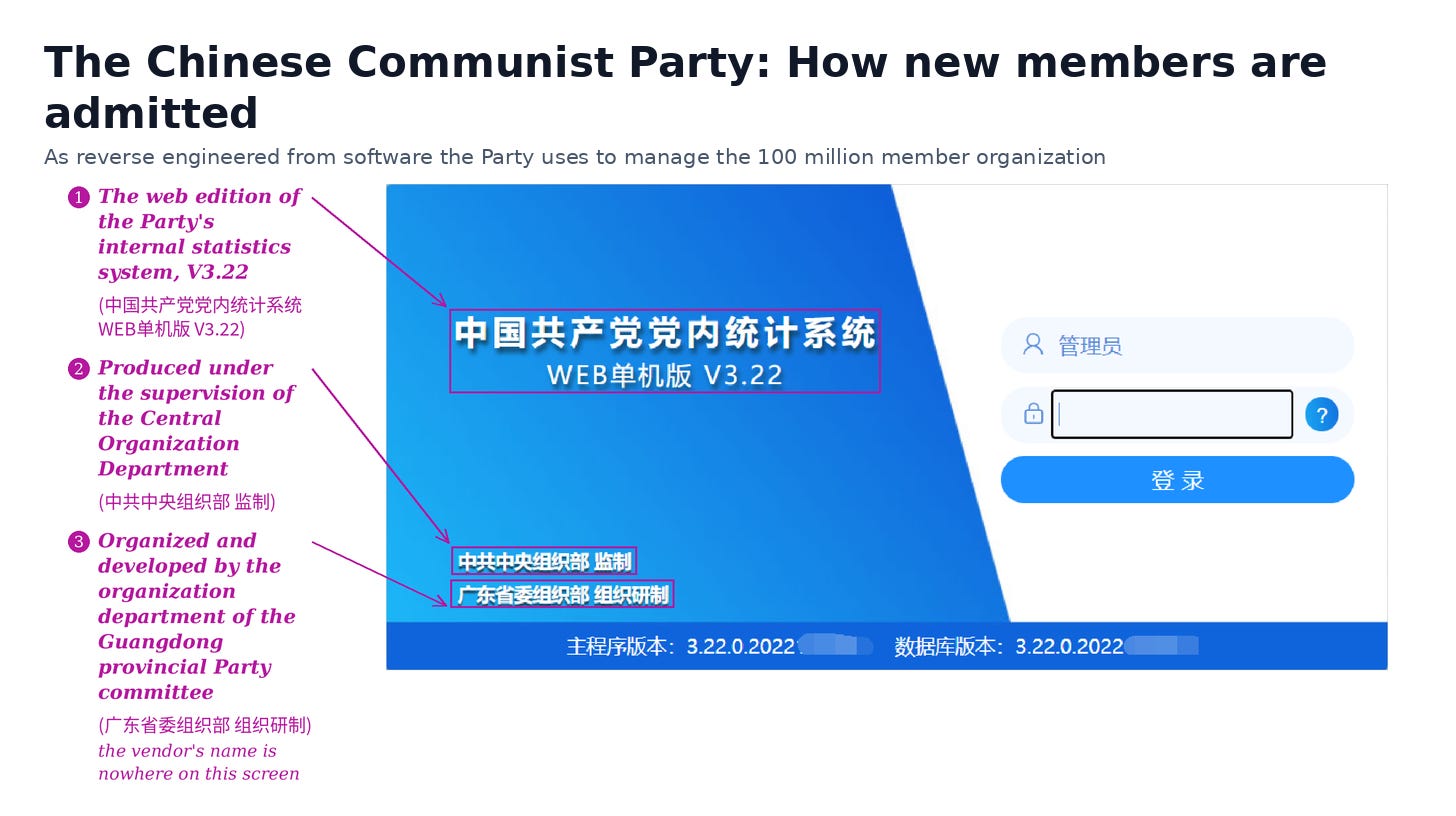
The web edition of the Party’s internal statistics system (中国共产党党内统计系统 WEB单机版) V3.22. The key translation under the title are that it was produced under the supervision of the Central Organization Department (中共中央组织部 监制).
Picture a branch-level Chinese Communist Party-affairs clerk. On one side he has the branch’s general meeting minutes about a candidate for Party membership, and on the other side is the Party software. The software tracks the dates the public notice about the candidate went up and came down, the candidate’s own account of themselves, and each sponsor’s opinion with a date beside it. The clerk enters information from the meeting: the members who should have attended (应到会人数), members present (实到会人数), ballots handed out (发出票数), ballots taken back (收回票数), ballots in favor (同意票数). Then the resolution text. And then the clerk checks pass (通过) or fail (不通过). Then he tries to save the updated record about the new member of the CCP. Sometimes I think paperwork is the lingua franca of our time.
But the software refuses to let the clerk save the record of the candidate’s admission to Party membership. The software enforces some of the Party policies, and allows bureaucratic flexibility elsewhere. This is how the Party really works. In this story the software tells the clerk that the branch meeting’s resolution date must be a year or more after the date the candidate was confirmed an activist (支部大会决议时间须大于确认为积极分子(03)时间一年以上,确认为积极分子时间:). And then it tells the clerk the exact day. It will not save the record that admits the candidate if they didn’t do their year as an activist.
The 2025 edition of the Party software checks that there were not more ballots returned than went out, and that there were not more votes in favor than ballots returned. But the software never checks the vote. The candidate’s Party membership is approved or rejected solely on whether the clerk selected pass or fail regardless of the vote. That is a Party vote with Chinese characteristics.
The software as a view into the CCP Central Organization Department
Before we actually go deeper, let’s talk briefly about the software itself. It calls itself the internal statistics system (党内统计系统) and the login screen proclaims it was produced under the supervision of the Central Organization Department (中共中央组织部 监制). That is significant to the China watcher. The COD is one of the CCP Central Committee’s functional departments and is led by a member of the Politburo. Calling it China’s human resources ministry would be underselling its power. The COD decides who occupies the PRC government posts that matter.
The screenshot above is from the 2022 and 2025 software of the organization department of the Guangdong provincial Party committee (广东省委组织部 组织研制). I have variants from Beijing, Gaoqing County, Zibo, Shandong, and Gansu as well. There are configuration settings which represent themselves as local versions or national editions. The different variants, built by different software vendors, are consistent. The COD sets the standards.
Handing in the application to join
A person gets a record in the Party database when the branch enters their written application into the software. There are only two fields that are strictly required: the date the application was submitted, and whether the person is an applicant, an activist, or a development target. Those last three just mean whether the person is starting on Step 1, 3, or 7 in the member development process that we’ll talk about below. Everything else is optional.
There are three routes through the joining process:
Normal development which we will walk through below
Admission at the front of the line which we will talk about in its own section
Special circumstances: re-admitted as a probationary member, directly approved as a full member, a re-joiner directly approved as a full member, recognized as a full member after death. These special circumstances just get recorded in the person’s file. Regardless, they are immediately a CCP member.
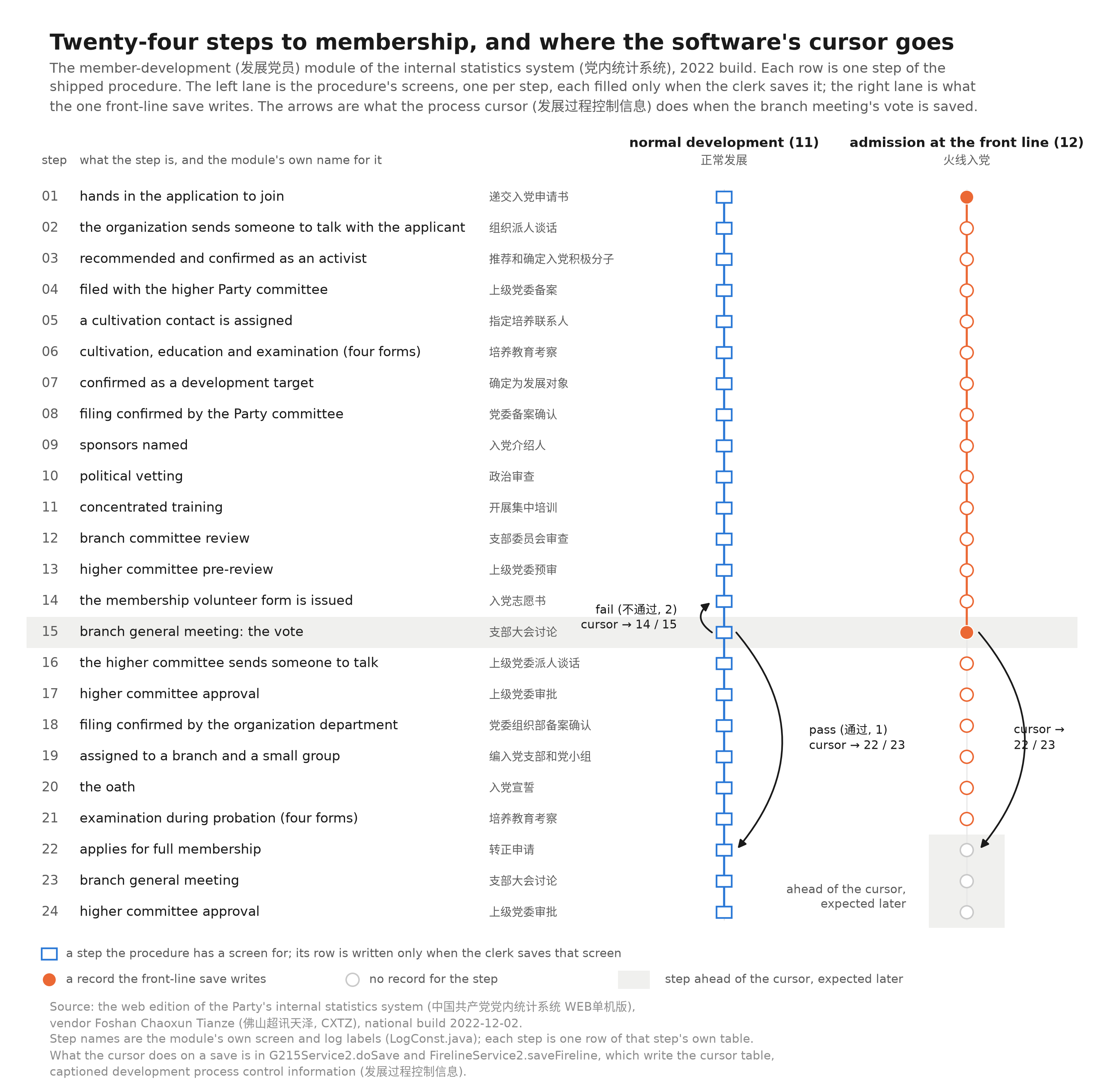
The below diagram encompasses all twenty-four steps of the CCP member-development process. Every step is its own page in the software, which updates the person’s CCP file as they progress through the joining process. There are a few special arrows. If the person passes a branch meeting vote in step 15 then they can jump straight to applying for full membership in step 22. Or they can proceed to step 16, where the higher committee puts them on a probationary period. Or if they fail they can get recycled back to step 14’s volunteer form.
Promotion from activist to a Party development target
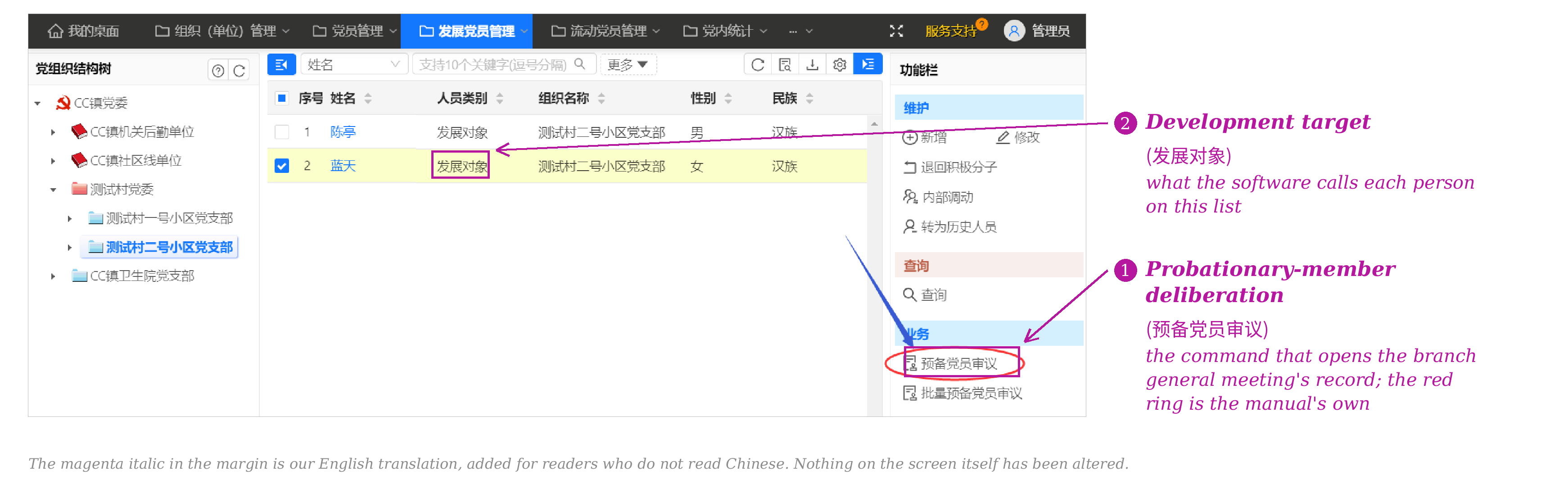
Training and vetting really start after a candidate becomes a development target, so it makes sense that there is policy around the promotion (Step 7 above). There is a bureaucratic process here where each body that the Party branch consulted offers up their opinion of the Party candidate. These include the Party cultivation contact assigned to the candidate, Party members, the masses (meaning people who are not Party members), the Party small groups, and the branch’s own committee. Each opinion is optional so a candidate can be promoted without any written opinions. But the date the person was proposed, the confirmation date, and the results of their promotion are required.
The COD are sticklers for their mandatory wait periods. The software does not allow a candidate to become a development target unless they have spent at least a year (一年以上) as an activist. The practice of hurry up and wait just might be universal across governments.
Political vetting and the volunteer form
Political vetting is a step of its own in between the naming of the candidate’s sponsors and the concentrated training. At this stage the political vetting process is remarkably light. But please don’t think the CCP does not vet its members. I will write an article in this series on the yearly in-depth vetting that leading cadre members undergo, which reminded me of the US Government security clearance paperwork and the financial disclosure forms of the Senior Executive Service (SES). But at this stage, the vetting just records a description of the candidate’s political history, present conduct, the branch committee’s opinion, and the date of that opinion. And the clerk marks the candidate as passed or failed vetting.
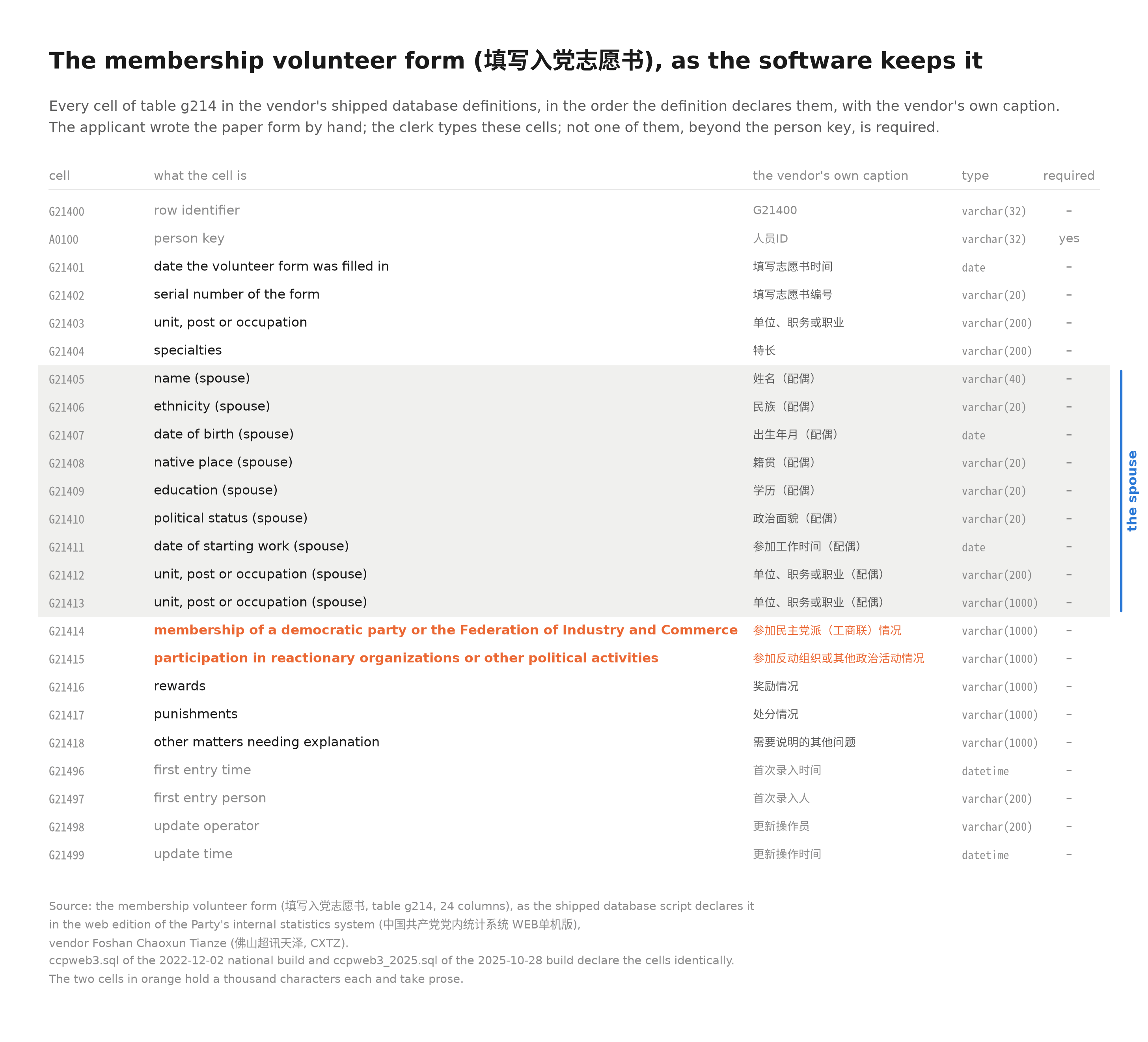
The candidate fills out the paper volunteer forms before the branch meeting about their political vetting. And the branch clerk enters it into the Party system. It’s still pretty simple: the applicant’s unit and specialties, and information about their spouse, which does include political status (full Party member, probationary member, masses meaning not a Party member, but there is some subtext here that I don’t understand which might indicate a former Party member). The candidate writes essays on their own politics, membership in a democratic party or the Federation of Industry and Commerce (参加民主党派(工商联)情况), and participation in reactionary organizations or other political activities (参加反动组织或其他政治活动情况). After those come rewards, punishments, and other matters needing explanation. Of course, all of these are optional.
The branch general meetings for probationary and then full Party membership
The branch general meeting is where a candidate is admitted to the Party as a probationary member. The software enforces a number of mandatory time periods before allowing admission to the Party which you can see in the below table. The summary is that the COD enforces how long the public and the Party had to contemplate the candidate’s membership, and if the candidate was an activist and development target for the prescribed period of time. There are a lot more policies written into the code but they are not enforced. And I don’t understand why. These include making sure many steps in the admission process were completed in the right order, and that ballots were taken. They are not enforced.
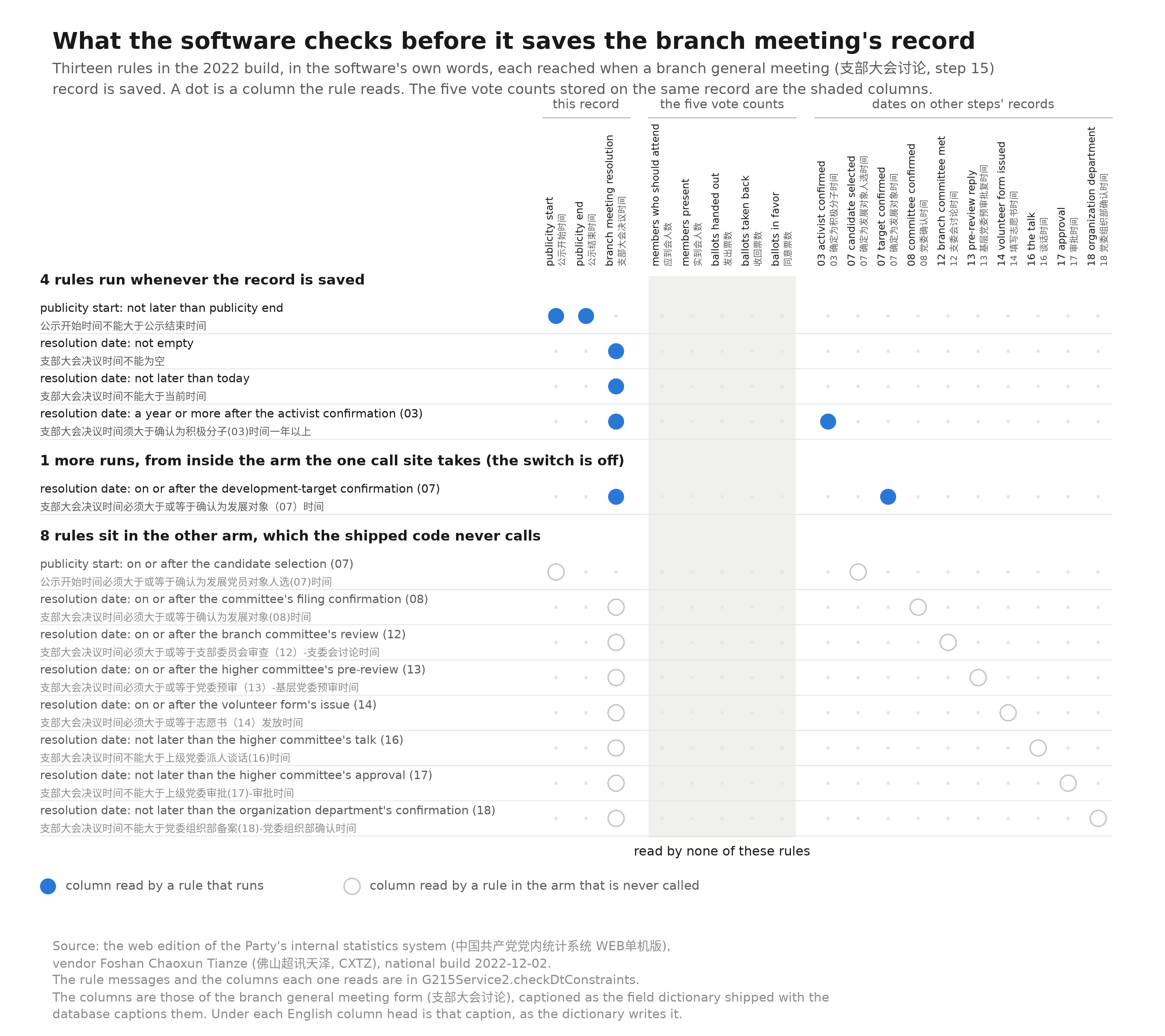
If the candidate passes then the program writes the person’s membership record as a probationary member and then moves their place in the procedure to the application for full membership. Between the meeting and that application the procedure has six steps: the probationary member’s talk with the higher committee, the higher committee’s approval, the organization department’s filing, the assignment to a branch and small group, the oath, and the probation-period examination. On a fail, the person goes back to the volunteer form.
The second, later branch meeting that votes on full membership is nearly identical to that of the probationary membership. It just includes the number of committee members who approved the member, and those who were merely present. I can’t tell if this is to hide the number who voted “no,” or if it allows committee members to just not vote yes as a sign of “no.”
Admission at the front line (火线入党)
So far we have focused on the normal Party admission process. If you’re gonna join the Chinese Communist Party, the way you want to do it is at the front of the line. There is a special process for admission that takes only the person’s basic details, the date, and the branch meeting record where they were voted in. That’s it. Immediate probationary membership and straight to the application for full Party membership. No political vetting, no volunteer form, no mandatory waiting periods. In short, there is no process.
Turning a candidate back
A candidate who is turned back is handled by the module’s go-back (回退). It deletes every record of every step after the step returned to, and nothing is flagged, nothing is copied, and there is no archive. The entire record of the person’s previous progress is purged from Party records. Demoting a probationary Party member back to a development target reduces the size of the Party by one and deletes their entire membership record. Purged. But purged cleanly so they are able to be rehabilitated.
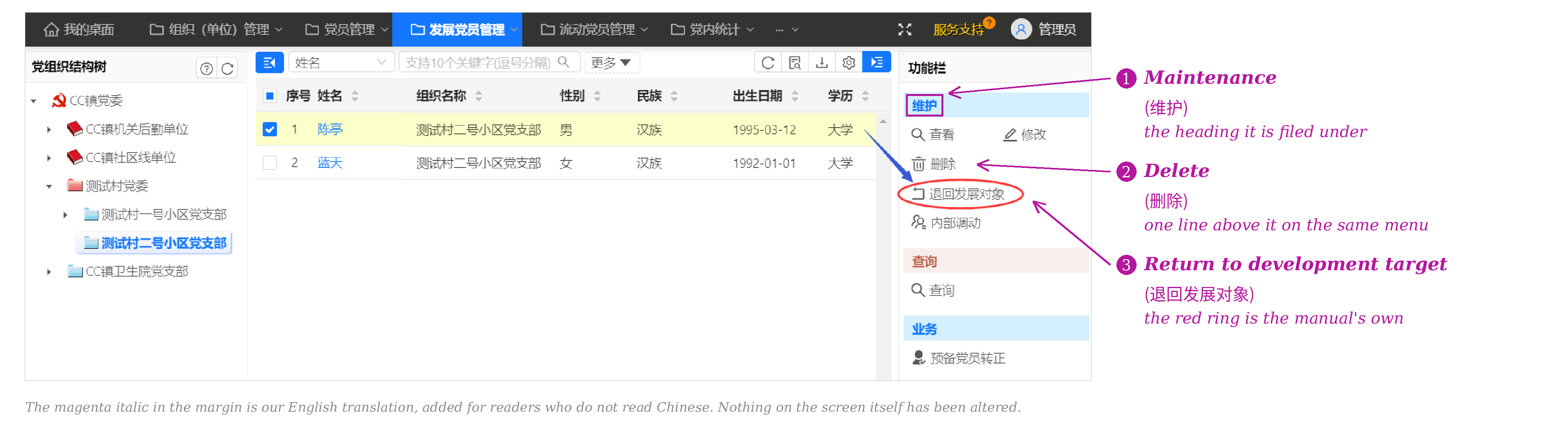
The probationary-member list of the 2022 build. Under maintenance (维护) the clerk can click on view (查看), edit (修改), delete (删除), return to development target (退回发展对象) and internal transfer (内部调动). Yes, it’s listed as “maintenance.”
Becoming a full member
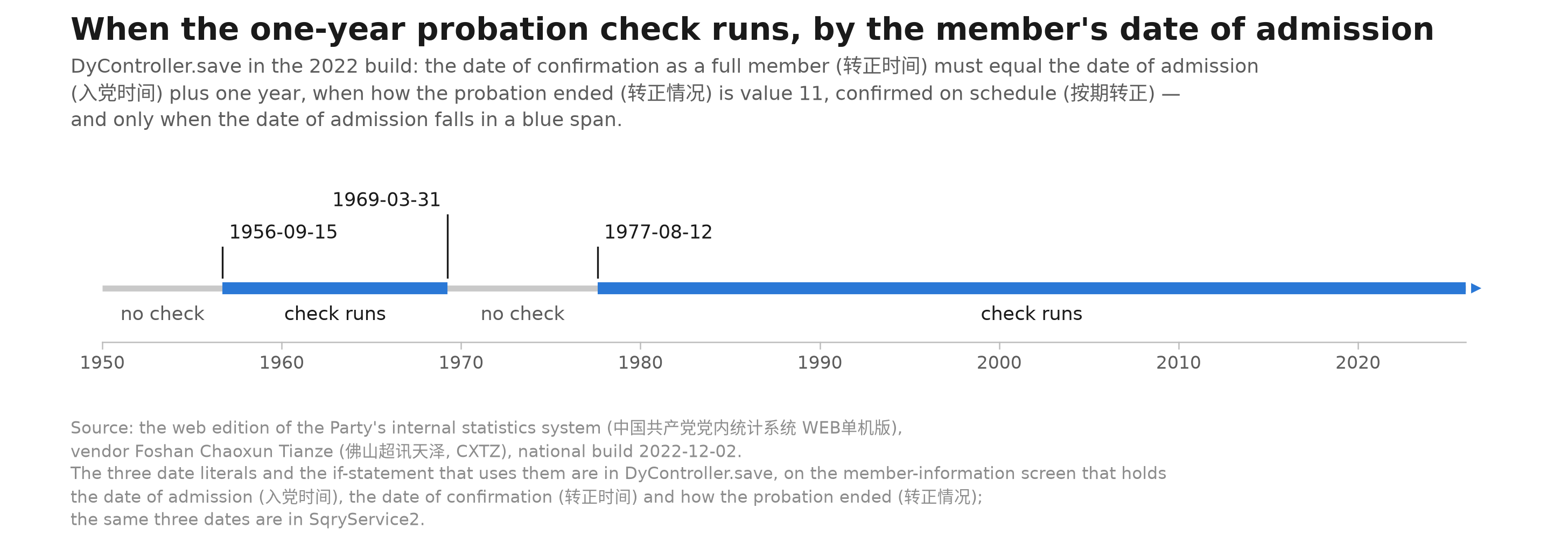
Like the rest of the person’s career in the Chinese Communist Party, becoming a full member is just an addition to their existing record. The paperwork always grows. The person’s permanent record tracks whether their probationary period ended on schedule, or whether it was extended. The software enforces the policy of a full one year probationary period before allowing someone to become a full member. They even incorporate the leap-day case.
But the one year probationary policy only applies for some joining dates. Anyone whose Party record began before September 15, 1956, or between March 31, 1969 and August 12, 1977, is exempt. Those three days are the opening days of Party Congresses. The 8th Congress opened on September 15, 1956, and its constitution set a flat one-year probation for everyone. The 9th opened on April 1, 1969, and the constitution it adopted has no probationary member at all. The 10th changed nothing, which is why the code has no 1973 boundary. The 11th opened on August 12, 1977, and restored the year.
The software is not reading the Party Constitution, though. The Central Organization Department publishes this on its own website as a table of how to compute Party seniority for members who joined in different eras, taken from its publishing house’s Handbook of Party Member Development (发展党员工作手册). The vendor’s three dates are that table’s boundaries. Another version of the same table circulates using the dates the constitutions were adopted instead. The code doesn’t follow that one. It follows the Department’s.
The Party added another option in October 2023 allowing them to postpone the discussion of a probationary member’s full membership. I don’t know why.
The annual plan number
I really didn’t expect to see this in the CCP software. They have an annual plan-number table (年度计划数表). Every Party organization appears to have a recruitment quota by year (年份), the planned number (计划数), the number completed (完成数), the completion rate (完成率), and the time of the last update. It appeared on September 29, 2020 and is still in the 2025 version. There is no route to that code in the software. Dead code? Future code? Canceled initiative?
I have found many references to a February 24, 2013 document by the General Office of the CCP Central Committee where they set a ten-year Party membership growth target of a net average of 1.5% a year. This is more corroboration that the Party leadership drives the recruiting and retention targets directly. But I have not yet found the actual Central Committee document.
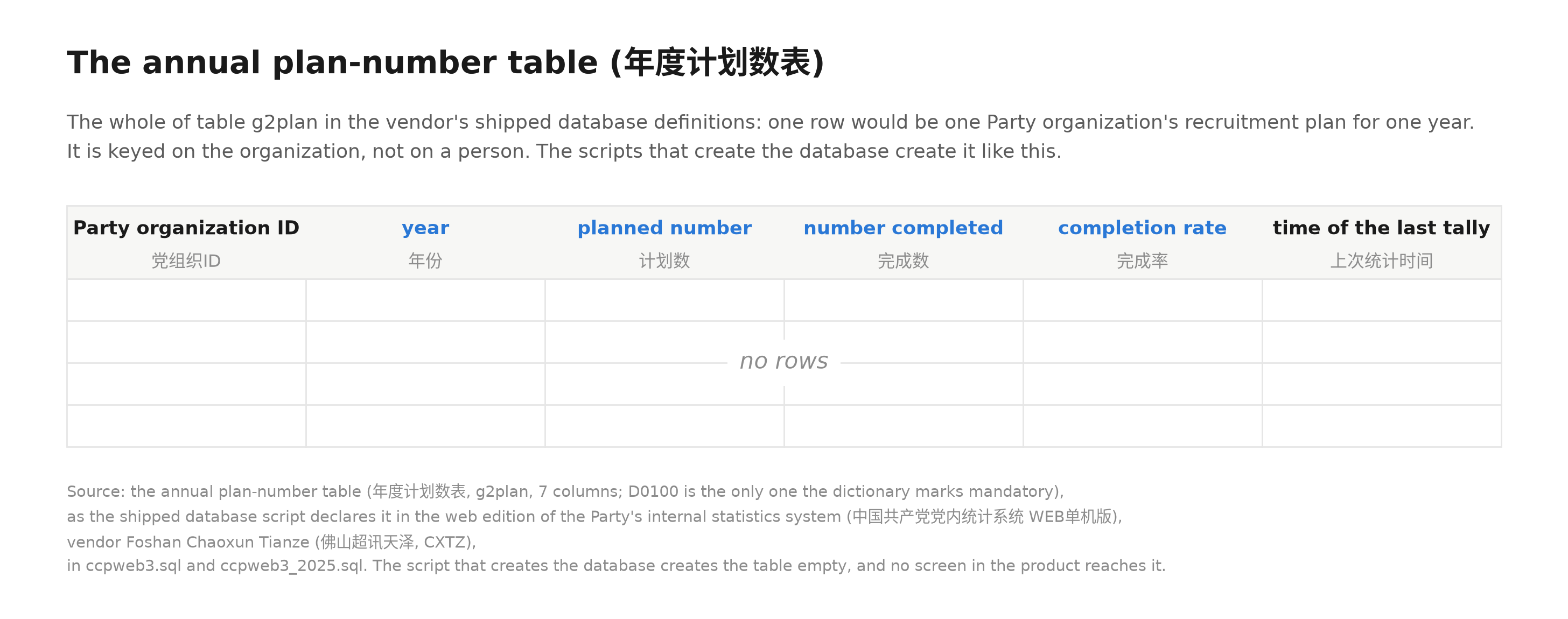
The annual plan-number table (年度计划数表). Nothing in the shipped product ever uses it.
The Party Central Organization Department’s own software is how they actually execute Party policy, not how they say they do. The next article will likely be on how the Party conducts the census on themselves. John Doerr wrote a book called Measure What Matters about setting goals, tracking progress, and delivering results in huge organizations. What does the Party choose to measure about itself? It probably matters.