
We took apart twenty-one of the personnel programs the Chinese Communist Party (CCP) and the Chinese state run (fifty packages, nine vendors, 2004 to 2026, including 144 databases, and their documentation). This is one of eight articles on how the CCP and the Chinese state are actually organized, extracted from their own enterprise software systems.
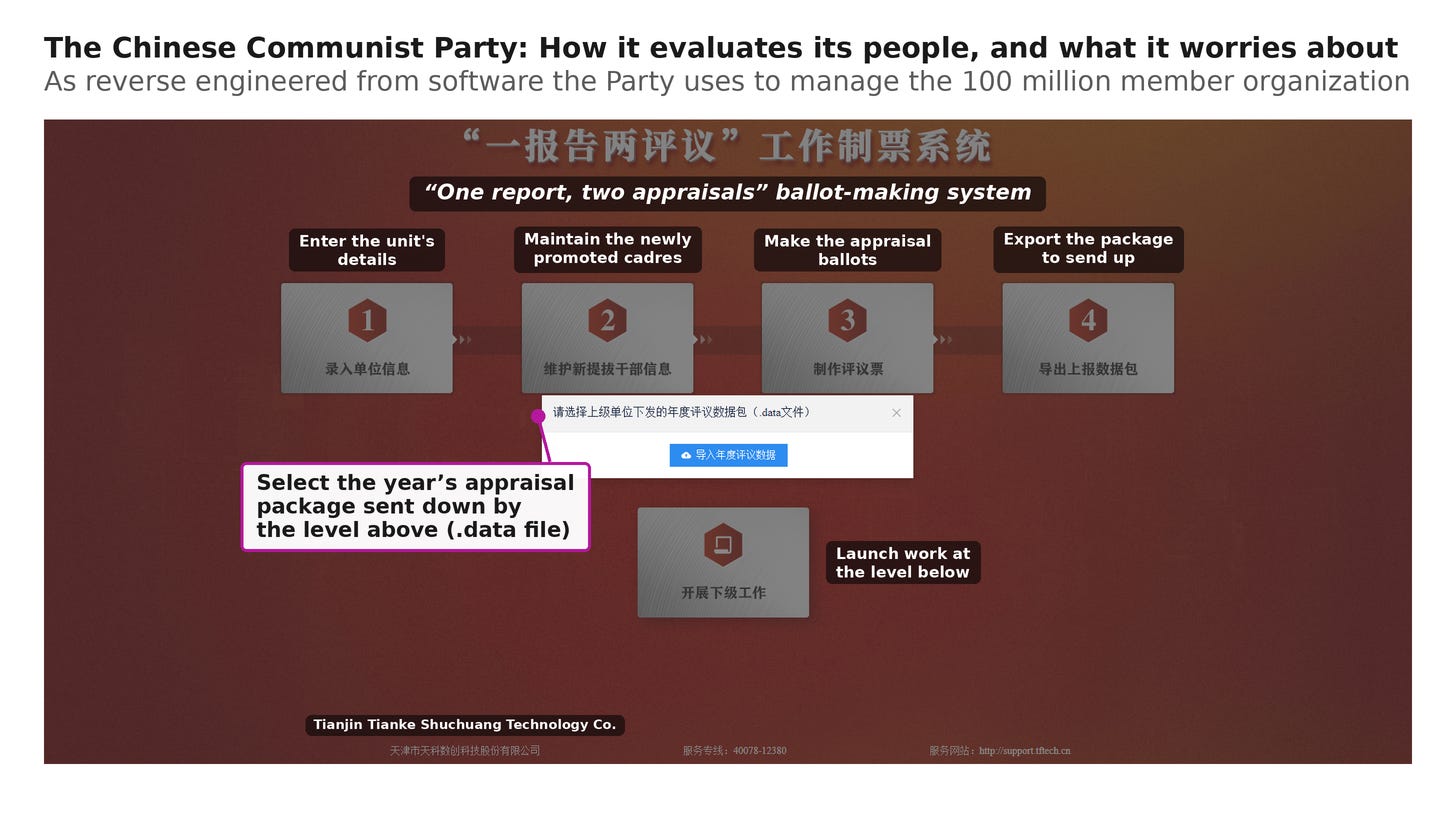
Anyone who has run a large organization knows that the anonymous staff survey and format of the annual employee performance assessments say more about whoever wrote the questions than about anyone who answered it. You’ll find a few innocuous questions to set a benign tone, and questions about what the leadership is really concerned about. The CCP does it all. They do yearly performance assessments of the Party members, the Party cadre officials installed into a post, and the leadership team of each Party committee. They check the committee’s boss on his way out of the job. They even put a poll into the field to see what the public thinks about the Party organization. We have windows into each. So start with the questions.
The scanned page below is a single printed sheet for the Inner Mongolia Earthquake Agency in 2021. It is titled the democratic appraisal sheet on the work of choosing and using people, class A (选人用人工作民主评议表(A类)). It was filled in by hand, and yes I stumbled over some of these. One of the sheets was for “Test Test Carrot”, which helps footstomp that they’re all probably test sheets. The questions are still the Party’s, and the questions are what this article reads. A class A appraisal is the sheet a member of the agency’s own Party committee or Party group leadership (党委(党组)领导班子成员) fills in. It rates the agency’s leadership selection of Party members into official posts as good (好) overall, and its strictness in managing and supervising cadres fair (一般). Then it checks off three of the ten printed problems:
selection (of Party members into official posts) as not strict and quality not high
appointing relatives and cronies, forming cliques (任人唯亲、拉帮结派)
and soliciting office, buying and selling office, pulling strings (跑官要官、买官卖官、说情打招呼).
The suggestion box is empty. The barcode names the poll, the unit, the form, the class and the page. But nothing about who filled it in. The appraisal forms do look anonymous.
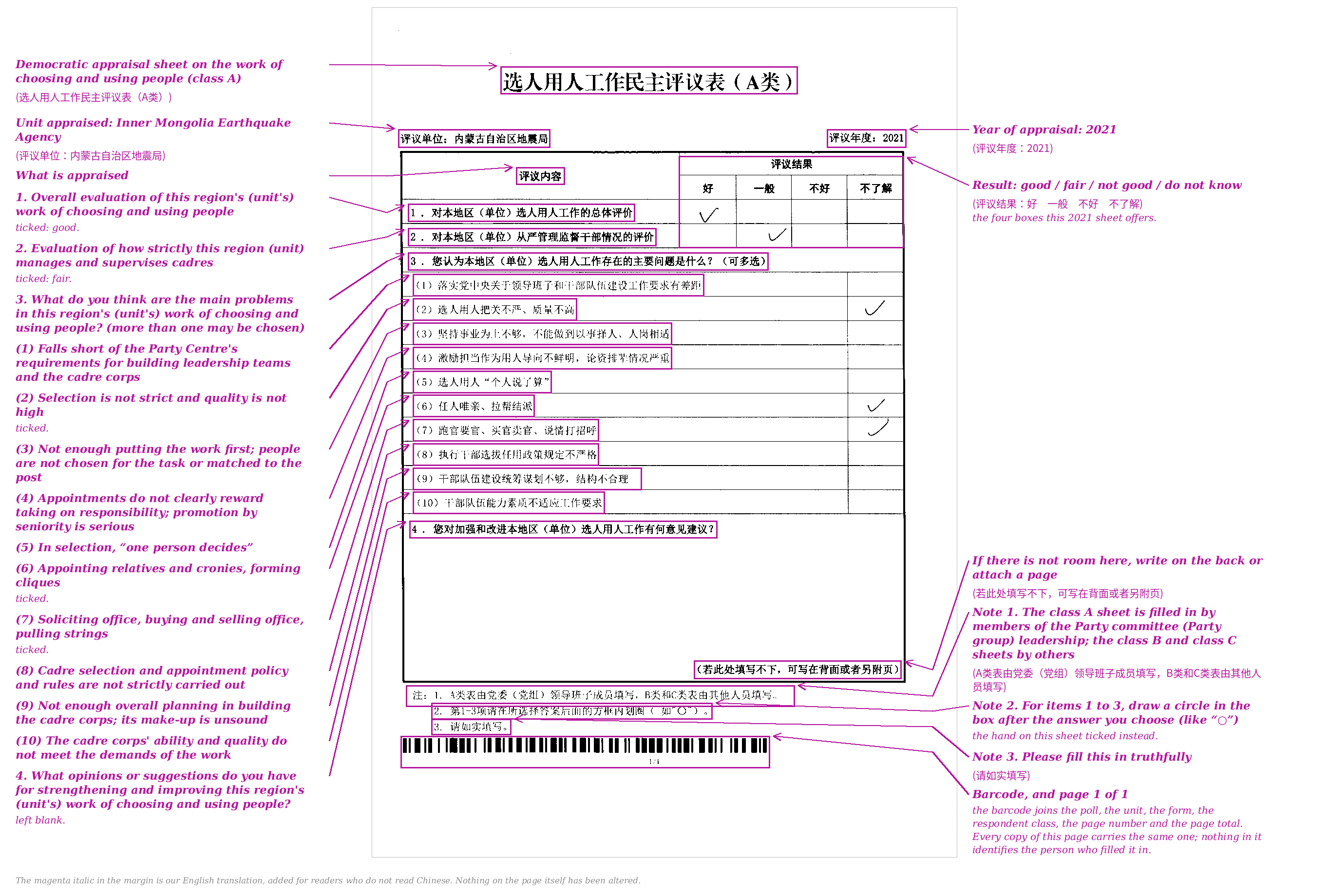
The vendor’s 2021 test round: a class A sheet printed for the Inner Mongolia earthquake bureau, rated good overall and fair on oversight. Three of the ten problems are ticked, including that posts are being bought and sold. N.B. this was included with others which were obviously test sheets, so treat it as a ballot they included just for software testing.
Picture a Chinese Communist Party member at his desk with the year’s performance assessment sheet in front of him. He works for a CCP bureau, firm, or university with a Party committee. If you read the last article, you saw that the Party has made a deliberate effort to put everything under the control of Party committees. In this worker’s case, he is being asked to rate how well that Party committee chose its cadres. Those are the officials whose posts the Party directly assigns members to. On the 2021 sheet above the worker is asked to rate it as good, fair, not good, or don’t know. Since 2023 the boxes read good, fairly good, fair, or poor. And then the form asks him to put a check mark next to the main problems of his Party committee. He doesn’t have to sign anything. The Party policy is that the feedback is completely anonymous. The software keeps it that way. The barcode is the same on every copy of a form, and nothing in the program ties a sheet to the person who filled it in. Truly anonymous feedback about middle management.
Now imagine what the Party committee thinks. If their party members notice their corruption then they can get ratted out on the yearly assessment. And if the boss of a city or county committee is leaving for a bigger job, his own people get a vote on how he chose his cadres. Fewer than two thirds satisfied, and the rule cancels the promotion once the organization department above him confirms the count. I’ve got to hand it to them, the CCP has built an aggressive machine for catching a corrupt boss on his way up.
Every year’s appraisal sheet is what the Party’s leadership wants to hear from its own people about its middle management layer, its committees and the officials they choose. It fundamentally changed in 2022. Since then it asks whether his committee puts political standards first and applies the political test when it picks cadres, and whether the committee’s top official is watched closely enough. The national sheet no longer asks whether posts are bought, although they do have a special phone hotline to report those. And in 2024 they dropped ten years’ focus on asking how many members had lost faith in the Party’s creed. But the members previously assessed as having lost faith have that permanently recorded in their CCP file for the rest of their doomed Party career.
Let me talk about the bottom line first before we walk through the CCP’s performance assessment system. Here are the risks, at each level of the Party, that the CCP leadership appears to be most concerned with. To be clear, this is me putting on my former CEO hat and reading how their assessments have changed over the years. The CCP leadership is very concerned about a local party boss corrupting an entire branch. One man deciding the appointments, nobody watching him, and the posts handed out on his way out the door.
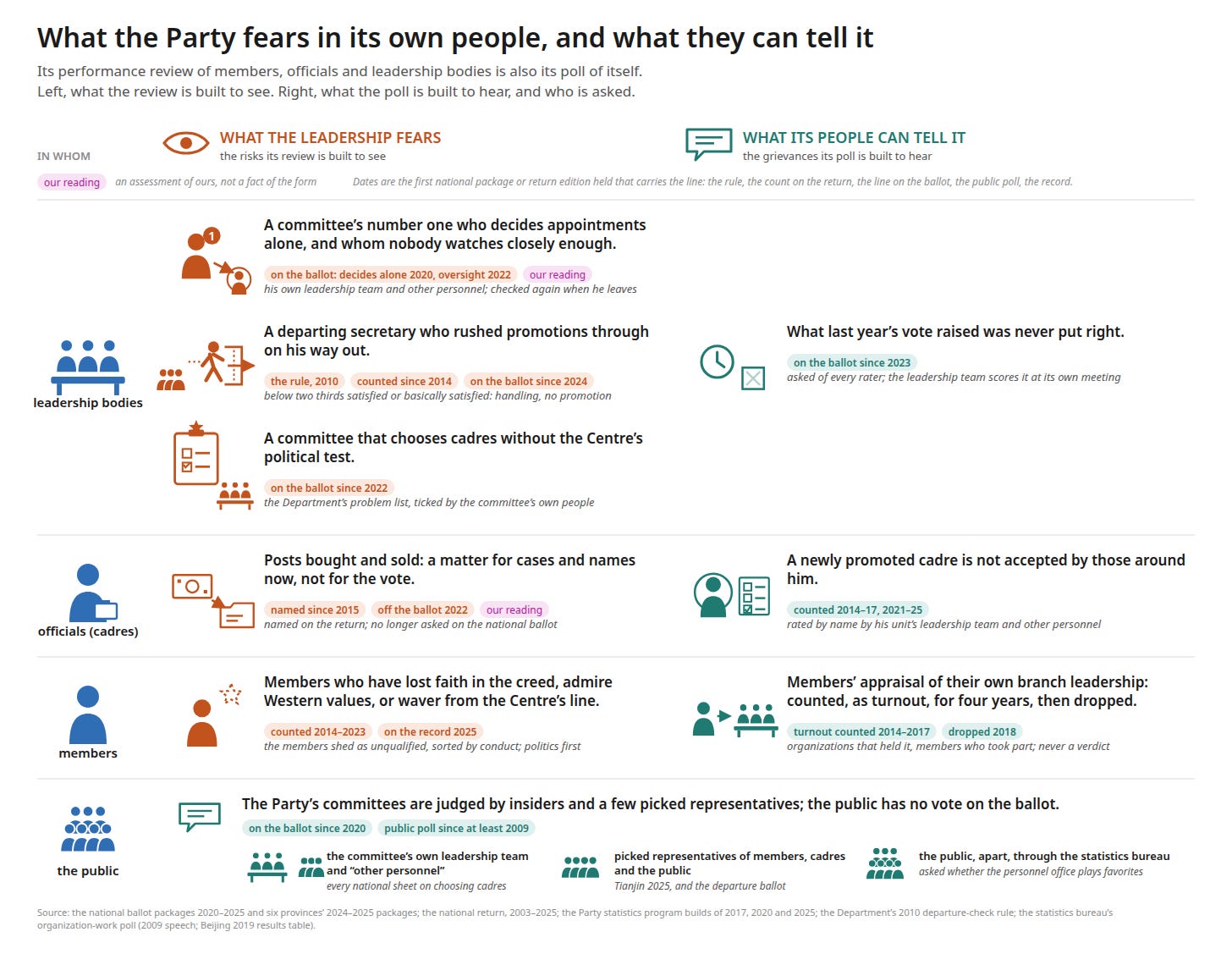
I think the review watches the committee boss first and foremost. The ballot hears insiders and a few picked representatives. The public is polled separately, by the statistics bureau (Beijing, 2019), on whether the personnel office lets improper practices into appointments.
The boss is watched in post and checked on his way out
The only officeholder the printed problem list names by his post is the local party boss, aka the committee’s number one (一把手). Four checks point at him. Since at least 2020 the ballot has asked his own people whether one person has the final say on appointments, which I read as the boss. Since 2022 it asks whether he is watched closely enough. A 2010 rule from the Organization Department, the Party’s central personnel office (中共中央组织部), has every departing city and county Party secretary checked. Promotions rushed through on the way out are the named thing to look for. And since 2024 the Department’s ballot program prints a departure ballot for him. Two of the four are new since 2022. I think that is where the Party Centre, the central leadership, now wants its people’s eyes. On the boss. Not on purchasing positions.
The departure check is the one with teeth. When a city or county Party secretary leaves his post, the organization department above him checks how he chose his cadres. His own people rate his personnel work and he must have two thirds “satisfied” or “basically satisfied” approval. If he falls below it, and it is confirmed at the department level, then he is handled organizationally, meaning just short of official Party discipline. Any promotion he was leaving for is canceled. The annual statistical return from the last article is the report every organization department sends up the chain. It has carried a row for those departure checks in every edition held since 2014.
In 2024 the assessment ballot program gained a departure sheet of its own. It asks the departing boss’s unit whether he, by name, clearly broke personnel discipline or rushed promotions through in his term. It lists his recent promotions for rating. It also opens the vote to a class of rater the 2010 rule never listed: representatives of grassroots members, cadres and the masses. More people get asked about a departing boss than the rule requires. The CCP has a solution to “up and out”.
The big 2022 redesign
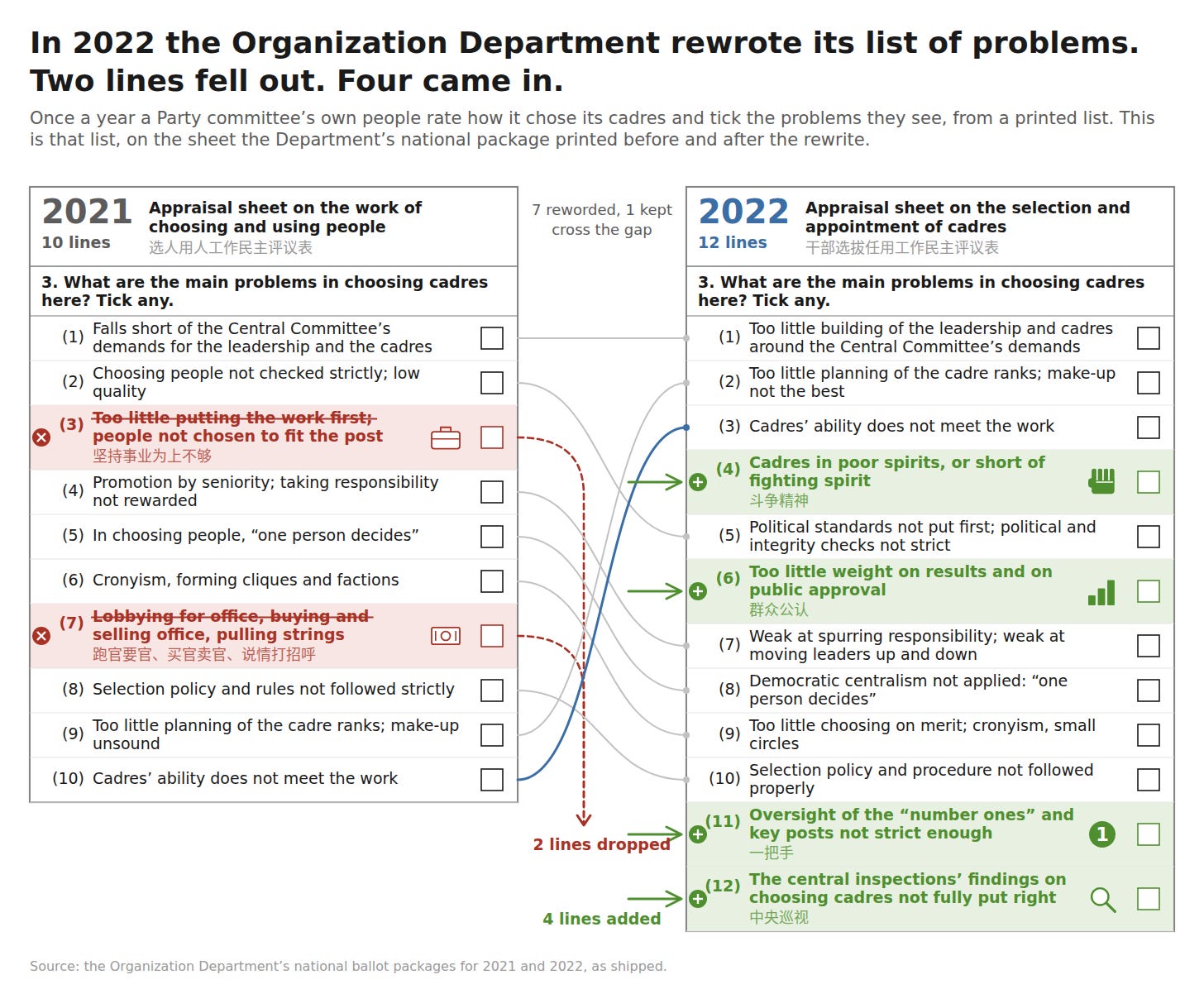
The assessment was rewritten for 2022. Buying office postings and choosing people to fit the post disappeared. Four new questions came in: fighting spirit, results and public approval, oversight of the boss, and the central inspections’ findings. The twelve lines have not changed since.
The 2022 assessment ballot looks like it was completely rewritten. Caveat lector: I am certainly not Chinese. I read the changes: the Party leadership took a heavy pen to seven of the ten questions, dropped two completely, and added four new questions. Two of the four new questions are the Centre’s inspectors and the oversight of the boss. The other two ask about fighting spirit and about results as well as public approval. N.B. that question puts “results” on an equal footing with “public approval.” I found that incredibly interesting, and it read like a change from the CCP’s historic technocracy to a more traditional political outlook.
Among the reworded lines, the first still asks whether the committee builds its leadership around the Party Centre’s demands, now more sharply. The old line on lax checks now names the political test and the integrity test. One-man decisions now reads as a failure of democratic centralism. Two lines fell out, office-buying and choosing people to fit the post, and promotion by seniority was struck from inside a reworded line. Post-fit and seniority are career complaints, the ones a passed-over cadre would tick. Set the 2022 list beside the 2021 one and it asks a committee’s people mostly about political and procedural failings. Of the old transactional complaints only cronyism and small circles remain.
The sheet was renamed too, to the appraisal sheet on cadre selection and appointment (干部选拔任用工作民主评议表), which is the same name the Department’s own 2010 method gives it. The twelve lines are the Department’s own wording. I could not find them in any published regulation. I read the big 2022 changes as the Department pushing its policies down into the processes and procedures actually employed by the Party. It was execution finally matching policy.
Purging underperforming Party members
The Party’s members get the same treatment as the bosses from the same statistics software. Since 2014 the Department has defined an unqualified member as one who lacks revolutionary will, does not perform a member’s duties and no longer meets the conditions of membership. That doesn’t just go in their personnel records. The unqualified member is fixed, or fired.
It is a three-part process:
they are told to reform by a deadline, like a Western performance improvement plan (PIP)
they are persuaded to withdraw from the Party, which in Western management practice is called “managing someone out”
they are struck off the Party roster. They’re fired from the Party.
The last two steps are out of the Party. Until 2013 the member would have been expelled by a branch vote, or via referral to the discipline inspectors until 2017.
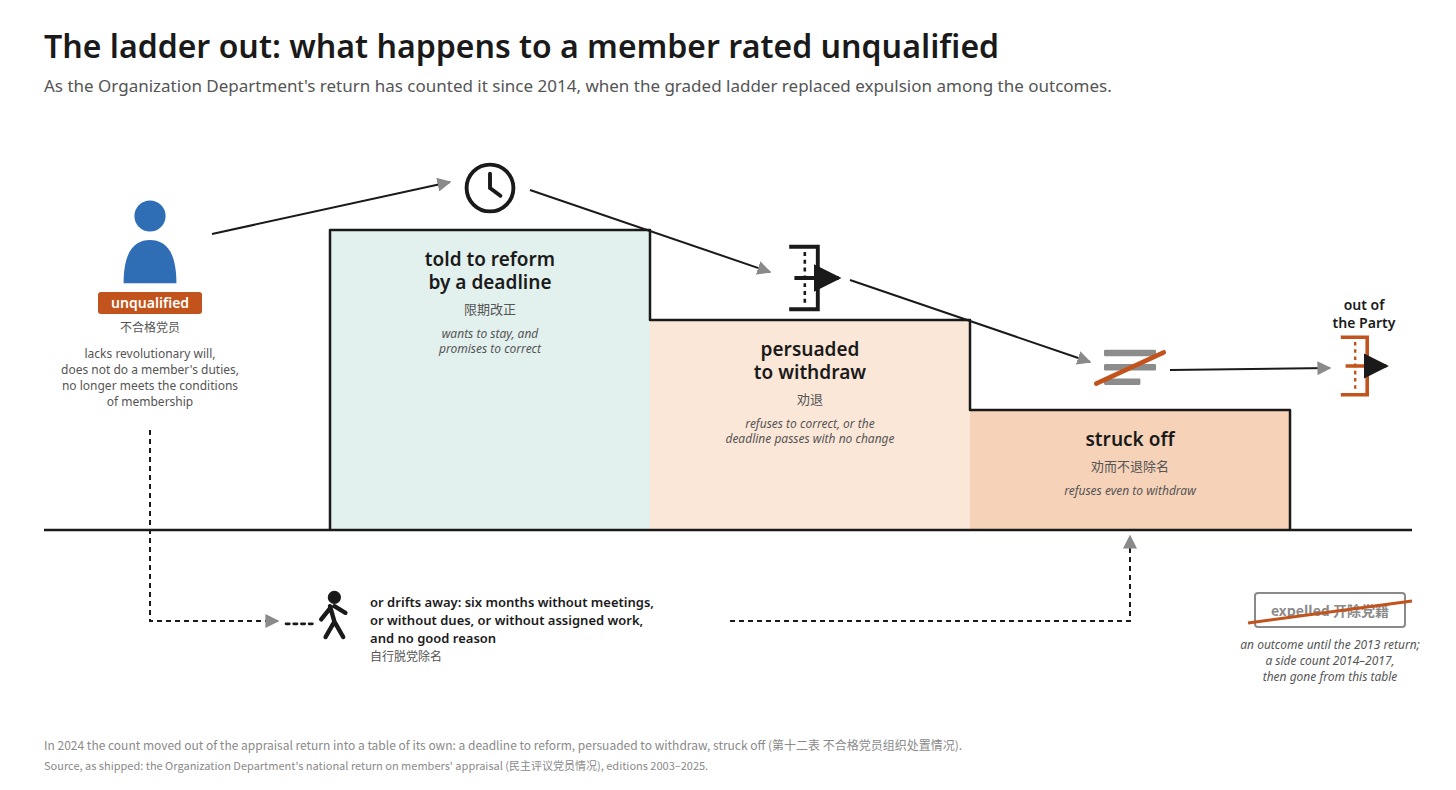
A member rated unqualified is handled in three steps.
The Party software tracks six reasons for unsatisfactory performance:
loss of ideals and belief (which is further defined as including admiring Western values and social systems)
wavering political stance
a weak sense of purpose
passivity at work
lax organizational discipline
moral misconduct
They stopped asking why in 2024. They still track them them as the reason for leaving in the 2025 software, but they stopped reporting it up to the national-level statistics.
Party members vote on appraisals, the public is polled separately
The Party calls the whole exercise “one report, two appraisals” (一报告两评议). Once a year the committee reports on how it chose its cadres. Its own Party members appraise the choosing as well as the newly promoted cadre members themselves. It is a poll of insiders. Every national package we hold prints two classes of voter for the sitting review. Class A is the committee’s own leadership team. Class B is the “other personnel” the round invites, which in a bureau can be the Party member. For a city or county committee the Department’s 2010 method names that circle. It is the rest of the full committee and the leaders of the other Party and state bodies at that level. For a bureau or a firm the sheet says only “others”.
The open public has no vote on the ballot. The masses reach it only as picked representatives: Tianjin’s 2025 package adds them as a class C, and the departure sheet has them as a class D. I have really sparse data on this public polling.
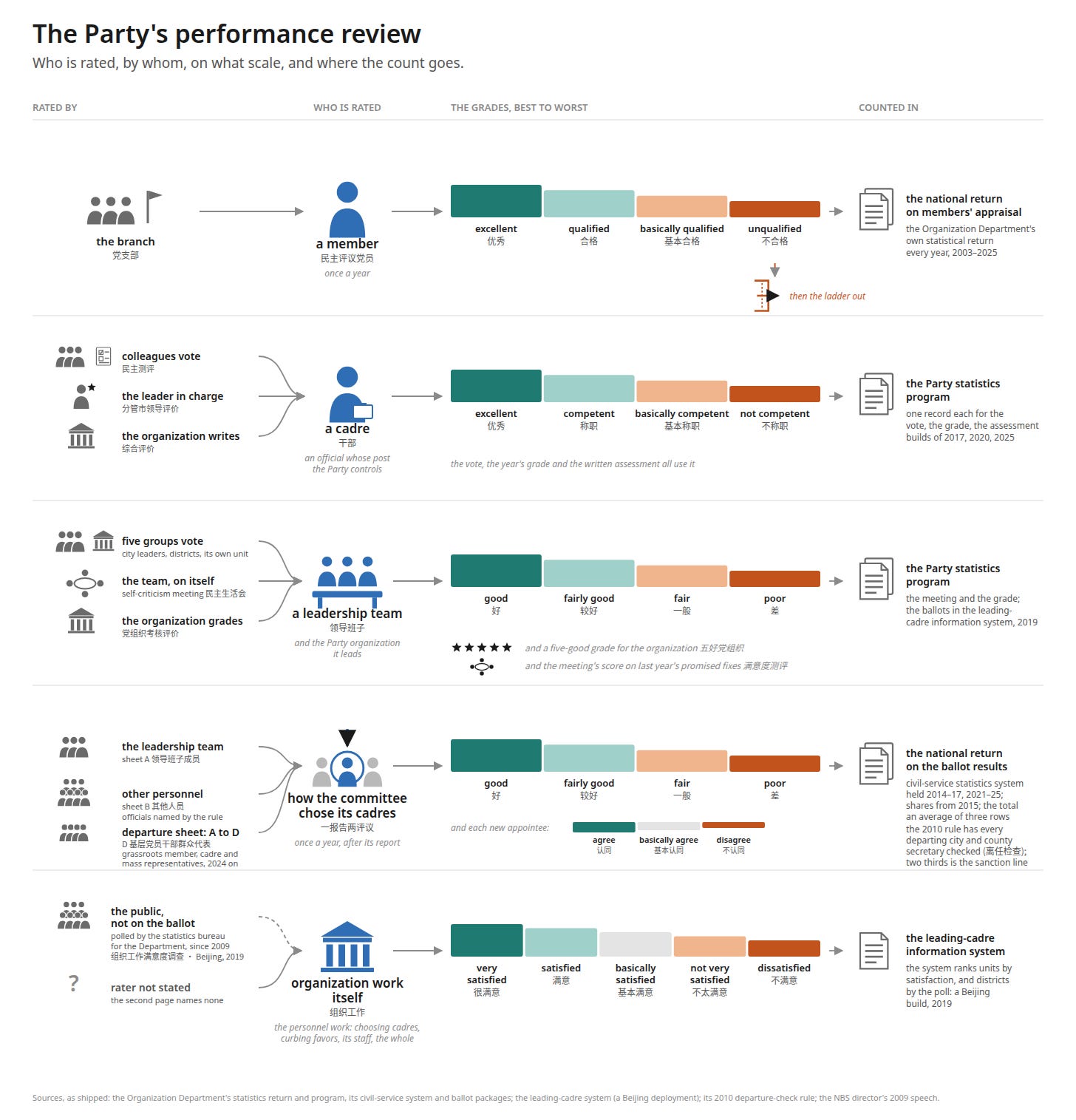
Every rating in the review is a short ladder of three to five steps. Every rating but that of organization work reaches the Department’s national return or its statistics program, though the leadership team’s ballots stay in the leading-cadre system.
The public is polled separately. The state statistics bureau has run an organization-work satisfaction poll for the Department since at least 2009. The one results table we hold, Beijing’s for 2019, asks four questions. One of them is how well the unit prevents and corrects improper practices in appointments. So the Party does ask the public whether its personnel office lets favors into appointments. On the national ballot its own people get the same complaint as one line: cronyism and small circles.
What reaches the Centre is an average. In every software version I have found since 2015 the return has carried each answer as a share. A province’s figure is the simple average of three rows: its own committee, its prefectures and its counties. Each row is itself a simple average of its units’ shares. A committee of ten voters weighs the same as one of a thousand, and the provincial committee’s verdict on itself counts for a third of the province’s. The Centre reads this poll by committee, not by voter.
Wrapping it up
The Chinese Communist Party crowdsources its oversight of middle management, and it manages out its underperforming Party members. It all reads like they got serious in 2022 about weeding corruption out of middle management and removing Party members who aren’t true believers. In Western (tech startup) management theory we call this the missionaries versus mercenaries philosophy. Your missionaries are your true-believer employees (or Party members), while your mercenaries are just in it for the money or the power. An organization of missionaries is built to last. The 100,000,000-member Party is rebuilding itself to last. I’m impressed.