
We took apart twenty-one of the personnel programs the Chinese Communist Party (CCP) and the Chinese state run (fifty packages, nine vendors, 2004 to 2026, including 144 databases, and their documentation). This is one of eight articles on how the CCP and the Chinese state are actually organized, extracted from their own enterprise software systems.
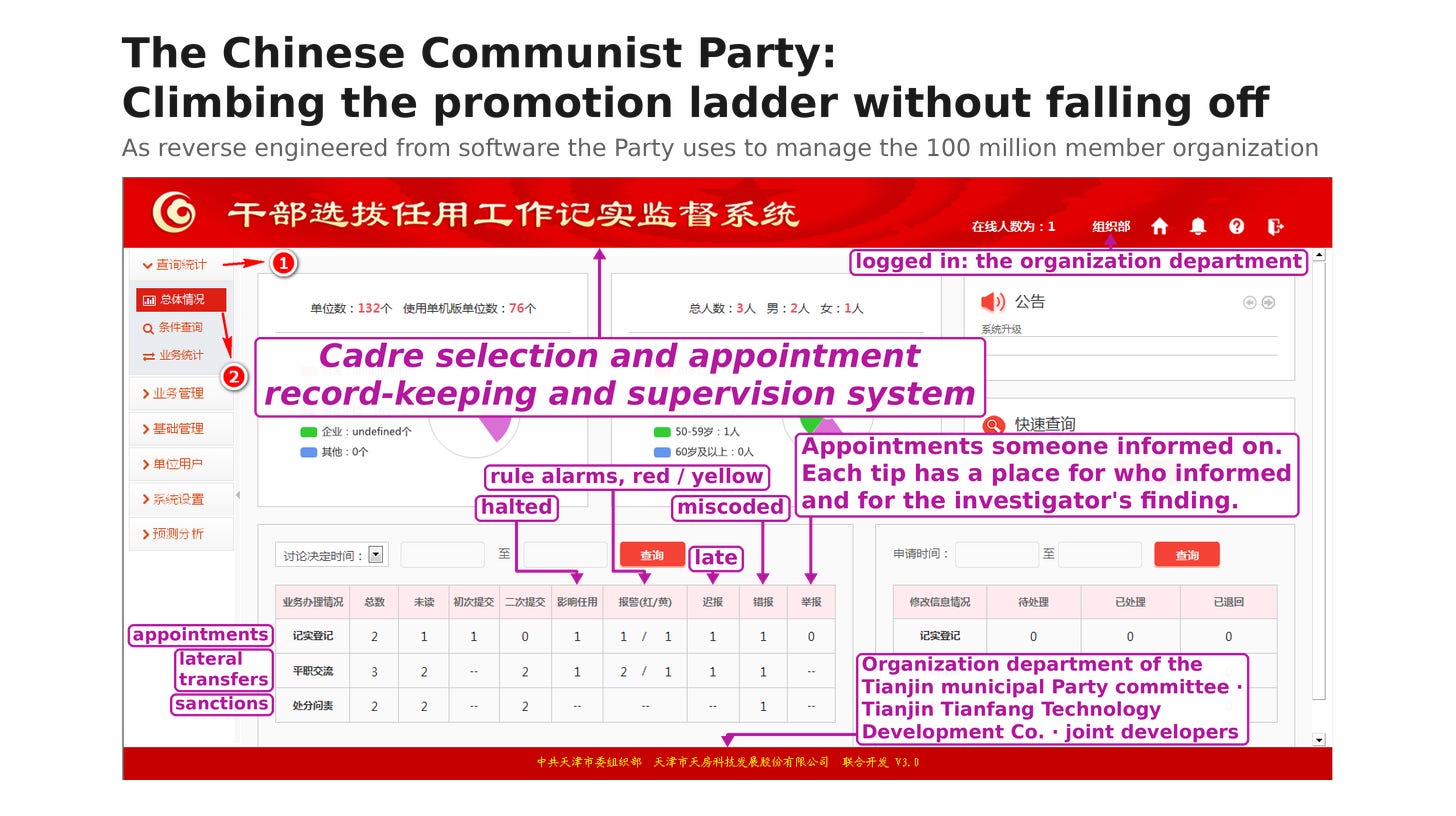
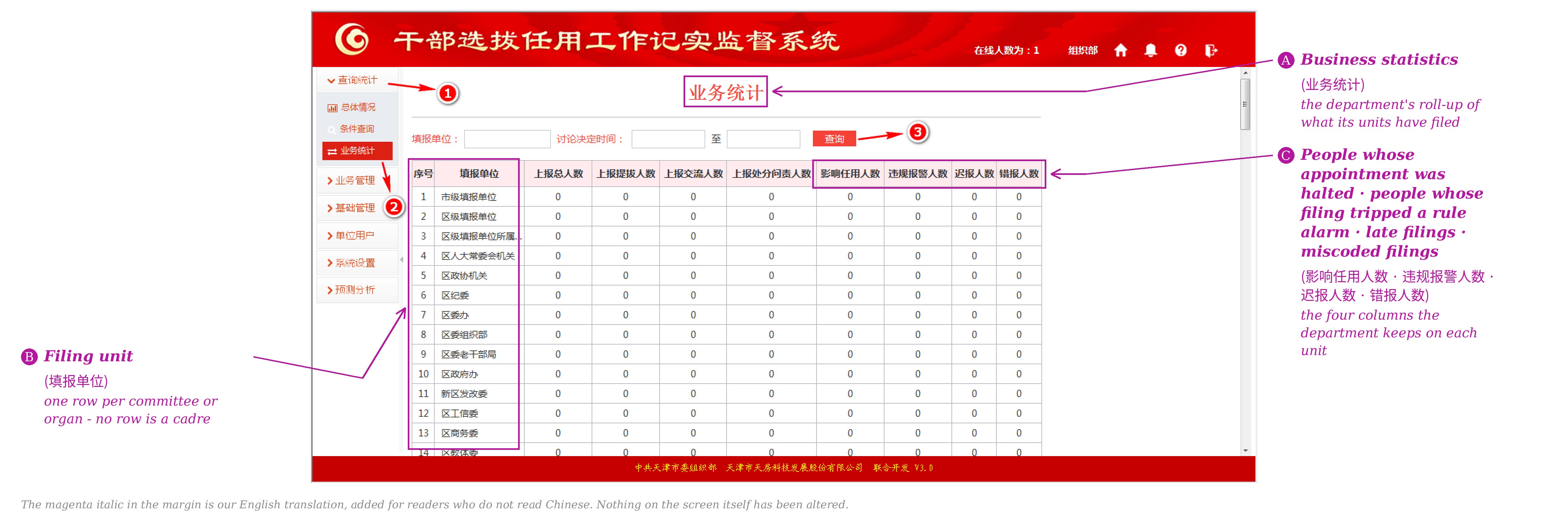
The Party personnel office sees what went wrong with its committees’ candidates. Note the column for informant tip-offs about candidates that trigger an investigation.
The top leadership of a large organization does not choose who gets promoted three levels below. It has neither the time nor the knowledge. The summary of the CCP promotion process is that the leadership decides which promotions or positions need permission from above, they count those that went wrong, they punish the leaders who made bad promotions, and otherwise they let the local leader appoint whomever they want to a position. If you only want one takeaway, then understand that the CCP is remaking the Party by punishing the leaders who make promotions or position appointments where the person later fails, or is found to be not politically aligned with the Party.
Once a year the Party’s Central Organization Department (中共中央组织部), the Politburo-led personnel office of the whole Party, sends every provincial, city and county organization department a form to fill out and return. The forms are included in the Party’s own statistics software so we can analyze them. Five of its tables are about what goes wrong in a promotion. It doesn’t ask for names, but it asks what the committee did:
which exceptions to the ordinary promotion ladder they asked for
how many were refused
which candidates were stopped after the committee had picked them and why
which leaders were punished for running a bad selection
which sitting leaders were warned before there was a case against them
since 2022, which leaders were moved down, on which grounds, and which of them climbed back
A sixth table counts the Party’s bench of young leaders. That is their talent pipeline. But the center doesn’t actually pick anyone; it only counts refusals, halts, penalties, warnings and moves. It’s good management. The Party lets the system work, tracks when it doesn’t work, and then it steps in.
Where this gets really interesting is reading how the process changes across twelve years for which we have both the paperwork and the software that actually analyzes the paperwork. It allows inferring what the CCP leadership really cares about. Because if you’ve ever run a large organization you understand how important it is to cut out the cancerous people who otherwise metastasize their way to the top, and to make sure the culturally healthy talents’ careers are progressing. If we look at the CCP itself, they started by allowing exemptions to the process and spent a few years tuning that process. Then they have been spending a few years figuring out how to remove promotions which haven’t worked out, which now looks all the way up to governors and ministers. But the management approach, which I admittedly had never thought of, is that they actually formally halt the career of the manager when they have been promoting poorly. I’m gonna put that one into my leadership toolbox.
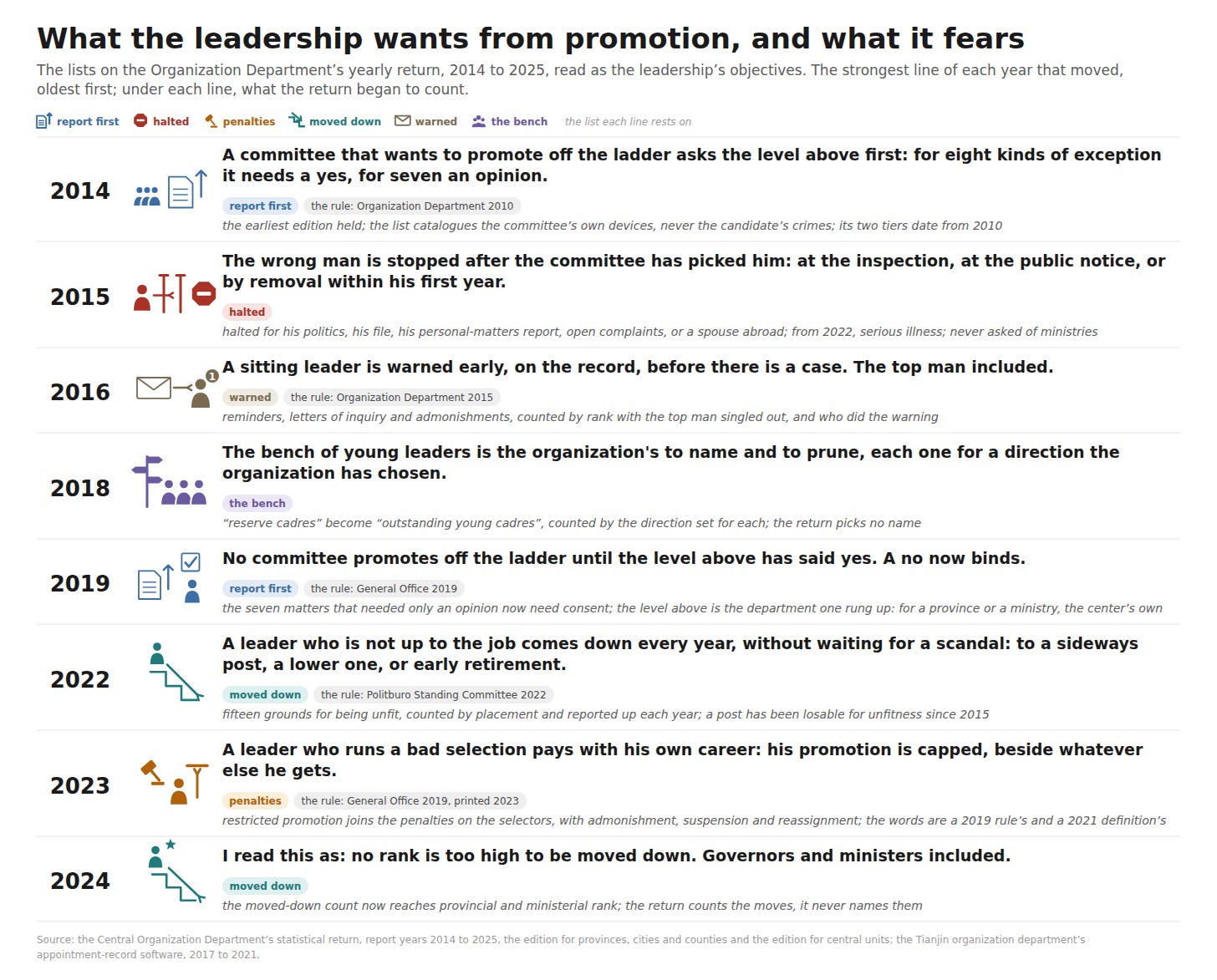
My first reading of these changes was that the Politburo had decided to clean up the promotion process and take it back from the committees. The documents say otherwise. The acts that clean up selection are three: the personnel office’s 2014 order for four checks on every candidate, and the General Office’s rules of 2016 and 2019. Those rules made the checks formal policy and the exceptions require the level above’s formal consent. Each says why in its own words: stop cadres being “promoted while corrupt”, and punish irregular appointments. The Politburo’s or its Standing Committee’s name is on two other policies: the 2018 opinion on the talent bench of young leaders, and the 2022 rules on moving bad leaders down. It’s not just that they’re cleaning up the promotion process. The leadership defined who they want as leaders, and how they get rid of the leaders they do not want. This isn’t just an anti-corruption drive. This is completely reshaping a 100 million member organization. The largest organization I ever had to completely reshape was 100 members and that was probably the most stressful period of my life.
Stopping the wrong candidate after the committee has picked them
The CCP’s Organization Department made a blunt statement in a January 2014 question-and-answer column: the anti-corruption campaign had found cadres who were promoted while corrupt (边腐边升). Remember that the Organization Department is led by a member of the Politburo. The Department ordered four checks on every candidate: get the discipline organ’s opinion, verify his reported personal matters, audit his personnel file, and investigate any complaint that arrived while his name was publicly posted as a candidate. In 2016 the General Office made the four checks required for every promotion. I can’t tell how much we in the West would consider to be an HR process versus a security-clearance-style background investigation, but I guess those aren’t too far apart for senior executive positions anyway.
In 2015, they started tracking statistics of how many and why candidates were suspended or dropped during the inspection and public-notice stages. The reasons they tracked were:
political beliefs and conduct
a problem in the personnel file
the personal-matters report
reports of corruption or misconduct
family living abroad. This is what they call the “naked official”.
in 2022 they added a category for serious illness
They also ask a harder question: how many appointees were removed within a year of appointment after an investigation. A stop before the appointment is the process working. A removal within a year is the process failing. And they’re counting both at the national level.
This is what the software looks like to the chair of the Tianjin municipal committee’s organization department. Specifically, these are the halted promotions.
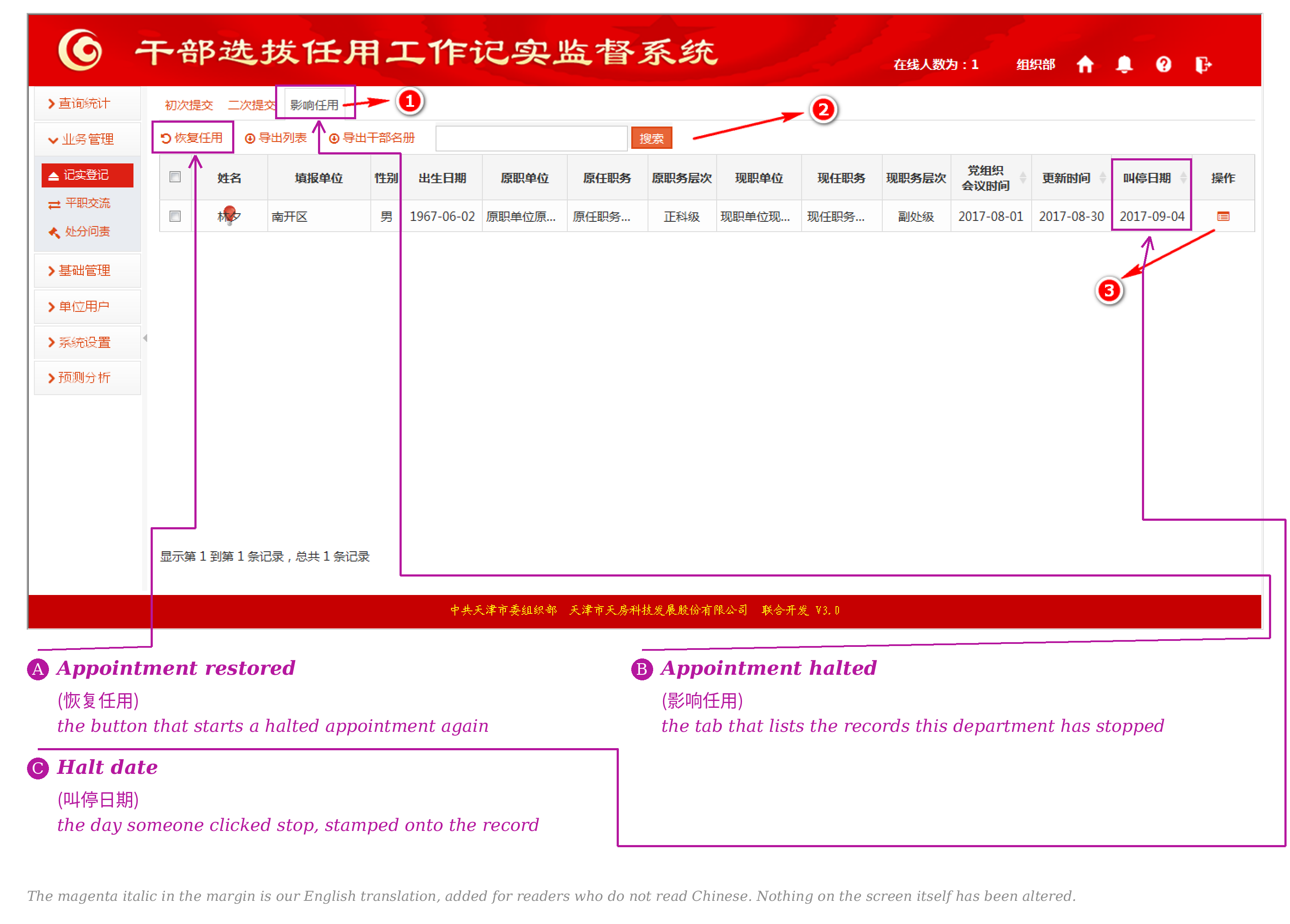
The department’s halted list. Halting stamps the date on the person’s record, and moves their record here to the halted list. Restoring puts it back. Only a top-level office in the system sees the halt and restore buttons. (This is the vendor’s demonstration record and not a real person.)
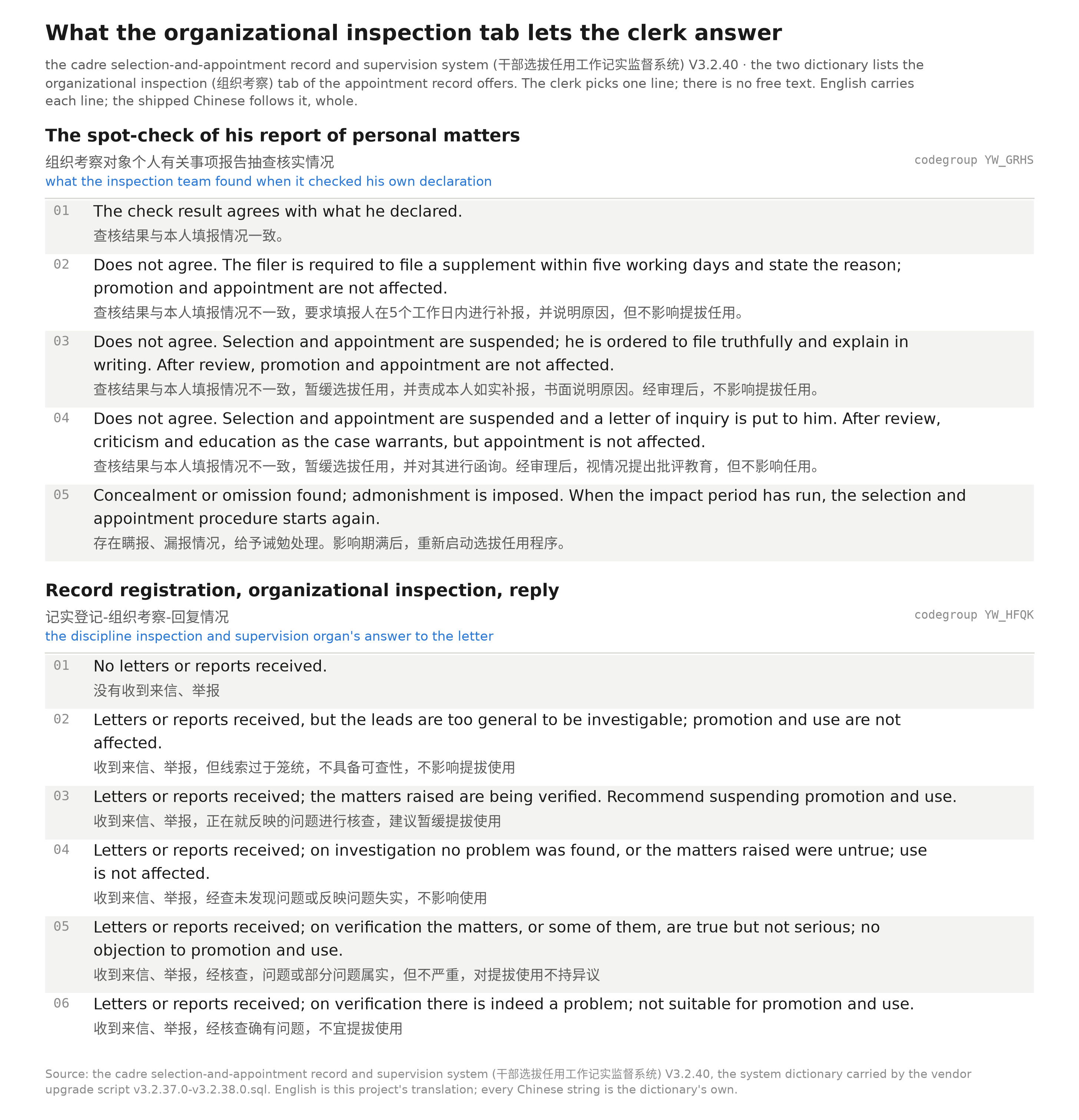
When the inspection team writes up its visit of the interview with the candidate, they have to answer two primary questions that end up in this record:
Did his declaration of his own personal affairs match what the checkers found?
Has anyone written in about him, and what did the discipline organ find?
Each adverse line carries its consequence. In the Party’s own words, the last line of the first list reads: concealment or omission found, admonishment imposed, the selection starts again once the waiting period has run.
The inspection team can give him five grades for the personal affairs, and six grades for inspecting his records. The description of the grades was lifted directly from their software, and translated in the figure below.
Punish the bad promoters, and warn the sitting leader
The promotion or appointment is just two signatures on a sheet of paper. The software fills out the form with the candidate’s c.v. from their own file, and prints it out. The proposed job posting and the post the person would leave vacant are not filled out by the software. I assume they’re written in by hand. You can see the form below. If you read it, keep in mind that the two people who sign off on a promotion are two of the people punished if it was a bad promotion.
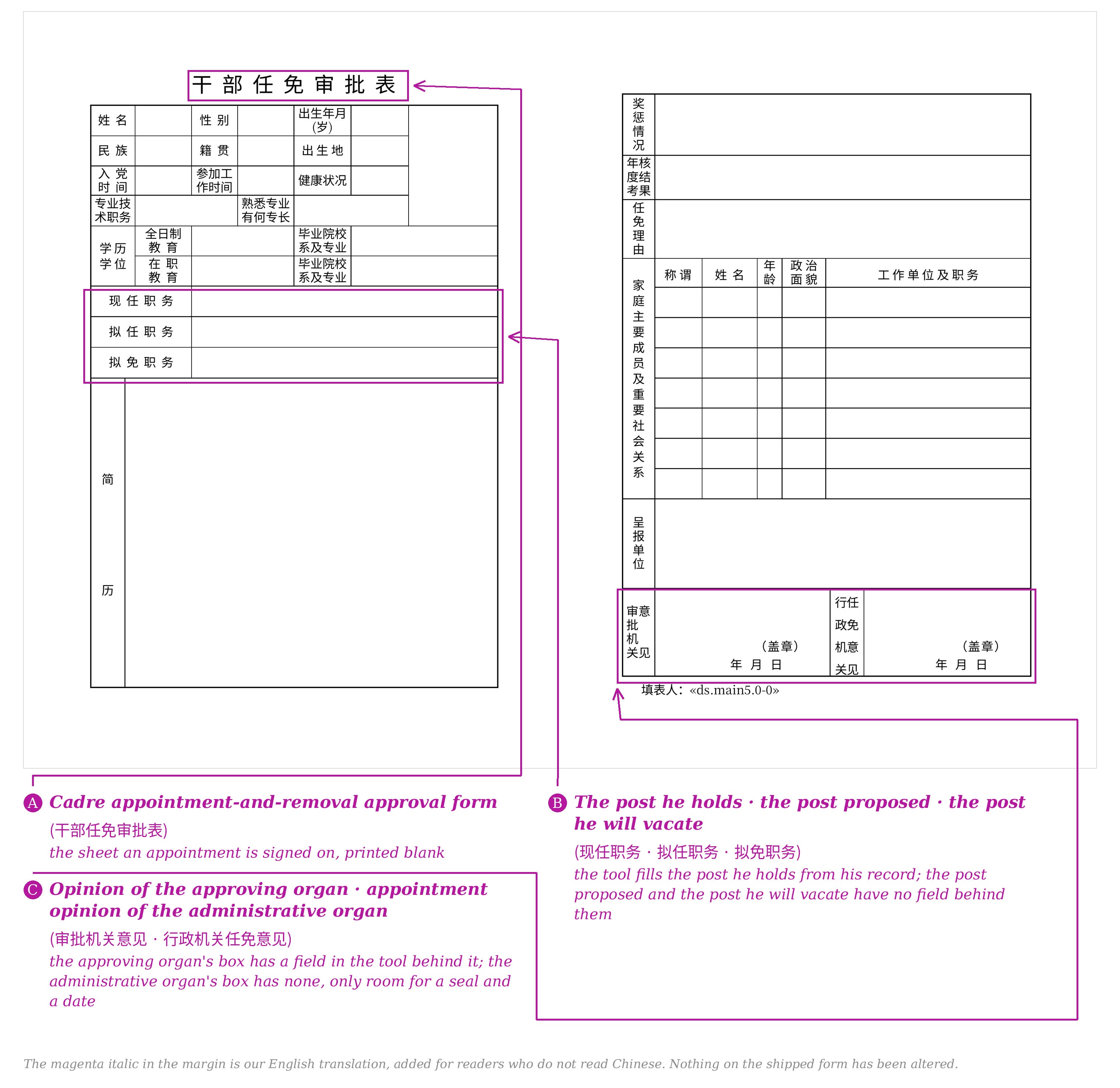
The earliest software I could find comes from 2014 and it already included twenty penalties handed to the leaders responsible for a bad promotion or selection of a Party member to a cadre posting. So I don’t know when the Party started punishing leaders for bad promotions. And in 2014 those punishments ranged from criticisms to criminal punishment. Let me footstomp something to someone who has never been a CEO or CFO, which are officer positions subject to criminal prosecution for the actions of the organization. Criticism and threats of civil (nuisance) litigation are so frequent that it’s just part of the job. But you always take things seriously when they’re subject to a criminal prosecution.
And China subjects CCP leadership to potential criminal penalty for promoting or appointing bad CCP members. Let me put that another way: a CCP leader is subject to criminal prosecution for the actions of someone they promoted or appointed to a position.
From 2016 the local levels’ return also counts the warnings given to sitting leaders before there is any case against them: a reminder, a letter of inquiry or an admonishment. It counts them by rank, with the committee’s top man on his own line. It records who did the warning. From 2018 it counts how often a department closed a letter of inquiry by believing the leader’s written reply. The Department’s stated reason for the rule was strict management combined with care. That is the Department deciding that a leader who explains himself can be cleared, but they’ll count how often it happens. That very effectively messages that the leader might get away with it once but treating it as a loophole to exploit repeatedly will put them on the top of the Party’s naughty list. And it’s right there in the Party software that you can see below in Tianjin’s software. The department’s statistics page has one row per filing unit, its committees and organs. The columns count appointments halted, rule alarms, late filings and miscoded filings. That’s the naughty list. In 2023 they formally added a restricted promotion penalty for those who make bad promotions.
The boss above must say yes, or sometimes just not say no
The 2014 software already included a list of promotions a committee must report to the level above before it acts. The list includes promoting people while the leadership is about to change, the boss’s secretary or his relatives, jumping a favorite past a grade, skipping the recommendation vote, and bringing a punished leader back. There were fifteen items. And yes, they include the boss’s secretary. I’ll let you read into that one. Eight of them required the level above’s explicit approval; the other seven needed to write it up and only wait for the level above’s opinion. In the latter case they could choose to ignore the boss’s opinion. But remember, criminal penalties...
The CCP General Office rewrote the rules in 2019. The big change: the boss’s answer was always followed. No candidate goes to the committee’s meeting until the level above has replied with its affirmative consent. A decision made against the answer is to be corrected. And in Tianjin’s software everything is dated such that promoting someone before the level above consents results in the person’s record lit up in red.
They also changed the valid reasons for the exceptional promotions. Three of them were narrowed to extra posts above the quota only as a passing effect of restructuring, and a skipped vote only for a committee’s own special need. The third, a spouse abroad, was narrowed to only high-level talent in a restricted post.
The center tracks statistics nationally: how many requests each level received, and how many it refused. That data is asked of every provincial, city and county organization department, and of the personnel departments of the central ministries. No, I haven’t found those statistics yet. But I’m looking. Regardless, it tells every half-competent middle manager that they are being compared against every other middle manager; deviations will stand out, and will probably be investigated.
The long march back for a disgraced leader
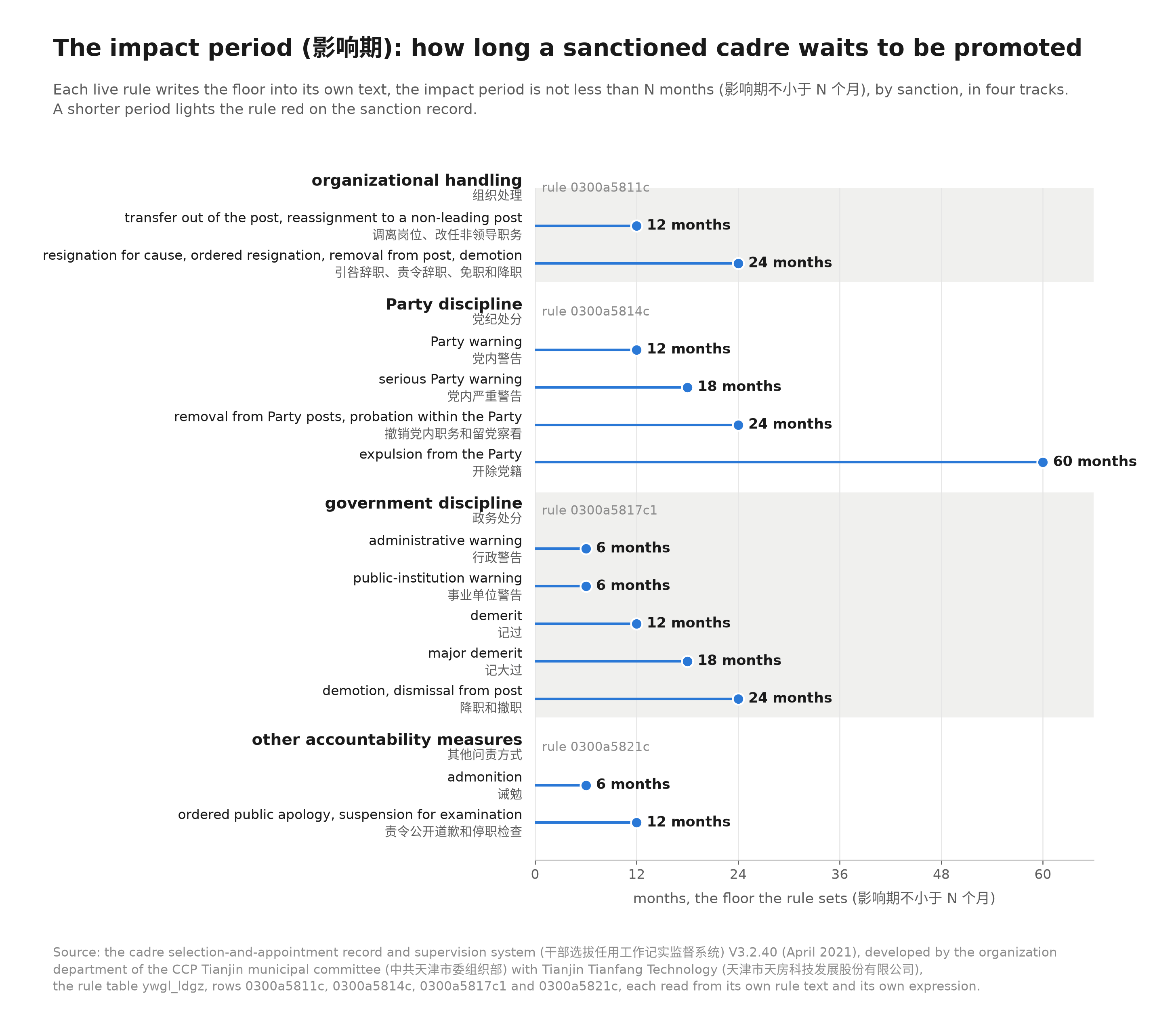
Remember, in 2019 the rules were rewritten so that the local committees didn’t have flexibility in applying those rules. And the software itself enforces the penalties before a fallen leader can be rehabilitated into a leadership post again or a promotion. And if a local committee does it anyway then that person’s record is lit up in red and sent up the chain. You can see the penalties in the figure below as they were extracted directly from the CCP software. I found it interesting that expulsion from the Party is only for five years.
Count who is moved down, and who climbs back
Since 2015, a Party leader could lose their post for unfitness without any disciplinary case as long as it met one of ten reasons. The Department reported more than twenty thousand county-level and higher cadres adjusted under it by 2017. The Politburo Standing Committee (PSC) revised those rules in August 2022 to include fifteen grounds for unfitness and that the results would be reported upwards. Two of the unfitness grounds were political capacity and wavering belief [in the Party]. But they did affirm that a demoted leader may be a leader again, promoted in rank, or promoted in post. And that every organization department must report the previous year’s moves to the level above by the end of January. The software’s form itself counts leaders moved out of a post for cause and by placement. The first cause for demotion is unfitness. They count those moved down in a previous year who rose again.
If I read between the lines, the Party has reduced the barrier to removing bad leaders who haven’t been caught doing something wrong. Western leaders will understand the difference. The American management phrase is start documenting, meaning start assembling the documentation needed to fire them, and it generally takes weeks or months to actually fire them.
In the West, when you know you’re probably going to have to remove someone from a position is when you start documenting. I read the Chinese system as a way to remove a leader for bad performance or weak political capacity when there is no documented cause yet. They made it easier to remove, but also easier to rehabilitate when the leader needs it, and to bring the person back in the case of an unjust removal. Because moving down is intended to be provisional. Even expulsion from the Party, the Party death sentence, is only mostly dead for five years.
In 2024 the software added two rows at the top for full and deputy provincial-and-ministerial rank. The Third Plenum that summer called for moving leaders up and down to become “normal”. The software was changed in a way that confirms no rank is too high to be moved down.
The CCP has been remaking the Party through the promotion process and how they appoint Party members to official positions (including positions in the government). By 2024 they had started remaking the provincial and ministerial rank. If a leader promotes or appoints a person that the Party disagrees with, then the leader’s own career is impacted. How to remake a 100,000,000 member organization: force leaders to develop their staffs’ skills and political alignment because if your people fall off the career ladder then they knock you down a rung too.