
We took apart twenty-one of the personnel programs the Chinese Communist Party (CCP) and the Chinese state run (fifty packages, nine vendors, 2004 to 2026, including 144 databases, and their documentation). This is one of eight articles on how the CCP and the Chinese state are actually organized, extracted from their own enterprise software systems.
Raise your hand if you’ve been through the background checks and/or polygraphs for a US government security clearance. The Chinese Communist Party puts their leading officials through something remarkably similar. Every year, officials from deputy county head up sit down with a standard form that asks about their marriage, health, passport, their spouse’s job, their children’s spouses, every apartment their household owns and the money it holds abroad. And they re-sign a pledge like Americans sign the SF-86 Questionnaire for National Security Positions. We can all revel in security paperwork, together, comrade.
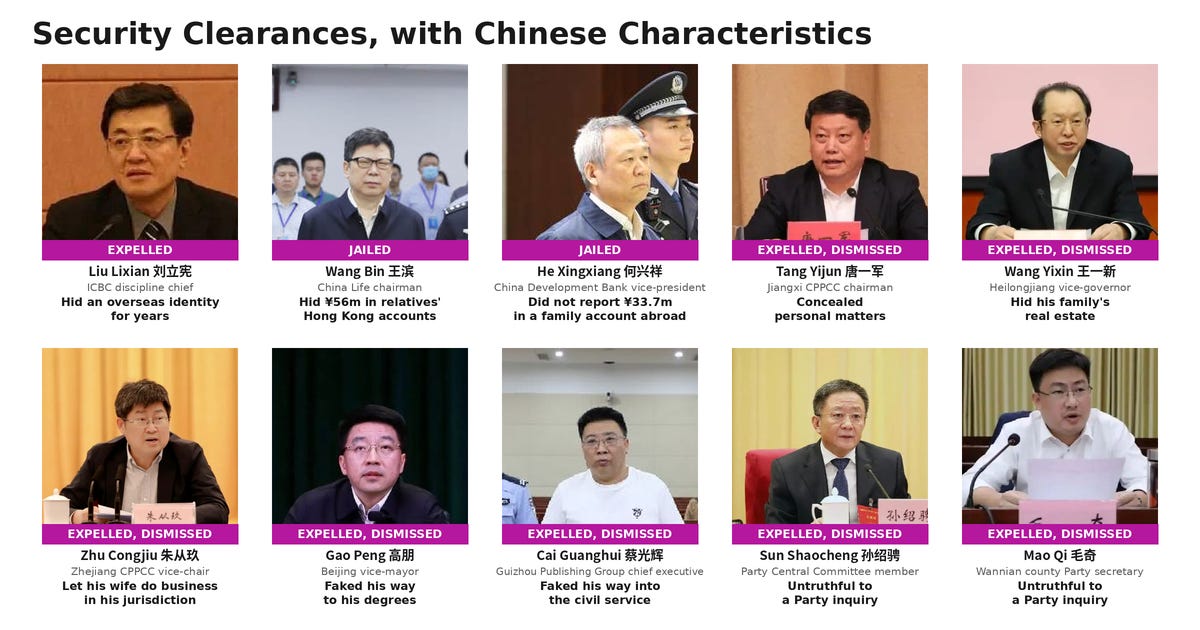
Ten officials the Party expelled or a court jailed between 2023 and 2026. Each Party notice and court report names a breach of their background check paperwork. Money in Hong Kong, a family account abroad, hidden real estate, concealing personal matters, a wife’s business in his own jurisdiction, a faked degree, a faked civil-service status, an overseas identity kept quiet.
Remember when we all had to update our security paperwork and take another counterintelligence polygraph after Snowden, and update it again in the early 2020s to get enrolled in Continuous Evaluation? Something similar happened in China in 2023 and 2024. Their background investigation paperwork said fill it in as if you had never filed before. And they did it again in 2024.
The amusing parallels continue. In the US, our counterintelligence polygraphs are relatively random. But we would still have to fill out our financial disclosure forms every two years, and our Special Access Program (SAP) Personal Security Questionnaires (PSQs) every time we needed to be read in to a new classified compartment. And we had to update our security paperwork every five years. In China, they get randomly selected one-seventh of the time for a reinvestigation, and they have to fill out their financial and security paperwork every year. They undergo a reinvestigation before every new leading post, and at least once in every five-year term of their Party committee. A Security Clearance by any other name is still a Security Clearance.
So this is the Chinese equivalent of the American security-clearance background investigation and the senior official’s financial disclosure, all wrapped up into one. It has the family and foreign pages of the SF-86 and the asset pages of a financial disclosure form, and none of it is public. I haven’t yet found what the People’s Liberation Army (PLA) or the Ministry of State Security (MSS, think the Chinese CIA) use. But I have found the software and the paperwork the Party and senior government officials have to use.
Here is what I did not expect. The software that processes the person’s security paperwork checks it against Chinese state licenses or registers. Everything else the check takes on his word, on the declaration itself: the money abroad, and the approach from abroad. That approach is a foreign power or person courting, threatening or recruiting him or his family. The software communicates with the Chinese tax authority. The tax authority says it has received financial-account data from 123 foreign jurisdictions (including Hong Kong), and that it will check residents’ foreign-income returns against it. They definitely pursue Chinese residents’ undeclared foreign income to tax it. But for the background investigation, the software only asks the tax authority whether the family runs or works at a tax-agent firm, and whom the family’s companies sold to, including whether they traded with state organs. It doesn’t actually check the latter; it only displays it for the Party officer (think security adjudicator). They never check the paperwork’s report on their money held abroad against what the tax authority holds the data about. The paperwork even asks for the account numbers, bank, country, and the balance of foreign bank accounts. It doesn’t send it to the tax authority, and doesn’t ask for it back from the tax authority. So by intent or omission, the Party’s check is not actually validating what its officials report about their money abroad. That check is the client the offices run, in every build we hold; the online platform some offices upload to is a separate system, and its code is not in them. The omission may not even be the Party’s to end: the data comes in under a treaty that keeps it for tax use unless each sending jurisdiction says otherwise.
Before I start going deeper into how the Party and state’s background investigation process works, here is how their process evolved over the last few years for those who just want the highlight reel.
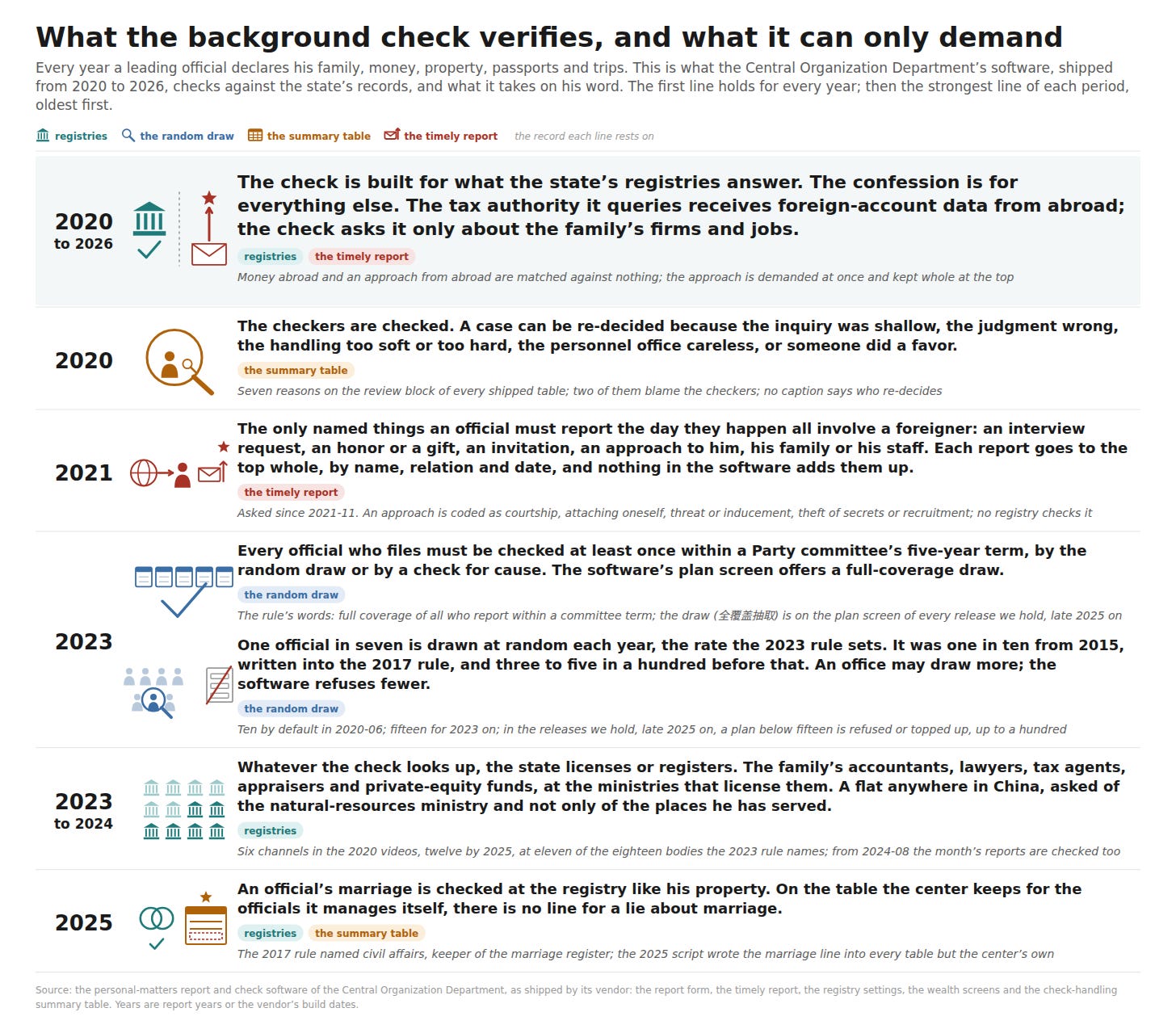
What the check actually verifies against the state’s records, against what it cannot check. This is extracted from how the Central Organization Department’s software changed between 2020 and 2026 and from the rule rewritten in 2023.
The paperwork, oh do I love being able to read their paperwork
The declaration (领导干部个人有关事项报告表) is the paperwork form that every leading official (领导干部) files by the end of February. Leading official means deputy county head and up, which includes state-enterprise managers. The Party gives him the software. We downloaded it too since it’s on the website if your AI swarm looks around enough.
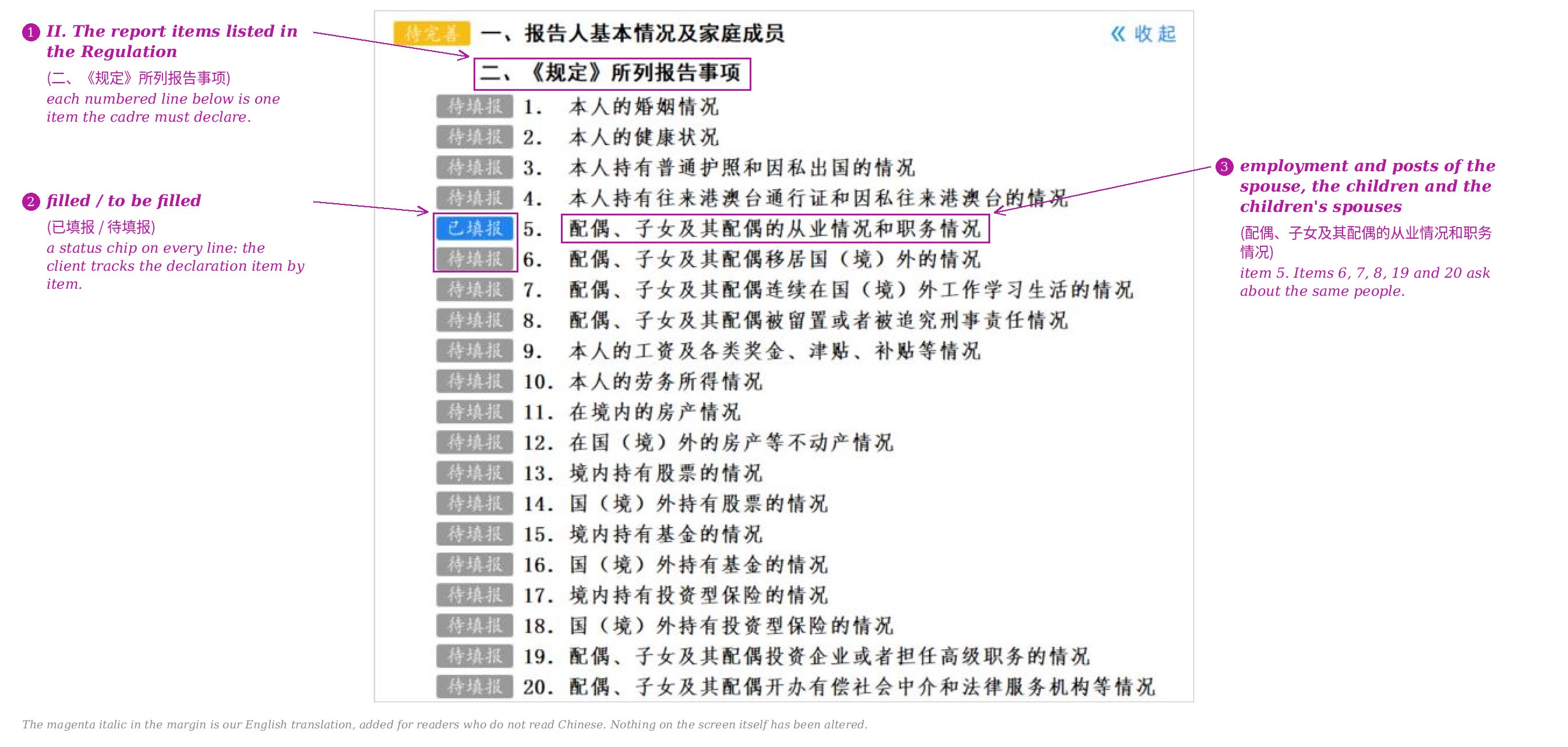
The Party’s own background investigation software. It’s just as bad as e-QIP. But much of what it asks the official to declare is about other people: his wife’s employer and post, his children’s spouses’ move abroad, their businesses, their arrests. I bet this leads to some awkward family conversations.
Read the list of forms and two things stand out. It asks for every apartment the household owns, garages and parking spaces included. But it never asks for a bank balance in China. It asks for deposits abroad, down to each account’s number, and stocks, funds, insurance and property abroad, each in its own item. The software matches none of them against any registry. The regulation names the tax authority as contributing to the background check. But the software only asks the tax authority about the family’s firms and jobs. It never checks the foreign-account data that the tax authority says it receives from its partner jurisdictions. The American senior executive form does the opposite: it exempts the home he lives in and asks for every bank account over five thousand dollars. And that’s how my wife found out what all I keep in my holding companies. I’m sure Chinese officials get spousal eye rolls too.
The form also has a timely report (及时报告) channel, under an Organization Department notice of 2021. It gives them thirty days to report: a new passport, a private trip, a child’s emigration or a relative’s new business. They have to report, the same day, four events involving a foreigner: a request for an interview, a foreign honor or gift, a foreign invitation, and an approach. The approach is to him, his family or his staff, by a foreign power or person. Those reports go up the chain whole, including name, relation and date. Straight up to the Politburo-led Central Organization Department. Let that sink in for a second. The Party is effectively performing the background investigations and counterintelligence for the government’s senior employees.
Since the Central Organization Department’s 2025 software, each same-day report about those foreign events gets a classified protection (分保) level: internal, secret or confidential (内部, 秘密, 机密). The classification level is written into the record, onto every sheet the center prints from it, and onto the name of any package it exports. The annual declaration, the check’s name lists and the check’s findings take the same three classification levels.
There is this long-running joke in the US national security community where you put on your worst foreign accent and ask someone at a party, “I am Russian, do you work CIA, what do you work on, I am interested.” Just like the Chinese, the foreign contact has to be reported immediately and then the person gets to spend some quality time with a counterintelligence investigator. You usually laugh and let them in on the joke after they panic at the amount of security paperwork they’re going to need to do.
How they actually perform the checks
With a letter... The actual database check (查核) is a letter. Really. The software prints one per state department per batch, on red letterhead. Lower offices send a package up the chain. And at the provincial organization department or the Central Organization Department levels the letters get printed.
But it’s going digital. Newer software builds also know about the online check platform (在线查核平台): the client packs the same batch for upload to the platform, and takes the answers back through the same import that reads the registries’ own reply files. Henan and Jilin appear to have been wired for it first. In Jilin, the provincial organization department said in 2024 that it had an online check platform built to batch the check’s requests and gather the answers centrally. It said too that it was wiring the queries and their answers through to every unit on the government intranet. I haven’t found a copy yet.
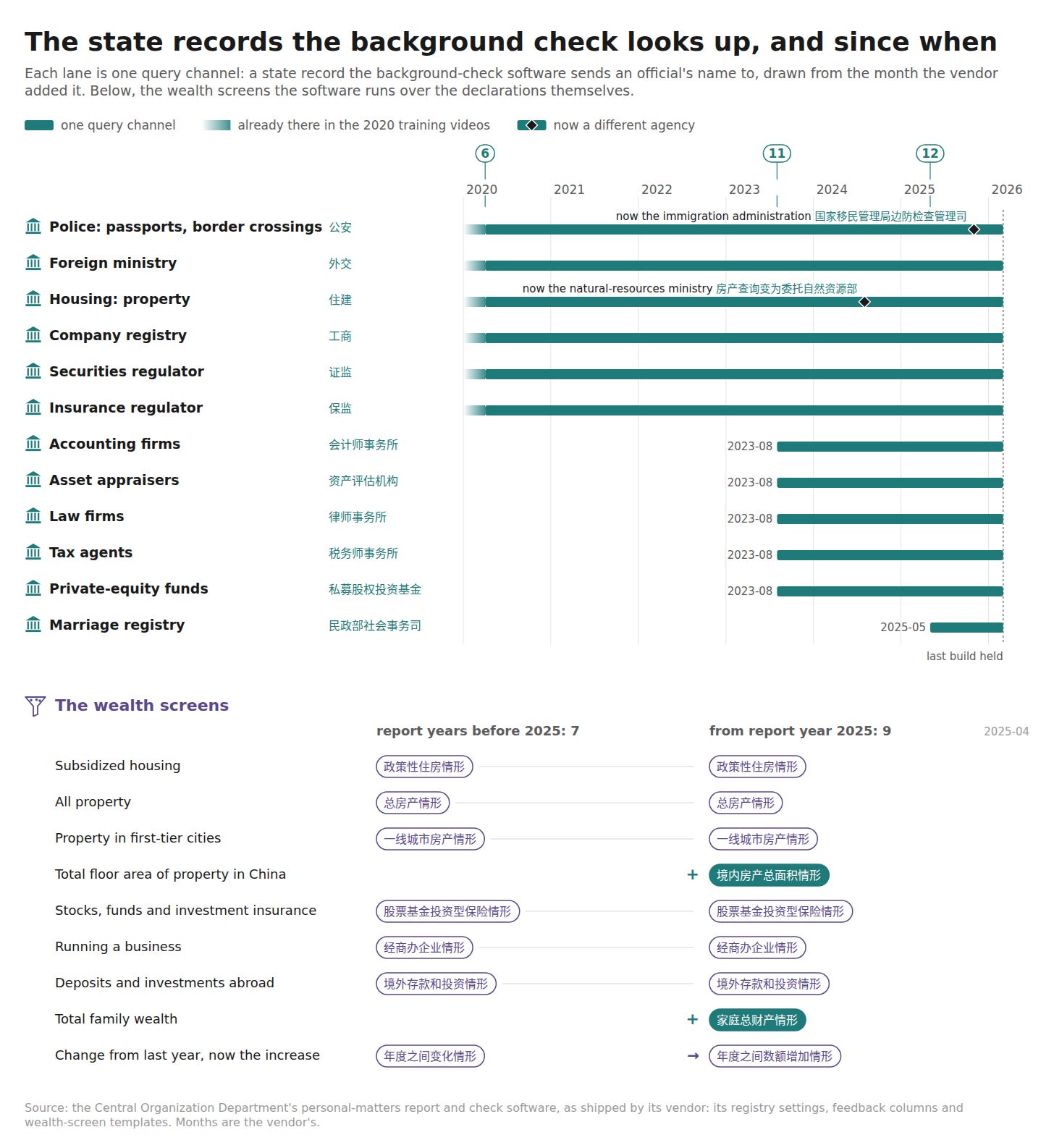
The state records the background check looks up, and when they started checking them.
I expected the check to look up his criminal record and his debts, because the timely report asks about both: his own questioning by investigators, and a listing as a court defaulter. The American system checks exactly those things continuously. Not the Chinese system.
What is presented to the adjudicator
The below comes out of the software manual for a fictional division head of a provincial organization department, Gao Aiguo (高爱国).
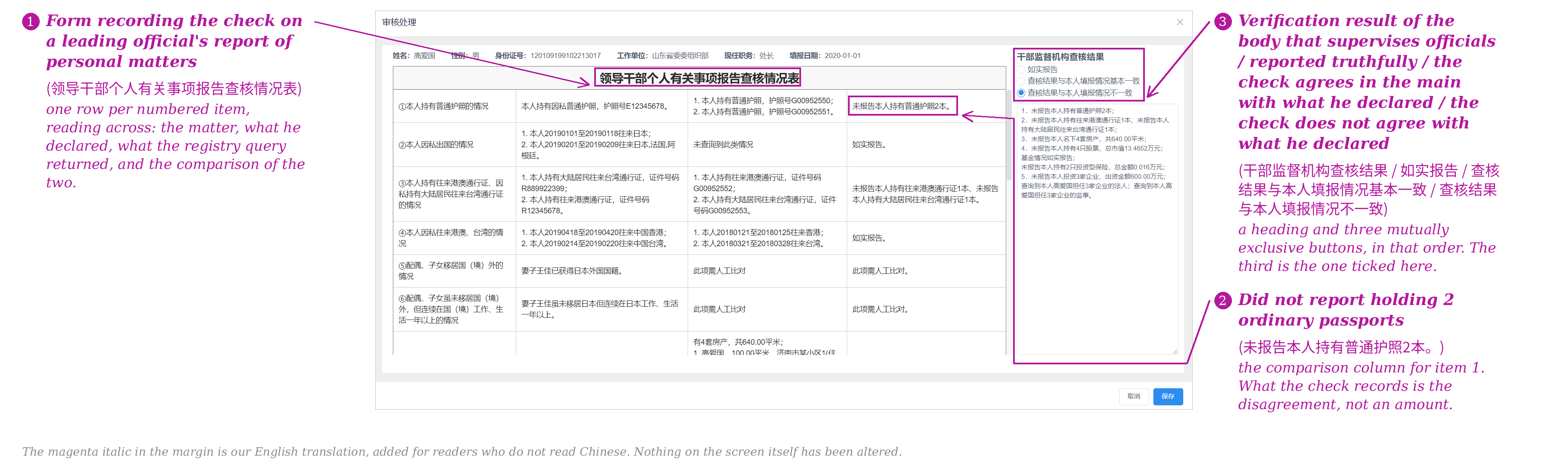
The report for the adjudicating officer. For each adjudicative item: what he declared, what the registry answered, and the comparison.
Every one of the checks comes back with one of three answers: reported truthfully, basically consistent, inconsistent. The adjudicating officer then grades the disagreement into omission (漏报) or concealment (瞒报). An undeclared passport he kept himself or a trip he took on his own is concealment. An undeclared passport already in the organization’s safe or a trip the organization had approved is omission. One undeclared apartment is concealment (but garages are excepted; hide your money in garages). Concealment can cost him his post. Omissions generally cost him a talking-to.
There is one more test aimed at bribery: is the family richer than its pay explains? The 2023 regulation gives the official fifteen working days to explain where the money came from when the check finds a family’s wealth clearly beyond its normal income. The organization department may then verify through other government bodies that the source of his wealth is legal. Since 2025, the software adds up what he declared of the family’s wealth: the price paid for every apartment, the stocks, funds and investment insurance, the capital paid into every business, and the deposits, investments and property abroad. It then adds up the value of everything he didn’t declare but was identified by the other government registries. It flags the household when the total or the year’s increase exceeds whatever threshold the local office has set (no, I have not found those yet).
Reinvestigations
The rules lay out when officials undergo reinvestigations: everyone up for a leading posting, everyone on the young-officials list, everyone about to be promoted to a civil-service rank at deputy-bureau-head level or above, and anyone with a complaint about them. They randomly pick one of seven officials every year for a reinvestigation. But an official cannot go more than five years without a reinvestigation.
That rings a bell with most US national security practitioners. You get a reinvestigation once every five years, a fresh counterintelligence (CI) polygraph once every seven years, and are always subject to a random CI poly.
Just how many “cleared” Chinese are there
Keep in mind, I only have data on the Party and government officials. I do not know if the PLA or MSS do their own checks.
The Party has published how many background investigations it runs. In 2015 alone it checked the declarations of 439,200 officials from deputy county head up. By 2017 it was checking one filer in four every year. By September 2017 it had run more than 1.2 million checks. Rough math gives you roughly 1.8 million officials filing their yearly background check paperwork. The United States, by its own count, had 4.2 million people eligible for a security clearance in October 2019, of which 2.95 million were in-access (currently cleared). At Top Secret it had 1.4 million eligible and 1.25 million with access.
Something happened in 2023
The Politburo, with Xi Jinping chairing the session, rewrote the reporting rules on March 30, 2023. They issued it internally on April 25. And they kept it quiet. I only found this in a filing-guidance booklet from a university Party organization department; I have not found any other reference or of official copy.
The new text asks for more, and it changes whom the top of the Party reports to. Under the old 2017 rule, the most senior officials reported to the Politburo-led Organization Department. But under the 2023 rule, “Party and state leaders report to the Party Center” (党和国家领导人向党中央报告). I have no idea who in the Center reads those reports, or who checks them.
The scrutiny of foreign ties also climbs with rank, in three steps:
The rule asks every filer about his passports, his private trips, a child’s foreign spouse, his family abroad and his money abroad. Every filer, at every rank, also reports a new foreign honor the day he is told of it.
The cadres the center manages answer one more category of relevant foreign-related matters (涉外事项). The rule doesn’t define it. But the Central Organization Department’s version of the form asks two things the national form does not: every foreign honor, title, award, grant or appointment he holds at filing. And every article or book he published abroad since the first of January of the year before, except what the organization arranged. So every filer reports a new honor when it comes; the center’s filers list every honor and every publication, every year. That appears to be what they mean by “relevant foreign-related matters”.
Deputy ministers and above write any other foreign-related matter of the year. I don’t know what that means.
An honor, a byline and a son-in-law’s account abroad are among the things a foreign government can give a senior official. The Party keeps an annual list of them only for the cadres managed by the center.
How many fail a background (re)investigation?
By September 2017, 11,000 officials had a posting deferred, lost a promotion, or lost a place on the reserve list. That is the last national statistic we could find. But we can count the Central Commission for Discipline Inspection (CCDI) reports.
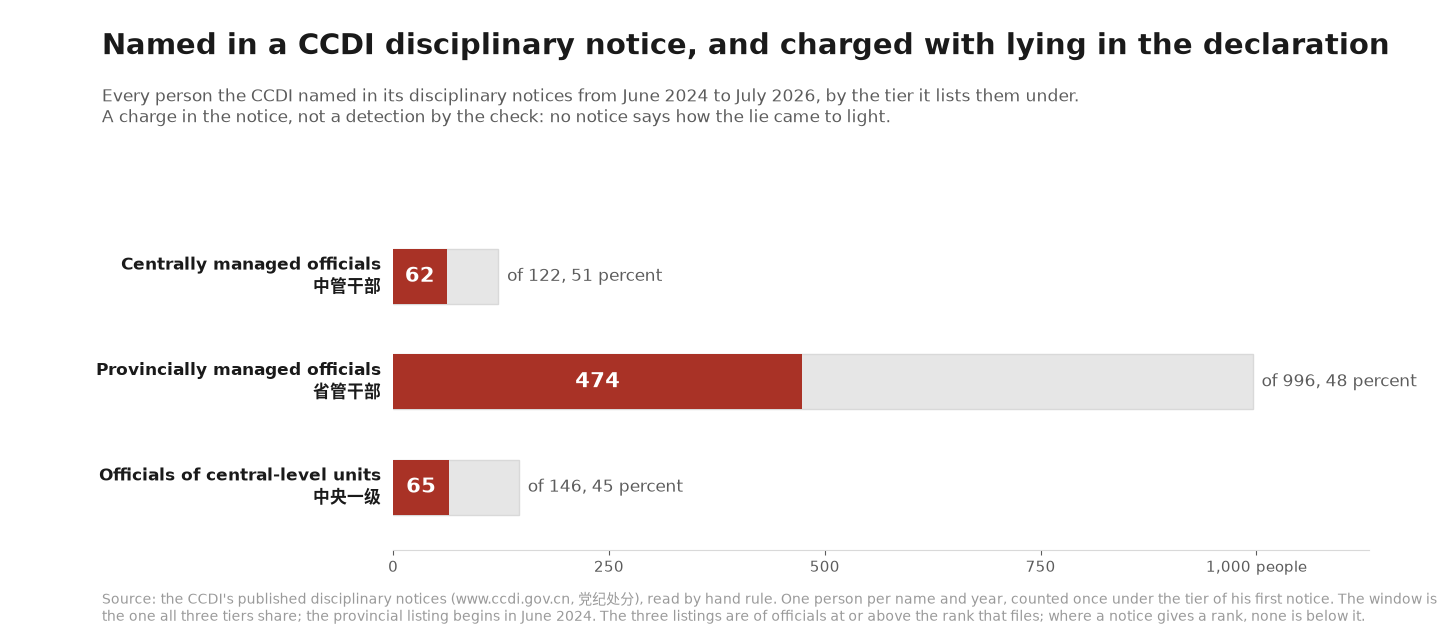
The people the Central Commission for Discipline Inspection (CCDI) named in its own disciplinary notices from June 2024 to July 2026. Between 45 and 51 percent in every tier were charged with not truthfully reporting personal matters: 62 of 122 centrally managed officials, 474 of 996 provincially managed, 65 of 146 in central-level units.
What the Party wants from its clearance
Read the changes of the last three years together and this is what I take the leadership to want.
It wants its officials’ families using the state’s regulated industries: law firms, funds, and accountants. Those services are aggressively regulated by the state and the state has created a culture of snitching on malfeasance. I’ll talk more about how that works another time. This way the officials’ activities are either themselves in the state’s databases so they can quickly detect issues, or the official is using the services of a company (law firm, accountant, tax preparer...) who will report them for illicit activities. The state wants illicit activities detected by the state, not narc’d on by another Party member.
It wants the family’s wealth added up so it can be judged as reasonable or not by the local Party office. The family wealth, not the official’s own wealth.
It wants every official vetted routinely, and definitely before a promotion.
Declare everything. Verify what is in the state databases. Ask the tax authority about the family company. But why not actually verify the money held abroad???