
We’ve been having trouble using local AI to process documents from the Chinese fly over state of Inner Mongolia and the the mountains are too tall to fly-over Tibet. That made me wonder if frontier and open-weight AI’s efficacy at certain languages is going to create AI haves and have-nots based on their native language. And if so, does that create spheres of influence where certain Great AI Powers dominate support in a country’s language?
So we ran a test to visualize AI’s spheres of influence based on a country’s language: whose models are even satisfactory, and whose are cheapest. We put 23 models from American, Chinese, European and Canadian labs through translation into and out of more than 200 languages. TL;DR: Cheap AI’s borders move with the extra cost of reasoning; and the fixed border is 51 languages where only American flagships work.
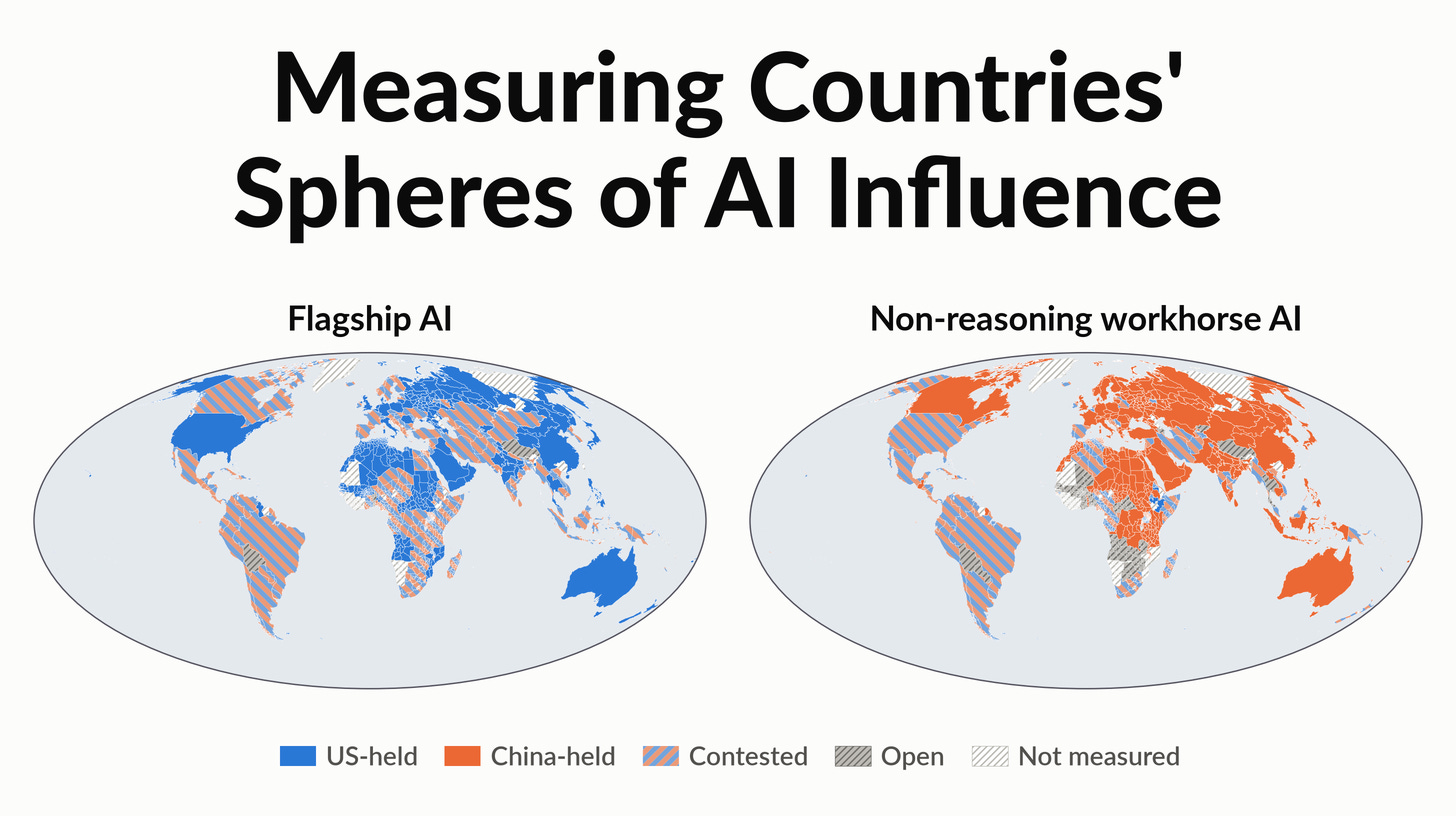
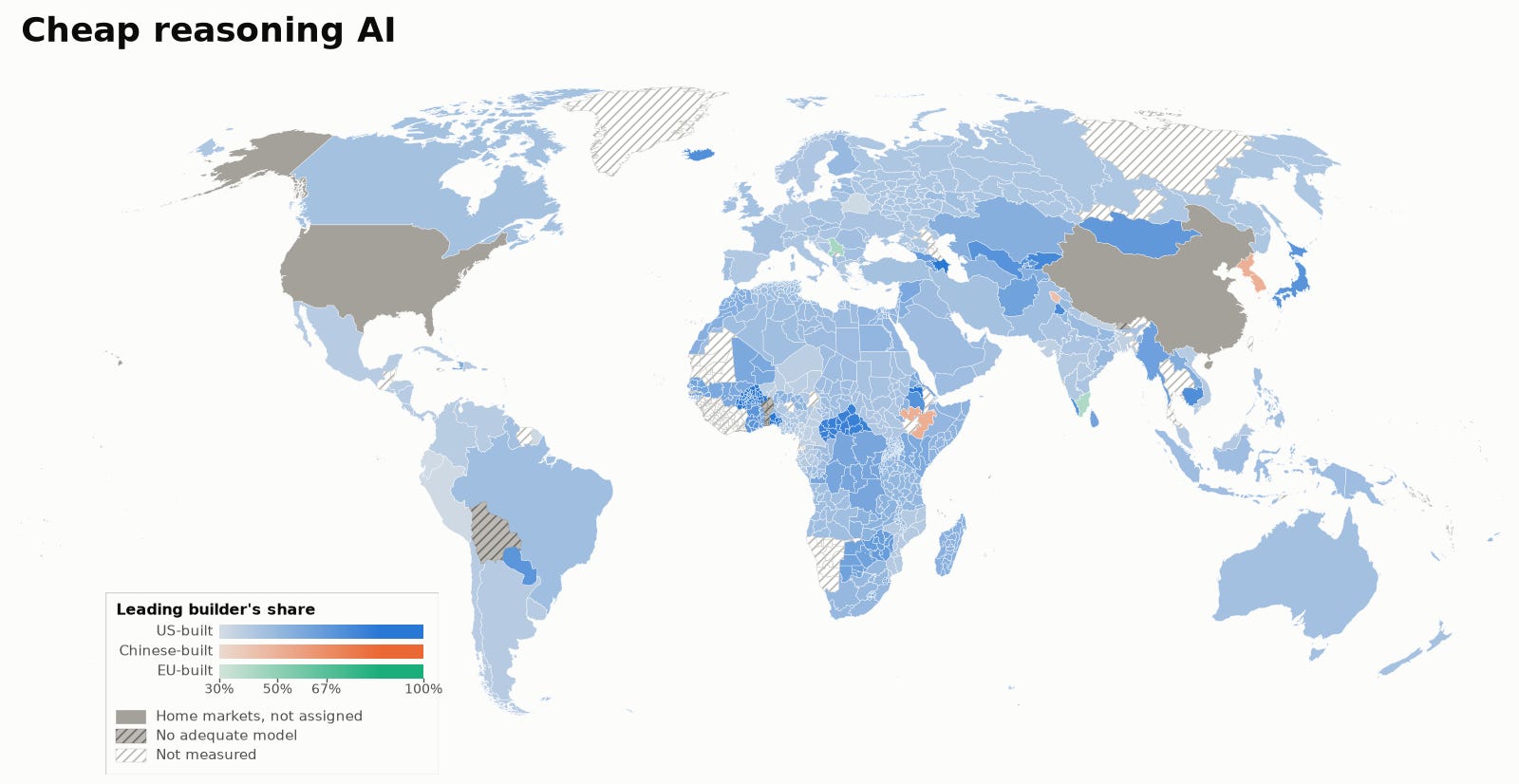
Look at the sphere of influence of the cheap non-reasoning AI below. How many of the American-dominated countries can you name? I’m struggling too. I use a lot of non-reasoning AI on my local projects for the types of data entry and data janitoring that I would have hired unskilled temporary workers for in the past. I’m processing terabytes of data through this layer a week. It’s important.
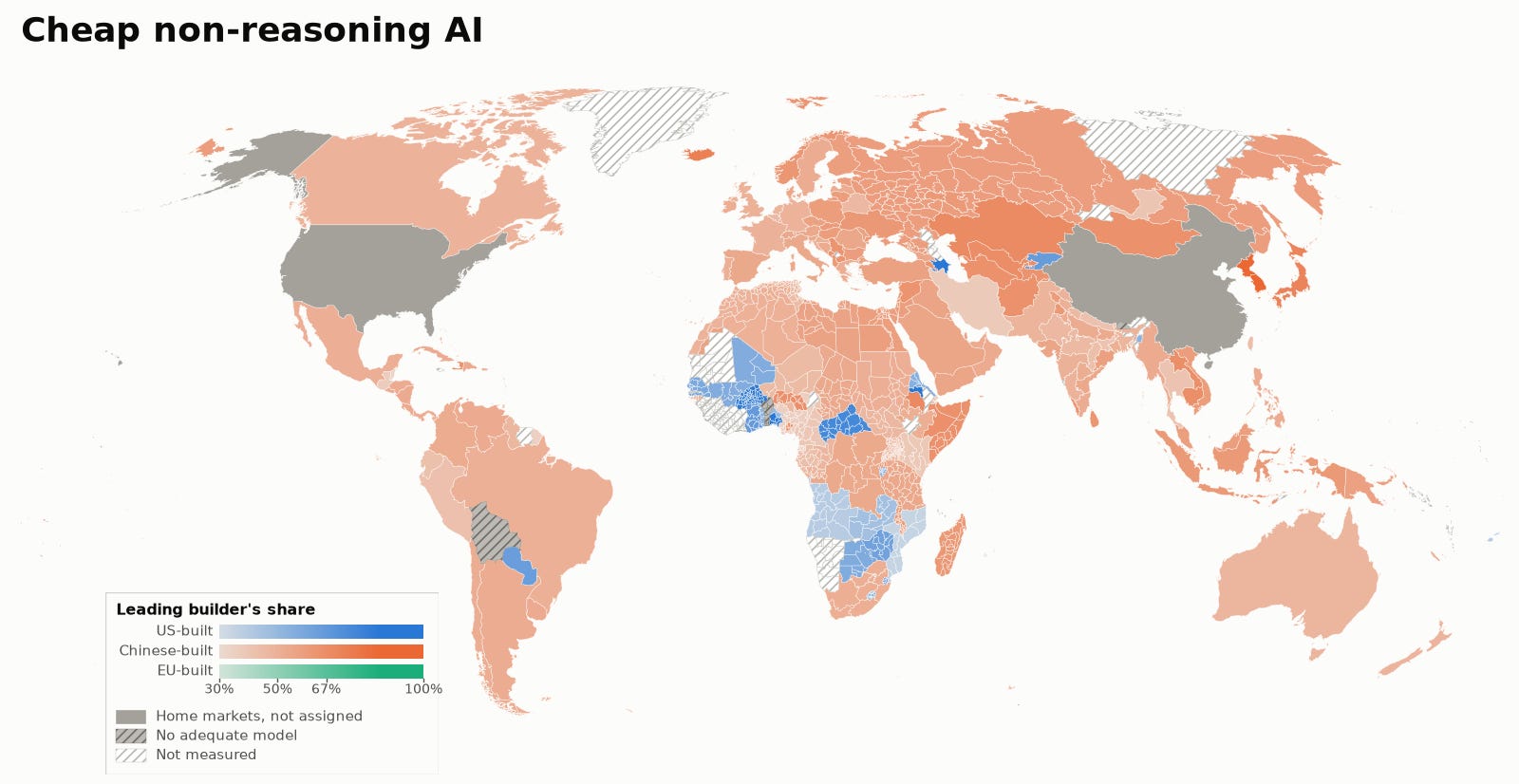
Now look at the important stuff below, the cheap reasoning AI. Before, I said that I was processing terabytes of data a week through the non-reasoning layer for data janitoring. The reasoning layer below is the sensemaking and validation layer. It makes the cheap non-reasoning layer actually valuable. Look closely and you can identify at least one of the countries in the Chinese sphere of reasoning-AI influence. Go look, I’ll wait.
Two things define an AI model’s influence in a country’s language. The first is training data, which is the text a model learns a language from. No lab we studied says how much of its current model’s training data is in each language. The last detailed breakdown of training data was a lifetime ago in 2020, so we’ll measure language support later. The second is the tokenizer, the part that chops text into the tokens a model reads and bills by. Think of it this way: my daughters are Marie and Mina. Marie is a common enough name, so assume her name costs one token. Mina has a very uncommon name, so she probably costs two tokens, Min and a. Shorter name, but double the AI cost. A word in an esoteric language may cost as many as one token per letter. If a human language is well supported by an AI model then each common word is one token. If a language is minimally supported then each letter is one token. And models work on and bill by token. In reality, most languages cost about double the tokens of English. Tibetan costs about eight times. For traditional Mongolian, each of the 60 tokenizers we checked used single-character tokens. Mongols pay for AI by the letter. Americans pay for AI by the word. But cheap tokens are not the same as knowing the language. Mistral’s newest tokenizer is the most efficient we found for Tibetan, and Mistral’s flagship still returned unusable output on more than half of our Tibetan test items. We’re going to need to measure the AI haves vs have-nots to determine spheres of influence.
How we measured. We asked 23 models from American, Chinese, European and Canadian labs (13 flagships, 10 budget models) to translate standard test sentences into and out of more than 200 languages. “Good enough” means translating out of a language at least 80% as well as the best models handle French or Japanese, and into it at least 85% as well as the best model does in that language. It is a translation test. Prices are what OpenRouter, a marketplace that resells most labs’ models, billed us at list rates on 15 to 17 November 2026. Models sold by many hosts are priced at the average of the hosts that served us. Budget models were run with reasoning switched off where the interface allowed. Left at their defaults, the Chinese-built ones cost 5 to 12 times as much with little or no gain in translation quality on a 200-item rerun. The largest gain, Qwen’s, was 1.4 points on a 100-point scale. With reasoning left at the defaults, the cheapest options became mostly American- and European-built. Paid prices only: no free tiers, no prices inside China, no usage data. Shares come from a rule with two assumed weights, one on price and one on quality; we tried 45 settings of the weights and the bar and report how many favor each side. Three labs had no budget model in the test. For a tenth of the world’s people there are no results because their languages aren’t even covered by the public test datasets: AI have-nots.
Where only flagship models compete
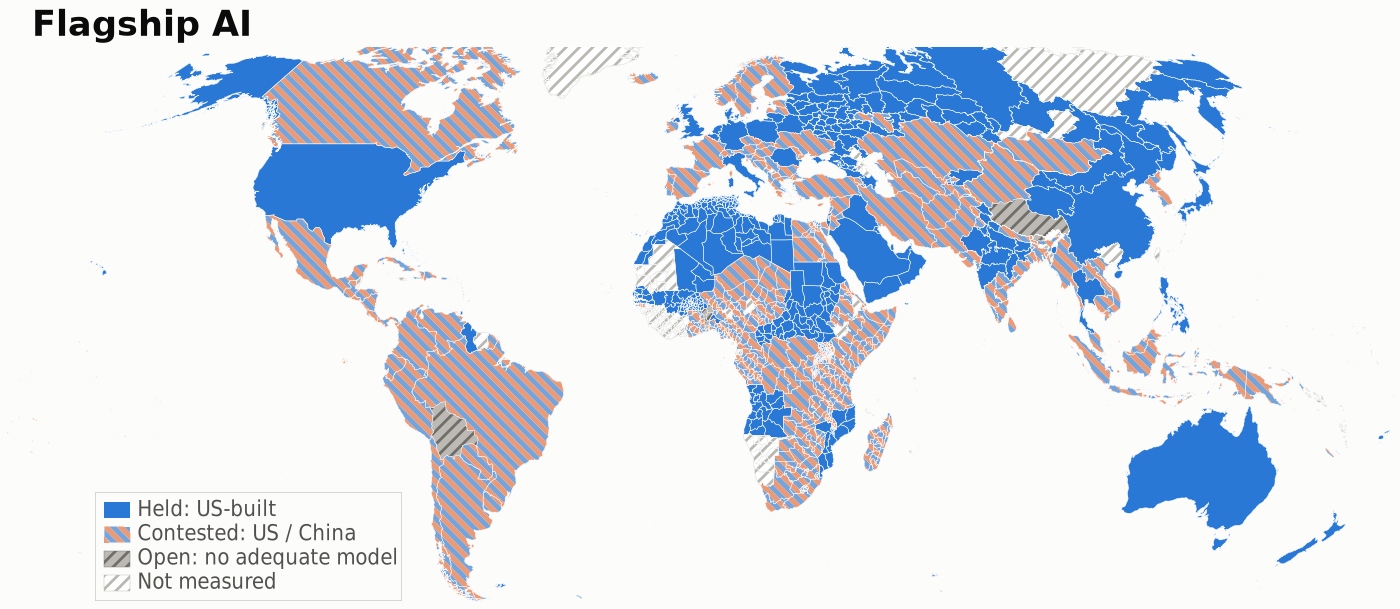
There were a number of languages in which the budget models did not pass the bar, but the more expensive flagship models were good enough. You can see the American vs Chinese spheres of influence below where on the Flagship models can compete today. There were 51 languages in which only the American-built flagships were good enough, which firmly puts roughly a quarter of a billion people squarely in the American AI sphere of influence. There were no languages where only Chinese-built models performed. There were a few countries where the two countries’ flagship models compete.
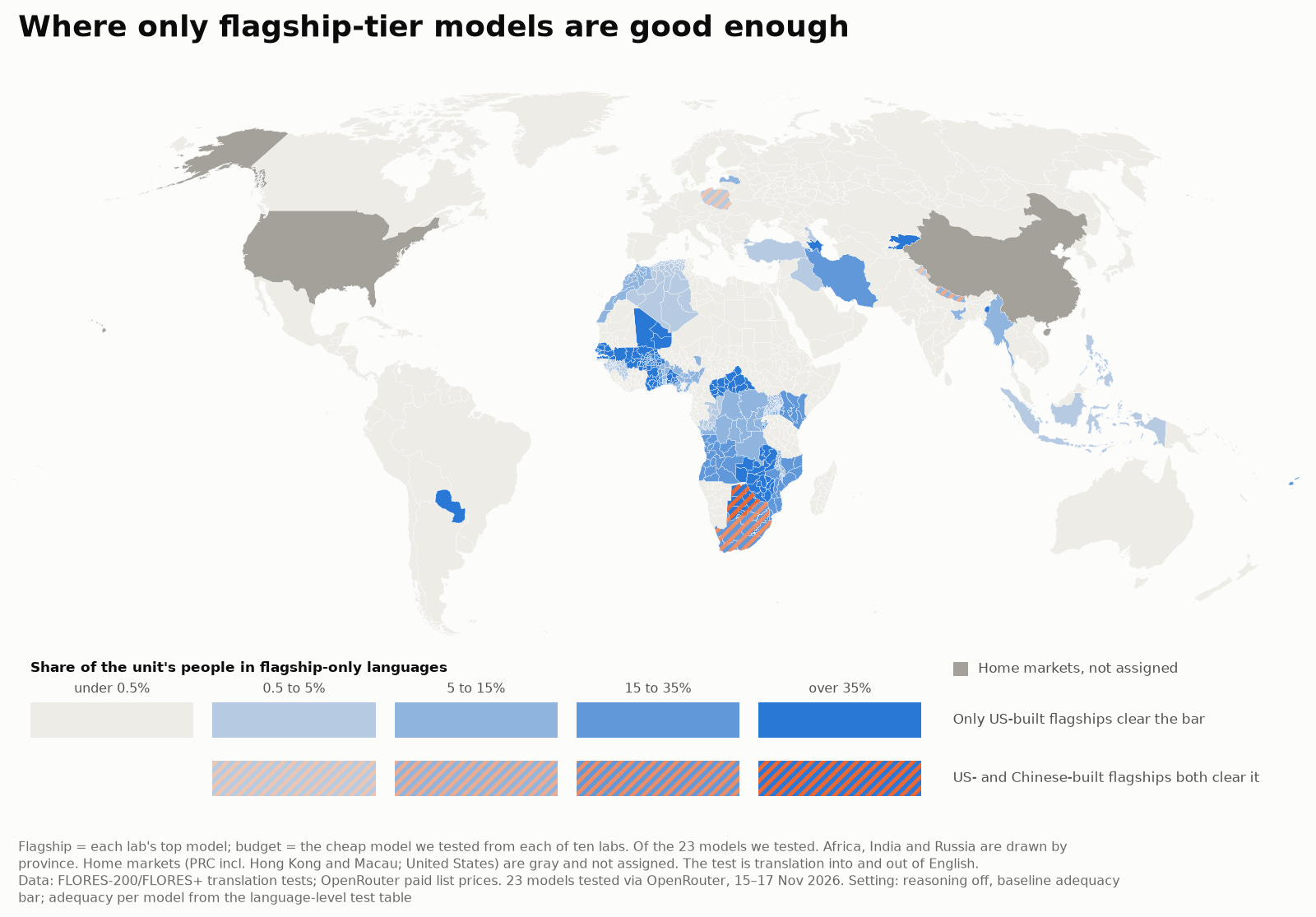
Frontier AI models’ spheres of influence where budget models failed to perform.
The have-nots are not just a matter of who doesn’t have access to an AI model performant in their native language. It’s the people priced out of a budget model. A thousand short tasks in English cost just under a cent from the cheapest model; those are clearly the haves. In these 51 languages the cheapest good-enough model charged between 63 cents and $5.17 for the same thousand tasks. These have-nots can have AI as long as they’re willing to pay roughly 65 to 550 times as much. About 85 million people have a good-enough model for which a thousand tasks a month cost more than 1% of the average monthly income in their country, and every one of them speaks one of these 51 languages.
And then there are 21 more languages where no model we tested was good enough at any price. The have-nots.
The cheapest labs did not have the furthest reach
Behind each color on those maps is a short list of AI labs. In the workhorse tier, with reasoning off, the lab was Tencent. Hy4-Flash was the cheapest good-enough model of the 23 in 119 of the languages we tested, including the 12 most spoken. It was also released the morning I ran the experiment. This appears to be the treadmill trend: whoever last released a cheap Flash model will lead the workhorse tier until the next lab releases a Flash model.
In the frontier tier the labs are Anthropic, Google and OpenAI. Across the 51 American flagship-only human languages, Claude Opus 5.5 cleared the bar in 42, Gemini 4 in 30 and GPT 6.1 in 19. Where a single model stood between a language and nothing, that model was Claude in 18 of the 24.
The flagship AI’s sphere of influence
Which flagship AI do you think has the broadest sphere of influence? Make a guess.
Score the 13 flagships on price and quality in every language we tested, including the ones budget models also handle, and one model does most of the winning for the American side. It is not from Anthropic, Google or OpenAI. It is Llama 4 Maverick. That’s Meta, you know, Facebook. At our default weights, Llama was the best-value flagship for 88% of the people whose language has a good-enough flagship at all. Meta’s model was the best value in Mandarin too, at the prices OpenRouter charged us, which are probably not the prices inside China. Take Llama off the list and Chinese-built flagships were the best value for 84% of the same people. The closed labs earn their place with breadth in the 51 otherwise unsupported languages. That border is coverage, and it is the definite one. Everywhere else the contest is value, and at those weights the American flagship that won most of it was the one anyone can download. This was not on my bingo card. And this test was the first time I’ve actually used Llama 4 Maverick. It’s a year and a half old too.
You can see both tiers’ spheres of influence below. Solid color means that side’s models came out ahead in most of the 45 settings we tried, and no one else’s did in any of them. Blue and orange stripes mean the lead changed with the settings. European and Canadian models did not come out ahead anywhere on either map, in any of the 45. Unlike the maps above, these two color the United States and China by their own results. On the flagship map American-built models are the solid color where 54% of the world’s people live. That includes most of China’s people, again at OpenRouter’s prices. The lead changed with the settings for another 43%. At our default, no Chinese flagship beat Meta’s on value (yet).
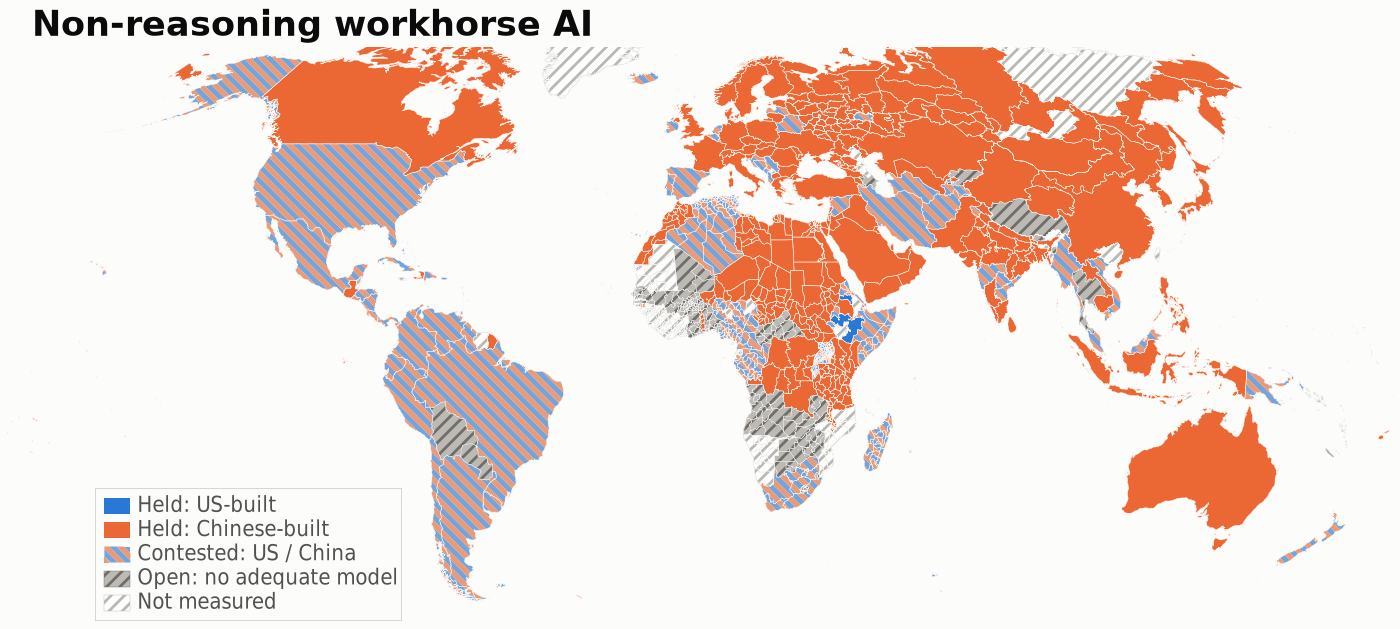
The workhorse map is the mirror image. It uses the first map’s reasoning-off run but counts the 10 budget models only, so where only a flagship is good enough this map shows no adequate model. Chinese-built models are the solid color where 67% of the world’s people live, and the lead changed with the settings for another 26%, a smaller share than on the flagship map. The only solid American sphere of influence is two provinces of Ethiopia. The United States itself is contested. Chinese-built budget models came out ahead there in 39 of the 45 settings and American-built ones in the other 6. Solid on these maps means solid across our weights at one week’s prices, and on this one with reasoning off. With the budget models’ reasoning left at the default, the cheapest good-enough supplier in most countries was American-built, as the second map in this article shows.
Where to compete for a sphere of influence
Budget models can compete on price only where they are good enough, and in our test that was always inside languages the frontier tier already covered. In the 51, the only models that cleared our bar are a few American flagships. If my view of the stack holds generally, whoever holds the frontier in a language holds the AI stack there regardless of which lab’s budget model does the bulk of the work.
For what it is worth, most of the world appears to be up for grabs in strategic competition by workhorse models that natively support the language without having to burn a ton of reasoning tokens to work in that language.