
I have one of those stories in my CEO bag of tricks that I use whenever someone asked why we spend so much energy on small things. I’m still using it on sabbatical, so it is time to write it down.
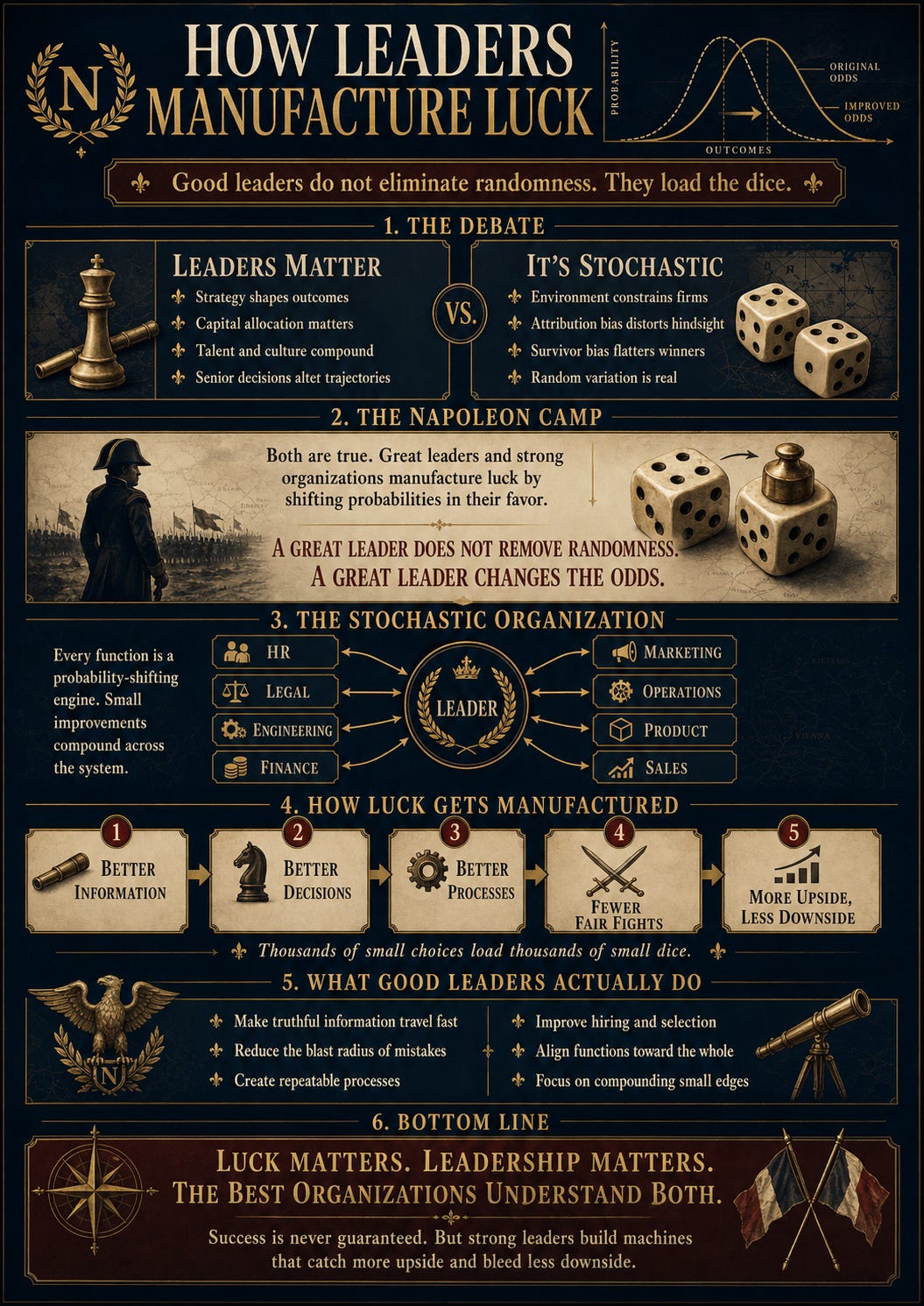
There is a long-running argument in management research about whether CEOs and leadership matters. One side says yes: executives shape strategy, capital allocation, who gets hired, what gets rewarded, what gets ignored, and what the organization eventually becomes. The other side says be careful: a lot of what we call leadership is market structure, timing, narrative, survivor bias, and plain randomness dressed up after the fact.
Both sides are right.
The bridge between them is the old line usually attributed to Napoleon: when choosing a general, he did not ask whether the man was brilliant; he asked whether he was lucky. The line is probably not Napoleon’s. It is more likely a version of Cardinal Mazarin’s question: Est-il heureux? Is he lucky? But whoever said it understood something most business writing misses.
Luck is not the opposite of competence. In complex systems, repeated “luck” is often competence others have not learned how to see.
If I am a supreme commander (and today I was a hockey dad), I do not want the general who wins a glorious fair fight or two. I want the general who keeps finding undefended bridges, arrives when the enemy supply train is exposed, chooses ground that makes battle unnecessary, and somehow ends each campaign without the glorious definitive battle. From a distance, that looks like luck. Up close, it is a series of many small probability shifts: better scouts, tighter logistics, faster messengers, healthier troops, disciplined staff work, better maps, and better judgment about when not to fight.
A great general does not win more fair fights. A great general makes fewer fights fair. The same thing happens in business.
Years ago, I worked with a vulnerability researcher I badly underestimated. I thought he was one of the least impressive researchers in the room. Then he made a weird, high-value discovery. My first reaction was: he got lucky.
Then he did it again.
Eventually I had to update my mental model. He was not dumb. I was. He was seeing structure I could not see. He had instincts I still do not have the resolution to understand. He was touching the system differently. He was asking questions I did not know were questions.
To me, the result looked random because I could not see the mechanism.
That is the real lesson: any sufficiently advanced skill looks like luck to the observer.
Business is not deterministic. You can make the right call and lose. You can make the wrong call and win. Markets move. Competitors stumble into advantages. Customers lie unintentionally. Great candidates decline offers. Bad hires interview well. A product bet that should have worked dies because timing was wrong. A mediocre idea catches fire because a customer says the right sentence to the right person on the right day.
This is uncomfortable for leaders because leaders are paid to act as if outcomes are controllable. They are not. The only honest model is probabilistic.
An organization is a stochastic machine. HR, legal, engineering, finance, marketing, operations, product, sales, and customer success are not clean boxes on an org chart. They are probability-shifting engines. Each function takes in uncertainty and either reduces it, amplifies it, or transfers it somewhere else.
A strong recruiting process does not guarantee a great hire. It increases the odds of one.
A real onboarding process does not guarantee performance. It reduces the odds of early failure.
A good legal function does not prevent all bad outcomes. It changes the expected cost of ambiguity.
A disciplined engineering review does not eliminate defects. It lowers defect density.
A serious sales qualification process does not make people honest. It reduces fantasy pipeline.
A real finance cadence does not predict the future. It prevents the company from being surprised by obvious things.
None of these is dramatic. None makes a great founder myth. But every one of them loads a dice.
This is why great leaders and great organizations obsess over small things. Not because small things are sacred. Because small things compound.
You do not build a lucky company, division, or team with one heroic decision. You build it by nudging thousands of conditional probabilities in your favor.
The board deck is clear, so the company can take high-payoff bets.
The forecast is honest, so the company knows what resources it has to allocate.
The job spec is technically precise, so the candidate pool improves.
The interview loop is disciplined, so charisma has less room to masquerade as competence.
The product review includes support, so edge cases surface before launch.
The postmortem is blameless but not toothless, so the same class of failure is less likely to recur.
The leader says the quiet thing out loud, so the organization stops wasting cycles pretending.
Each move is small. Each move changes the odds. Over enough repetitions, the company starts to look lucky.
This is also why the leader matters so much. They make the probability changes compound across the organization.
If the leader is bad, every function can be locally competent and the company can still be globally doomed. HR can hire well. Finance can report accurately. Engineering can execute. Sales can grind. Legal can protect the downside. But the leadership sits above the system and can inject uncertainty into all of it at once.
A bad leader makes the organization fight fair fights. I won’t list examples of bad leadership, you all have your own list that you have experienced. Regardless of how, it results in negative luck manufactured at scale.
A good leader does the opposite. They do not remove randomness. They make the organization better at absorbing it. They improve the surface area for good surprises and reduce the blast radius of bad ones. They make truthful information travel faster so random opportunities are seized and negative events are quickly handled. They make irreversible decisions rarer and reversible decisions cheaper. They create an organization where small corrective actions happen before big heroic rescues are needed.
The longer I have operated, the less impressed I am by leaders who want credit for the dramatic save. The more qualified leader is the one whose organization rarely needs saving. The organization who prizes clearing flammable material is far more impressive than the organization who put out a fire before it burned down the whole building.
That is Napoleon luck. He called it his “étoile” (lucky star)
A lucky leader is someone who has built a machine that catches more upside than it deserves and bleeds less downside than it should. A lucky organization is one where hundreds of people, often without being conscious of it, are making tiny decisions that improve the distribution of future outcomes.
This does not guarantee success. Nothing does. Loaded dice still lose. Great companies still die. Bad companies still occasionally print money. Variance is real, and anyone who says otherwise is selling a memoir.
But the fact that outcomes are random does not make effort meaningless. It makes effort more precise. The work is not to control the outcome. The work is to control as many inputs to the distribution as you can find, without lying to yourself about the ones you cannot.
So yes, leaders matter.
And yes, luck matters.
The best leaders understand both. They do not stand outside randomness pretending to command it. Napoleon said I walk with the goddess of fortune, accompanied by the god of war.
Great piece Mike, and at the risk of “me too-ism” my experience maps yours directly. That bit about talent recognition in particular. I hope you’re enjoying your sabbatical as much as I’m enjoying its outputs!