
I found just about all of the 2024 and before Chinese data that I needed to draw conclusions; actionable conclusions. The UN trade database returned 855,028 records for Chinese 2024 exports. There wasn’t anything for 2025.
An empty set is still data. This post is about a year of empty sets, and about eleven other places China’s official numbers changed form under my queries while I built the dataset behind this series. The public narrative is that China lies about its numbers. The ledger supports something narrower and more useful: China changes where you can see the numbers, exactly where seeing them would matter.
The narrower claim is worth more than the accusation. An accusation ends the analysis. A taxonomy tells you what each gap costs and how to route around it. You act based on that knowledge.
Bottom Line Up Front
Twelve documented reporting behaviors sit in the ledger behind this series, sorted into six categories: omitted, reclassified, basis-shifted, accounting-contaminated, delayed, and inaccessible. A seventh category exists for strictly false statements, meaning an official number contradicted by primary evidence. It’s empty. I didn’t find evidence that China is lying. This project has 29GB of raw Chinese government and corporate filings. There were mistakes yes. But I’m not seeing economic filing evidence that corroborates the widespread belief in China lying about its numbers. That makes the other twelve rows worth briefing.
China is omitting I sat between two lawyers at dinner tonight and they probably would have argued if lying by omission was lying. But that doesn’t make past data suspect. China filed its full 2024 trade data with UN Comtrade (the United Nations database where each country reports its own customs returns) in June 2025, on its normal cadence. It has filed nothing since. As of July 1, 2026, verified directly against the Comtrade API rather than by rumor, there is no China-reported 2025 trade data: all twelve monthly queries and the annual query come back empty. To be precise about what stopped: China’s customs agency still publishes its own headline releases at home. What stopped is the standardized UN filing, the one format that lets an outside analyst (me) audit product-level detail against everyone else’s books. The blackout covers exactly the period in which China’s 2023-2025 export controls need grading.
The workaround is a partner mirror: add up what every other country reports importing from China. The mirror is honest in aggregate and noisy per product, and both halves of that sentence matter. In the years China still reported its own trade, the mirror is unbiased at the median, a mirror-to-reported ratio of about 1.019 across 131 validated product-years. But only about a third of product lines land within plus or minus 10 percent of China’s own figure, and roughly one in six is off by more than a factor of two. Yuan figures below convert at CNY 7.2 per US dollar, the single round rate used across this series. I assuming that I couldn’t find all of the partner data because many of those partner countries aren’t sophisticated data reporters (and there is probably a lot of graft going on at the receiver end in some countries). The research data was current as of June 19, 2026; the Comtrade absence was re-verified live on July 1, 2026.
The strategic translation fits on a PostIt note. Never write a verification regime, a sanctions damage assessment, or a deal-compliance clause against data the counterparty can switch off. The off switch has now been demonstrated by China on the record.
The findings
1. They don’t lie, they omit. Each of the twelve rows records one statistic, what happened to it, the innocent explanation, and what would falsify the entry. The categories sort by what the analyst loses. Omitted, three rows: a series stops or never appears, the trade blackout being the live case. Reclassified, four rows: the line survives but folds into a broader one, so the specific figure stops being legible. Basis-shifted, one row: the series continues on a changed methodology, so new numbers do not compare with old. Accounting-contaminated, one row: the figure is accurate as filed but mixes in items an outside reader does not expect. Delayed, one row: the number arrives years after the question. Inaccessible, two rows: paywalled or never published.
Then there is the seventh category, false, and it is empty. That emptiness is the credibility engine of this whole post. Anyone can shout fraud at an adversary’s statistics; the shout costs nothing and proves nothing. A ledger that hunted for a year and still reports zero strictly false statements is a ledger you can trust when it reports everything else. And every row carries its boring explanation printed beside it: funds get consolidated when they wind down, methodologies change, notifications lag, accounting standards mix items. I dispute none of those. The taxonomy exists to price the gaps, not to prosecute them.
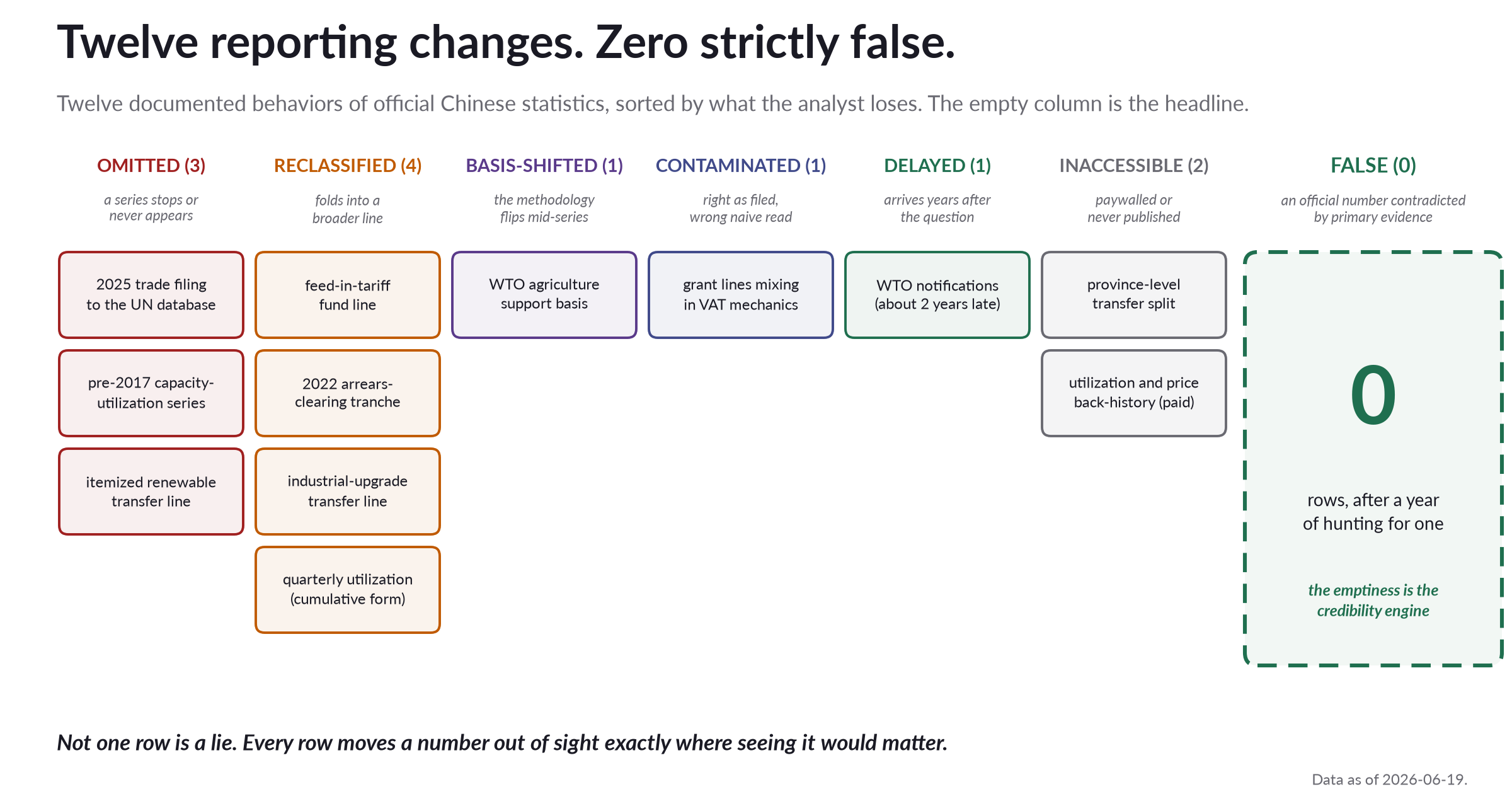
How to read it: twelve documented reporting changes sorted into six categories, with the column for strictly false statements standing empty.
What to see: zero lies, six kinds of dark.
2. The flagship omission. The tracked basket is thirteen products: the controlled minerals, gallium and germanium, graphite, antimony, rare-earth metals and compounds, and the magnets made from them, plus the dominant subsidized exports, solar modules, lithium-ion batteries, electric vehicles, and coated steel. Through calendar 2024, China reported its own exports of all of them. Its 2024 batch landed at the UN in June 2025, roughly six months after year end, the normal rhythm. For 2025, China has reported zero of the thirteen. Not late. Absent, as of July 1, 2026.
Now put the control dates next to the blackout. Gallium and germanium went under export licensing in August 2023, graphite in December 2023, antimony in September 2024, rare-earth magnets in April 2025. The single question every Western planner asks about those controls, did the flows actually stop, turns on 2025 data. That is the year the feed went dark.
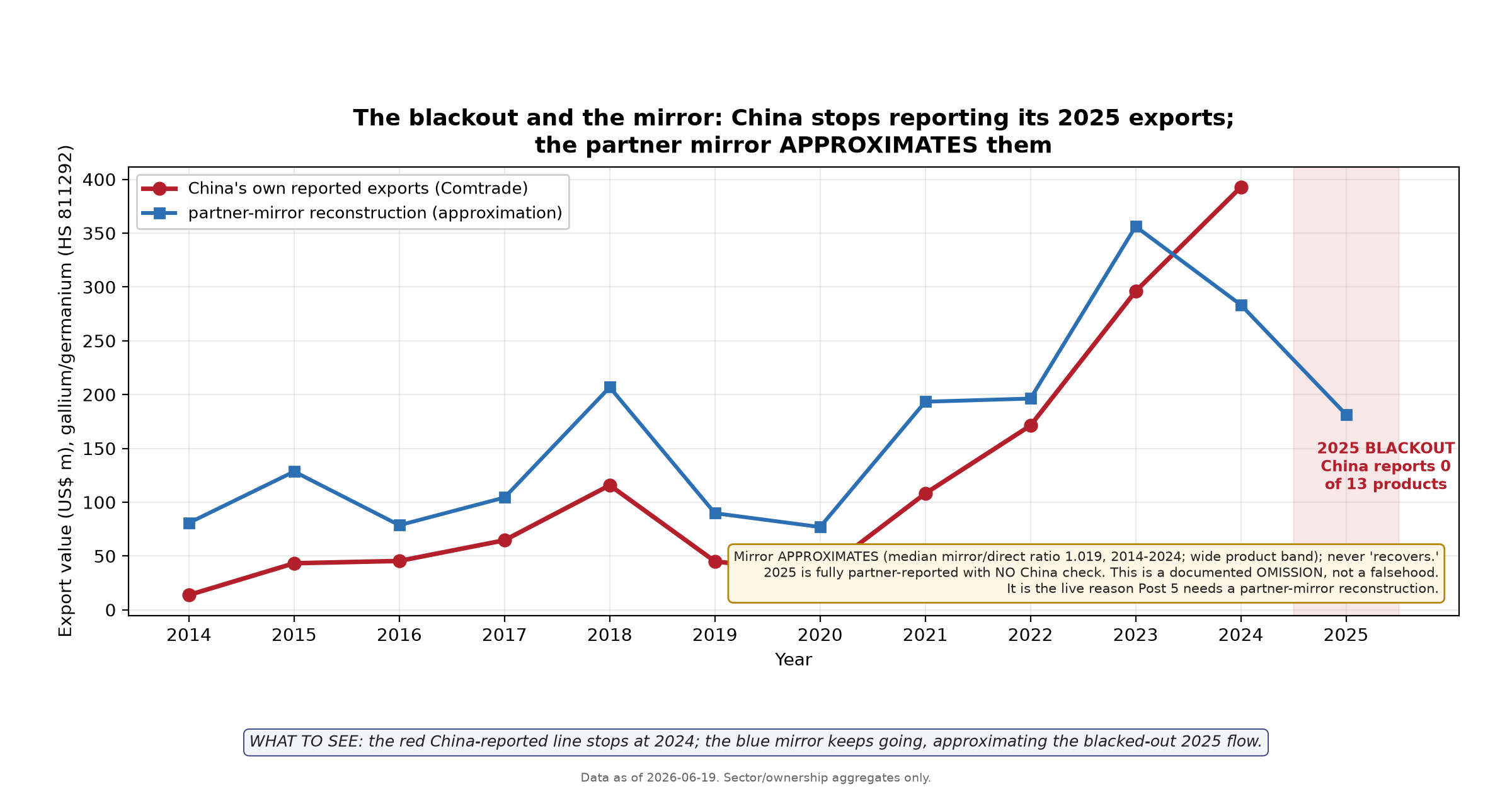
How to read it: the red line is China’s own reported gallium and germanium exports to the UN database; the blue line is the sum of what every other country reports importing from China.
What to see: the red line stops dead after 2024; the blue line keeps reporting straight through the blackout year, which is the only reason the year can be graded at all.
The mirror routes around it, at a measured price. Every export that left China arrived somewhere, and that somewhere filed a customs return. Summing those returns rebuilds China’s exports from the receiving end. Against 2014-2024, when both sides of the ledger exist, the reconstruction is unbiased at the median. Product by product it is rough. About a third of validated product-years land within plus or minus 10 percent. Roughly one in six misses by more than a factor of two. And the misses concentrate exactly where the stakes are: on the thin mineral lines, gallium and germanium ran 1.6 to 5.9 times China’s own figure in the early validation years, antimony ore has had as few as four reporting partners in a year, and the worst thin-reporter mineral year is off by roughly twenty-four times. The fog is thickest directly over the chokepoint products.
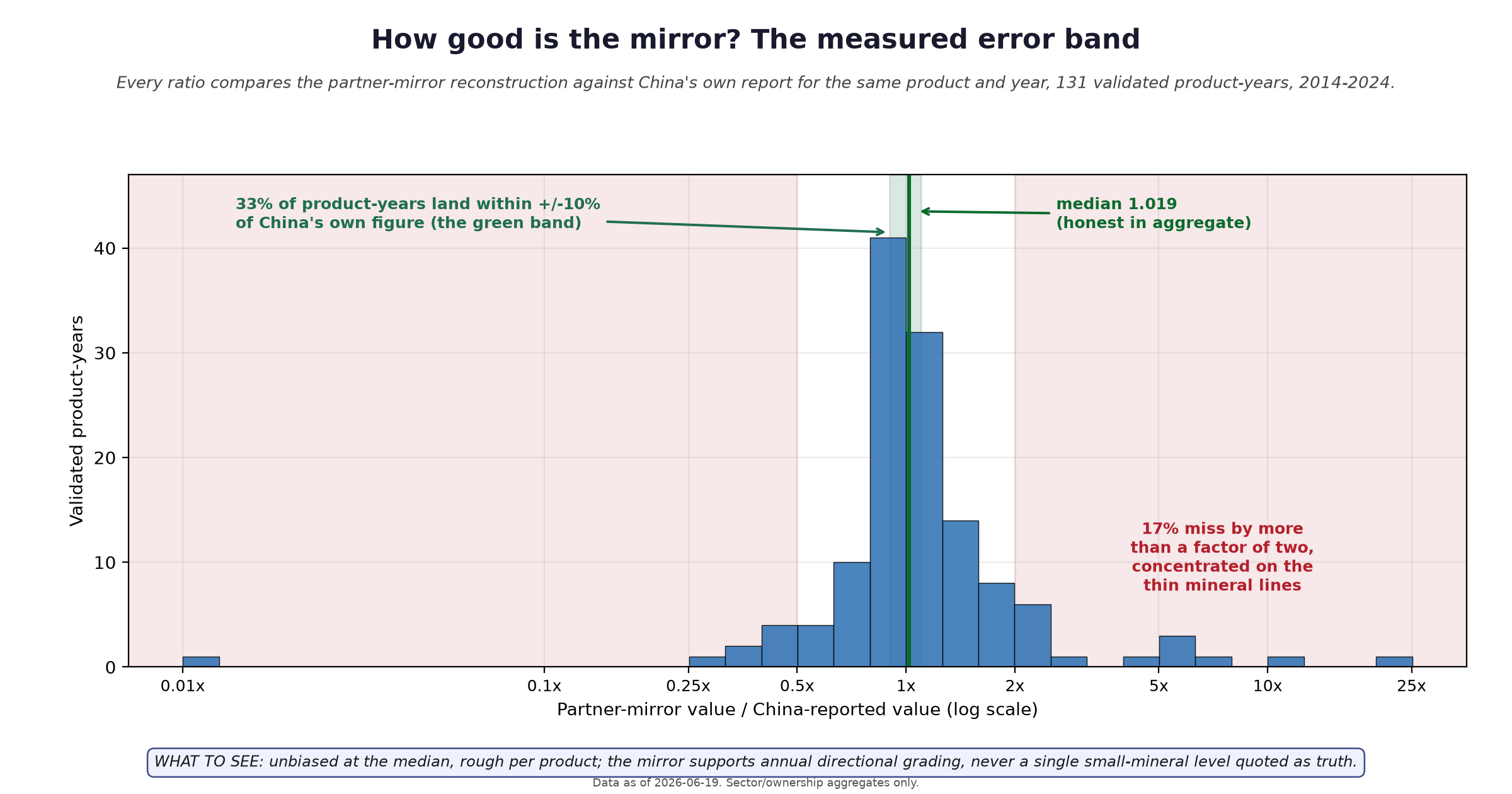
How to read it: each count is one validated product-year, 2014-2024, comparing the partner-mirror reconstruction against China’s own report for the same product; the horizontal scale is logarithmic.
What to see: the distribution centers almost exactly on 1.0, a third of product-years land within ten percent, and a sixth miss by more than a factor of two; the mirror is honest in aggregate and rough per product.
Partner customs returns are logs from the far side of the connection. Useful, but it’s lossy. The mirror supports annual, directional grading of fired controls, which is what the scorecard in Post 5 ran on. It does not support quoting any single small-mineral level as truth, just truth with error bands.
3. Complying with a WTO ruling by changing methodology. The feed-in-tariff fund. A feed-in tariff (FiT) is the above-market price a government guarantees renewable generators; China paid its FiT through a surcharge on electricity bills, collected into a dedicated central fund with its own named line in the Ministry of Finance accounts. From budget-year 2023 that named line vanishes, folded into a catch-all “other government funds” line. The fold-in is provable from the table itself: the 2023 other-funds revenue figure of CNY 111.4 billion (about USD 15 billion) is stated in the table to be 102.8 percent of the prior year’s renewable line. The identity is legible. The line is not. The innocent explanation is genuinely strong: the FiT was winding down, and consolidating a dying fund is ordinary accounting. What keeps it in the ledger is the timing. The fold came immediately after a roughly CNY 394.5 billion (about USD 55 billion) two-year clearing of the fund’s payment arrears, a magnitude reconstructed from explanatory notes, so treat it as approximate. The decade’s largest green-support instrument became non-itemized right after finishing its largest job.
The WTO basis shift. DS511 was the World Trade Organization dispute the United States brought, and won in February 2019, over how China measured the price support it pays wheat and rice farmers. Before the ruling, China’s notifications counted eligible production as only the grain actually procured at the support price, which printed support ratios of 7.25 percent of value for wheat and 6.13 percent for rice, comfortably under the allowed ceiling. In the first post-ruling batch, filed in December 2022 and covering 2017-2020, the basis flips to the total production of the major producing regions. Eligible wheat quantity rises about 4.3 times, rice about 7.7 times, the ratios print at 19 to 25 percent of value, and China notifies its first positive total support figure, CNY 240.6 billion (about USD 33 billion) for 2017. Yes, this level of “eligible-production basis” bores me too. But it moved a printed national statistic by a factor of eight which has geopolitical implications I wanted to understand. The innocent explanation is again real: changing methodology after losing a ruling is called compliance. The analytical consequence is also real: the same support channel reads at wildly different magnitudes depending on the basis, which is why this series carries it as a band, roughly CNY 141-248 billion (USD 20-34 billion) per year, and never as a point.
And one clause covers the quietest category: the grant-carrier lines in listed-company filings are accurate as filed but mix value-added tax (VAT) mechanics into what a Western reader books as subsidy income, overstating true grants by 3.2 to 4.6 times in heavy industrial classes, so the number is right and the naive read is wrong.
4. The changes cluster exactly where the economic question becomes important. Run the timing test across the ledger. The national trade feed stops in the first year that would have graded the export controls. The FiT line folds directly after the arrears clearing. The agriculture notification basis flips in the first filing after the courtroom loss. The named industrial-upgrade transfer line leaves the central tables after 2019, just as central industrial support migrates into guidance funds and capital-budget specials that are far less legible, though that row may prove to be a renaming rather than a burial. The agriculture notifications themselves run about two years late, so the latest covered year is 2020 and the recent support wedge has nothing official to check against.
Every one of those rows keeps its innocent alternative, and I am not claiming intent. Clustering is consistent with coordinated design, and it is equally consistent with many separate agencies each independently preferring dim light when a number turns sensitive. The data distinguishes behavior, not motive, and the behavior is the finding. One honest clause on the final category: inaccessible is not suppressed. The pre-2017 capacity-utilization back-history and the province-level split of roughly CNY 453 billion (about USD 63 billion) in central transfers are unpublished or paywalled, not deleted, and calling them suppressed would make this post the mirror image of the accusation it declines to make.
5. Write the verification before the deal, and point it at the receiving end. This is the finding for the staffer with a drafting pen. The next negotiation with Beijing will produce commitments: purchase volumes, export ceilings, licensing rates, something. Whoever drafts the compliance clause needs a data source to score it against. If that source is the counterparty’s official feed, the clause ships with an off switch installed, and the off switch has a documented history of being used at the analytically decisive moment.
Three design rules follow from the numbers above. First, score against receiving-end data from day one: partner customs returns, port throughput, disclosures filed in the buyer’s jurisdiction, things the counterparty cannot un-publish. Build the mirror before the crisis, validate it while both feeds still exist, and record the bands. Second, budget those bands into every threshold. A compliance trigger set at plus or minus 10 percent, running on a sensor where only a third of product lines resolve to 10 percent, is not a trigger. It is a coin flip with legal consequences. Third, treat cadence as a term of the deal. Data the counterparty files annually, at its own discretion, six months in arrears, enforces nothing on any timeline that matters.
The deadline is not hypothetical. The control pauses Beijing granted under the October 2025 truce expire in November 2026. If controls refire, every Western damage assessment will run on partner mirrors with exactly the error bars measured here, because China’s own feed will show nothing at all. Better instruments exist only if someone commissions them now, while the calibration data still flows.
Yes officer, I was driving the speed limit.
Best Arguments Against This
The strongest objection: everything in this ledger is normal statistical practice somewhere. Funds get consolidated when their purpose ends. Methodologies change after legal rulings, which is compliance working as designed. Notifications lag in most WTO members. Accounting carriers mix items because standards say so. Some series were never collected. All of that is correct, and I concede it row by row rather than argue with it; the innocent alternative is printed beside every entry because most entries, taken alone, deserve it.
A sharper version of the objection notes selection: a ledger compiled while researching sensitive topics will find its gaps in sensitive places, because that is where the researcher was looking. Partly right, and worth saying out loud. But the flagship rows are not obscure corners I went digging in. They are the country’s headline feeds: the national customs return to the UN, the largest green fund in the central budget, the WTO agriculture notification. Normal practice scatters its gaps randomly. These cluster on schedule, at the decision points. The concession covers the rows. It does not cover the clustering.
What Would Change My Mind
China posts its 2025 trade batch to Comtrade. On the 2024 cadence, a batch could land any week in the second half of 2026. If people would find it useful then I will re-run the availability query. If it lands, the row reclassifies from omitted to delayed, the taxonomy absorbs it, and the mirror gets a free validation year. If China’s numbers then diverge materially from the mirror on the major products, the reconstruction, and the control grades built on it, would need to be redone. Both outcomes are progress. If people wouldn’t find it useful then I’m going to put down financial projects for a while to recover from country-level financial filings analysis.
A benign published reconciliation. A Ministry of Finance table re-itemizing the renewable fund line, or evidence the industrial-upgrade transfer line was renamed and remained itemized, converts those rows into fully explained consolidations and shortens the ledger.
A strictly false statement. One official number contradicted by primary evidence would fill the empty column, and I would have to retire the zero-false headline and reframe the post from visibility to fabrication. Through the data freeze, none exists.
A consistent-basis re-notification of China’s 2011-2016 agriculture support, or a WTO finding blessing the original procured basis, would collapse the CNY 141-248 billion band toward a point and downgrade the basis-shift row.
The close
Statistics are not a window. They are a valve. Beijing has never needed to falsify the flow; it adjusts the aperture instead, which lines stay itemized, which basis applies, which year gets filed. A valve, unlike a window, closes without breaking, and nothing in this ledger broke. The defense is not louder accusation. It is plumbing of your own: sensors on the receiving end, error bands you measured while both feeds still ran, and the standing assumption that the official feed fails precisely when you need it most. The data going dark is not noise. Dark, on schedule, is signal.
Next, Post 8: the scorecard and the playbook. What the machine actually delivered, what it cost Beijing, and what the data says the West should do about it.