
If I’m going to spend eight articles writing about Chinese economic anti-access/area-denial then this is the article that turns it around and explores where China itself is vulnerable. What are the viable economic weapons against China that we can pull out of their own economic data? I’m not an economist by trade. Heck, the reason it took me so long to write these articles is that I find reading financial statements mind numbingly boring. I’m a hacker by trade, and we look for the subtle asymmetries.
Common wisdom assumes China’s economic vulnerabilities and allied Economic weapon feasibility are the same thing. Squeeze China where they are most dependent and they feel the most economic pain. But the data says vulnerability and economic weapon feasibility barely co-move. This post scores the difference, because the previous five posts mapped where China holds leverage over everyone else, and the obvious next question is the mirror one: where does anyone hold leverage over China, and which of those holds could actually be used?
The answer is not the intuitive one. The deepest dependences are the worst levers. The usable economic warfare front is narrow, technical, and already in allied hands.
Bottom Line Up Front
A target list sorted by China’s depth of dependence is mis-sorted. We took fifteen candidate inputs that China imports at scale and scored each on four external-control feasibility tests, two points apiece, eight points maximum: does an allied bloc actually control the supply, can China substitute or onshore it, are the relevant stockpiles thin, and is the collateral abroad tolerable. Raw dependence and feasibility turn out to be nearly orthogonal. Knowing how badly China needs an input tells you almost nothing about whether you can withhold it.
The extremes make the point. Lithium carbonate is China’s deepest single dependence, roughly 98 percent import-dependent, and it scores 5 of 8, because no allied bloc controls the ore and China owns the conversion midstream. Soybeans and maize, the deepest raw exposures after lithium, score 0 of 8. The only inputs that pass all four tests sit in the semiconductor toolchain: lithography, etch, and deposition equipment at 8 of 8, metrology and inspection instruments at 8 of 8, and high-bandwidth memory (HBM, the stacked memory that binds AI accelerators) at 7 of 8. A United States, Netherlands, and Japan bloc holds roughly 56 to 66 percent of the equipment market. China’s own world exports in those categories run 1.4 to 1.9 percent.
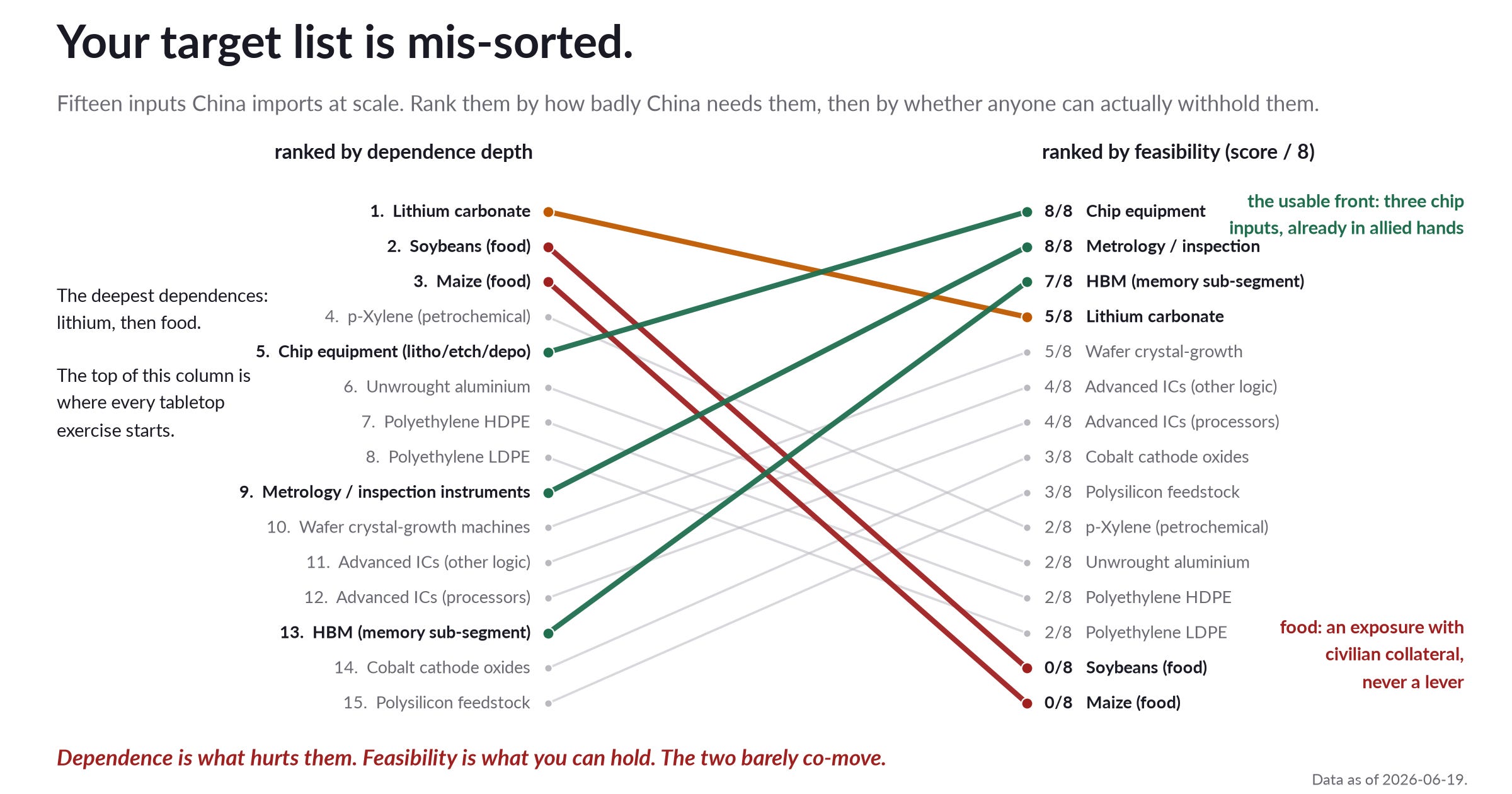
How to read it: fifteen candidate levers ranked twice, by dependence depth on the left and by feasibility on the right.
What to see: the lines cross hard. The deepest dependences make the worst levers, and the usable front is three chip inputs wide.
The strategic translation is a mirror. Beijing’s own playbook against its bottlenecks is visible in this data: stockpile deep, diversify origins, own the midstream, subsidize the residual chokepoint. The West spent late 2025 and 2026 building exactly that machine for minerals, with names and dates. The feasible offensive complement is narrower than most target lists assume: hold the chip toolchain front, with allies, for years, and do not confuse the other thirteen rows with leverage.
The findings
1. Vulnerability and feasibility are different axes, and lithium is the proof. Walk the deepest dependence through the four tests. China imports roughly 98 percent of its lithium carbonate, the deepest import dependence on every index in the panel. First test, allied control: raw lithium supply splits across Australia at about 37 percent of world mine output, Chile at about 20 percent, and Argentina at about 8 percent. Australia is allied. Chile and Argentina are friendly and non-aligned. There is no single controller, so an embargo needs a cartel first; and building a cartel was not on my life’s bingo card. Second test, substitution: China already owns the step after the mine, roughly 65 to 70 percent of the world’s conversion midstream, the step that turns ore into battery-grade chemical. Its route around a squeeze is mine equity abroad, which Chinese firms keep buying, so the controllable point is the ore and the window on it is closing. Third test, stockpiles: China’s strategic lithium reserve is undisclosed, which is not the same as thin, and commercial inventories sat in a glut at the data freeze. Fourth test, blowback: the one test lithium half-passes, since the collateral falls mostly on China’s own battery build-out rather than on civilians abroad.
Score: 5 of 8. The deepest dependence on every index is a medium lever at best. That is the whole sorting insight in one row.
One thing must be said plainly, here, where the map appears. This map is analysis, not a targeting recommendation. It scores dependences; it names no firms and recommends pulling nothing. The food rows in particular are flagged as exposures with severe civilian collateral, never as targets.
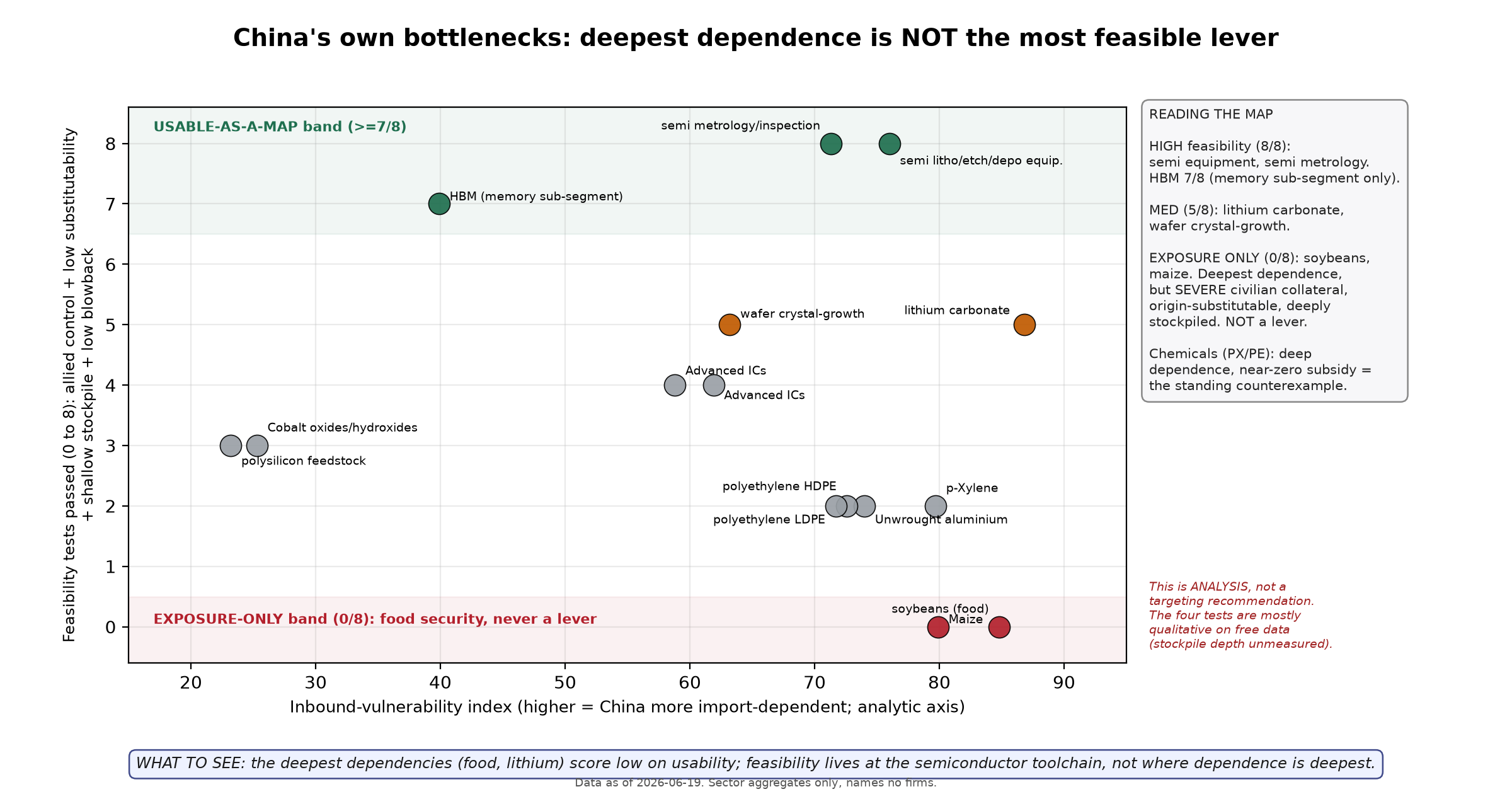
How to read it: each dot is one of fifteen inputs China imports at scale; right means China is more import-dependent, higher means the input passes more of the four external-control feasibility tests.
What to see: the deepest dependences, food and lithium on the right, sit low; the usable band at the top holds only chip equipment, metrology, and high-bandwidth memory.
2. The feasible front is narrow, allied, and already fortified. Three inputs pass the tests. Lithography, etch, and deposition equipment: 8 of 8. Metrology and inspection instruments, the tools that tell a fab whether its wafers are any good: 8 of 8. HBM: 7 of 8. Concentration does the work. Five toolmakers, Applied Materials, Lam Research, and KLA in the United States, ASML in the Netherlands, and Tokyo Electron in Japan, hold roughly 56 to 66 percent of the equipment market among them. China’s own world-export share in these categories runs 1.4 to 1.9 percent, which is what low frontier substitutability looks like in trade data. HBM comes with its own caveat: the 7 of 8 holds only at the HBM sub-segment, supplied by SK Hynix, Samsung, and Micron, where Chinese buyers have been drawing down pre-ban stock. The broad memory category is not a chokepoint at all; China exports about 27 percent of it. Precision matters more than breadth here.
Two features make this front different from every other row. Stockpiles fail China quietly: Chinese fabs stockpiled tools ahead of each control round, but the binding consumables are advanced-tool spares and service, and those are thin. And the blowback is low, because the collateral falls on chipmakers, not on civilians. The control architecture already exists: the 2023 United States, Japan, and Netherlands trilateral understanding on chip equipment, Japan’s 23 equipment categories licensed from July 2023, the first United States controls on HBM in the December 2, 2024 package, and Dutch national licensing of metrology and inspection equipment from April 1, 2025. This is the one place on the map where the deepest feasible lever and the operating policy already coincide. The erosion risks are mature-node leakage and indigenization, and they are risks, not facts, as of the data freeze.
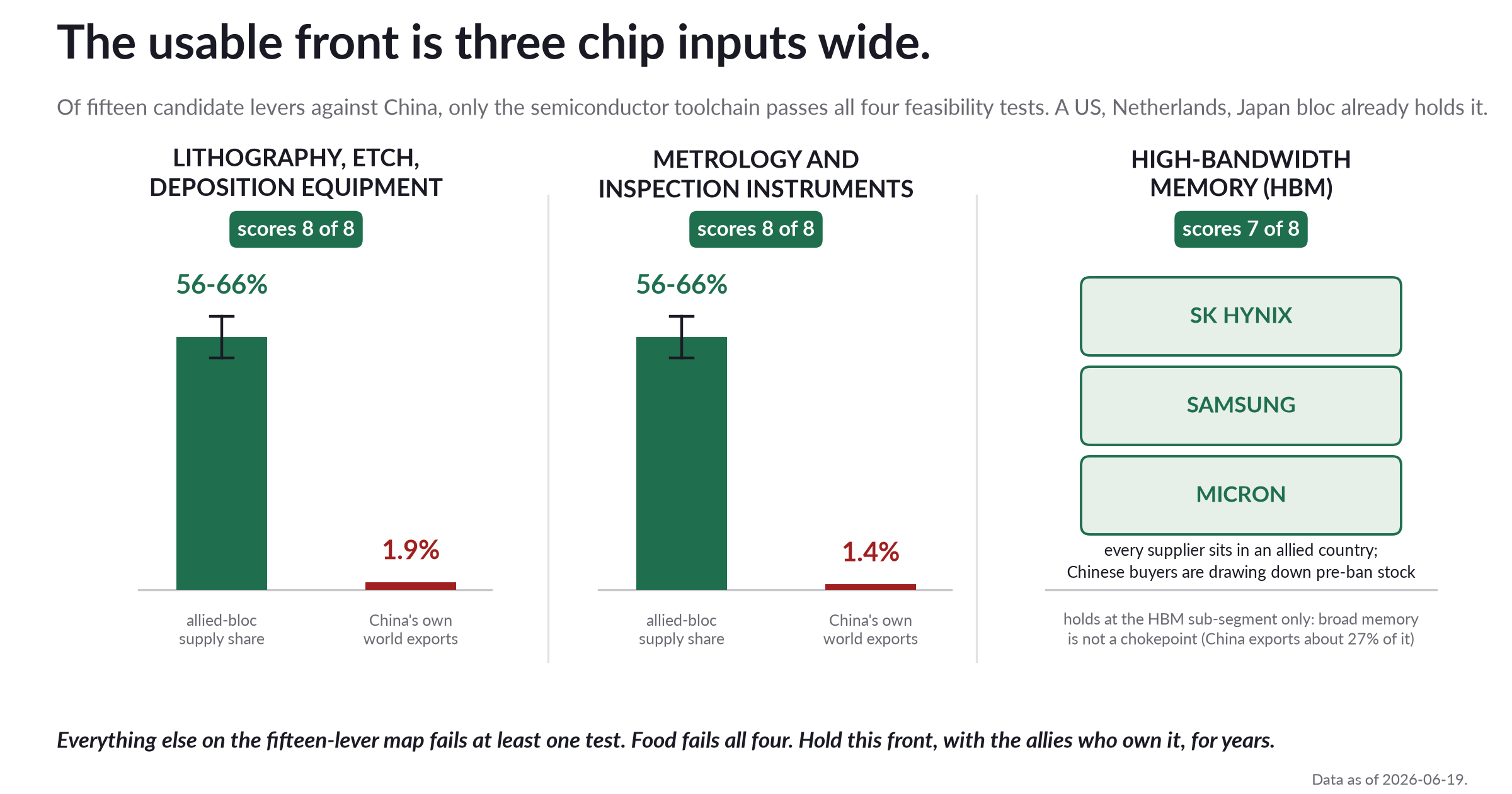
How to read it: allied-bloc control of each toolchain input beside China’s own exports in the category.
What to see: the feasible front is narrow, and it is allied by construction.
3. Food is an exposure. But we have a soul. Soybeans and maize are China’s largest inbound dependences after lithium, and they score 0 of 8. Run the tests and watch every one fail. Origins are substitutable: Brazil and the United States together supplied 92 percent of China’s 2024 soybean imports, Brazil is non-aligned and gaining share, and China already rehearsed the reroute once, after 2018. Stockpiles are deep: state soybean reserves run around 40 to 45 million tonnes, roughly five months of demand, and China holds about 60 percent of the entire world’s corn stocks, around 166 million tonnes. And the blowback test is not close: a food squeeze lands on feed, meat prices, and nutrition, which is to say on civilians.
So the line gets drawn explicitly. Food is a hardening target for Beijing and a collateral catastrophe as an instrument of a Western Democracy. It would not coerce, because the reserves and the reroute absorb it, and it would injure civilians while failing as an economic weapon. This analysis scores the dependence. Read Beijing’s behavior and you see the same map: the May 2026 Beijing summit’s touted agriculture purchases, about US$17 billion a year through 2028, are reassurance procurement for an exposure Beijing intends never to feel. Food on this map tells you what China fears. It does not tell you what you can use.
4. The China subsidy follows economic vulnerability law dies on contact; the per-sector stories survive. There is a seductive statistic in this data. Across nine sectors, the rank correlation between how vulnerable China is to an inbound cutoff and how much subsidy the sector receives runs about 0.67. That looks like doctrine: Beijing pays where it bleeds. It looked like doctrine to me for the first week of this project. Then the robustness checks came back. The correlation holds only with agriculture in the sample and only on the grant channel; drop agriculture and it falls to roughly 0.52 and loses significance. Agriculture’s cash is income and margin support for a politically vital constituency, not import substitution, so the one sector carrying the law does not even belong in it. Chemicals then break it from below: China is roughly 90 to 100 percent import-dependent on p-xylene and the polyethylenes, exactly the profile a targeting law says should draw defensive money, and the listed subsidy response is near zero. The feasibility map agrees those rows are safe to neglect, at 2 of 8, since the supply is a diffuse world commodity market with easy route-arounds. A blind spot, but a cheap one. One reconciliation note, because an earlier post leaned on a similar-sounding number: the six-sector intensity ranking the fear-map post used as corroboration is the cell that survives these checks. The nine-sector cross-channel law is what dies here.
What survives is the strongest single story, semiconductors as a defensive bet. Chips draw the heaviest support intensity of any sector in this panel, 7.3 percent of listed-firm revenue, plus roughly CNY 368 billion (about US$51 billion) in state equity, and chips sit precisely where the feasible external levers concentrate. The money points at the map. What the money has not bought is escape: China’s integrated-circuit import bill rose from about US$250 billion to about US$413 billion across the buildout, and China remains the world’s largest chip importer. A rational defensive bet, not a measured escape, and the distinction is significant. Print the stories. Do not print it as a law.
5. The counter-doctrine is already on the map: play China’s hardening game back, on the narrow front. Look at how Beijing treats its own limiting factors, its LIMFACs (limiting factor, the military term for the bottleneck that constrains everything else). It stockpiles deep, five months of soybeans and 60 percent of world corn stocks. It diversifies origins, shifting soy from the United States to Brazil. It buys the midstream, 65 to 70 percent of lithium conversion. And it subsidizes the residual chokepoint it cannot buy or reroute, the chip toolchain. That is a coherent doctrine, and it is a doctrine anyone can run.
The West, mostly without saying so, spent 2026 standing up the same machine. The Comprehensive Outbound Investment National Security Act (COINS Act), signed December 18, 2025, made outbound investment screening statutory instead of an executive order. Project Vault, announced February 2, 2026, put up to US$10 billion of Export-Import Bank financing behind a public-private strategic critical-minerals reserve, the stockpile leg. FORGE (Forum on Resource Geostrategic Engagement), launched February 4, 2026 as the successor to the Minerals Security Partnership, is designing coordinated reference prices and price floors backed by adjustable tariffs, the midstream-economics leg. And the June 17, 2026 G7 platform agreed at Evian added monitoring, lithium and nickel stockpile pilots, and a dated target: below 60 percent dependence on any single non-G7 supplier of rare earths and magnets by 2030. Diversify, stockpile, own the economics, screen the capital. Each mechanism is a named, funded rhyme with a line of Beijing’s own playbook.
That is the defensive half. The offensive half is what the map licenses: hold the equipment, metrology, and HBM front, with the allies who own it, and hold it for years. The previous post’s arithmetic applies with full force here, because held leverage beats fired leverage, and this front only stays feasible while the three-country bloc stays aligned and indigenization stays slow. The doctrine is not “hit them where they are most dependent.” It is “hold what they cannot substitute, and harden what you cannot.”
Best Arguments Against This
The strongest attack: this feasibility scoring is a structured framework on public data, not an economic war plan supported by the full weight of the intelligence community and people who actually enjoy reading financial filings. Correct, and I will state it harder than the critic would. Four tests at two points each is a sorting rubric. The stockpile axis is mostly qualitative, because China does not publish strategic-reserve volumes for lithium or chemicals; undisclosed got scored, not measured. The framework carries no substitution elasticities, so “China substitutes poorly” is a reading of trade shares, not a model. And public trade data cannot separate leading-edge chips from mature ones inside a customs category. What survives the concession is ordinal, not cardinal: the claim is that dependence-sorted target lists are mis-sorted, and every one of those limitations would have to break in the same direction, food becoming usable and the chip toolchain becoming substitutable, to un-sort the map. I have never met an OPLAN that fit on a one page chart. This is the chart you check the OPLAN against.
The second attack: the vulnerability-targeting result is carried by one sector. Conceded, by design. The 0.67 correlation was printed above with its own obituary attached, because it dies without agriculture and chemicals falsifies it from below. Nothing downstream leans on the law; the findings lean on lithium’s supplier map, food’s reserve depths, and the toolchain’s concentration, which stand or fall row by row.
What Would Change My Mind
An omitted lever. If someone names an input China depends on that is allied-controlled, hard to substitute, thin-stockpiled, and low-blowback, and it is not in my fifteen, the map is wrong and the narrow front may be wider. Then the thread we pull on is why my analysis of Chinese financial filings identify that input. There would be gold at the end of that rainbow.
Indigenization moving the trade data. China’s world-export share in chip equipment and metrology climbing well past the 1.4 to 1.9 percent band, or frontier tools shipping from Chinese vendors at scale, degrades the 8 of 8 rows on a schedule of quarters, not decades.
A measured semiconductor escape. If China’s integrated-circuit import bill falls while its wafer capacity holds or rises, the defensive bet becomes a closing chokepoint and the front narrows from the other side.
The correlation resurrecting. A multi-specification vulnerability-targeting result that survives dropping agriculture and holds on all-channel cash would upgrade Beijing’s defensive arm from per-sector stories to doctrine, and make the mirror strategy more urgent, not less.
The architecture failing to ship. If the Evian stockpile pilots and FORGE’s price-floor design produce nothing bankable by the 2027 G7 summit, the hardening half of the mirror strategy is a communique, and this post’s recommendation loses its instruments.
The close
A dependence table is not a target list. It is the other side’s hardening schedule. Vulnerability is what hurts them; feasibility is what you can hold; and in China’s case the two coincide in exactly one place, a toolchain three inputs wide that the United States, the Netherlands, and Japan already control. Sort by dependence and your list starts with food that a Democracy can never touch and lithium you cannot corner without forming a Cartel. Sort by feasibility and the list is short, allied, boring, and real. Or become the godfather of a lithium cartel; I hear cartel chiefs get hippopotamus or is it hippopotami?
Next, Post 7: every number in this series that rests on China’s own reporting stops in 2024, because Beijing stopped filing. The data went dark on schedule, and that is a finding, not an accident.