
I started this whole project trying to understand China’s industrial subsidization mechanics. I naively assumed that state subsidies worked. What I didn’t understand was “what” they actually did. Ask an economist whether China’s industrial subsidies work and the test is productivity: did the firm get better per unit of input. Ask the state that wrote the checks and the test is different: did the capacity get built, and did the firm survive. Those are two different exams. The money passes one and fails the other, and the one it passes is the one that shapes what the United States faces.
Bottom Line Up Front
Grade China’s industrial subsidies the way an economist would and the machine fails. I tested capability three independent causal ways: a difference-in-differences (DiD) design around dated subsidy withdrawals, a regression discontinuity at a corporate tax threshold, and an event study of state fund entries. All three agree with the raw association: state money buys research and development (R&D) spending and output scale, and it buys no measured productivity gain and no patent-quality gain. Among subsidized firms, more subsidy ranks with slightly lower patent quality (a rank correlation of about -0.20). Read that as a bounded null: no positive effect detected at my resolution, not a certified zero.
Grade it the way the state does and one effect is causally secured: survival. After a government guidance fund buys into a firm, the firm becomes measurably less likely to slide into distress. The coefficient on the distress flag is -0.033 with p = 0.003, and the pre-trends pass. That is the cleanest causal result in this entire project. It is a rescue effect, not an improvement effect.
Hold both results at once and the strategic picture resolves. The product of this machine is not excellence. It is endurance: excess capacity, retained engineers, intact supplier networks, and production routines that refuse to exit. A rival cannot wait this machine out. Any plan that assumes China’s weak firms will eventually die is a plan against the wrong machine.
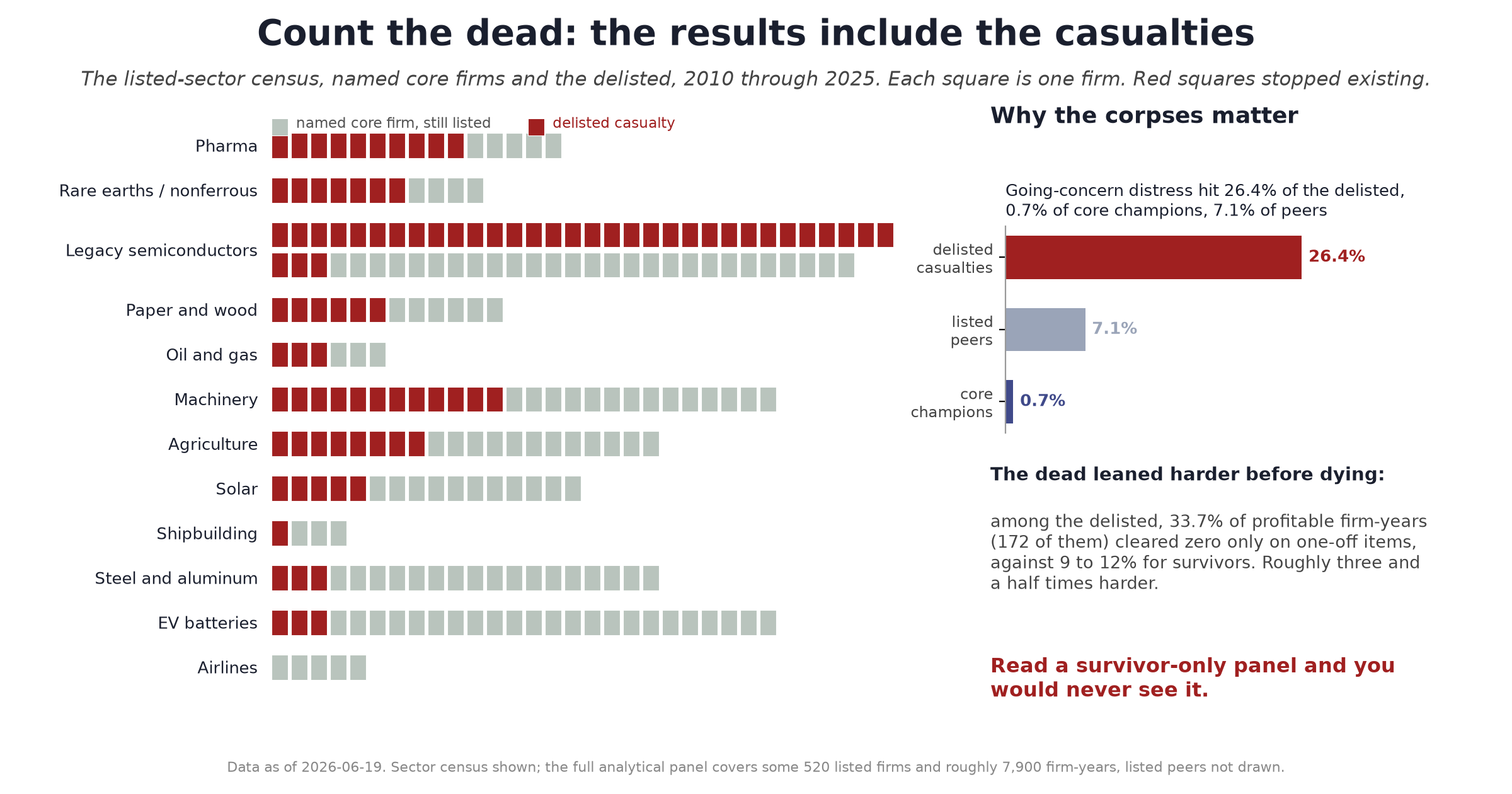
How to read it: one square per listed firm in the sector census; red squares are firms that delisted.
What to see: the casualties are in the data. Every result in this post counts the dead.
One perimeter note before the details: this is the listed-company layer, so the biggest rescue instruments, unlisted funds and off-book recapitalizations, are systematically undercounted, which biases the survival finding down, not up.
1. The money tracks inputs, not results
The association is already telling before any causal design touches it. Take the roughly 7,900 firm-years across some 520 listed Chinese firms, 2010 through 2025, with the delisted casualties deliberately kept in the sample. Rank the subsidized firms by how much they get. More subsidy comes with more R&D spending and more output scale. It does not come with more capability. Patent quality ranks slightly negative against subsidy intensity (about -0.20), and the total factor productivity (TFP) residual sits at roughly zero. The state is buying inputs. The outputs those inputs are supposed to produce do not show up.
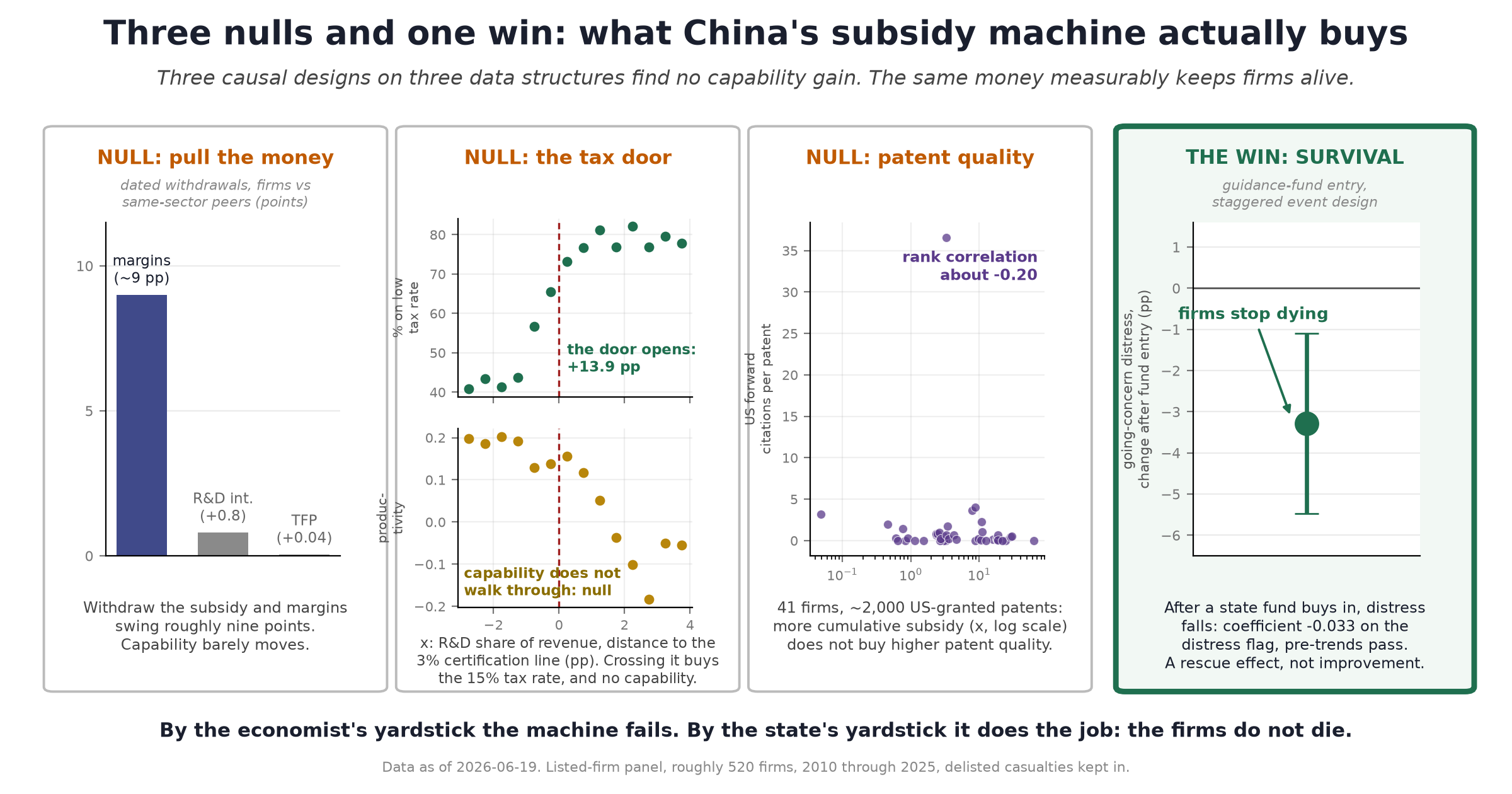
How to read it: four cards, one per research design; the three muted cards are the capability nulls, the green-bordered card is the survival effect.
What to see: three ways of asking whether state money buys excellence come back empty. The one causal yes is survival.
The US-citation slice deserves its own sentence, because it is corroboration and not proof. I scored 41 firms on roughly 2,000 US-granted patents using forward citations, the standard quality proxy. More subsidy associates with lower per-patent citations in all three specifications, rank correlations of about -0.15 to -0.27, none individually significant. That is a narrow, survivor-skewed subsample. It corroborates the null from independent data. It does not power a test. The panel that would settle the question, citation-weighted Chinese, European, and world patent filings, is paid data I did not buy. I will come back to that, because it is the strongest argument against this post.
2. Three causal designs, one shape
Associations have confounds, so I asked the question three causal ways, on three different data structures. Their agreement is the part I trust most.
Walk the cleanest one fully, because it shows the mechanism. A firm certified as a High and New Technology Enterprise (HNTE) pays corporate income tax at 15 percent instead of the standard 25 percent. Certification hinges partly on an R&D-intensity threshold: 3 percent of revenue. A hard threshold is a natural experiment. Firms just above the line and firms just below it are close to identical, except one group gets the tax break. That is a fuzzy regression discontinuity design (RDD), and the first stage is strong: crossing the 3 percent R&D line raises the probability of paying the low rate by 13.9 percentage points, with a confidence interval of 8.4 to 19.3. The tax door really opens at the R&D line.
Capability does not walk through it. Every capability outcome behind the threshold is null, and the one statistically significant sign runs the wrong way: sector share falls at the cutoff (p = 0.021). A 2021 study in the American Economic Review of this exact tax notch explains why. Firms bunch right at the 3 percent line and relabel spending to clear it; about 24.2 percent of reported R&D at the notch is relabeled from other budgets, not new science. The subsidy bought reported R&D. It did not buy what reported R&D is supposed to represent. And a caution that generalizes: HNTE-certified firms are the healthiest cohort in the panel, and that is selection, not treatment. Taxable income is the precondition for a tax break. The tax door only opens for firms that already make money.
The other two designs stay at altitude, and they rhyme. The withdrawal DiD studies dated subsidy removals: if the money had built capability, pulling it should reveal capability moving. The 2022 power-support withdrawal moved sector margins by roughly nine percentage points, a story Post 4 owns, and the capability needle barely moved with it: about +0.8 points of R&D intensity and +0.04 of the productivity residual, both inside the noise. The fund-entry design studies government guidance funds as staggered events, with a sector-mandate instrument confirming entry is real (first stage +9.6 percentage points, p below 1e-10). The balance check fails in the revealing direction: the firms the funds picked were already ahead before the fund arrived, by about 2.4 points of R&D intensity and roughly 3 to 5 points of sector share. Post-entry capability: null. The state picks winners more than it creates them, and the clean causal result is survival, not improvement.
The null also survives the obvious measurement attacks. Recomputing productivity with sector value-added deflators moves the estimate toward zero, never positive (about -0.01 across all firms, -0.15 among subsidized firms). The grant channel shows the relabeling signature beyond the tax notch: grant intensity ranks +0.36 with R&D-spend growth and negative with real productivity, while the patent-quality reading straddles zero. Better measurement does not rescue the claim. If you came here for proof that a state can purchase innovation on command, this is the wrong post.
3. The one thing the money causally buys is survival
Fund entry keeps firms alive, and that result is clean. After a guidance fund buys in, the probability of going-concern distress drops: coefficient -0.033 on the distress flag, p = 0.003, pre-trends pass. Weeks of failed experiments, then that. I did not expect the most strategically important number in this project to come out of an accounting flag.
Do not soften this until it disappears. Survival preserves capacity, employment, supplier relationships, and engineering teams. It preserves the option to surge later. If your objective is strategic capacity rather than shareholder return, keeping a weak firm alive is rational even when it ruins a productivity chart.
Do not harden it either. Survival is not capability. A tourniquet is not a training program. Inside state-owned enterprises (SOEs) the sign even flips: within the SOE cohort, more subsidy tracks more distress, which is what you expect when the money is running toward the bleeding. And the firms outside the rescue perimeter show what the rescue is worth: going-concern distress hit 26.4 percent of the delisted casualties, against 0.7 percent of the core champions and 7.1 percent of their listed peers.
4. The survivors lean, and the leaners die harder
Endurance has a texture, and the texture is fragility that does not exit. Across the decade, 11.6 percent of profitable firm-years clear zero only after counting one-off items: asset sales, fair-value swings, impairment reversals, and government grants. Call that non-recurring-dependent, never subsidy-dependent; grants are the largest single component but only about 32 percent of the profit-flipping gap at the median. The share is macro-cyclical, not a trend: 18.9 percent in 2014, down to a 6.6 percent trough in the 2021 boom, back to roughly 10 to 12 percent in the 2023 to 2025 downturn. The state’s flattery of the books peaks exactly when the cycle turns against the firm.
Now the survivorship contrast, which is why the dead firms stay in my sample. Among the delisted casualties, about 33.7 percent of their profitable firm-years leaned on one-off items, measured across 172 profitable firm-years, against roughly 9 to 12 percent for survivors. The firms that died were leaning about three and a half times harder. Read a survivor-only panel and you would never see it.
Airlines are the case that makes rescue visible as a shape. From 2020 through 2025 the core state carriers absorbed roughly CNY 117 billion (about USD 16 billion) in recapitalizations against roughly CNY 208 billion (about USD 29 billion) in cumulative losses, with COVID as the named confounder behind the worst years and only five carriers in the post-COVID window, so treat it as an illustration rather than an estimate. The shape is the point. The peak recapitalization landed in 2023, a full year after the worst loss. The carriers were still loss-making after the money went in. Capital went in; returns did not come out. That is equity buying solvency, not recovery. It is the survival result drawn in a single sector.
5. Endurance is the strategic product
Translate this to the state level and the machine snaps into focus. China does not need every subsidized firm to become excellent in order to change another government’s choices. It needs enough capacity, engineers, suppliers, and production routines to stay alive that a rival cannot simply wait for the weak firms to die. Market logic says the shakeout comes. The rescue machine says it does not.
That forces the rival state into an unpleasant menu: protect your own industrial base indefinitely, accept dependence, or pay to build a parallel one. Every option is expensive. None of them is “wait.”
In military language, this is not force improvement. It is force preservation. An economist looks at a subsidized Chinese firm with flat productivity and sees waste. A planner should look at the same firm and see a unit that has been kept in the field for fifteen years without ever winning an engagement, and has not gone home either. Capacity and scale gains are real in the data too, but they arrive through selection more than treatment, so I hold them at association strength. The load-bearing causal fact is simpler. The firms do not die.
Best Arguments Against This
The strongest surviving attack: I measured the wrong quality. My patent yardsticks lean on US-granted filings and an invention-share proxy. Maybe Chinese-language patents, process learning, or tacit engineering know-how would show the capability gain the US filings miss.
It is a fair objection, and it is the residual I could not close on free data. Here is the honest answer. The invention-share proxy on the full panel is negative. The US forward-citation slice is negative in all three specifications, independent data pointing the same way. The null survives recomputing productivity on deflated output rather than nominal revenue. And three causal designs on three separate data structures all fail to find a capability gain. For the objection to win, the unpurchased citation-weighted CN/EP/WO patent panel would have to reverse a sign that holds in every free design I can run. It might. That panel is the named falsifier, and until someone buys it, the residual stands: the capability counterfactual for firms that applied and were refused is unobtainable on free data, and I log that rather than guess it.
The second-best attack is that survival gains from fund entry are just selection too, funds picking firms that were never going to die. The pre-trends say otherwise: treated and untreated firms tracked each other before entry and diverged after. Selection explains who the funds picked. It does not explain the timing of the divergence.
What Would Change My Mind
As of the June 19, 2026 data freeze, none of these has fired.
A citation-weighted CN/EP/WO patent panel showing state support associated with higher per-patent quality would break the capability null.
A clean productivity gain surviving pre-trends in either the withdrawal DiD or the fund-entry design would mean the money buys improvement, not just inputs.
A balanced fund-entry sample showing post-entry capability creation, rather than funds entering already-ahead firms, would flip picking winners toward making them.
A secular, monotone decline in the non-recurring-dependence share, replacing the 2014 to 2025 cycle, would mean the system is weaning its firms rather than sustaining them.
The mental model to carry forward
Stop asking whether China’s subsidies work. Ask what they bought. They bought R&D budgets, output scale, and above all the refusal of subsidized firms to die. By the economist’s yardstick that is failure. By the state’s yardstick it is the mission.
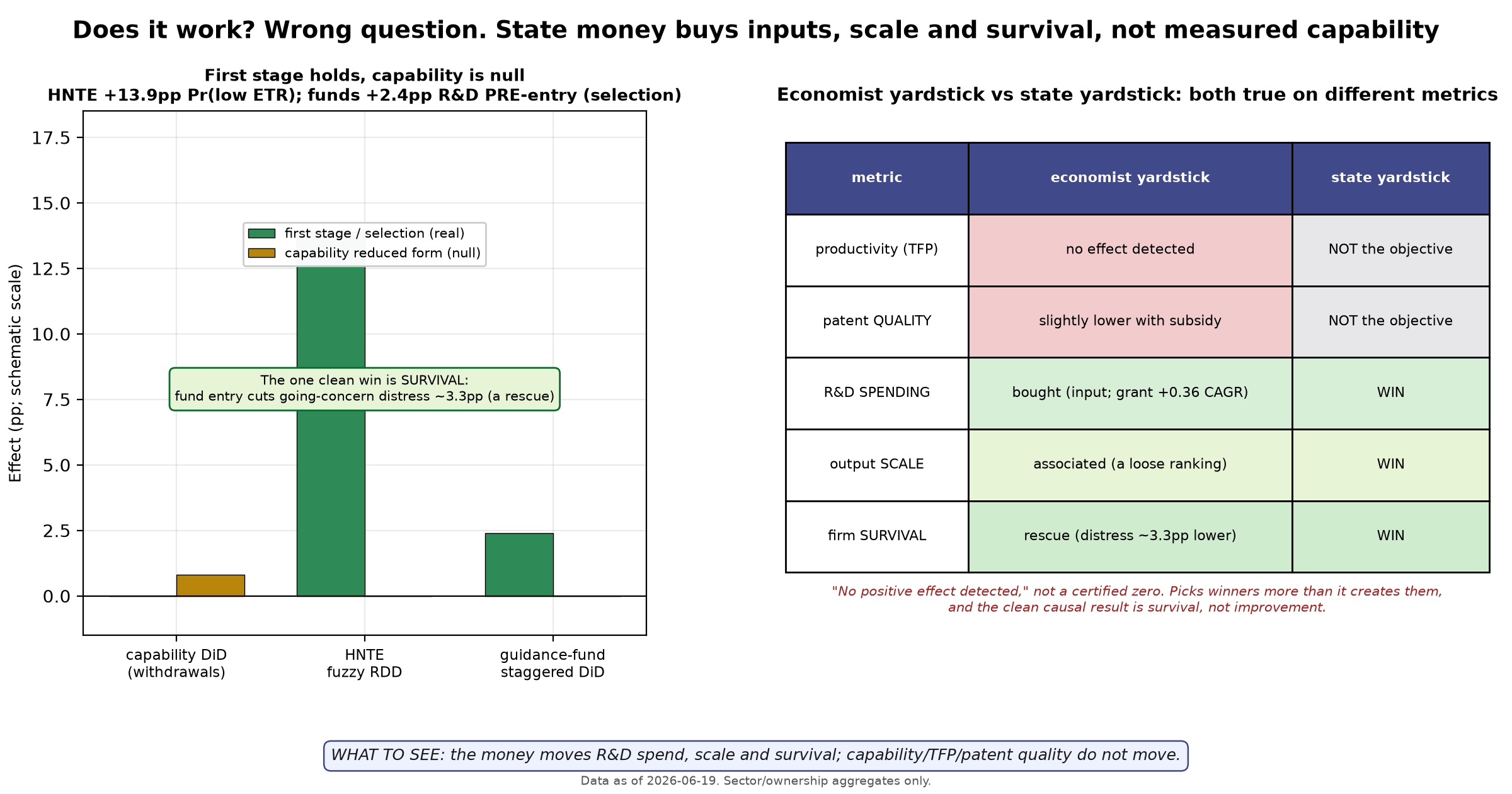
How to read it: the left panel shows the three causal designs, with the real first-stage and selection effects in green and the capability reduced forms in gold; the right panel grades the same money on the economist’s yardstick and on the state’s.
What to see: the tax door and the fund selection are real, capability barely moves, and survival is the one causal win.
China’s subsidy machine is not a capability forge. It is a life-support ward. And a rival that plans for the patients to die is planning against the wrong machine.
Next in this series: the checkbook turns out to be the loudest and least informative instrument Beijing owns. The deadliest instruments are free.