
For the past few weeks I have been measuring China’s industrial-subsidization machine the way you would audit a system you expect to be attacked by: listed-company filings, provincial budgets, customs records and their foreign mirrors, patent data, satellite imagery. Not opinions about China. Boring financial Ledgers. This post announces an eight-part series on what that audit found, and the short version is that both camps in the Washington argument are wrong in measurable ways. The hawks are wrong about how the machine works. The skeptics are wrong about whether it matters. That’s what the data says.
The military has a term for a strategy that does not try to beat you in the open field but makes it prohibitively expensive for you to show up at all: anti-access/area-denial, A2AD. China built the economic version. I started this trying to understand PRC industrial subsidies, the data has the size and shape of an economic warfare arsenal.
Bottom Line Up Front
China runs an economic-warfare machine with three measurable arms: market denial pointed outward through exported overcapacity, access denial held in reserve through export chokepoints, and a defensive arm that pours the heaviest money into hardening China’s own bottlenecks. Keep one thing in mind through this whole series: this is what the system does, as measured. I have no proof of two PLA Colonels writing a secret economic warfare plan.
What makes the machine unusual is not the size of the checks. It is breadth. China runs material programs across all nine support channels in my taxonomy: profit-and-loss grants, deferred grants, state equity, tax relief, demand-side purchase support, administered power prices, below-market inputs, directed credit, and in-kind transfers of land and infrastructure. The peer economies run three or four. The European Union scores four of nine, South Korea four, the United States three, Japan three. The caveat sits next to the claim: that count rides my own taxonomy and a judgment about what counts as material, so treat the nine-versus-three as a shape, not precision. Spending intensity points the same direction. An IMF-derived estimate puts China’s industrial support near 4.4 percent of GDP against 0.9 for the EU and 0.4 for the United States; the direction is robust, the exact multiple is not, because the accounting bases differ.
Why now? The Chinese/American trade clocks run out in the fall 2026. The Busan truce of October 30, 2025 was a one-year pause, not a settlement, and its expiries are specific. China's October 2025 rare-earth expansion, including the extraterritorial rule reaching any foreign magnet with 0.1 percent Chinese-origin content, is paused until November 10, 2026. Its US-directed gallium, germanium, and antimony ban is suspended until November 27, 2026. Washington's Affiliates Rule is suspended until November 9, 2026. The April 2025 licensing regime on seven rare earths never paused at all, and controlled exports still ran roughly 50 percent below pre-control levels into the May 2026 Beijing summit. The two presidents meet again in September 2026, weeks before all three alarms ring.
Here is what a policy-maker should now believe. China’s economic statecraft is not a larger version of everyone else’s subsidies. It is a different class of system, running more instruments at greater intensity, and its behavior, measured sector by sector, follows a loop: build capacity, overshoot, export the glut, convert export share into chokepoints, and spend the biggest money defending the economic chokepoints held against China. Whether anyone in Beijing drew that loop on a whiteboard is a question the data cannot answer. Whether the loop exists is answered by the data. The research data behind this series was current as of June 19, 2026. Yuan figures convert at roughly CNY 7.2 per dollar throughout.
1. The loop is measured behavior, not a blueprint
Let’s start with the concession. A large share of the machine’s supply side is not central strategy at all. It is bureaucratic competition. Chinese cities fund factories the way American universities fund football programs: because the neighboring city has one, and because careers are scored on it. The payer records show the split plainly. Cities and provinces fund supply, the capacity race. The central government funds demand and security, the purchase subsidies and the strategic bets. Nobody architected the machine in one document that I can find.
That is precisely why the Economic A2AD frame survives scrutiny. I am not claiming intent. I am claiming mechanism. A rainstorm has no plan, and you still bring an umbrella. Local tournaments build the capacity. The uncapped sectors overshoot and bust. The glut exits through the ports. The export share accumulates into one-way dependencies. And the central government, watching which dependencies point back at China, aims the heaviest cash at exactly those. Every link in that chain is measured somewhere in this series, at its own strength, with its own failure modes printed next to it.
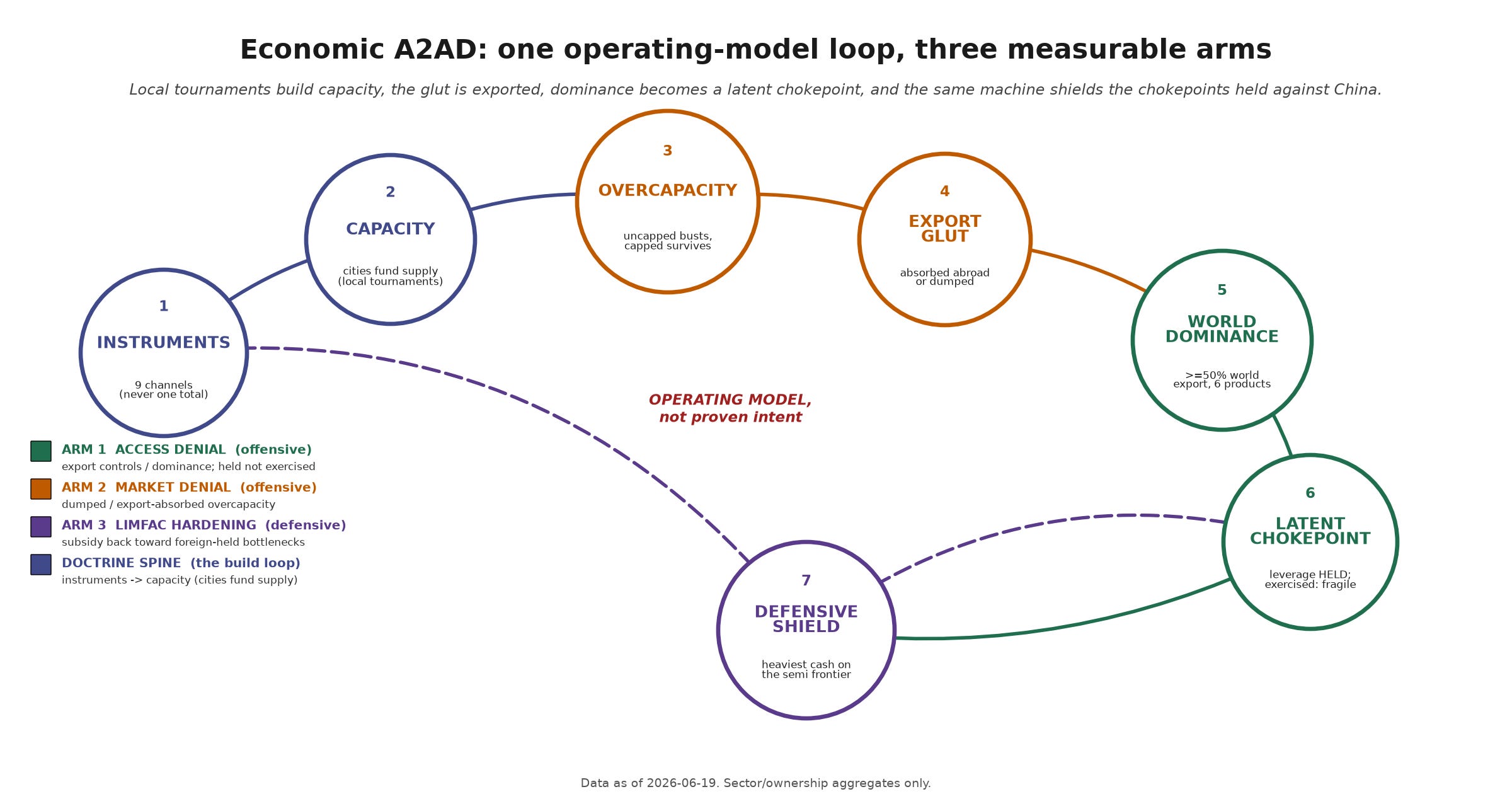
How to read it: seven nodes trace the loop from instruments through capacity, overcapacity, export glut, and world dominance to a latent chokepoint, with a dashed defensive arm pointing back at China’s own vulnerabilities. What to see: the machine is a loop, not a list of subsidies, and one arm of it aims home.
2. Breadth is the anomaly
Nine channels but never one total. The first discipline that we enforced on the project is that the nine subsidization channels cannot be added together. A deferred grant is a stock; a power-price discount is a flow; state equity is a balance-sheet position. Anyone who hands you one all-in “China subsidy number” has already made an accounting error you should not forgive. The channel mix is not a measurement nuisance. It is the message. Tax relief rewards firms that already have profits. Demand subsidies conjure markets. Equity keeps strategic bleeders alive. Reading which channel a sector gets tells you what the state’s intent, and that decoder ring does more work in this series than any yuan figure.
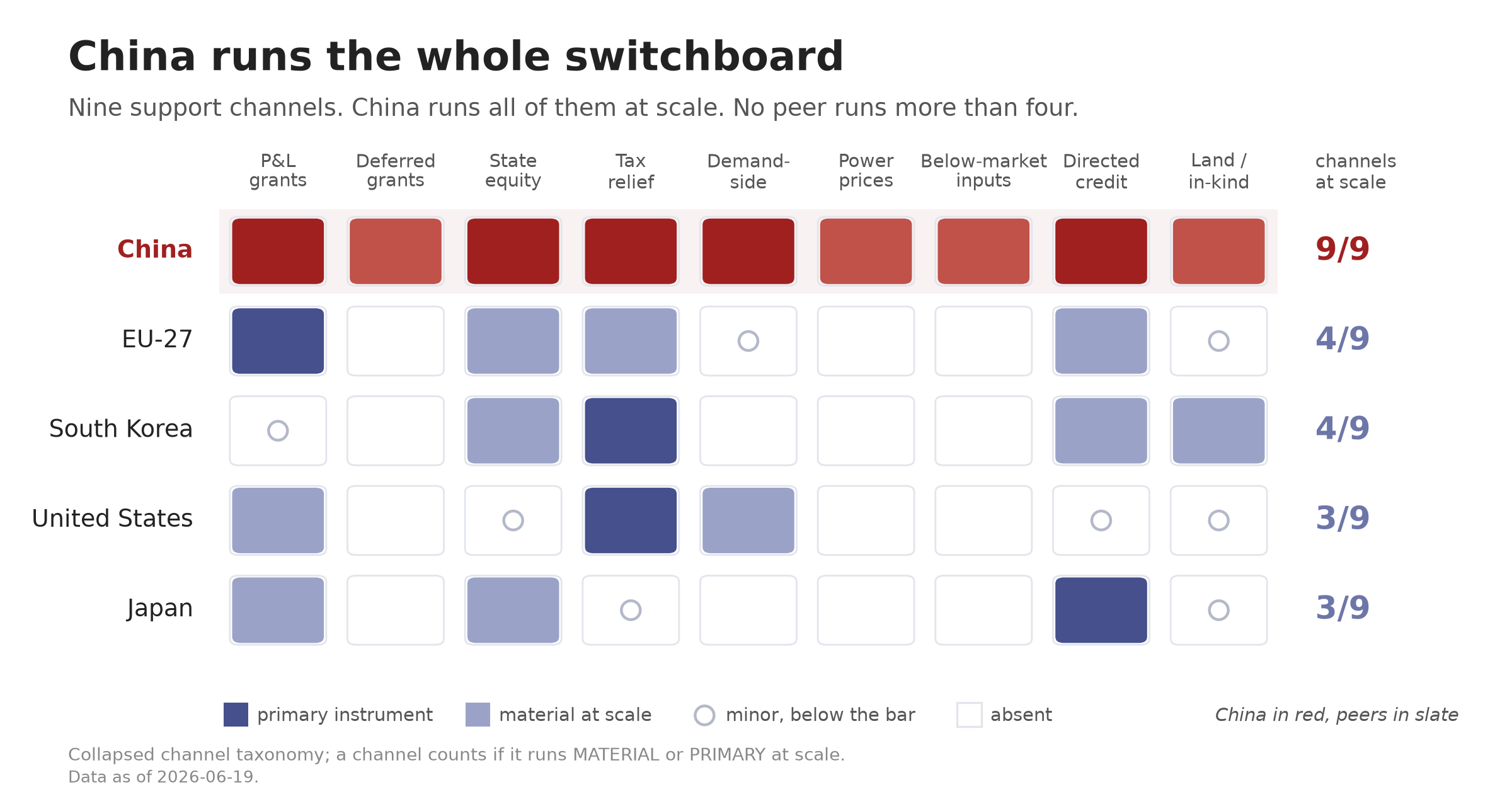
How to read it: rows are governments, columns are the nine support/subsidization channels under one collapsed taxonomy; a filled cell is a channel run at material or primary scale, a small circle is a minor program below the bar. What to see: China’s row is fully lit. No peer row lights more than four of nine.
The intensity ranking points the same way, held loosely. China near 4.4 percent of GDP, the EU at 0.9, Korea at 0.67, Japan at 0.50, the United States at 0.39, on an IMF-derived basis. The one study that measured everyone on a single yardstick put China lower in level but still far ahead of every peer. Direction: settled. Multiple: honest range, not a point.
3. The method is the product
Three disciplines run through every post, and they are where this series earns the right to its conclusions. First: count the dead. Most subsidy studies grade the survivors, which is like grading a casino by interviewing the people still at the tables. Every sector-level result in this series includes the delisted firms, and in at least one sector that choice flips the sign of the answer. Second: when China’s own data goes dark, and it does, the numbers get rebuilt from the other side of the transaction, from what the rest of the world reports importing from China, with the error bands printed rather than waved at. Third: causal claims, associations, and hypotheses are kept in separate sentences. When a post says the state causally bought survival, there is a research design behind the word, and when a post says a pattern is suggestive, it means exactly that and no more.
The policy debate about China runs almost entirely on opinions with artistic infographics. The wager here is that Chinese financial ledgers, read with discipline, will beat opinions. And hard-conclusions become more actionable when soft-suggestions are called out as deriving from spotty data.
4. Washington started copying it, which is the tell
The strongest objection to this series used to be “every country subsidizes.” In 2025 the United States answered it for me. In August 2025 the federal government converted CHIPS Act grants into an equity stake of roughly 10 percent in Intel. A month earlier the Department of War took a 15 percent position in MP Materials, the rare-earth producer, and wrapped it in a ten-year price floor and an offtake guarantee. By October the federal government held stakes in five public companies. I am not grading those moves here. I am observing that when Washington starts buying golden shares and writing price floors, it has conceded that grants-versus-tariffs was never the real instrument set. The channels are the economic weapon. The United States just started acquiring them.
5. What the next seven posts will show
Each post kills or sharpens one piece of Washington conventional wisdom, stands alone, and carries its own chart. In order:
Post 2. The Money Goes Where China Is Losing. Across the six sectors measured, subsidy intensity and export leverage rank almost exactly inverted. Semiconductors absorb the heaviest support intensity, 7.3 percent of listed-firm revenue plus roughly CNY 368 billion (about US$51 billion) in state equity, and China remains the world’s largest chip importer. Read Beijing’s ledger as a fear map, not an ambition map.
Post 3. It just so happens that your friend here is only MOSTLY dead. Subsidies don’t buy excellence, they buy refusal to die. Three independent causal designs find no measured productivity or patent-quality gain. One effect is causally secured: survival. The product is endurance, and you cannot wait it out.
Post 4. The Deadliest Economic Instruments Are Free. The same 2022 support withdrawal made capped aluminum more profitable by 9.4 points of margin and buried uncapped solar. China’s one repeatedly fired economic weapon, critical minerals, runs on quotas and licenses built on a rounding error of cash. Track caps and licenses, not budgets.
Post 5. Weapons Depreciates When Fired. As of 2024 China held 50 to 72 percent of world exports across five product families. Held leverage is real. Fired leverage erodes: the 2010 rare-earth embargo cut Japan’s China-dependence from roughly 90 to roughly 60 percent over a decade, and the 2023-2025 controls are printing the same signature faster.
Post 6. The Target List Is Wrong. Vulnerability and feasibility are nearly orthogonal. China’s deepest dependences, food and lithium, are the West’s worst levers. The usable front is three chip inputs wide and requires allies.
Post 7. Never Verify Against a Sensor the Adversary Owns. Twelve documented Chinese reporting changes, zero strictly false statements, and no 2025 trade data posted to the UN as of July 2026. Never write a verification regime against a sensor the adversary owns.
Post 8. So, Is it Working? There is one causal win, and it is not the one Washington argues about. The honest grades, cell by cell, and six operating rules for US strategy, each tied to a measured finding.
Best Arguments Against This
“This is local overinvestment and bureaucratic competition, not warfare.” Largely true on the supply side. The answer is that the frame never required intent. The loop’s outputs, chokepoints held, gluts exported, defenses funded, are real regardless of whether the inputs were ordered or emergent. Post 2 will show the strongest evidence for the emergent read: the money flows toward China’s fears, not its ambitions, which is exactly what a fear-driven allocator looks like and exactly what a master plan does not.
“Your nine-of-nine is your own taxonomy.” It is. A different taxonomy would move the count. I have not found one under which the peers reach China’s breadth, and the graph above states the judgment it rides on. If someone produces a defensible taxonomy where the EU runs nine of nine then please send it my way.
What Would Change My Mind
A primary Chinese central-planning document that specifies the loop as doctrine. That would upgrade “operating model” to “intent,” and this series would say so.
A pre-specified, cross-sector test in which subsidy cash positively predicts later export dominance. Post 2 stakes the opposite claim.
Peer economies scoring seven-plus of nine channels under this project’s own taxonomy.
China resuming trade reporting to the UN and reconciling the flagged gaps benignly. Post 7 carries the dated version of that trigger.
A fired Chinese export control that holds market share and volume at a price premium for four consecutive quarters. Post 5 explains why none has yet.
Economic A2AD is not a doctrine China published. It is a behavior China exhibits. Doctrine is an argument about documents. Behavior is an argument about data, and data is what the next seven posts are made of.
Post 2 runs next: the money goes where China is losing.
Please check my Paper about America vs China dominance in next 20 years.