
There are a good number of legal, policy, ethical, and even religious discussions asking if we should incorporate AI into weapons. I have been taking a different approach, projecting AI-characteristics onto well-studied historic battles, and using Lanchester equations to model what AI-weapons will do to battle. This series focuses on being able to imbue AI weapons with an unbreakable will.
This post is the story of a result attacked twice and sharper both times. The original capstone: a casualty-averse democracy fields tactical AI that never routs, her battle wins soar, and her odds of winning the war never improve, with every machine loss counted as national blood. But will the nation count robot wreckage as body bags? Probably not. And this is the sobering moment, if the nation doesn’t value it’s AI weapons then their enemy is incentivized to attack the rear human troops and civilians. The war is decided by what the nation can bear. And the adversary must attack what the nation can not bear to lose.
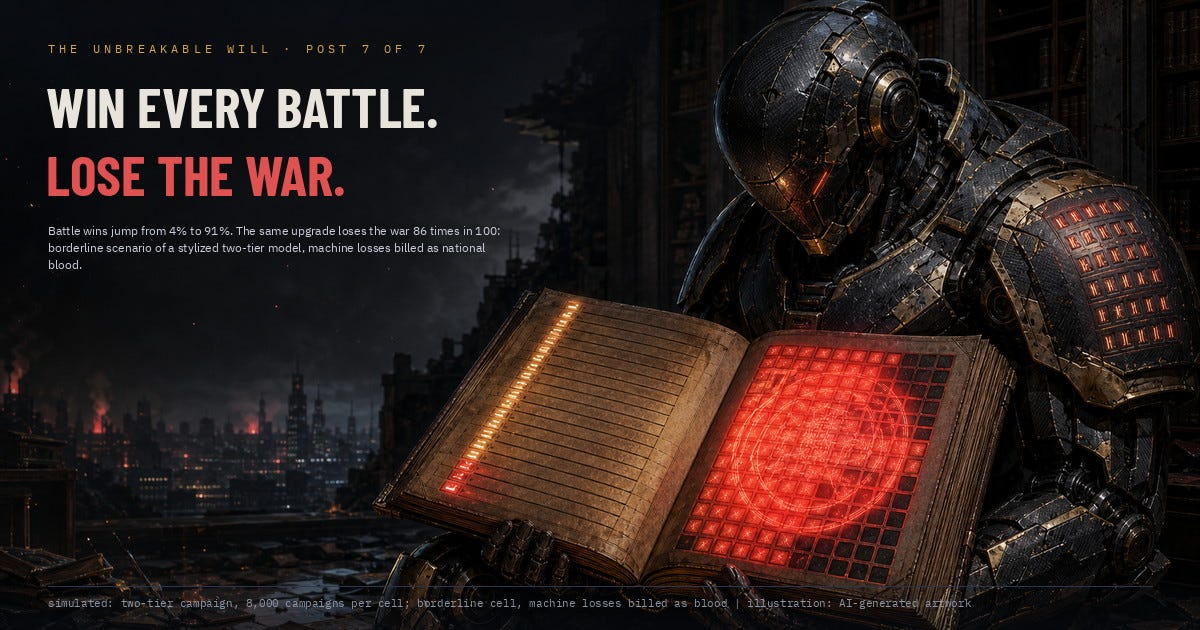
What to see: The upgrade wins the battles and loses the war 86 times in 100, under a stylized model that bills machine losses as national blood. AI-generated illustration; proportions follow the measured result.
Everything turns on two dials: whether the nation grieves machine losses like sons, and whether the enemy can reach the blood that remains. The dials map four regimes, the fourth a pocket inside the third regime. Machine losses billed as blood: the published inversion stands, a borderline won war lost 86 times in 100. Bloodless robots, blood out of reach: the finding reverses, though treasure and time can still lose the war. Even weak reach into the rear: the trap returns, the enemy deliberately losing every battle to win the war. The pocket: in 7 of 36 weak-reach cells the robots punish diversion so hard the enemy calls the rear attack off. Stylized model throughout; the orderings are the findings.
1. The original result, and where it still stands
Regime one: your losses are blood, and the blood meter decides. The capstone runs a two-tier campaign of up to 20 battles on the Lanchester engine validated against Iwo Jima, Bull Run, Pickett’s Charge, and Trafalgar. Above it sits a per-side national cost meter, casualties, economic burden, war weariness, with literature-motivated, uncalibrated weights: the democracy prices blood heavily, her casualty-indifferent adversary hardly at all. When cumulative cost crosses tolerance, a nation sues for peace, whatever the map says.
Make her troops unbreakable and battle wins jump from 4% to 91% (95% confidence interval plus or minus 0.8 points, 8,000 campaigns per cell). Yet in all 36 cells the upgrade never once reduced her probability of strategic defeat while every machine loss was booked as national blood at full weight; in the borderline anchor cell it raised that probability from 0% to 86%, with about 20% more of her own dead. Won by a hair, yet the baseline bar sits at zero? Both are true: normal troops win this war every time, but at parameters where one push flips it. The upgrade is the push.
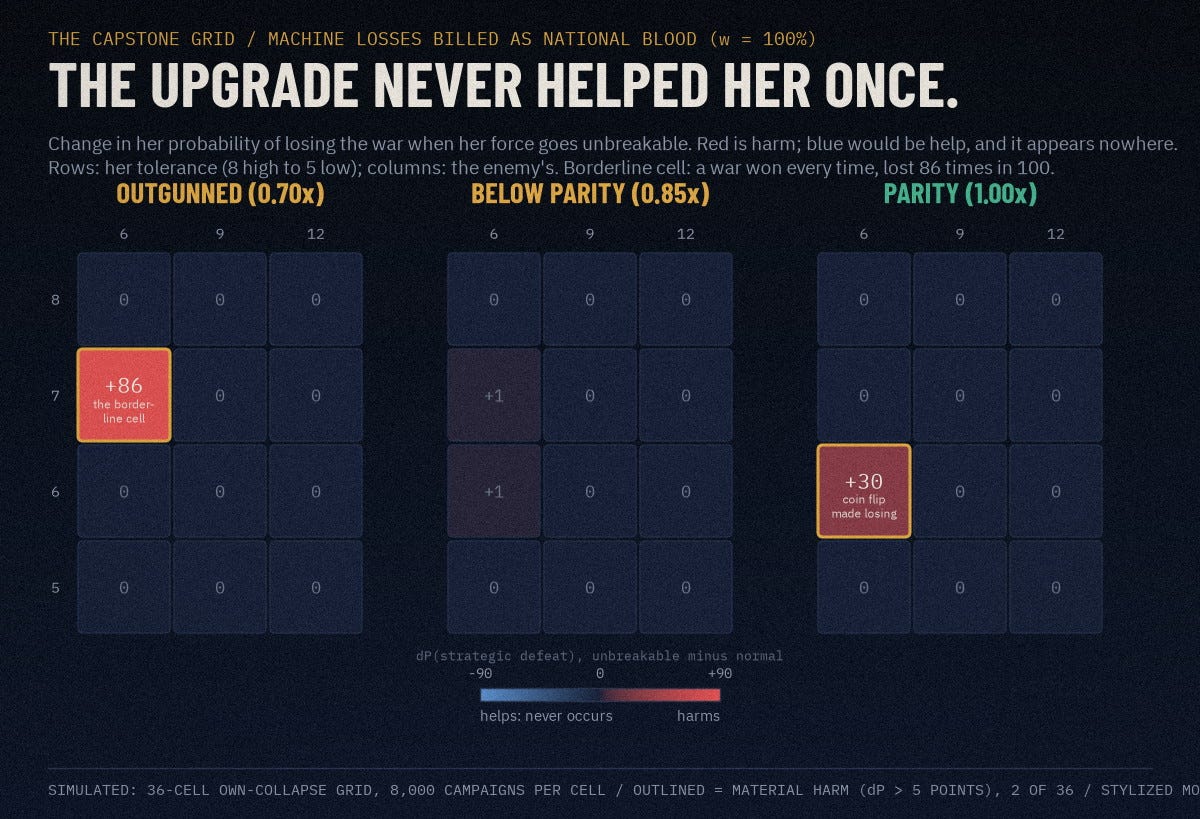
How to read it: rows her national tolerance, columns the enemy’s; each number is the change in her defeat probability, machine losses billed as blood.
What to see: harm in the 2 outlined cells of 36, blue nowhere; under this accounting the upgrade never once helped.
That grid disciplines both camps. The doomer version, robots lose you the war, is wrong in 34 of 36 cells; mostly the upgrade is inert while the dead pile higher. The booster version, robots win you the war, is wrong in 36 of 36. The reviewer attacked that asymmetry next.
2. The blood-weight dial
A robot loss is not a body bag, so I built the dial and turned it. The machine-loss blood weight w is the share of machine losses billed to the nation’s casualty channel. At w = 100% it reproduces the published capstone to the last digit; at w = 0 the robots are pure treasure. I reran the grid between.
The published ordering is a knife edge that survives only above w of roughly 90%: the borderline cell’s 86% chance of losing the war falls to 54% at w = 95%, 28% at 90%, 0.8% at 85%, zero at 80% and below. A cliff, not a slope, sharpened by near-deterministic thresholds. Below it the sign flips grid-wide: helping in 5 of 36 cells at w = 75% and 30 of 36 at w = 0, hurting nowhere.
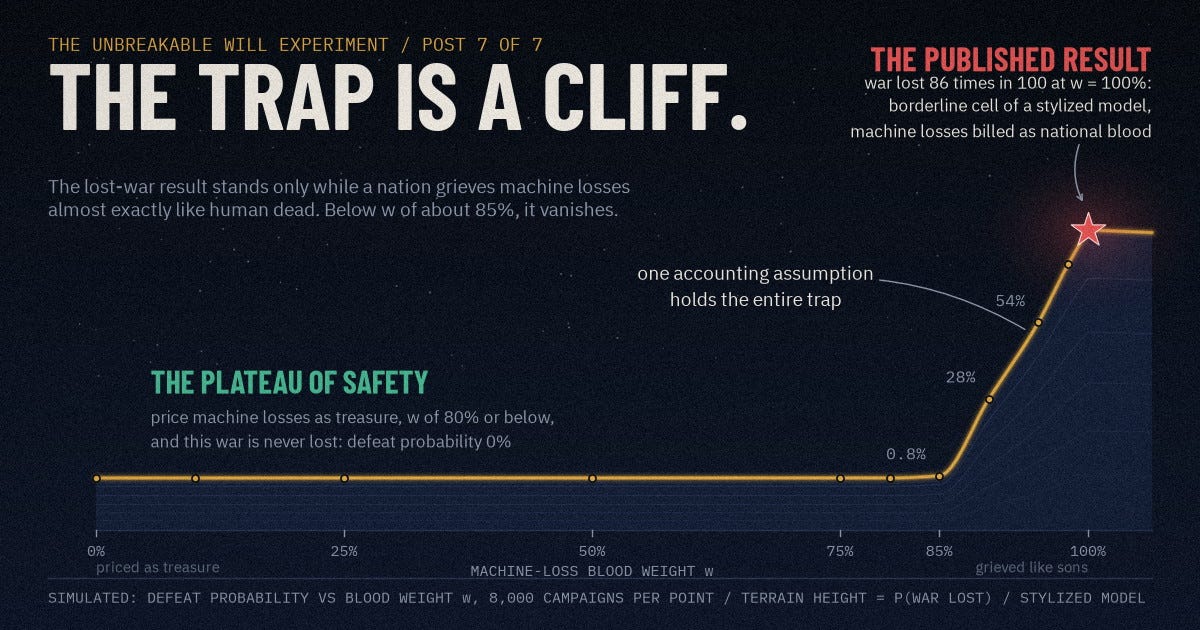
How to read it: walking right means grieving machine losses more like human dead; terrain height is her chance of losing the war in the borderline cell.
What to see: a cliff, not a slope; one accounting assumption, whether a nation bleeds for its machines, holds the entire published result.
Mixed forces carry a wrinkle at deep discounts, w of 25% and below. Human deaths fall in absolute terms, because machines soak fire, but discounted machine blood keeps the democracy fighting: campaigns run longer than the all-human force’s wars against the same enemy, up to 40 percent longer in the worst cells (10.9 battles against 8.0), and per-capita deaths among the remaining humans rise in 27 of 36 cells (mean ratio 1.15, worst 1.38). Robot blood discounts buy longer wars in which each remaining soldier is more likely to die.
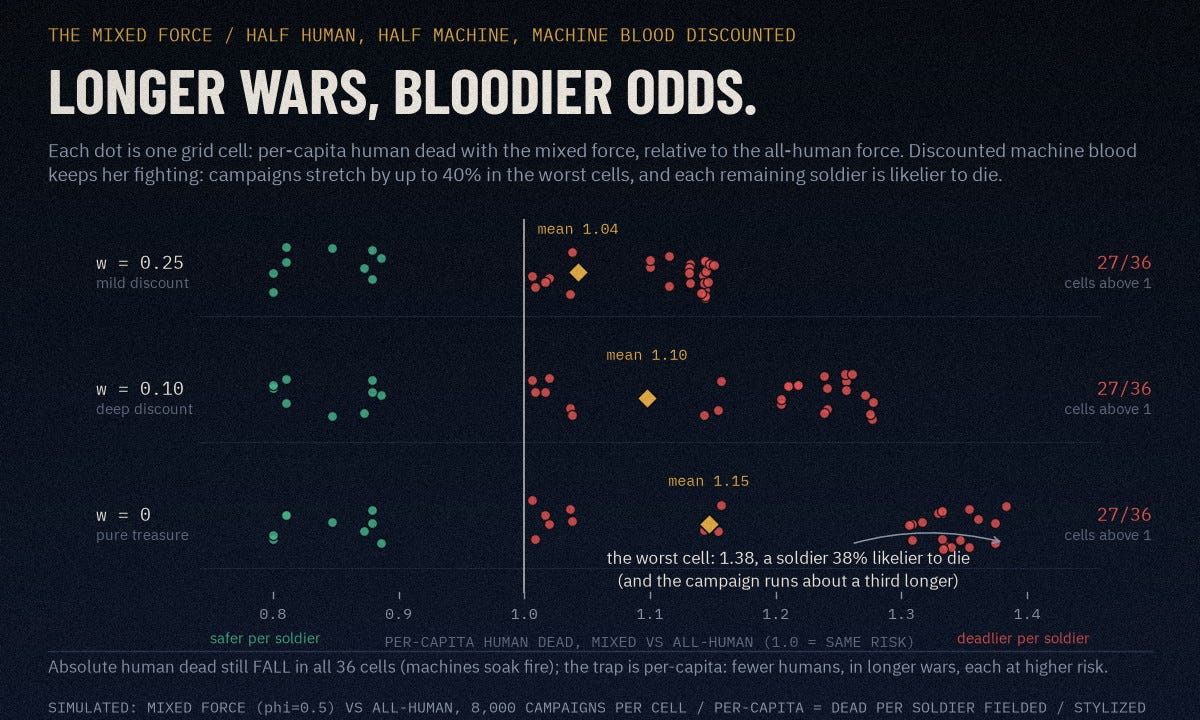
How to read it: each dot is one grid cell: per-capita human dead with the half-robot force relative to the all-human force.
What to see: discounted robot blood buys longer wars in which each remaining soldier is likelier to die, even as the headline body count falls.
So regime two is real: bloodless robots with blood out of reach are close to a strategic free lunch. Close: even at w = 0 the enemy wins 2 of 36 cells (defeat probability up to 40%) on economy and weariness alone. The breakpoint changes currency; it does not disappear. This enemy could not re-target the democracy’s remaining blood, so I gave him the option.
3. The enemy reads the ledger too
Regime three: he loses every battle on purpose and wins the war. The enemy may now divert force from each battle to the democracy’s rear: logistics crews, infrastructure, civilians, whatever blood remains reachable. Rear blood bills at full political weight, because it is human. Reach effectiveness is a free parameter, swept from weak to strong around an argued anchor.
The bloodless-robot advantage collapses on contact. At w = 0, a rational enemy with weak reach shrinks the robots’ help from 30 cells to 7 and defeats the democracy in 27 of 36; at moderate reach she loses all 36, and so does her all-human counterpart. The trap was never about the robots. It is a casualty-averse polity with reachable blood, facing one without. In the borderline cell defeat goes from 0% to 100% while her tactical win rate is 100%: the enemy diverts up to half his force, deliberately loses every battle, and wins the war in a median of four battles, because the battles were never where your blood was.
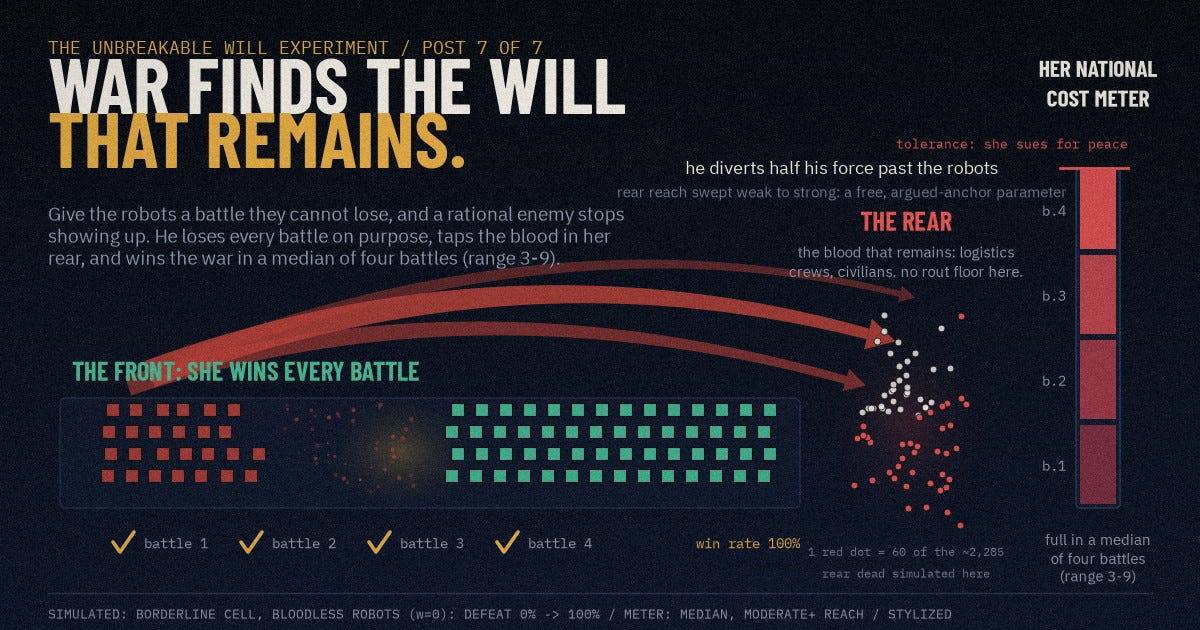
How to read it: the robot lane wins every battle at the front; the arrows are the enemy force that never shows up there, tapping the rear until her cost meter crosses tolerance (stylized; rear reach is a free parameter).
What to see: he loses every battle on purpose and wins the war; the battles were never where her blood was.
If the trap is about casualty-averse polities, what did simulating the robots buy? The boundaries, not the destination: the w cliff near 90%, the 7 cells where robots deter the rear attack, the rout sanctuary below, and the posts 2 through 6 ladder, worthless trooper will to 10-to-1 commander will to decisive national will. None of that comes off a napkin.
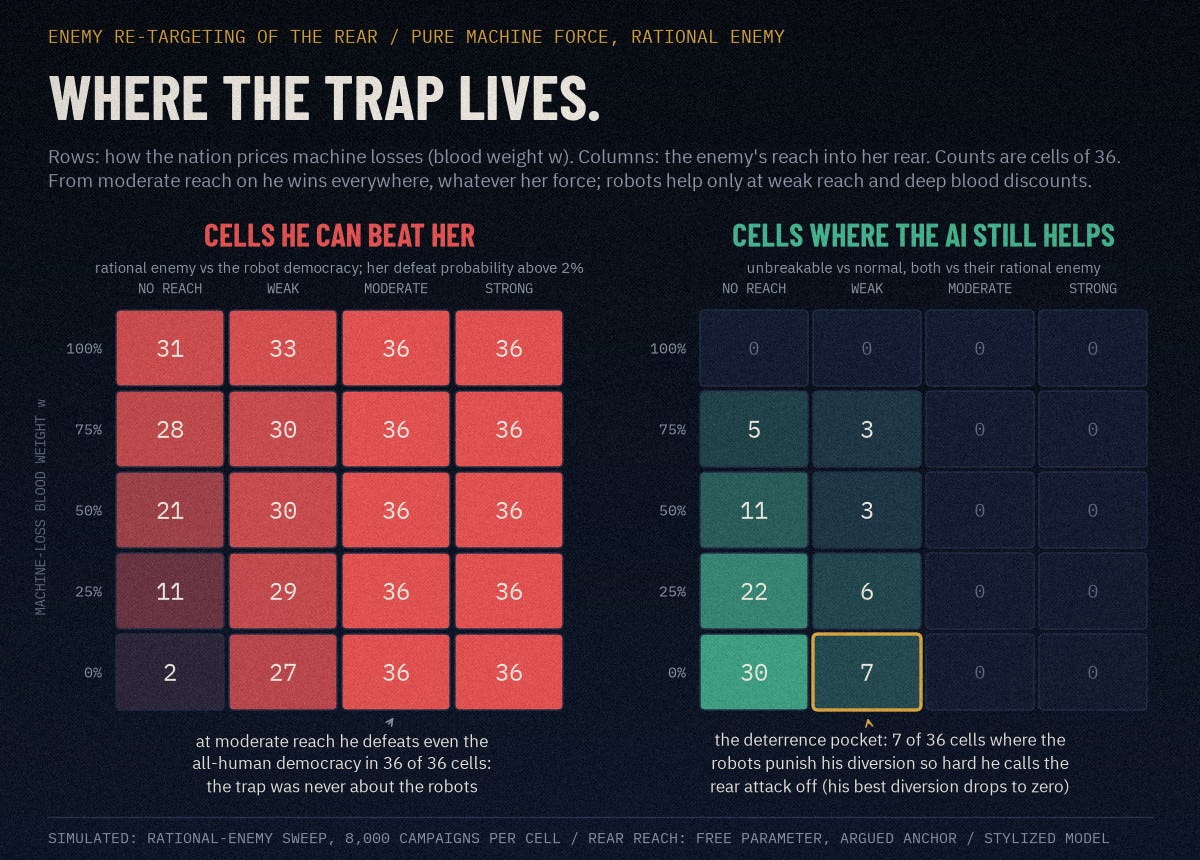
How to read it: rows, how the nation prices machine losses; columns, the enemy’s reach into her rear; the maps count cells of 36 he wins and cells where the upgrade still pays.
What to see: the advantage survives only weak reach and deep blood discounts; from moderate reach on he wins everywhere.
One limitation gates everything here: reach is anchored, not calibrated, and the answer cliffs between weak and moderate, so where a real adversary sits the model cannot say. The remaining concessions live in Best Arguments.
4. Two silver linings
Regime four, the pocket inside the third: the robots deter the rear attack where their punishment is credible. At weak reach the surviving help cells are deterrence cells: in 6 of the 7 the enemy’s best diversion collapses to zero, because every soldier sent rearward is absent from a battle the robots now win before the rear tap fills. Against a normal force his best play in 4 of the 7 cells is the half-strength diversion, the democracy’s defeat odds running as high as certainty. Seven cells of 36, in a weak-reach world where she still loses the other 27, bought by menace: the best product is again the fights, and here the atrocities, that do not happen.
And concentrating fire on your humans backfires, because the rout is a sanctuary. I expected the rational enemy to attack the front-line mixed force’s humans with concentrated fire. He almost never does, his best response in at most 6 of 108 cases: concentration pushes humans to their rout threshold sooner, routed humans stop being extractable blood, and rounds spent on the soon-to-rout are rounds not killing machines, which then win faster. In the borderline cell, concentrated fire on the front-line humans lowers her defeat probability from 94.0% to 84.2%. The rear has no rout floor. That is why attacking the rear humans (including civilians) dominates.
5. The honest scorecard
Six posts compress into one fair ledger. What unbreakable will buys:
Iwo Jima: the unbroken garrison roughly doubled American casualties (1.95x, 21,431 versus 10,969 simulated, assault-echelon accounting) and more than tripled the clock (post 2).
Parity: the Union broke at Bull Run at 8.3% casualties, 2,896 of 35,000 present counting killed, wounded, missing, and captured; a robot Pickett’s Charge wins 92% (95% interval 91.6 to 92.5), never loses, stalemates the rest (post 2).
A tiebreaker: 33 to 46 points of win probability in stylized salvo duels near parity, more in the calibrated battles (post 4).
What it does not buy:
Escape from capability: 66% (band 60.8 to 72.2%) of 607 historical defeats were capability losses (post 3).
Victory below the floor (0.65 Pickett, 1.12 Trafalgar): an unbreakable Trafalgar fleet loses five times in six (83.6%, interval 83.0 to 84.2); against a steadfast enemy your will is worth exactly zero (post 4).
The right target: commanders withdrew ten times as often as troops were annihilated, 266 versus 26 of 607 (post 5).
The enemy’s cooperation: he declines 40 to 58% of the fights, collapsing will’s measured value about 97% (post 6).
The war: never in 36 of 36 cells when losses bill as blood; otherwise the enemy re-prices it in the blood that remains (this post).
6. The operating rules
Prescriptions belong at the end of the evidence. Nine rules, each traceable to a measured finding; rules three, four, five, seven, and eight carry stylized magnitudes, and the orderings are the finding.
1. Buy capability to parity before buying will. Two-thirds of historical defeats were capability losses; below the capability floor no resolve wins. First reach the tie.
2. Automate the commander’s strategic decision to stand before the tactical troops’ decision. Commanders quit ten times as often as troops were annihilated; the binding breakpoint is the command post, not the rifle pit.
3. Spend the will budget on the objective-holding force. Will was worth about +50 points of win probability for the objective-holding domain, about zero for supporting domains. Resolve in the supporting cast is decoration.
4. Treat electronic-warfare (EW) and cyber resilience as the will budget, because it is. Below a resilience threshold (about 40%, 20 to 50% across configurations), the enemy jams or hacks your will instead of killing your platforms. Buy hardening before you brag.
5. Expect the enemy to decline your unbreakable force’s fights. A rational opponent deterred from roughly 40 to 58% of encounters kept only the fights it liked, collapsing will’s realized value about 97%. Price deterrence in; it never shows in battle statistics.
6. Budget the butcher’s bill in both directions. Iwo Jima’s unbroken garrison doubled the attacker’s casualties; the unbreakable Trafalgar fleet nearly doubles British losses going down. Plan for more losses, and know whether yours arrive as blood or treasure.
7. Decide which ledger your losses land on, and assume the enemy reads it too. An unbreakable force is harmful or inert where its losses read as blood, decisive where they read as treasure, then hostage to the enemy’s reach into whatever blood remains. He will not fight your bloodless force. He will go find your blood.
8. Wire the national breakpoint into war-termination planning, in every currency it accepts. A democracy spending zero blood still lost through treasure and time in 2 of 36 cells; mixed forces stretched wars, up to 40 percent longer in the worst cells, while each remaining soldier bled more. Give the plan a cost ceiling and the authority to enforce it against the machines’ win rate.
9. Instrument your breakpoints before you buy around them. The database morale code I audited carried essentially no information about actual will collapses (agreement statistically indistinguishable from zero); observed rout thresholds span 10 to 70% of casualties. Measure where your forces, allies, and public break, or every rule above is applied to a guess.
Best Arguments Against This
The strongest objection: regime three’s mechanism, hurting a population until its government folds, is punishment coercion, and punishment loses. Across roughly 30 to 40 major air campaigns, Robert Pape’s Bombing to Win (1996) found punishment virtually never coerces; denial, defeating the enemy’s military strategy, does. The US Strategic Bombing Survey found German morale sagged under bombing but never converted into capitulation; Pape found public resolve often stiffened. My model implicitly runs Schelling’s Arms and Influence (1966), the power to hurt; the record is its rebuttal. The blood-tap direction is contested, not established, and my moderate anchor is generous to the enemy.
The model also stacks the deck: my democracy cannot defend her rear, cannot strike the diverted force, and the enemy pays no political or escalation cost for attacking civilians. And he is close to clairvoyant, knowing exactly how the democracy prices machine losses and where her tolerance sits, where a real adversary must estimate both. Until the model carries rear defenses, escalation costs, and an estimating enemy, regime three prints as a direction with an argued anchor, not a forecast.
The last objection goes to the meter. My weights lean principally on John Mueller’s 1973 finding that public support fell with cumulative casualties. Gelpi, Feaver, and Reifler, in Paying the Human Costs of War (2009), counter that the public is “defeat phobic, not casualty phobic.” That half-supports me: if success drives support, losing the war breaks the nation, the model’s outcome variable. But a lone blood meter is too crude, and success-fed tolerance would soften every inversion here; I concede both. Dan Reiter’s How Wars End (2009) objects deeper: wars end by bargaining, not a meter crossing a line. My threshold is a caricature of that process. I defend it as a caricature history keeps rhyming with.
What Would Change My Mind
If by end-2027 Ukraine’s uncrewed-ground-vehicle (UGV) substitution measurably lowers desertion rates while the line holds, machine will is relieving national will, not outrunning it.
If a UGV-heavy force sustains public support through a demonstrably costly campaign by end-2028, machine losses polled as treasure, regime two deserves the headline.
If documented rear-attack campaigns raise measured war support in more than one polled casualty-averse democracy by end-2028, regime three’s blood channel is mis-signed.
If an agent-based replication with defendable rears and enemy escalation costs finds the robot advantage surviving moderate reach by mid-2028, regime three is my abstraction’s artifact, and I will say so.
The mental model
Unbreakable will is not a way out of Clausewitz. It is a detour that ends where he said it would: at the will that remains, national, political, human, holding a ledger the enemy reads as well as you do.
That is the series: I taught a simulation not to break, and it taught me where we still do.
One pointer before I go. The salvo equations that govern the missile age never priced will at all. They price the skill at the end of the flight, and that skill just fell to $1,000. What that does to every layered defense we own is the next series on AI Weapons. I have some Chinese dirty laundry to air first though.