
There are a good number of legal, policy, ethical, and even religious discussions asking if we should incorporate AI into weapons. I have been taking a different approach, projecting AI-characteristics onto well-studied historic battles, and using Lanchester equations to model what AI-weapons will do to battle. This series focuses on being able to imbue AI weapons with an unbreakable will.
Every result in this series so far assumed the enemy shows up. Put both forces on the field, run the battle 15,000 times, count the outcomes. That assumption does enormous, silent work. Real enemies read your order of battle first, and then decide whether to fight at all.
This post puts that decision inside the model. It is the most deflationary result of the whole project. When I gave the simulated enemy the choice of whether and how to engage, three things happened. First, a rational enemy declined roughly 40-58 percent of the engagements he would have fought against a breakable force. That range comes from a stylized model with a perfectly informed enemy, so read it as an upper bound on deterrence. Second, of the fights he still allowed, the unbreakable force won only 10-43 percent, against the 91-100 percent a naive model predicts when every fight happens. Third, when the enemy could pick the kind of fight, not just whether to fight, the measured value of unbreakable will collapsed by about 97 percent, from 46 points to 1 point on the model’s win-probability scale. The direction of that collapse survived every parameter sweep I ran; the exact size belongs to this particular setup. All three results are illustrative engagement games built on top of the validated battle engine, not calibrated history. The orderings are the findings. The magnitudes are illustrations.
The one-line version for the meeting: the enemy will not fight your unbreakable army. He will fight around it.
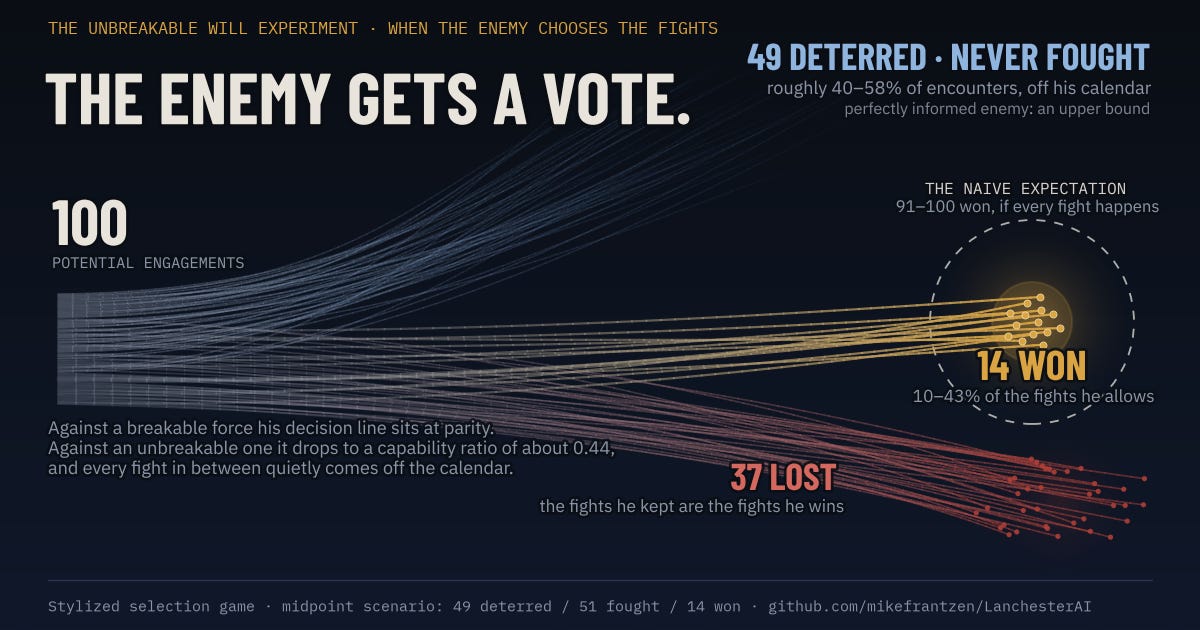
How to read it: Follow 100 potential fights left to right; the blue stream bends away unfought, and only the brass threads end inside the win zone, small against the dashed naive ring.
What to see: A force that “never loses” banks about 14 wins per 100 opportunities once the other side picks the fights.
The funnel’s bar widths show the midpoint scenario: 49 fights deterred, 27 percent of the allowed fights won. The printed ranges carry the uncertainty.
1. Deterrence is real, and it is the largest single effect. The selection model fits in a paragraph. Two equal forces meet repeatedly. Each encounter draws a capability ratio from a distribution centered on parity: sometimes you have the edge, sometimes he does. Your force is either normal, breaking at historical morale thresholds, or unbreakable. The enemy knows your capability and your will, and he declines any battle he expects to lose.
Against a normal force, the enemy’s decision line sits at parity. A fair fight is a coin flip, so he takes anything at even odds or better. Against an unbreakable force, his line moves dramatically. In this setup, the unbreakable force wins any fight where its effectiveness ratio is above roughly 0.44, because it converts every close fight into a grinding attrition contest the breakable side quits first. That 0.44 is not a dial; it falls out of the two sides’ breakpoint parameters, where fighting to destruction reaches even odds against routing at a quarter losses. Everything between 0.44 and parity becomes a fight the enemy would have taken against you yesterday and refuses today.
Sweep the spread of capability draws and the engagement rule, and roughly 40-58 percent of encounters come off the calendar. That number never appears in any battle record. No dispatch reads “the enemy declined contact because our will was unbreakable.” The single largest effect of the whole investment is invisible.
Political science knows this mechanism: wars are a strategically selected subset (Fearon 1995), democracies pick wars they expect to win (Reiter and Stam 2002), initiators pick targets they can beat (Gartner and Siverson 1996). This post gives that insight a combat-model engine.
Which sounds like winning. Hold that thought.
2. Now look at which fights he declines. Part four of this series found that unbreakable will pays most in the near-parity band: at heavy disadvantage it cannot save you, and at heavy advantage you did not need it. Now overlay the enemy’s decision line. The band he vacates, 0.44 to parity, is exactly the band where will is worth the most. He donates the fights that do not matter and keeps the ones he wins.
The arithmetic that falls out is brutal. A naive model, one where every possible engagement gets fought, predicts the unbreakable force wins 91-100 percent of encounters across the swept settings. The selected record shows it winning 10-43 percent of the fights it is actually allowed. Same force. Same will. The only change is who picks the fights.
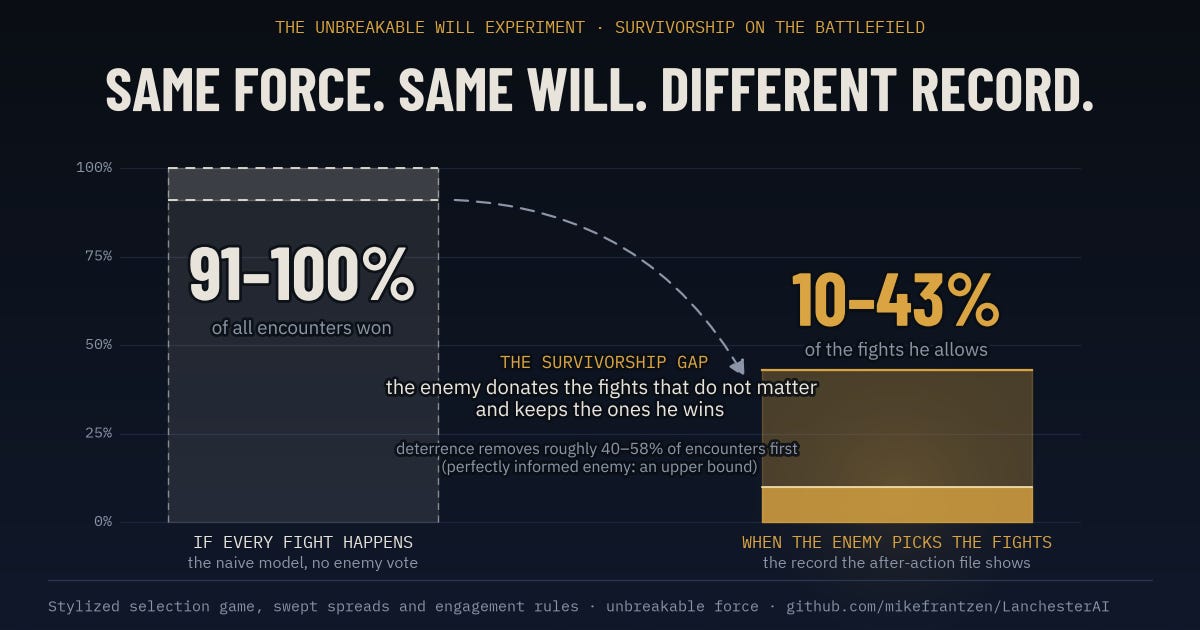
How to read it: The dashed slab is the record a model with no enemy vote predicts; the brass slab is what the after-action file would actually show.
What to see: Same force, same will; who picks the fights is worth up to roughly 80 points of win rate on paper.
There is a career-review joke buried in this. A near-invincible force, assessed on its win-loss record, looks mediocre. Its after-action file reads like an officer passed over twice. Selection does that: the enemy only ever meets you where he holds the overmatch, so the record samples your worst days. One phrasing trap is worth flagging honestly. Whether the unbreakable force’s win rate in fought battles drops below a normal force’s depends on the engagement rule; under a stricter rule it stays higher. The robust claim is the survivorship gap against the naive expectation, and that gap is large under every rule I tested.
3. A deterred fight is not a won fight. Here is the part the funnel chart cannot show. The deterred 40-58 percent are not victories. They are non-events. The enemy who declines battle keeps his army, keeps his ground, and keeps his options. He waits, adapts, and presses somewhere else.
Wars need decisions. Clausewitz’s whole argument is that war is an act of force to compel the enemy to do our will; a battle that never happens compels nothing. A force that must take ground, relieve a siege, or force a political settlement cannot cash deterred engagements. It shows up ready to fight forever, and finds that forever is exactly what the enemy is happy to give it.
So the ledger reads: the biggest effect produces no decision, and the residual fights are the enemy’s picks. That is what “the enemy gets a vote” costs.
4. Let him choose the kind of fight, and will’s value nearly vanishes. The second model gives the enemy a richer menu. Instead of fight-or-decline, he chooses among three engagement types: a grinding attrition battle, a decisive first strike, or avoiding battle entirely. The payoffs come from the same engines validated earlier in the series, at near parity where will matters most.
Walk the matrix. In the attrition column, unbreakable will is magnificent: it lifts the win probability from 49% to 95%, a premium of 46 points. In the first-strike column, will is nearly worthless for either side; part four showed why, since a fight decided by the opening salvo never reaches the morale check. Win probabilities there are 0.3% and 1.5%. The avoid column pays the status quo to both.
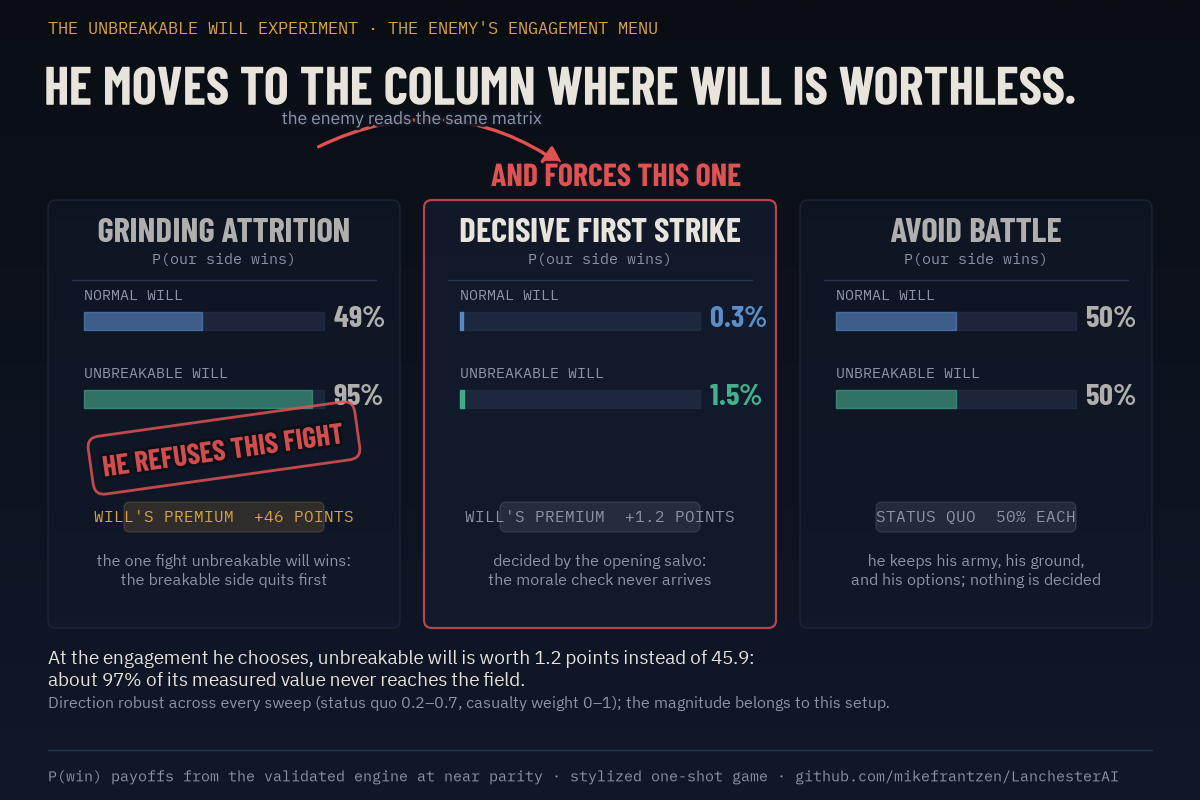
How to read it: Each card shows the chance our side wins under normal versus unbreakable will; the enemy stamps the one column where will pays refused.
What to see: Advertising “we will grind out any attrition fight to the death” is also an advertisement of which fight never to give that force.
The enemy reads the same matrix. Attrition is the one column where your unbreakable force does well, so he refuses it and forces the first-strike fight instead. At that equilibrium, the value of unbreakable will is 1.2 points of win probability instead of 45.9. About 97 percent of its measured value is gone, and the collapse direction held across every status-quo payoff and casualty weight I swept. The magnitude is a property of this setup; the structure is not. Any enemy with one available engagement type where will is worthless will steer the war there.
Can unbreakable will go negative, an actual liability? Only under two conditions jointly: the enemy forces a first strike at low lethality, so your force survives the opening blow but is behind, and your commander weighs casualties at more than about a third of a win. Then the normal force routs at about 60 percent casualties while the unbreakable force bleeds to about 80 percent in a battle it still loses; routing saved a fifth of the force. At the pure one-shot equilibrium, will is worthless but never negative; both sides die at the same rate regardless of resolve. Fielding a force that advertises “we will grind out any attrition fight to the death” is also an advertisement of which fight to never give it.
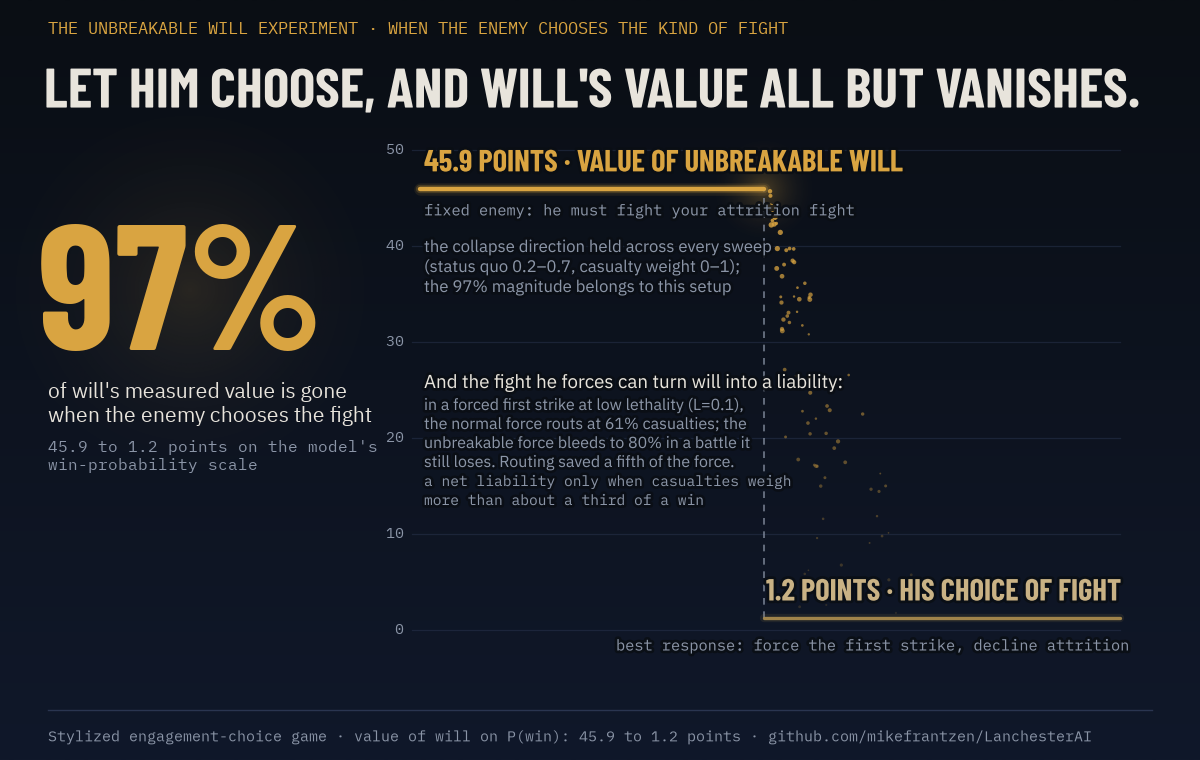
How to read it: The brass level is will’s value when the enemy must fight your attrition fight; the thin level at 1.2 points is what remains once he chooses the engagement.
What to see: The direction survived every sweep, the magnitude belongs to this setup; in the forced low-lethality fight will can even turn liability.
5. Russia is running this playbook right now. The closest live case is Ukraine’s drone wall. First-person-view (FPV) attack drones and persistent surveillance have created a kill zone many kilometers deep where, as witnesses told British members of Parliament in 2026, per Forces News reporting, anything that moves gets targeted. That testimony described a stalemate: roughly 1,000 Russian and 200-300 Ukrainian casualties a day while the line barely moves. The wall does not tire, does not panic, and does not rout.
One attribution I will not make. The wall deters because it kills, not because it is brave. It is sensing plus fires, the capability post 3 spent its length separating from will; a jittery wall with the same kill rate would earn the same detour. So this case is evidence of the selection and adaptation mechanics, not of deterrence by unbreakable will: a rational enemy redesigning his war around a standing threat rather than feeding it.
Russia’s response was not to feed it. A Royal United Services Institute (RUSI) commentary in August 2025, and independent open-source analysts, documented a redesign of the Russian assault echelon to fight around the drone wall rather than through it: dispersal into small teams, which open-source analysts put at four to six men, instead of massed columns, spider holes and thermal camouflage, movement at night in short bounds, electronic-warfare screens, and motorcycles. Analysts tracking Russian procurement reported targets on the order of 120,000 to 200,000 bikes plus tens of thousands of all-terrain vehicles. A motorcycle crosses a 1.5-kilometer kill zone in three to five minutes, inside the reaction time of many FPV crews. Dispersion makes each drone kill one man, not a squad.
Read that against the models. The kill zone deterred the engagements it would have won: massed armored assaults into prepared drone coverage largely stopped happening. What remains are the engagements the attacker chose, shaped to the defense’s weakest sensing and reaction seams. The unbreakable wall got a vote on nothing; the breakable humans riding motorcycles picked every fight. And as part five argued, the wall’s standing threat is only as good as its wiring against jamming, one of the seams the adaptation targets.
None of this means the drone wall was a bad investment; Ukraine holds its line partly because the wall made most attacks not worth having. It means the wall’s value migrated from won fights to prevented ones, with section 3’s warning attached.
6. And when the enemy cannot decline, will pays at full face value. The mirror case proves the mechanism. Some soldiers in this war have no vote: wounded, encircled, abandoned by their units, pinned under persistent observation. Against them, the machine’s tirelessness prints exactly as advertised, and the currency it prints is surrender.
In August 2024, per Ukrainian-side reporting, a drone from Ukraine’s Khartiia brigade found a wounded Russian soldier abandoned by his unit, dropped water and written instructions, and walked him through a surrender to Ukrainian lines. In January 2026, per Forbes reporting, three Russian soldiers surrendered to an armed ground robot near Lyman. Ukraine’s digital-transformation minister Mykhailo Fedorov claimed more than 100 drone-compelled surrenders over the winter of 2025-26; that is a belligerent’s own count, so treat it as an indicator, not a statistic. Part two of this series showed the Union army at Bull Run breaking with more than nine-tenths of its men still standing; these incidents are the same morale mechanism, collected by machine.
Put the two halves together and the insight sharpens. The variable that decides what unbreakable will is worth is not the robot. It is the enemy’s menu. Where he can decline or reshape the engagement, the value collapses toward the 1-point end of the model. Where he cannot, a tireless, fearless system breaks human will retail, one pinned soldier at a time. Strategy is the art of deciding which of those two worlds you are fighting in, and the enemy is co-author of the answer.
Best Arguments Against This
The perfectly informed enemy is a fiction. Conceded, and it is why every deterrence number here carries “upper bound” next to it. Real commanders misjudge relative capability, cannot always refuse battle, and fight under political orders that ignore the odds. Every one of those frictions shrinks the deterred share and puts value back on the battlefield. The honest reading is a band running from my frictionless number down toward whatever the enemy’s actual information and freedom of maneuver allow. Russia’s motorcycle adaptation suggests a competent enemy gets usefully close to the rational benchmark, but that is one adversary in one war.
Deterrence is not a consolation prize; it is strategic value my win-rate metric undercounts. Mostly conceded. The Cold War’s central front was held for four decades by forces whose entire purpose was to make the fight not worth starting. If your mission is defending the status quo, the top stream of the funnel is not leakage, it is the mission, and an unbreakable force that gets declined is doing precisely what you bought it for. The rebuttal is narrower than the concession: the vote is still his. He declines where you are strong and presses where you are weak, on his schedule, and a force that must attack or compel cannot spend deterred fights. Deterrence is real value that accrues only to the side content with the map as it is. Honestly, I personally find this the most valuable insight out of this project and it was completely unexpected (to me anyway).
The ugliest number leans on a modeling choice. True. The 10-43 percent depends on how eager the modeled enemy is to fight marginal battles; a stricter rule shrinks the fought set and lands the win rate higher within that range. I printed the framing that survives both rules, the gap against the naive 91-100 percent, and the gap is the finding.
What Would Change My Mind
If by mid-2027 Russia has returned, at scale and sustainably, to massed mechanized assaults into established drone kill zones, the fight-around thesis fails its strongest live test.
If a spatial, agent-based replication of the selection model with realistic misperception and political pressure to fight shows the deterred share collapsing below about 10 percent, the funnel’s top stage is an artifact of the perfect-information assumption. That replication is on my open-threads list for 2027.
If wire-service-verified reporting by December 2027 documents never-routing systems compelling the surrender of intact, un-encircled units in open battle, then unbreakable forces can force decisions rather than just deny them, and section 3 is too pessimistic.
If an engagement-choice game calibrated to a real campaign, and 2022-2026 Ukraine is the obvious candidate, finds the equilibrium value of resolve above half its fixed-enemy value, my 97 percent collapse is a property of the model, not the world.
Unbreakable will is not a bigger hammer. It is a posted sign telling a literate enemy which fights to skip. He reads it, thanks you, and redesigns the war around the fights you cannot decline, while your perfect record accumulates in battles that decide nothing.
There is one more rung on this ladder, and it is the worst one. Next post: what happens when a casualty-averse democracy fields the unbreakable army against an enemy who does not count his dead, and wins every battle on the way to losing the war.