
There are a good number of legal, policy, ethical, and even religious discussions asking if we should incorporate AI into weapons. I have been taking a different approach, projecting AI-characteristics onto well-studied historic battles, and using Lanchester equations to model what AI-weapons will do to battle. This series focuses on being able to imbue AI weapons with an unbreakable will.
This series’ default reading of AI in warfare goes like this: robots do not panic, so automate the weapon and you get an army that cannot rout. Post 4 already narrowed that promise to fights near capability parity. This post kills what is left of it. In my simulations, WHERE the will lives determines what it is worth, and the trooper is the worst address on the list.
Three results, one ladder. First, the commander. Across 607 recorded defeats in a US Army battle database, losing sides ended the battle by a commander’s decision to withdraw 266 times, and by the physical annihilation of their troops 26 times. Ten to one. That is a historical count, not a model output, and it means an unbreakable command decision touches ten times more endings than unbreakable troopers do. Second, the domain. In the stylized joint-force model, unbreakable will buys about +50 points of win probability, but only for the force holding the objective; supporting forces get about zero at any firepower share. Third, the substrate. “Unbreakable” turned out to be a property of the electronic-warfare and cyber layer, not of the silicon psyche. Every configuration I tested had a resilience threshold, about 40% in the anchor case and 20–50% across configurations, below which a rational enemy stops shooting the bodies and starts jamming the will, and the value of unbreakability decays from 84 points to 17 to 1.
Your robot’s will is only as strong as its radio.
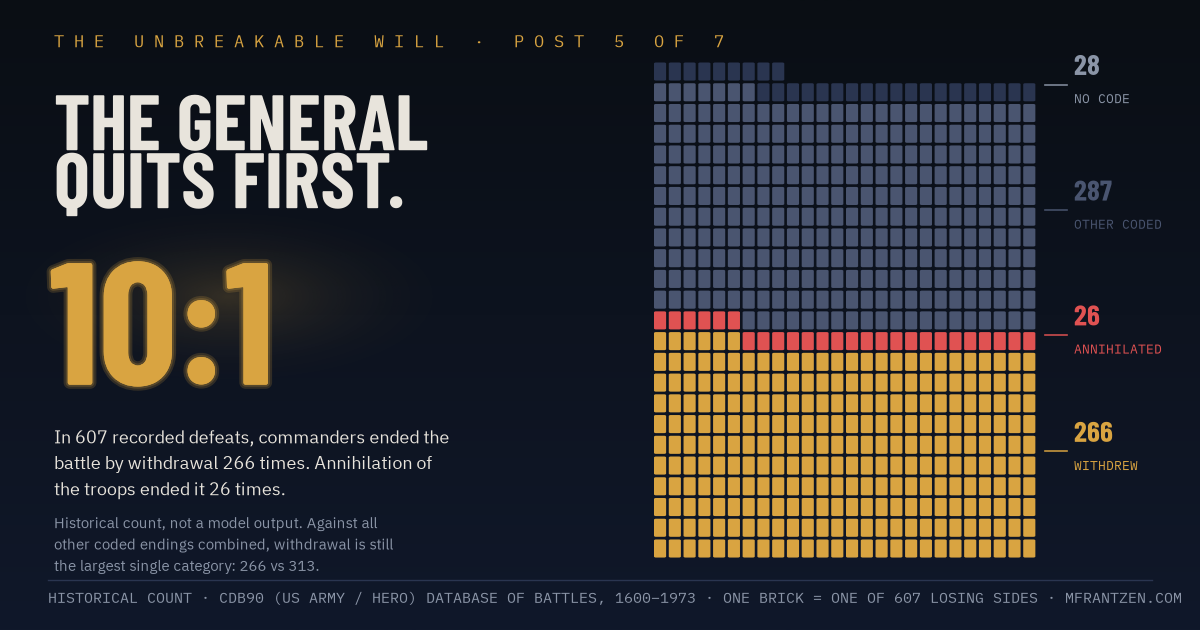
How to read it: Every brick is one of 607 recorded defeats in the CDB90 battle database, colored by how the battle ended for the loser; the red seam is every army that was actually destroyed.
What to see: Brass buries red 266 to 26, about ten to one; defeat is usually a commander’s decision at the top, almost never annihilation at the bottom.
One caveat travels with everything below. Except for the ten-to-one count, which is historical data, these are stylized model extensions of the validated battle engine. The orderings and directions survived every parameter sweep I ran; the exact magnitudes are illustrations, not measurements. The research data was current as of July 1, 2026.
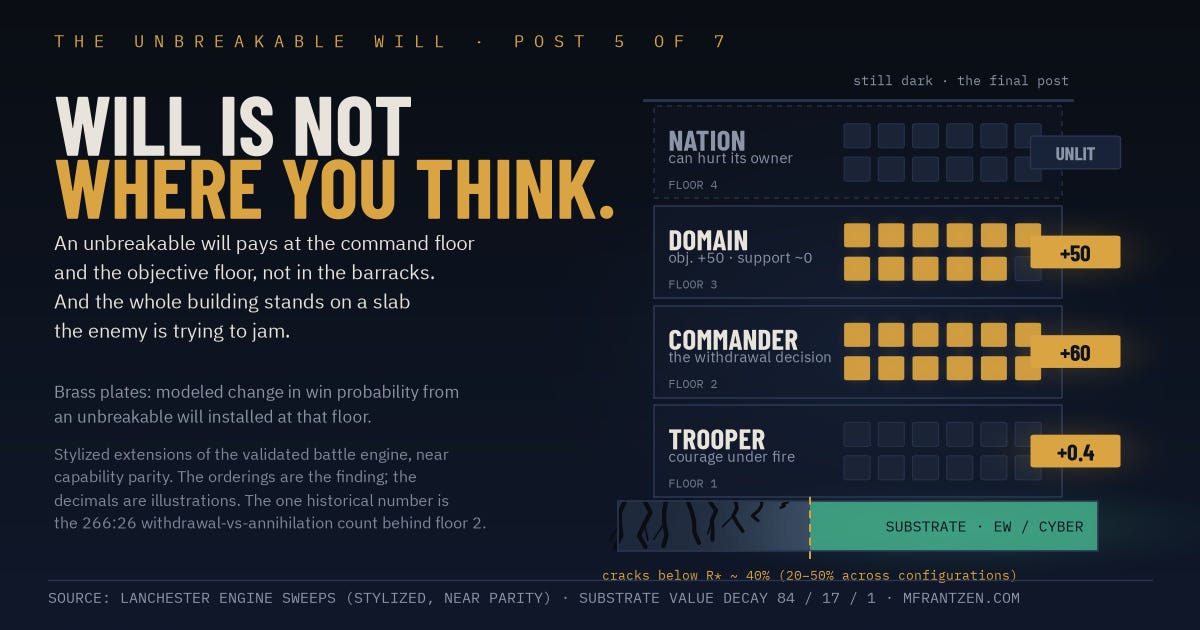
How to read it: Climb the building from the trooper floor to the dark nation floor; each brass plate is what an unbreakable will is worth installed at that floor, and the slab under everything is the electronic-warfare foundation.
What to see: The lights are on in the middle of the building, not the barracks; the top floor stays dark on purpose, that story is the final post.
The findings
1. Battles end at the top, not the bottom. The database is CDB90 (the US Army Concepts Analysis Agency’s Database of Battles, compiled by HERO, the Historical Evaluation and Research Organization, in the 1980s and delivered as the 1990 database), covering over 600 land battles from 1600 to 1973. Each losing side carries a code for how its battle ended. I counted the endings. Withdrawal by command decision, including withdrawals under heavy loss: 266. Troops annihilated or overrun where no one was left to withdraw: 26. That is 10.2 to 1. Even counting every other ending together (repulsed, penetrated, surrendered, scattered, annihilated: 313 in all), the commander’s withdrawal is the largest single category. Twenty-eight losers carry no code.
The pattern is not my discovery. Robert McQuie, an operations research analyst at the same Army agency, published its shape in “Battle Outcomes: Casualty Rates as a Measure of Defeat” (Army magazine, November 1987). Analyzing 80 engagements from 1941 to 1982 in the same HERO data lineage, he found that defeated forces typically quit below 10 percent casualties, and that the recorded reasons for defeat ran about 64 percent enemy maneuver against about 12 percent firepower and casualties. My 266-to-26 count replicates McQuie’s pattern in the successor database of 607 defeats. Replication is the claim, and it is a strength: two counts, two datasets, four decades apart, same answer.
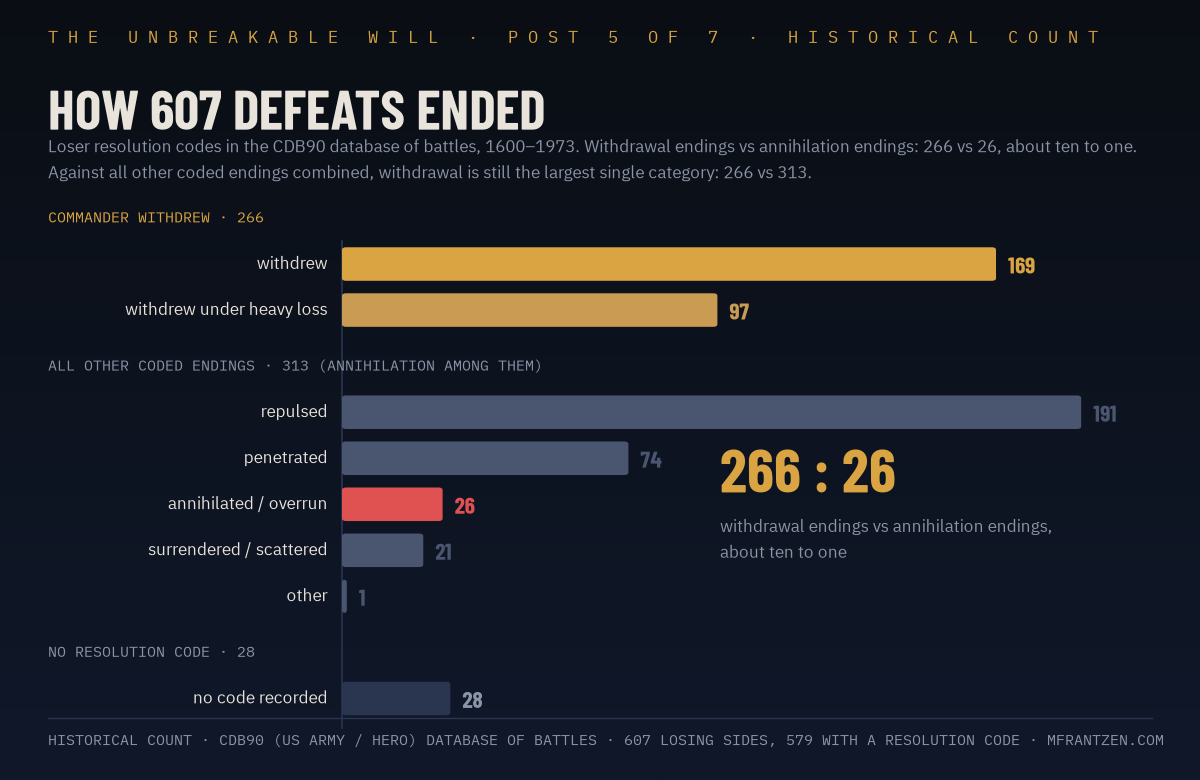
How to read it: Each bar counts how the 607 recorded defeats ended, by the database’s loser resolution code; brass bars are commander-ordered withdrawals, the red bar is troop annihilation.
What to see: Withdrawal endings outnumber annihilation endings 266 to 26, and even against all other coded endings combined (266 versus 313) the commander’s withdrawal is the largest single category.
Most defeats are not a dying army. They are a live army whose commander decided the price had been paid. So I gave the model two breakpoints instead of one: a troop threshold where units physically rout, and a command threshold where the commander orders the whole force out. The result is almost embarrassingly clean. The lower threshold governs. Where the commander’s nerve gives out first, which the historical count says is the common case, making the troops unbreakable bought a mean win-probability change of +0.4 points, averaged over the six command-binding cells at 5,000 runs each. Statistically nothing. The troops never got the chance to prove their steel; the order to withdraw came first. Making the command decision unbreakable in those same cells bought about +60 points and flipped the majority of contests. Where the troops break first, the mirror image holds. The ordering held in every one of the 16 cells of the 4x5 threshold sweep where the two thresholds differ; the +60 points is a stylized near-parity magnitude, not a portable constant.
I set out to model courage and ended up auditing org charts. The lever is not the trooper who never runs. It is the command decision that never flinches early. RAND’s Will to Fight framework (Connable and colleagues, RR-2341-A, 2018) is the standing treatment of what will is, a 29-factor model of the fighting unit. My ladder asks a coarser question: not what will is made of, but where removing the break pays. Jamestown Foundation analyses of PLA (People’s Liberation Army) writing on “cognitive domain operations” suggest at least one great power already reads it this way: the doctrinal target is the adversary’s decision system, not its infantry’s stomach.
2. Will pays only where the objective lives. Now widen the lens to a joint force: land, air, and maritime elements pooling fire on a shared enemy, with exactly one domain holding the objective that defines victory. I rotated which domain holds the objective, swept the firepower shares, and made each domain unbreakable in turn.
The pattern did not budge anywhere on the grid. Make the objective-holding domain unbreakable and the side gains about +50 points of win probability (51 to 55 points across all 21 tested cells). Make a supporting domain unbreakable and the side gains about zero (within 0.4 points of zero across all 42 tested cells). Firepower share is irrelevant to this. In the amphibious scenario the maritime force holds the objective with the smallest gun share, 20 percent, and its will is worth the full +50 points; the air component carries half the firepower and its will is worth nothing. Push a supporting domain to two-thirds of total firepower and its unbreakability is still worth nothing. The mechanism is blunt: supporting forces are overrun the moment the objective falls, so their endurance is never the binding constraint. Their firepower matters. Their will does not.
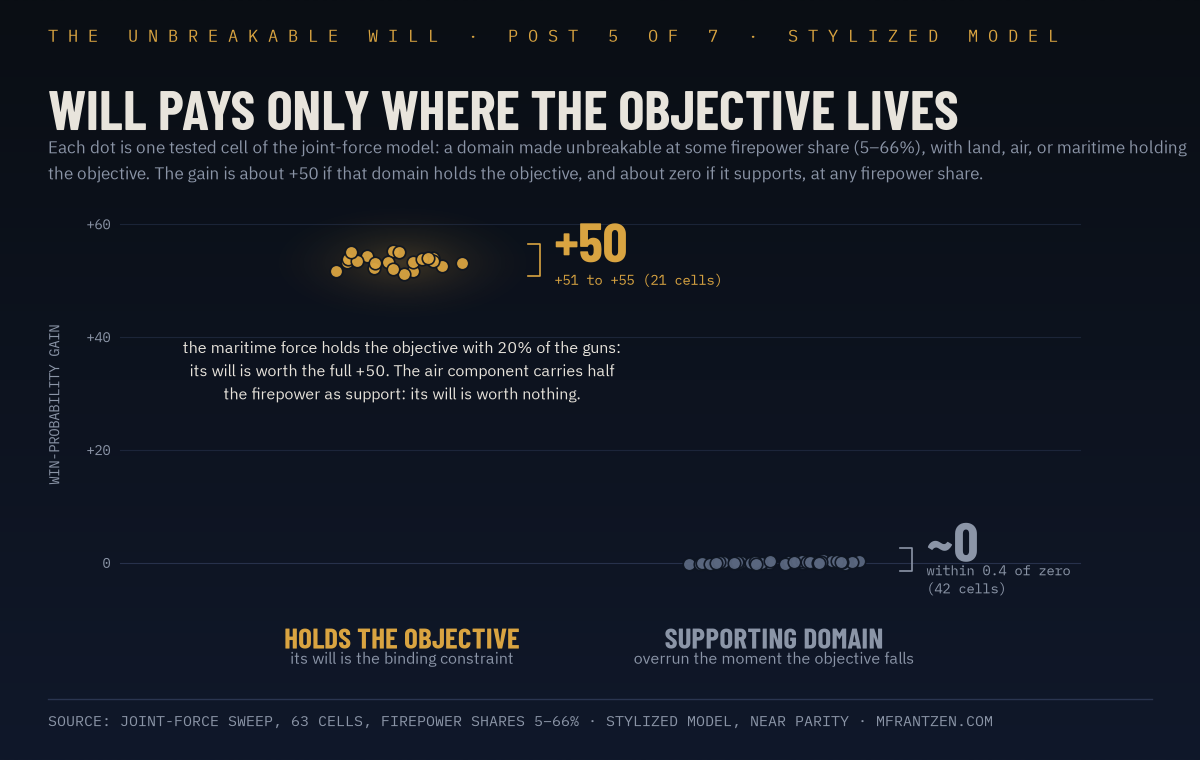
How to read it: Each dot is one tested cell of the joint-force model, a domain made unbreakable at some firepower share, split by whether that domain holds the objective or supports it.
What to see: About +50 points for the objective holder and about zero for everyone else, no matter who carries the firepower.
The procurement translation writes itself. Buy endurance for whatever holds the objective. Buy cheap, expendable firepower for everything else. Paying unbreakable prices for the loudest shooter is decor. This is a stylized result, near parity and symmetric by construction, but the ordering never reversed in any sweep.
3. “Unbreakable” is a property of the wiring. Here is the uncomfortable one. A human’s will is attacked with fear. An AI’s will is attacked with electrons. Jamming, spoofing, cyber, and decapitation of control nodes do to a machine exactly what Bull Run’s panic did to the Union army in post 2: they end its participation without killing it.
So I let the enemy choose. It holds a fixed effort budget and splits it between attrition (killing bodies) and suppression (attacking the will’s substrate). Our side is nominally unbreakable, protected by a substrate resilience R running from 0 to 100%. Suppression effort past R drags the effective breaking point down a linear ramp, at a fixed gain, to a floor at a normal human rout threshold. The result is a threshold, R*, in every one of the five configurations tested. Below R*, the rational enemy stops buying bullets and buys jammers: it drives our effective breaking point down to an ordinary human rout threshold while keeping enough residual firepower to exploit it. Above R*, suppression costs more firepower than the will-kill is worth, the enemy reverts to pure attrition, and “unbreakable” finally means what the brochure said. In the anchor case R* is about 40%. Across enemy jamming potency and overmatch levels it spans 20–50%, and it rises as the enemy’s electronic attack gets sharper. That range is the right way to read the result: the threshold’s existence is the finding, its location is set by the adversary’s kit, not yours.
Below the threshold, the decay is brutal. The value of unbreakable will runs 84 points of win probability with a healthy substrate, 17 points at 20% resilience, and 1 point at zero. At the bottom of that curve you have bought a normal, breakable force at an unbreakable price. And there is a second, independent way to be worthless: against threefold capability overmatch, the will premium is near zero at every resilience level, because will cannot close that gap at all. Post 4’s parity condition still binds. All of this is a stylized mapping from electronic attack to breaking point; the shapes, not the decimals, are the claim.
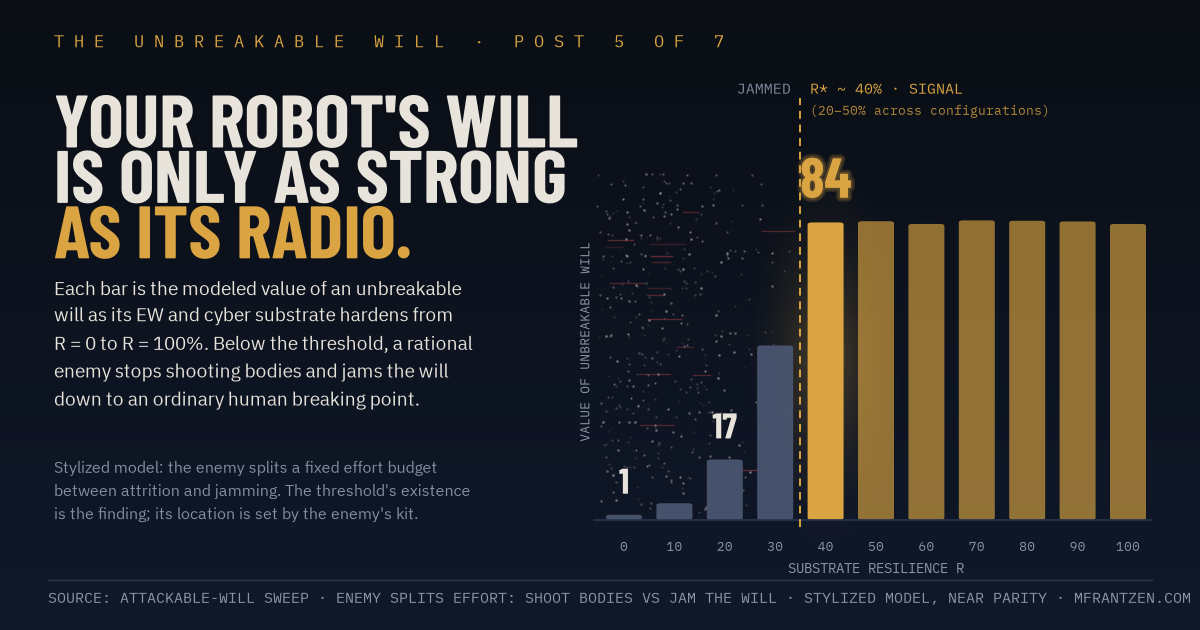
How to read it: Each bar is the win-probability value of an unbreakable will at one substrate resilience level; the static is the enemy’s jamming effort, and the dashed line is where jamming stops paying.
What to see: Below R* of about 40% (20-50% across configurations) the signal drowns, 84 points of win probability collapsing to 17 to 1, so “never routs” is a property of the radio contest, not the silicon psyche.
4. Ukraine is running this experiment, in both directions. The jamming direction first. Excalibur guided artillery shells reported fall from roughly 70 percent effectiveness to 6 percent under Russian GPS jamming, per Washington Post reporting of Ukrainian and US assessments in May 2024, is the decay curve with a serial number on it. GMLRS (Guided Multiple Launch Rocket System) rockets were similarly degraded by late 2023, with truck-mounted jammers reportedly suppressing satellite guidance across tens of kilometers. And the substrate war has a cyber flank: reporting in April 2025 described Ukrainian drones abandoned for capture that carried malware, infecting the Russian systems that read them and reportedly geolocating their operators. A machine’s will cannot be frightened. It can be stolen.
Now the honest countermove, because the contest did not stop there. Fiber-optic drones, physically tethered by a hair-thin cable, are immune to jamming entirely; Ukrainian sources counted roughly 40 fiber-optic models codified for its forces in 2025, with ranges that doubled within a year. Onboard autonomous terminal guidance rides through jamming the same way: no link, nothing to cut. As of the data freeze, the attack side of the substrate war was winning, so much so that countering fiber drones was the theme of NATO’s 2025 innovation challenge, and the fashionable counters are nets, radar tripwires, interceptors, and shotguns.
Read that carefully, because it is the point, not an exception to it. The model’s claim was never “jamming wins.” The claim is that the machine’s will is a ratio, R, contested ground between suppression and hardening, and the ratio moves. In 2023 the jammers were winning and Excalibur’s will broke. In 2025 the fiber spools and the autonomy stacks pushed R back up, and the counter-effort shifted to physics: nets and shot. Each swing relocates R* and repositions everyone’s “unbreakable” claim. Morale warfare did not disappear when the soldiers became machines. It moved into the spectrum, and it is being fought right now.
Best Arguments Against This
The strongest objection: these are stylized models, not calibrated campaigns. Correct, and I will not soften it. The two-level breakpoint, the joint-force fires, and the jamming-to-breakpoint mapping are illustrative mechanisms bolted onto a validated battle engine; nobody has fitted a command breakpoint to a real headquarters. What I can defend is that every ordering in this post, command over troops, objective-holder over supporter, threshold over no-threshold, survived every parameter sweep without a single reversal. The decimals are illustrations. The directions are the findings. McQuie adds an honest wrinkle here: he read his own 80 engagements as evidence that Lanchester-style attrition equations misstate what drives combat outcomes, and this series runs on Lanchester engines. My reply is that the breakpoint mechanism exists precisely because pure attrition does not end battles. And the audit prints orderings with bands, not attrition decimals.
Second, the ten-to-one ratio depends on a definitional choice. Withdrawal endings against annihilation endings is 266 to 26; withdrawal endings against all other endings combined is 266 to 313. Some coded withdrawals surely followed local routs, and 28 losers carry no code at all. I concede the framing but keep the conclusion: under the most conservative reading, the commander’s withdrawal is still the single largest way battles end, and annihilation is still the rarest. The finding needs “commanders end battles far more often than annihilation does,” and that survives any cut of the codes.
Third, a skeptic can say the substrate argument is already dated: fiber optics and autonomy are beating electronic warfare as I write, so hardened AI will is a solved problem. That reads a moving contest as a final score. Unjammable tethers spawned net fences; autonomy spawned interceptors; every countermeasure in this war has had a counter-countermeasure inside a year. If the contest ever does end permanently in the defender’s favor, the substrate finding dies. I have put a date on what that would look like below.
What Would Change My Mind
One. A re-coding of the CDB90 endings, or a better modern battle database, published by December 2027, showing that most coded withdrawals actually followed physical unit collapse. That would deflate the ten-to-one anchor and finding 1 with it.
Two. By December 2027, credible field evidence that autonomous systems held most of their unjammed effectiveness against a peer electronic-warfare opponent for two consecutive years with no effective countermeasure fielded at scale. That would indicate that the substrate contest has ended, and the resilience-ratio framing with it.
Three. A calibrated campaign study by the end of 2028 in which hardening a supporting arm flipped an outcome that the objective-holder’s endurance could not. That would break the domain gating.
Four. A spatial or agent-based replication of the two-level breakpoint model, before this series’ planned 2027 follow-on, in which the binding-threshold ordering reverses. That is the one structural assumption everything in finding 1 leans on.
The close
Unbreakable will is not a trait you install in a tactical weapons system. It is a stack: a commander’s decision that does not flinch early, sitting on the force that holds the objective, riding on a substrate the enemy is actively trying to jam, spoof, and infect. Get any layer wrong and the courage above it is decoration. The ladder’s top floor, the nation, is still dark in the elevation above, and it is dark on purpose: that is where this series ends, and it is the rung where unbreakable machines can hurt the side that owns them.
Before that, one more escalation. Everything in this post assumed the enemy shows up and fights. Next post: what happens when it simply declines. The enemy gets a vote.