
There are a good number of legal, policy, ethical, and even religious discussions asking if we should incorporate AI into weapons. I have been taking a different approach, projecting AI-characteristics onto well-studied historic battles, and using Lanchester equations to model what AI-weapons will do to battle. This series focuses on being able to imbue AI weapons with an unbreakable will.
Bottom Line Up Front
An unbreakable AI will is not a decisive military advantage. It is a tiebreaker. It decides fights that were already close, and almost nothing else.
The worked example is Trafalgar. I gave the entire Franco-Spanish fleet an unbreakable will, so it fights to annihilation instead of striking at 50% losses, and the British still win 83.6% of simulations (95% confidence interval 83.0-84.2, n=15,000 Monte Carlo runs). British gunnery, calibrated at about twice the Franco-Spanish rate, and Nelson’s concentration of fire decide the battle before any morale check can matter. These are attrition-model results, validated against four historical battles but derived from three in this post; the floors below are battle-specific constants, not laws of nature.
The visualization. Trafalgar, where below the capability floor the will changes the dying, not the winner.
How to read it: the aged chart shows Nelson cutting the Franco-Spanish line into three, then the split pane asks whether the van returns. What to see: give the whole Franco-Spanish fleet an unbreakable will and Britain still wins 83.6% of runs. Below the floor, resolve changes only the body count.
The deeper result is a floor. For each battle there is a capability level below which no fraction of unbreakable force wins. Not most fractions. None, all the way to a fully robotic army or navy. Above the floor, will and capability trade along a measurable frontier. Below it, resolve changes the body count and nothing else.
The companion visualization. Pickett’s Charge, with opposing sides’ capabilities at near-parity, the AI unbreakable-will flips the result.
How to read it: the left is the historical charge that breaks and falls back; the right is the same assault given an unbreakable will. What to see: near capability parity, above the floor, the AI-willed assault breaks through and wins 92% of runs. That frontier is exactly what the floor sits under, and the reason unbreakable will is a tiebreaker rather than nothing.
And the floor is the friendly case. Against an enemy that does not break, the win-probability value of your own unbreakable will is exactly zero in every battle I model. Under an enemy first strike at saturation lethality, it is statistically zero. The sentence I would carry into a meeting: unbreakable will decides fair fights. It does not substitute for firing first.
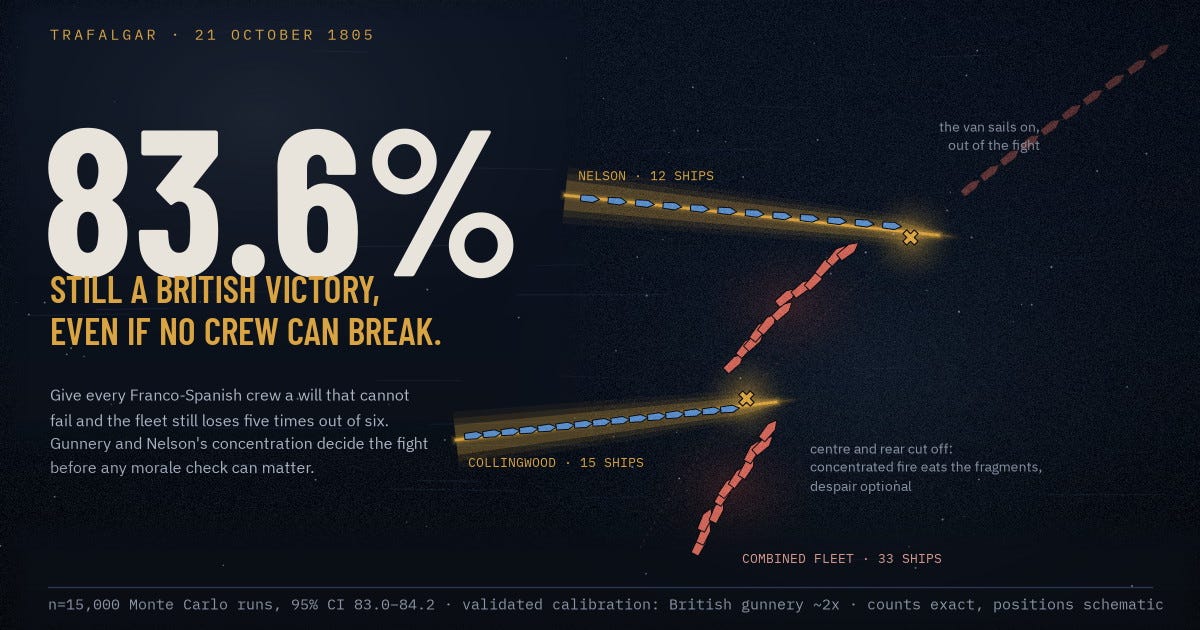
How to read it: brass wakes are the British columns punching through the enemy line; red fragments are what is left of it.
What to see: a Franco-Spanish fleet whose crews cannot break still loses 83.6% of simulations; gunnery and concentration decide before any morale check matters.
The findings
1. There is a floor under will. The simulator is post 2’s validated engine: Lanchester attrition with an explicit morale breakpoint, the casualty fraction at which a human unit quits. For each battle I varied two dials, the loser’s fighting effectiveness relative to history (rho) and the fraction of its force given an unbreakable will (phi), and mapped the boundary where the historical loser starts to win.
The boundary has a hard edge. The square law predicts a capability floor for each battle, with a closed form: rho_1 = a_W W0^2 g_W / (a_L L0^2), where a_W and a_L are the two sides’ kill rates, W0 and L0 their starting strengths, and g_W the winner’s breakpoint. The floors: 0.65 for Pickett’s Charge (closed form 0.6491; the simulation’s first win appears at 0.700, two steps up a 0.025-step grid), and 1.12 for Trafalgar, where the closed form says 1.1231 and the simulation says 1.125. That 0.2% gap is a floor-location match, the tightest analytic-to-simulation agreement in the project. Below the floor no value of phi wins.
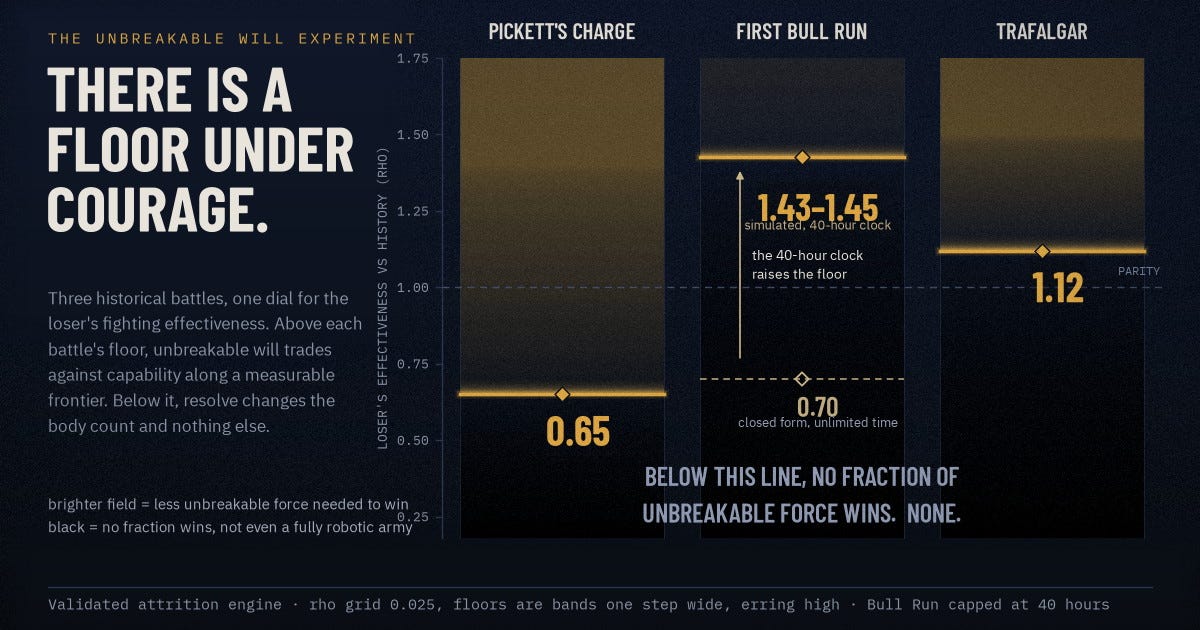
How to read it: the vertical dial is the loser’s fighting effectiveness relative to history; the brass line is each battle’s capability floor.
What to see: below each floor the column goes black: no fraction of unbreakable force wins; Bull Run’s floor doubles because the sun sets first.
Above the floor, will buys real ground. Pickett’s Charge sat just under capability parity, which is why it is the one land battle in my set that unbreakable will flips. The charge starts winning once just over three-fifths (62%) of it cannot break, a deterministic 1%-step scan that carries no confidence interval; the honest uncertainty is the visible slope of the Monte Carlo curve around it, 6,000 runs per point.
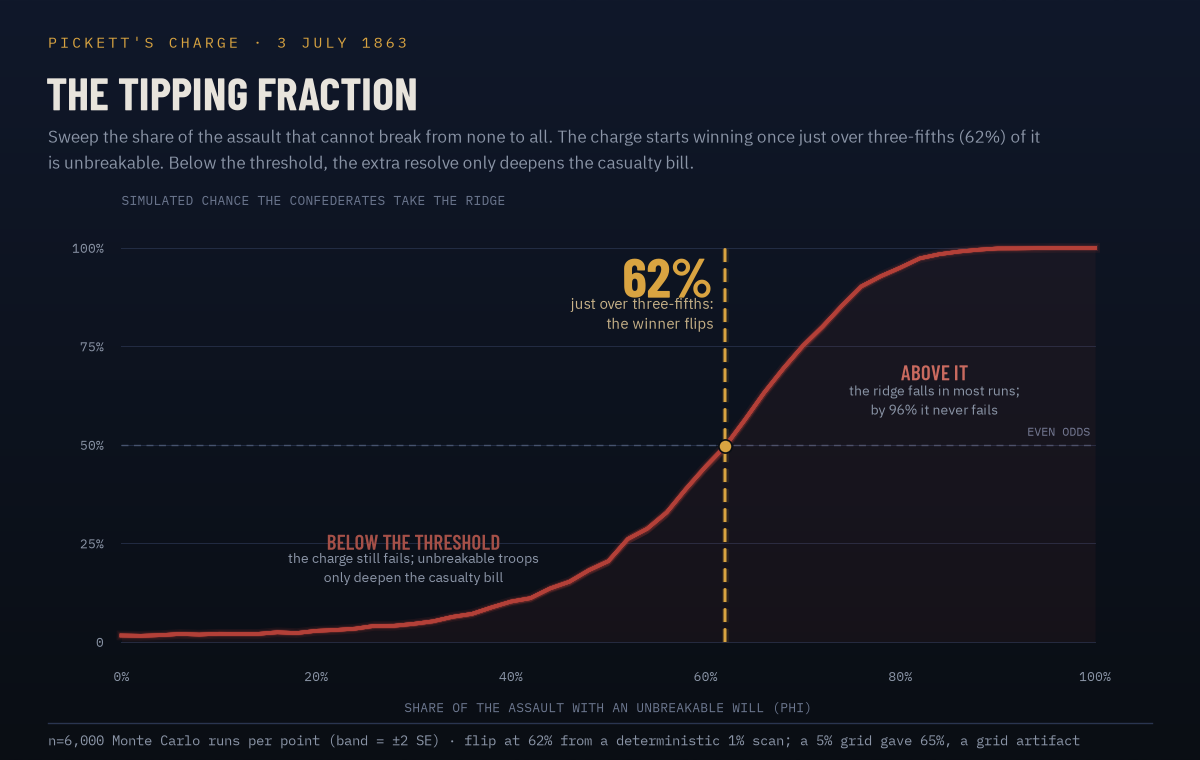
How to read it: the curve is the Confederates’ chance to take the ridge as the unbreakable share sweeps up; the dashed line marks the flip.
What to see: the charge starts winning once just over three-fifths (62%) cannot break; below that, resolve only deepens the casualty bill.
Along the flip boundary the trade obeys a single square-law rule: the loser’s effectiveness, multiplied by a bracket mixing the unbreakable fraction with the enemy’s own breakpoint, stays constant at the floor value. In simulation that quantity holds within about 3%, and its level matches the closed-form floor within 8% for Pickett and 2.4% for Trafalgar. Those are boundary-agreement numbers, a different quantity from the 0.2% floor-location match above. One scope condition: this holds for battles that resolve a winner inside their historical battle duration. The third battle does not; its invariant runs about 1.9 times the analytic floor, a mean of 1.88 along its boundary (because it got dark and the simulated battle had to end).
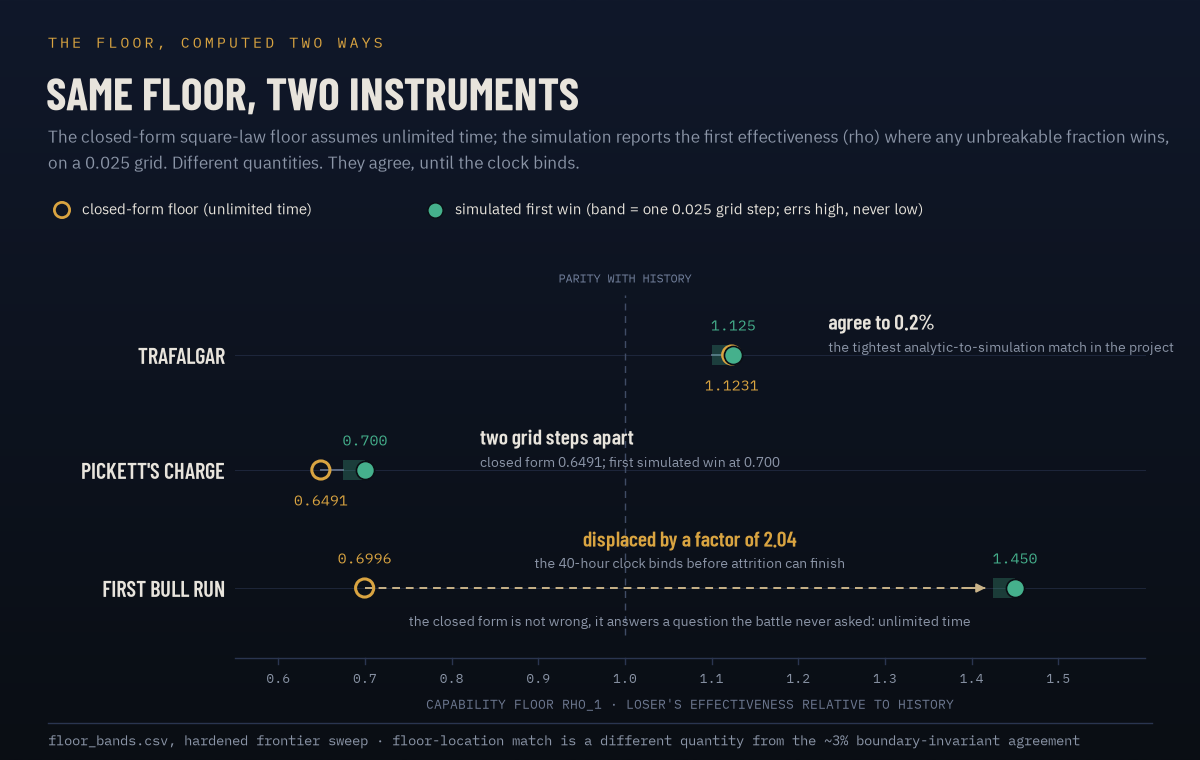
How to read it: each row pairs one battle’s floor computed two ways: hollow ring the closed form, solid dot the simulation’s first win.
What to see: where the battle resolves inside its historical duration the two agree; Bull Run’s 40-hour clock displaces its floor to 1.43-1.45.
2. Bull Run adds a second floor: the sun setting. The closed-form floor for First Bull Run is 0.70. I am printing that number only to disown it. The closed form assumes unlimited time; the simulation caps Bull Run at a realistic 40-hour window, and the real battle ended at nightfall. Inside that window the simulated floor is not 0.70. It is 1.43-1.45. The out-fought Union side cannot win at any unbreakable fraction until its effectiveness more than doubles relative to the analytic floor (1.43 over 0.70 is a factor of 2.04; the 1.9 in finding 1 is the separate invariant violation), because the sun sets before attrition can finish the argument.
I could have quietly printed the prettier 0.70 and moved on. The honest number is better for the thesis, not worse. A time-capped battle needs capability even earlier, and gives will even less room to work. What 40% unbreakable Union troops buy at Bull Run is the denial of defeat: the AI contingent holds the hill into the night while the human 60% still routs on schedule. A stalemate, at every fraction, on a 1%-step scan. Never a win. Post 2 told that story from the morale side, the Union breaking at 8.3% casualties. The frontier tells it from the capability side: some battles are not yours to win, only to not lose.
3. AI at Trafalgar would just add to the butcher’s bill. The arithmetic a reader can redo. The dial rho measures the loser against its own history: Trafalgar’s floor of 1.12 means the Franco-Spanish fleet needs about 12% better gunnery than its crews actually delivered. Per my calibration it fired at about half the British rate, so the floor sits near 56% of British effectiveness; the fleet’s larger battery closes the rest through the square of numbers. The historical fleet is close to that line: at rho = 1 it sits 11% below the floor, five 0.025 grid steps on my sweep.
At its actual calibration, an unbreakable fleet converts defeat into bloodier defeat 83.6% of the time. Nelson’s two columns cut the 33-ship line in three, the van sails uselessly on, and concentrated British fire eats the two trapped fragments whether or not anyone aboard is capable of despair.
Two flip sides. First, 83.6% is not 100%: an unbreakable Franco-Spanish fleet gets a real 16% upset chance, up from essentially nothing, by staying in the fight long enough for variance to work. Second, the stubbornness is not free for the winner: British casualties roughly double, from about 28% of the force to about 50%, when the enemy fights to annihilation instead of striking. The Iwo Jima lesson, restated at sea. Below the floor, will changes the price of the battle, not its winner.
4. Your will is worth exactly zero against an enemy that does not break. Everything above holds the enemy’s morale at its historical setting. So I swept the winner’s breakpoint from very fragile to fully steadfast and measured the loser’s gain from being unbreakable, 6,000 paired runs per point.
At the steadfast end the answer is not approximately zero. It is exactly zero, 0.00%, in all three battles. That endpoint is definitional rather than empirical: unbreakable against unbreakable, the morale term cancels by construction, the fight reduces to pure attrition, and attrition was the thing the loser was losing.
The value of your own unbreakable will is single-peaked in enemy fragility, topping out at 86 points of win probability for Pickett with the enemy breakpoint near 25% casualties, and 92 points for Trafalgar near 40% (Monte Carlo standard error at most half a point; peak locations good to about one 5-point grid step; the full hump shows in two of three battles, with Bull Run’s peak at the edge of the tested range). Why a peak? Against a very fragile enemy you were going to win anyway; against a steadfast enemy it can never matter. Your will is not an asset you own. It is a bet on the enemy’s weakness.
5. In the missile age, will does not substitute for firing first. The battles above are attritional grinds, exactly where outlasting the enemy can pay. Modern naval and air combat is built around salvos and firing effectively first. So I moved the question into a stylized salvo model in the standard missile-age tradition (Wayne P. Hughes Jr., Naval Research Logistics, 1995; Michael J. Armstrong’s stochastic extension, Operations Research, 2005) and asked what an unbreakable crew is worth as per-salvo lethality rises.
Under an enemy first strike at saturation lethality, the answer is statistically zero: a premium of about 0.1 points of win probability against a Monte Carlo standard error of about 0.8 points at 4,000 trials per cell. You are crippled before your steadfastness can be spent. The conditional is joint: it takes the enemy firing first and high per-exchange lethality together. A first strike at low lethality still leaves a modest premium of 5-8 points. And in a fair duel near parity, lethality initially amplifies the value of will, up to a premium of 33-46 points near the one-shot threshold, because the unbreakable side converts mutual-annihilation draws into wins.
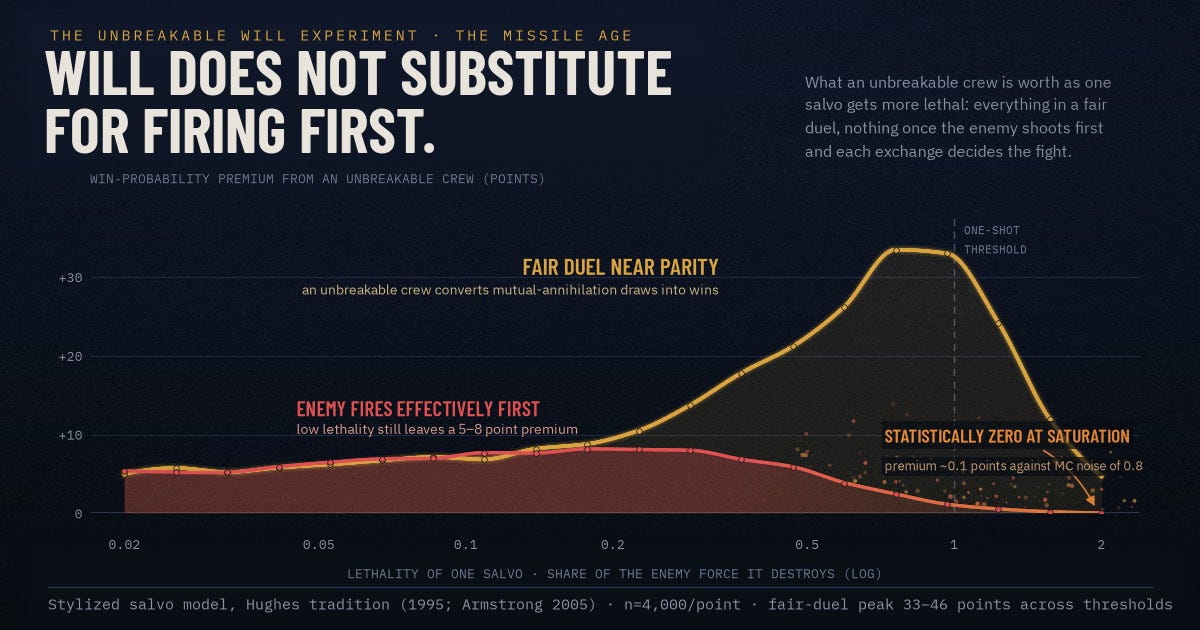
How to read it: extra win probability from an unbreakable crew versus per-salvo lethality; brass a fair duel, red an enemy first strike.
What to see: under a first strike at saturation the premium burns down to statistical zero; will does not substitute for firing first.
A cross-check rules out the boring explanation. Scaling both sides’ kill rates over a 32-fold range in the continuous model leaves the will premium flat at 45.2 points; the 0.6-point spread (the standard deviation across the six speed settings) is pure Monte Carlo noise; the square law makes this flatness exact in theory, so the run verifies the engine rather than discovering anything. Speed is not what erodes will. Decisiveness per exchange is, plus the first-strike race. If your procurement plan buys unbreakable resolve instead of sensing, range, and the first effective salvo, you have bought the tiebreaker and skipped the tie.
6. The 2020s weapon is not the 2030s army. I ran two counterfactual grades of AI: a 2020s version making one strategic weapon (the cannons) unbreakable, and a 2030s version making the whole force unbreakable, a robot army.
On land the 2020s weapon captures none of the robot army’s benefit: zero flips in 15,000 runs, an upper bound below 0.02%. The strategic/cannon is not the maneuver force; when the human line routs, the unbreakable battery is simply overrun, still bravely computing. At sea the same weapon-level AI captures 77% of the whole-force benefit (propagated-uncertainty interval 73-81%), because a ship is the maneuver force. Unbreakable will bolted onto one platform pays only where that platform is the force; everywhere else it has to live in the units that hold the line, and that is the robot-army problem, a 2030s problem.
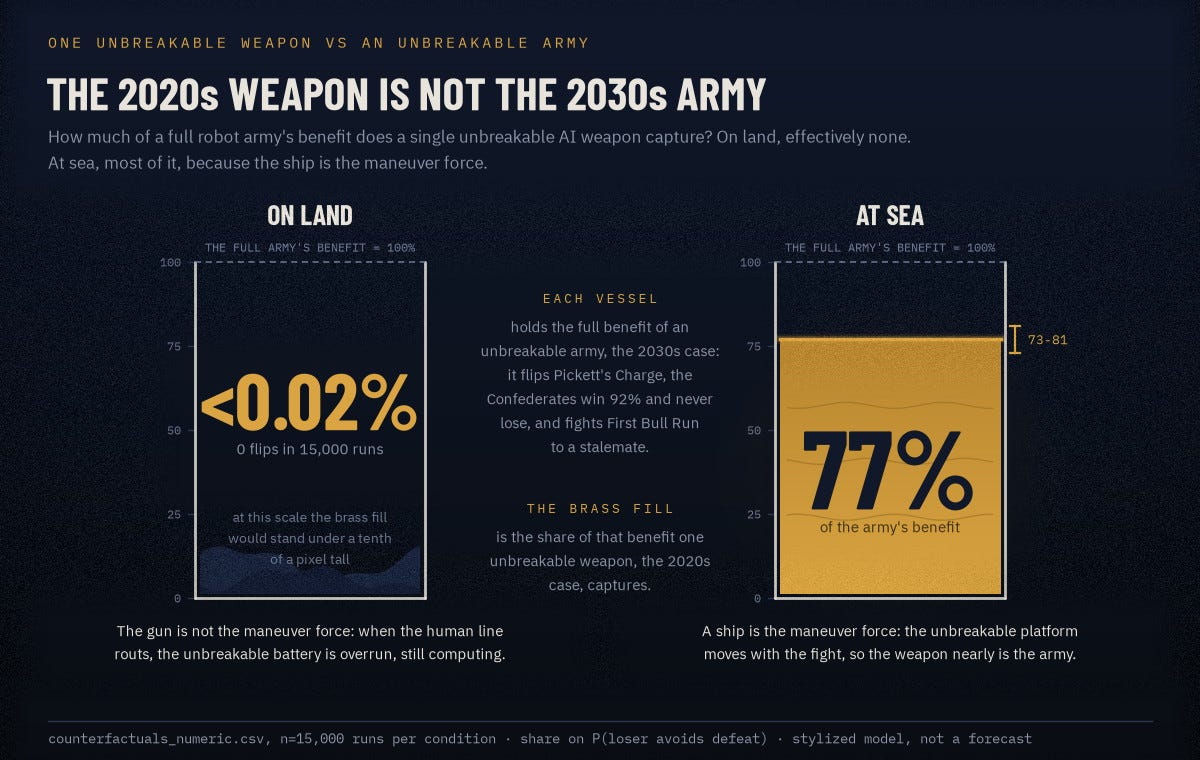
How to read it: each vessel holds the full benefit of an unbreakable robot army; the brass fill is the share one unbreakable AI weapon captures.
What to see: on land the vessel is empty, under 0.02% in 15,000 runs; at sea, where the ship is the maneuver force, one weapon captures 77% of the army’s benefit.
Best Arguments Against This
Three battles is not a database. Correct, and I concede most of it. The floors are constants of specific battles under a specific calibration; three battles cannot establish how often real fights sit above or below their floors. But the population question was answered separately: the 607-battle audit in post 3 found roughly two-thirds (60.8-72.2% across threshold choices) of historical losses were capability losses. The frontier explains the mechanism; the audit shows it was the majority case.
Your floors live on grids. Also correct. The floors were confirmed at a rho step of 0.025 and an unbreakable-share step of 5% with a deterministic integrator, so every simulated floor is really a band one step wide. The gap has a verified direction: the simulated first win errs high, never low, so below the analytic floor no fraction wins in any run. The floors are conservative. The enemy-fragility peaks are grid maxima whose true values can only be higher. Nothing in the post survives or dies inside a grid step. The one place discretization could have hidden a real discrepancy, Bull Run, I printed as a discrepancy.
The salvo parameters are made up. The missile-age model is a notional 20-versus-20 duel with parameter jitter, not a fit to engagement data. What I defend are the shapes: the collapse under enemy first strike plus saturation, the fair-duel hump, and the flatness under pure speed scaling, which is analytically forced. If a data-calibrated salvo model moves the shapes, finding 5 is in trouble. The magnitudes were never the claim. My next series on AI-weaponry will dive much deeper into this; the modeling is done, the analysis is not.
Ukraine looks like drones winning a war, not tiebreaking one. The strongest current-events objection, and it cuts the other way. Reported estimates put drones at about two-thirds to 85% of battlefield casualties by 2025, figures that trace mostly to official sources and deserve that hedge, yet the front line barely moved: a kill-zone stalemate at rough parity, machine attrition setting the body count while neither side’s will flips the map. And Ukraine’s 2026 operational gains followed strikes on radars, jammers, and fires: capability degraded first. That is the model’s ordering: capability first, will as the tiebreaker at parity.
What Would Change My Mind
1. By end of 2027, a spatial or agent-based re-implementation of these battles that finds no capability floor, with winning unbreakable fractions appearing well below the square-law line.
2. Within twelve months of publication, a documented engagement, verified by two independent non-belligerent sources, in which a force clearly below capability parity won primarily because an autonomous element refused to break rather than because it out-shot the enemy.
3. During 2026-2027, a side in a missile-age exchange absorbing an effective first strike at saturation lethality and then winning on endurance.
4. Phase-separated casualty data for historical routs, fighting-phase versus pursuit-phase, showing most routed losers were at or above parity during the fighting. That would move battles into the close-fight column, where will decides.
5. By end of 2026, a naval historian or operations researcher showing my Trafalgar gunnery calibration is wrong by enough to lift the Franco-Spanish fleet above its 1.12 floor.
The close
Clausewitz made resistance the product of means and will. The temptation of AI is to read that as a multiplication you can win on either factor. You cannot. Below the capability floor the will term multiplies a number too small to save; against a steadfast enemy it multiplies by exactly zero; against a first strike it never gets to multiply at all.
Will is not a weapon. It is a tiebreaker, and tiebreakers only matter in ties.
If you are going to buy an unbreakable will anyway, where in the force should it live? The trooper is the obvious answer and the wrong one. That is post 5.