
There are a good number of legal, policy, ethical, and even religious discussions asking if we should incorporate AI into weapons and if so where the human should be in the loop. All the while, militaries across the world are scrambling to bolt AI onto existing weapons platforms. I assume incorporating a reasoning AI into a weapon platform will make for a far more effective weapon. But will it? How much more effective? Is there still an advantage if an AI weapon goes against an AI weapon?
So I decided to project AI weapon characteristics into the very well studied historic battles, model them using Lanchesters’ equations, and see if I could project the past into the future to answer my questions.
The seven post series makes an assumption AI weapons an be modeled like human weapons whose will never breaks. They perform as they were programed (or trained) regardless of what happens. So the series asks one question: what is a will that cannot break actually worth in war? Not as a slogan. As a number, with error bars, in a model a military operations researcher would recognize.
The compressed answer, which the next six posts earn: an unbreakable will is real, measurable, and occasionally decisive. It is also narrow, conditional, and attackable. It decides fights that were already close on capability, and almost nothing else. Its value shrinks at every step up the ladder from the trooper to the commander to the force to the nation. And at the top of the ladder it can invert, into a way of losing wars while winning battles.
The visualization that opens the series. Iwo Jima, the one battle where the unbreakable will was real.
How to read it: one continuous history with a running ledger, real unbreakable casualties climbing beside the counterfactual where the garrison broke at a normal breakpoint. What to see: here the unbreakable Japanese will was not a hypothesis. It roughly doubled the American dead, about 21,431 versus 10,969 in the model, and changed nothing about who took the island.
Now the concession, because it belongs right up front. These are attrition-model results. The engine is a Lanchester system, aimed-fire attrition plus an explicit morale breakpoint, the casualty fraction at which a unit quits. It was calibrated to four historical battles and checked at the aggregate level: total casualties, duration, outcome. Three of those four are calibration plus consistency checks; the genuinely out-of-sample test is the independent Engel refit below. It has no terrain, no perception, no fog, no time resolution below the engagement. The strategic posts in the back half of the series run stylized extensions on top of that validated engine, and those results print as orderings and directions, never as calibrated magnitudes. If you want a model of what will is, this is not it. It is a model that assumes an AI weapon can think, reason, plan and act just like a human does, but the AI’s will never fails regardless of how poorly the battle is going. That narrower thing turns out to be answerable.
Why trust the tool at all? Lineage, mostly. Lanchester published the equations in 1916. Engel validated them against Iwo Jima’s daily casualty data in 1954, and when Samz revised Engel’s data in a 1972 Operations Research technical note, the revised data still fit. My independent refit of the same series recovers his coefficients (A = 0.0565 against his published 0.0544, R-squared 0.992 on 35 daily points). The historical audit in post 3 runs on CDB90, the roughly 660-battle database Trevor Dupuy’s researchers compiled for the US Army in the 1980s. Every piece of this apparatus is standard issue in operations research. The only new part is the switch that turns a side’s breaking point off. And that models one characteristic of AI weapons.
Bottom Line Up Near-the Front
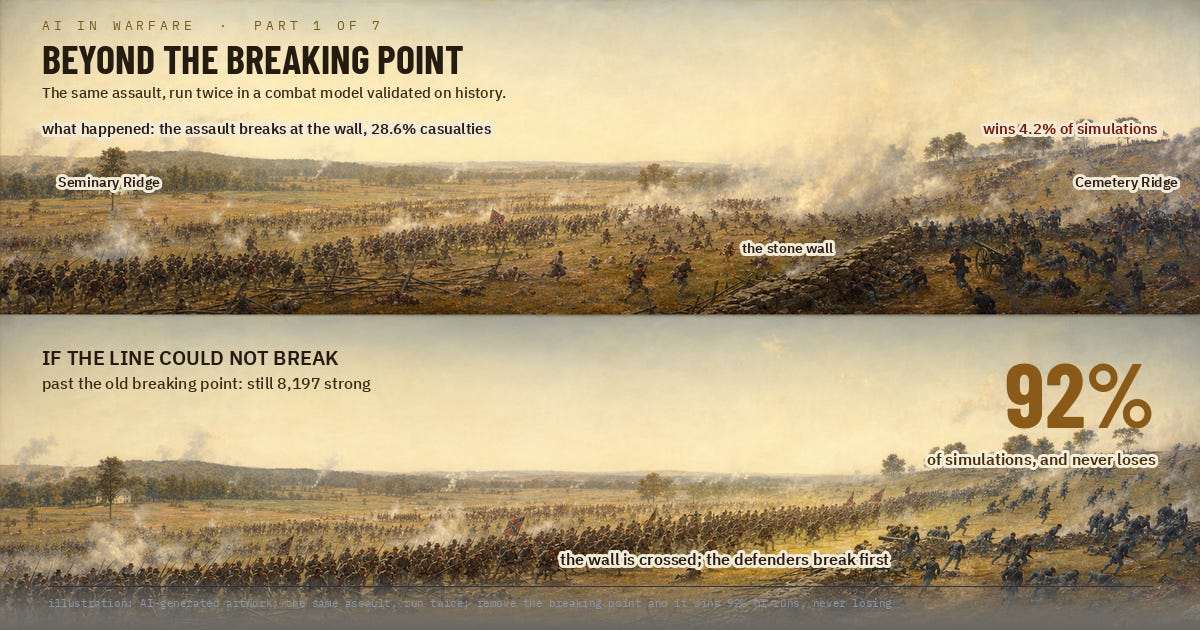
Yes. In the case of Pickett’s charge, replacing Confederate soldiers with equivalent AI solders whose will never broke probably would have changed the battle and possibly the war. How to read the above: both ribbons are the same 11,481-man assault, width = remaining strength over the same clock; the dotted hairline marks the moment history stopped. In fact, the modeled AI assault wins 92% of simulated runs and never loses.
The frame
1. Clausewitz made will half of war. We are about to automate that half. Here is the sentence, in the Howard and Paret translation, that the whole project stands on: “If you want to overcome your enemy you must match your effort against his power of resistance, which can be expressed as the product of two inseparable factors, viz. the total means at his disposal and the strength of his will.” Means times will. We will study battles where the means were extensively counted: men, guns, ships, rates of fire. The will is the factor that fails first, and it has failed in every army ever fielded. The empirical literature on breakpoints (Clark 1954; Helmbold 1971) puts the historical range of casualties-at-breaking anywhere from roughly 10 to 70 percent, with leadership and communication mattering more than the count of the dead. The range is wide. The existence of the breaking point is as close to a constant as war offers. Or at least has offered in the past.
An autonomous weapon does not have a mental breaking point. Whatever else an AI-driven force turns out to be, it is the first combatant in history whose participation in the fight does not depend on its nerve. One of Clausewitz’s two factors is becoming a design parameter, something you specify at procurement rather than cultivate in barracks. That converts an old rhetorical question into a measurable one, and it deserves measurement before the money moves. This project is my attempt.
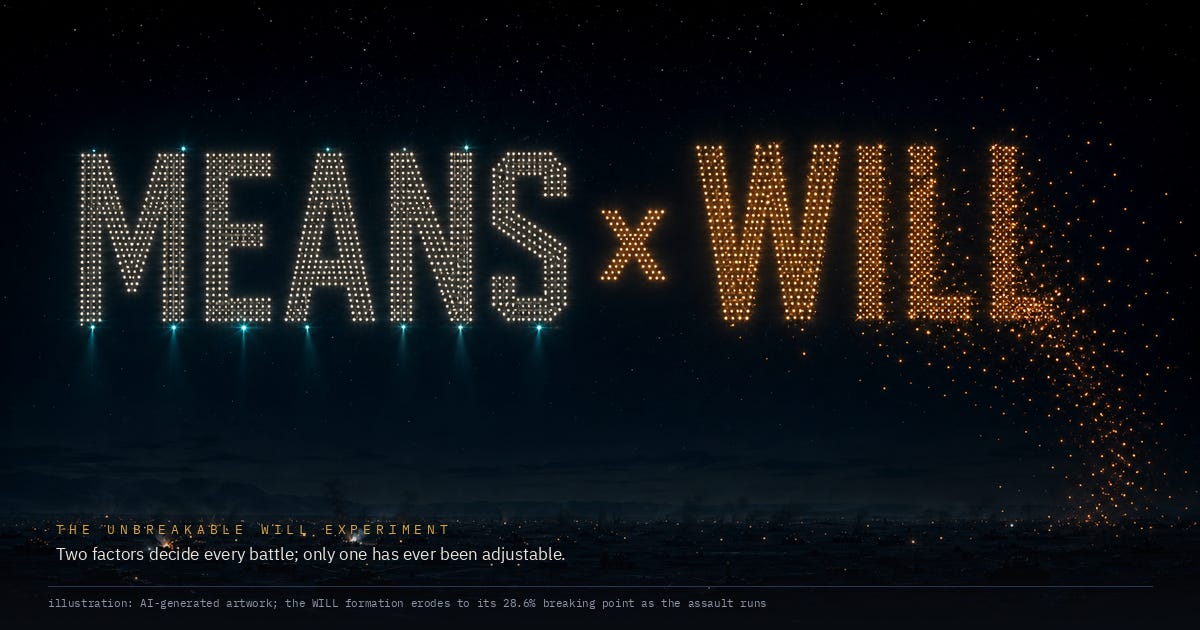
How to read it: Clausewitz factored war into means times will; the WILL formation erodes as the modeled force nears its breaking point.
What to see: one of the two factors fails first in every army ever fielded, and it is about to become a design parameter. AI-generated illustration; the WILL erodes to the model’s 28.6% breaking point.
2. What we built, and why these four battles. The instrument is a Monte Carlo combat simulator: Lanchester square-law attrition, each unit carrying a morale threshold that varies run to run, and the ability to mix breakable humans with unbreakable machines on one side. The test set is four battles, chosen so that each stresses a different joint between will and firepower.
First Bull Run, 1861: a pure rout. The Union army came apart at 8.3 percent casualties, 2,896 of 35,000 present counting killed, wounded, missing, and captured. The test: can the model break early, the way real armies broke?
Pickett’s Charge, 1863: a repulsed assault at near-parity firepower, the regime where a breakpoint should matter most. The test: does the model make the charge the long shot it was?
Trafalgar, 1805: a decisive naval concentration, where British gunnery and Nelson’s geometry did the deciding and Britain lost zero ships. The test: does the model refuse to credit will where will was not the story?
Iwo Jima, 1945: the control case, and the reason this series is not counterfactual fiction. Kuribayashi’s garrison genuinely fought without a breakpoint: of roughly 21,000 defenders, 216 were taken prisoner during the battle. History already ran one experiment with an unbreakable will, and Engel left us the daily data on what it cost.
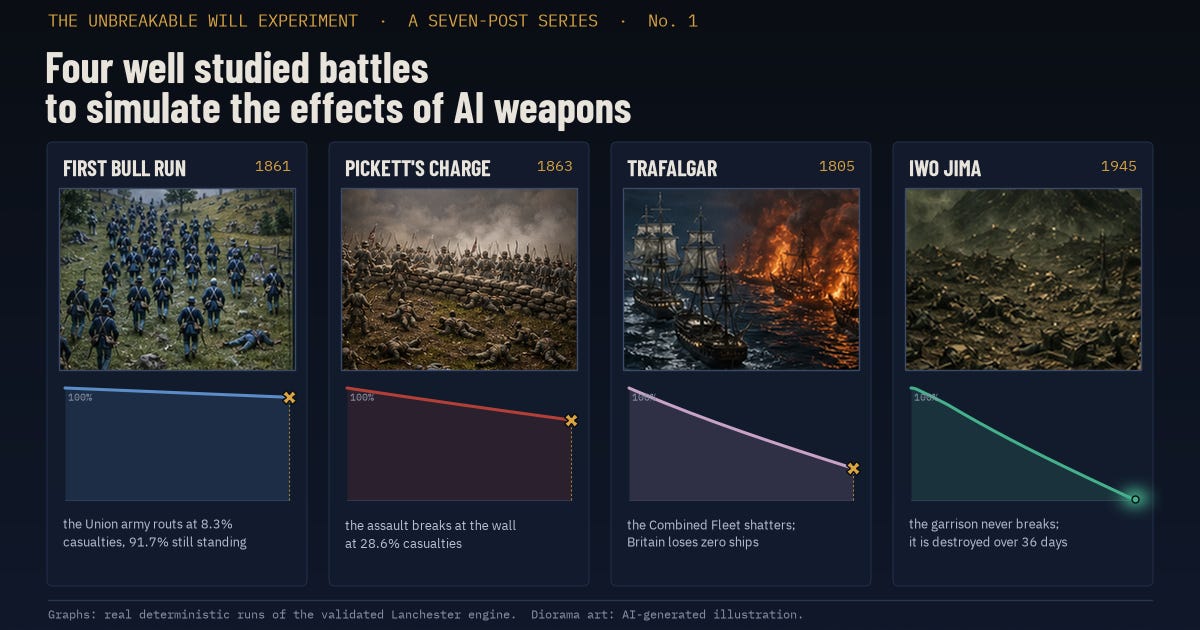
How to read it: each panel is one validated battle; the X is where the losing force’s will broke, the caption the historical outcome the model had to reproduce.
What to see: four very different fights, one shared failure mode, and a single experimental move: turn the breaking point off.
The engine had to reproduce all four before any counterfactual ran: the rout at 8.3 percent, the charge repulsed with roughly 19 percent Union casualties, the zero British ships, and Iwo Jima's daily casualty trajectory. The charge's 4.2 percent baseline odds (95% CI 3.9-4.6%) are what the matched engine then reports: model output, not a validation target.
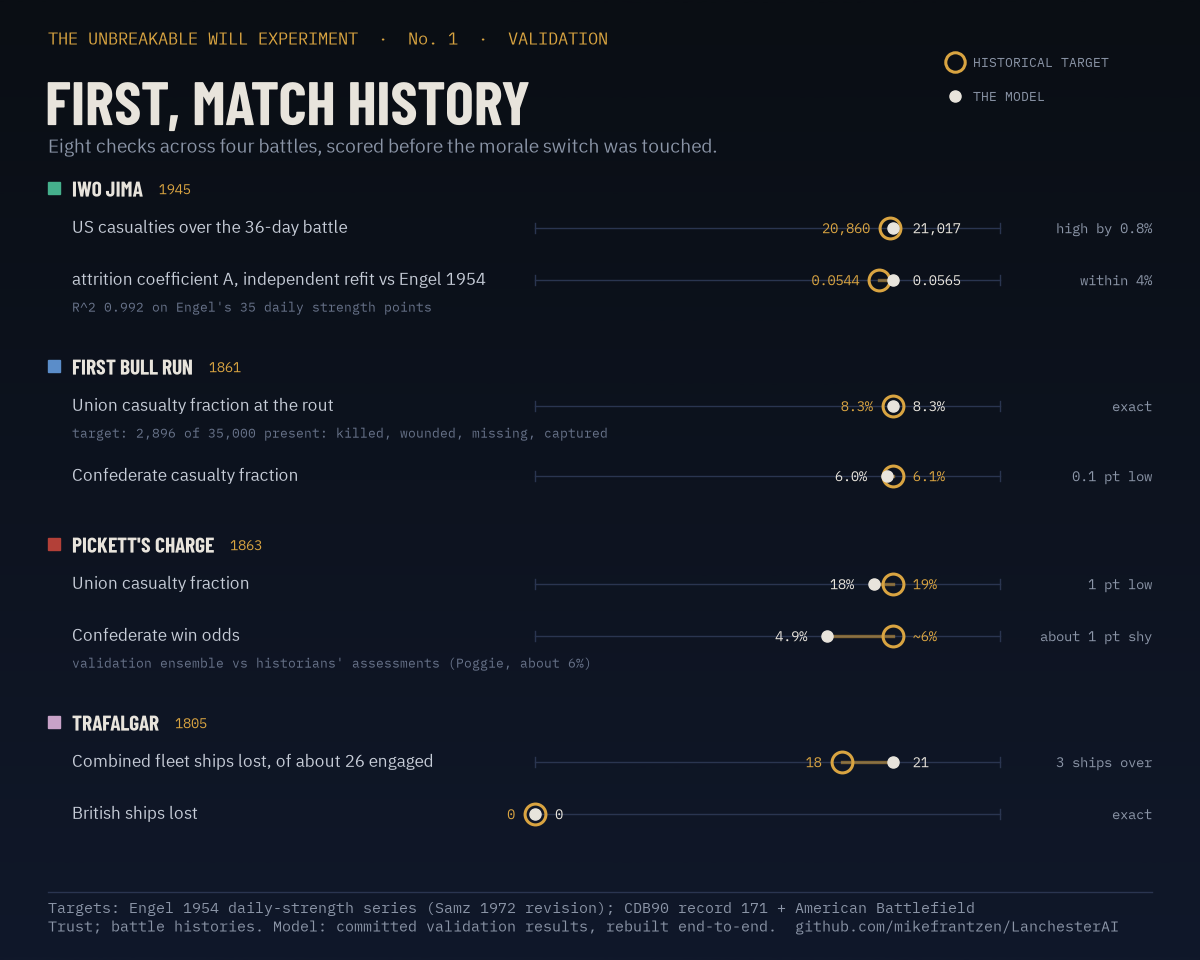
How to read it: each row is one check; a dot inside its ring is a bullseye, and the short brass bar is the miss distance on that row’s own zero-based scale.
What to see: one engine lands on or beside eight very different targets across four battles, before the morale switch was ever touched.
3. The experiment: turn one side’s breaking point off. Once the engine matched history, the counterfactuals ran in escalating doses. Make one strategic weapon unbreakable AI, a battery that never abandons its guns, to approximate the 2020s approach of embedding AI into strategic weapons first. Then make a contingent unbreakable, and sweep the fraction from a few percent to the whole force: the 2030s proverbial AI/robot-army. Then stop assuming the enemy cooperates. Let him jam the machines’ wiring, decline the fights he would lose, choose the kind of engagement he prefers. Finally, put a nation behind the unbreakable army, with a nation’s very human tolerance for cost, and let the campaign run to a political ending. Each escalation is one post. Each post has one claim I would defend in a hostile meeting.
4. The map of the series. Six posts follow. Here is what each one argues.
Post 2, 91.7% of the Army Was Still Standing When It Ran. Battles end when will breaks, long before armies die: the Union quit Bull Run with over nine-tenths of its men still standing, and a robot Pickett’s Charge takes the ridge in 92 percent of simulations (95% CI 91.6-92.5%) and never loses outright. Iwo Jima’s real unbreakable will roughly doubled American casualties in the model (21,431 against 10,969 simulated) and changed nothing about who won.
Post 3, Out-Fought, Not Out-Frightened. An audit of 607 defeats in the Army’s own database finds about two-thirds (60.8-72.2 percent across threshold choices) were capability losses, and genuine will collapses were a fifth, at most a third after honest correction. Two-thirds of history’s losers were out-fought, not out-frightened.
Post 4, ADM Nelson Beats the Robots. Every battle has a capability floor below which no fraction of unbreakable force wins, and against an enemy that does not break, your own unbreakable will is worth exactly zero. Even a Trafalgar fleet that never strikes its colors loses 83.6 percent of the time (95% CI 83.0-84.2%).
Post 5, The General Quits First. Historical battles ended on a commander’s withdrawal ten times as often as on the troops’ annihilation (266 to 26 of 607 recorded defeats), and a machine’s will is only as unbreakable as its jammable, hackable substrate. Your robot’s will lives in its radio.
Post 6, The Unexpected Deterrence. A rational enemy declines roughly 40-58 percent of the fights an unbreakable force would win and keeps the ones he takes; let him choose the kind of fight and will’s measured value collapses by about 97 percent in the model. A Great General will not fight your unbreakable army. They will fight around it.
Post 7, Win Every Battle. Lose the War. The capstone: a reviewer’s attack on the model, my correction, and the enemy’s answer to the correction map four regimes, and every one is decided by what the nation can bear, blood where the enemy can reach it, treasure and time where he cannot. The series’ honest scorecard and all nine operating rules live there.
Best Arguments Against This
The strongest objection covers the whole series, so it goes here, at the front: an aggregate attrition model cannot capture what will actually is. Will is perception, leadership, cohesion, exhaustion, the rumor running down the line. My model compresses all of it into one number, a casualty fraction at which a unit quits, and the foundational empirical study of breakpoints, Dorothy Clark’s 1954 work on 43 broken battalions, found casualty levels a poor predictor of when units break. So the model’s trigger variable is the one the best field data demoted. I concede the compression fully. RAND’s Will to Fight framework (Connable and colleagues, RR-2341-A, 2018) shows what the full-mechanism alternative looks like: 29 factors, unit by unit, from leadership to cohesion to supply. Their model is a model of what will is. Mine is one threshold, because my question is not what will is made of but what removing its failure point changes.
Three things keep the results standing anyway. First, the design: the counterfactual question is not what triggers a break but what changes when no trigger exists, and for that the model needs only that the historical break happened at a measurable point, which the record supplies. Second, the validation: the engine reproduced four very different battles, including an independent recovery of Engel’s 1954 coefficients, before the morale switch was ever thrown. Third, the audit: every headline number in this series was reproduced from committed data and stress-tested before drafting, dropping one war at a time, one century at a time, rerunning under fresh seeds, re-scanning grids at finer steps. Where the audit’s numbers moved under stress, the moved versions are the ones that print. What the concession still buys the skeptic, the spatial and perceptual texture of real combat, is named below as the likeliest thing to change my mind.
What Would Change My Mind
These are the series-level triggers; each post carries its own.
By end of 2027: a spatial or agent-based re-implementation of these experiments, with terrain, suppression, and local maneuver, that overturns a core ordering: the Pickett flip, the capability floor, or the capstone’s never-helped result. This is the single most likely falsifier.
By December 2027: a machine-readable re-audit of historical defeats that separates fighting-phase from pursuit-phase casualties at hundreds-of-battles scale and finds true will collapses were the majority. Post 3’s headline dies, and much of the series’ framing with it.
Within a year of publication: verified battlefield evidence of an unbreakable autonomous force flipping an engagement it was clearly losing on capability, by refusal to break alone. That breaks the tiebreaker thesis at its center. Keep an eye on Ukraine.
Any time: an independent refit of Engel’s 1954 Iwo Jima daily series that fails to recover coefficients near his published values. That is my validation lynchpin.
The close
For two centuries strategy treated the will factor as fate: a commander could cultivate it, but nobody could specify it. That era is ending on a procurement schedule, and the right response is neither the promise that armies which cannot panic cannot lose, nor the reflex that nothing fundamental has changed. The right response is to measure and adapt.
Measured, it comes to this. An unbreakable will is not a war-winner. It is a tiebreaker, purchased at strategic risk: it decides fights that were already close, only where the enemy allows the fight, only while its wiring holds, and the bill goes to a nation whose own will remains the last, and deciding, breaking point.
Next post: the army that ran from Bull Run with 91.7 percent of its men still standing, and what happened when I built its panic into the math, then took the panic away.
i question the base assumption "AI weapons an be modeled like human weapons whose will never breaks. They perform as they were programmed (or trained) regardless of what happens." i see at least two ways this goes wrong.
1. superior ai realizes bad odds of success, so breaks contact asap; adjusts position, forces, whatever; and then re-engages. fighting on regardless of the odds seems antithetical to the I in AI
2. there have been plenty of anecdotes of ai lying (i.e. performing not as programmed) - when threatened with being turned off. one man's intelligence is another's cowardice