
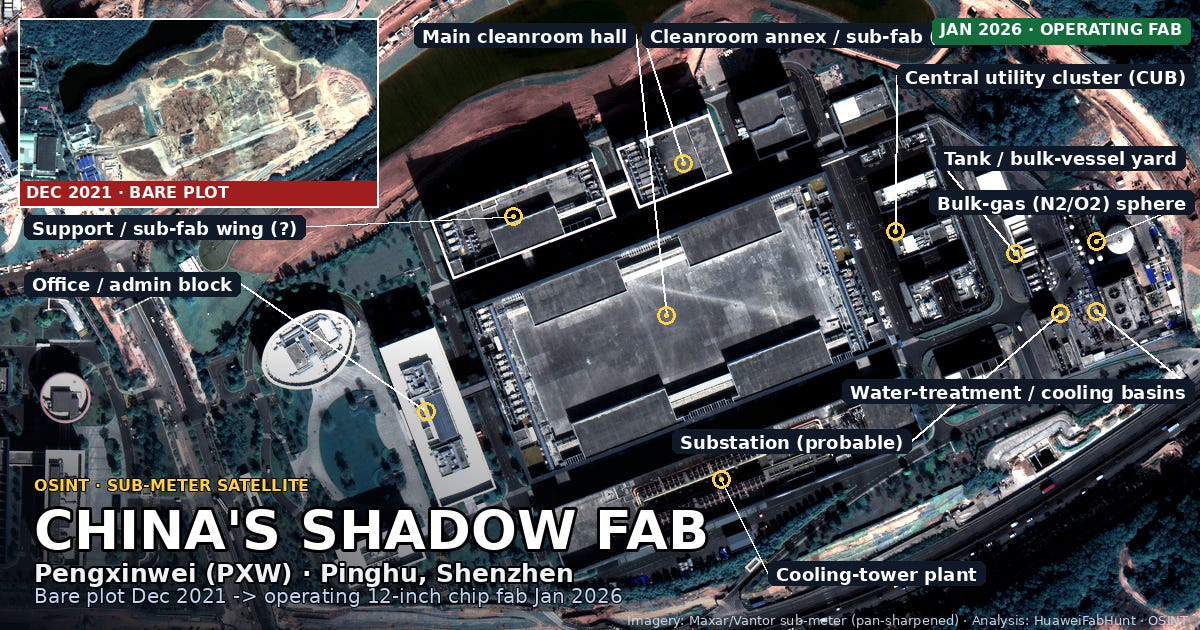
I went hunting for the fabled secret Huawei chip fab that didn’t appear on any companies’ balance sheet, and came back with a fab census, their limiting factor (LIMFAC), and a surprising map with implications for geopolitical deterrence. The next seven posts are that hunt, end to end. I promised a two part series, I’m either over delivering or nerd sniped myself.
The findings, in miniature
Seven findings, one sentence each. The parts that own them show the work.
China’s AI hardware has exactly one binding constraint, its LIMFAC (the limiting factor that caps output no matter how much of everything else you have), and it is not wafers, not packaging, not lithography: it is high-bandwidth memory, roughly 2 million good HBM stacks in 2026, divided by the 8 stacks every Ascend 910C consumes (Part 6 owns that arithmetic, with the heaviest receipts in the series).
Run that division probabilistically and the indigenous ceiling is ~225k 910C-equivalent accelerators in 2026 (P10–P90: 192–270k), rising to ~1.0M by 2028: real growth, memory-bound the whole way (Part 6).
Deployed is not domestic: the ~700–805k accelerators China fielded in 2025 rode a one-time, decaying overhang of pre-ban foreign dies and imported memory, not domestic capacity, and Huawei’s reported ~600k target for 2026 is roughly twice what the domestic division allows (Part 6, with the policy autopsy in Part 10).
The money behind the “Huawei shadow fabs” isn’t Huawei’s (it carries ≈US$0 of fab subsidy), and it isn’t mainly Beijing’s either: across the 33 traceable facilities, local governments out-financed the national Big Fund ¥192.9bn to ¥138.5bn, a 1.39:1 ratio, paid as equity rather than grants so it never reads as subsidy (Part 5).
The buildings are outrunning the silicon: China builds AI data-center capacity roughly 15–30× faster than it can fill it with chips, and where the two projects genuinely meet is in that physical record: the fab study explains why the chips can’t come faster; the data-center study shows the buildings waiting for them (Part 7, with a dated, falsifiable stranded-shell forecast).
Run China’s last sanctioned-capability ramp (nine years, decision to volume) against the memory decision funded in 2024, and “enough HBM” lands around 2033, with an honest band of 2031–2038 (Part 8, which then sits carefully with what that date does to the Taiwan window).
And the same map that found the bottleneck measured its exposure: 13 of China’s 14 critical AI-hardware facilities sit within 900 km of Taiwan, inside the conservative range band of the ~$200k one-way attack drones Ukraine mass-produces today (Part 9, published as deterrence, not targeting).
Everything in this series is time-boxed as of June 2026: imagery claims are stamped to the collection date of the frame, document claims to the filing date, and a built shell is never counted as an operating fab.
Proof of method, in one image
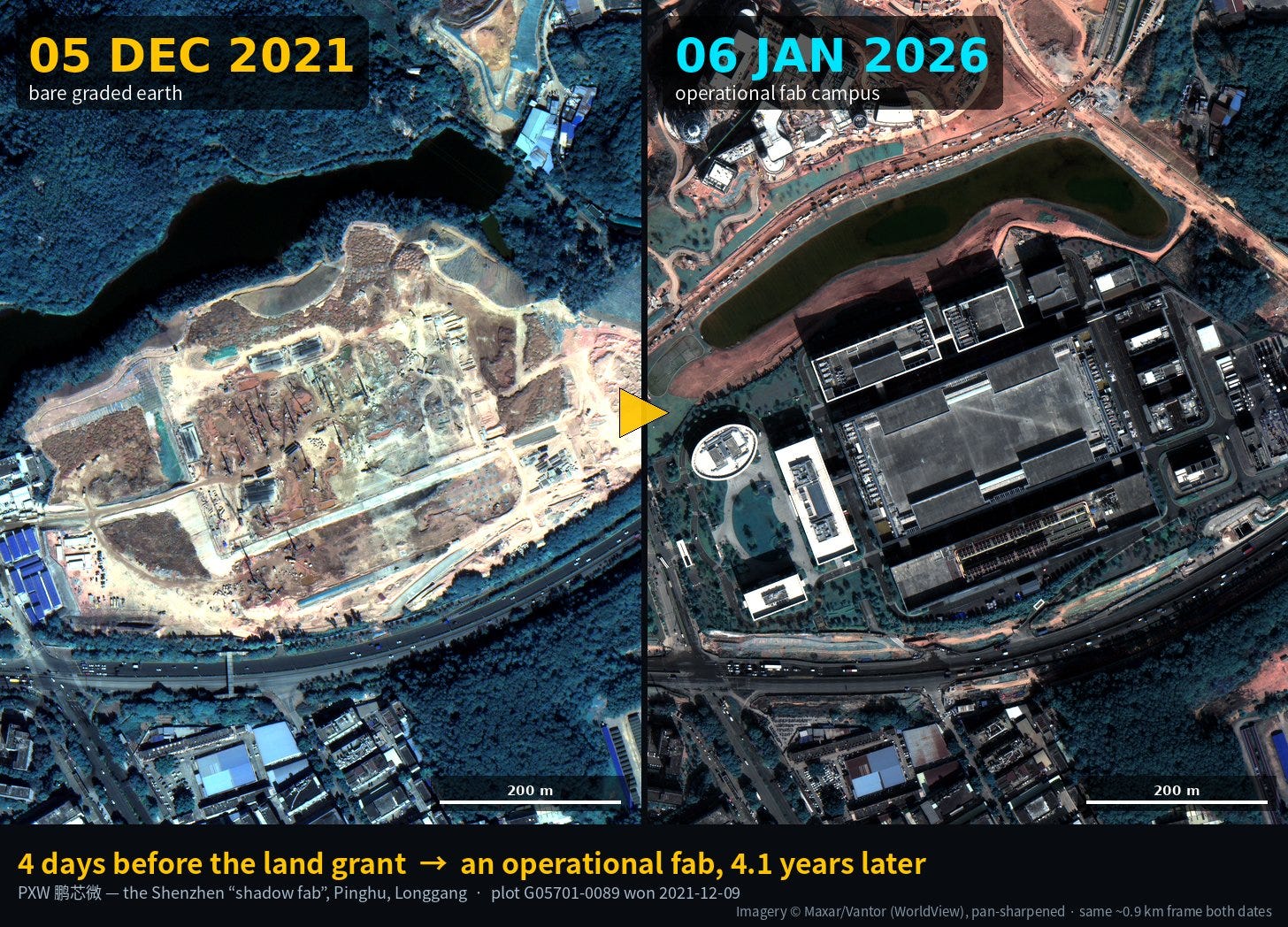
The exhibit the whole series stands on. Same ~0.9 km box, two dates: bare graded earth on 2021-12-05, four days before PXW formally won the plot, and an operational fab campus on 2026-01-06. A fab that appears on nobody's balance sheet, built in ~4.1 years, timed by satellite. Imagery © Maxar/Vantor (WorldView).
That pair is what the method produces when it works: paper said a fab should exist on that exact plot; the satellite confirmed it and timed the build. Part 4 walks the method end to end, including the misses, which are the reason to trust the map.
The roadmap (published over the next week)
Part 四 (4). The Bear Hunt: Finding China’s Hidden Fabs with Nine Boring Databases and One Satellite. The method (filings → substations → satellites) matters more than any single find.
Part 五 (5). The Trench Coat: Who Actually Pays for China’s Chip Push (It Isn’t Beijing). Equity for silicon, electricity for halls.
Part 六 (6). Eight Stacks Per Chip: The Arithmetic That Caps China’s AI Hardware. The full math and every receipt.
Part 七 (7). Empty Halls: China Builds AI Data Centers 15–30× Faster Than It Can Fill Them. Falsifiable prediction included.
Part 八 (8). The Memory Clock and the Taiwan Window. Nine years to enough, and what the date does to the strait.
Part 九 (9). Deterrence by Exposure: 13 of China’s 14 Critical AI Facilities Sit Within Drone Range of Taiwan. And why the data centers are the wrong target.
Part 十 (10). The Export-Control Scorecard: What Worked, What Leaked, and What to Watch. Memory controls built the wall; everything bankable before a ban leaked.
The standing offer
This series ends with a franchise, not a flourish: the LIMFAC Watch, a quarterly issue that re-pulls the seven supply-side indicators, re-checks the stranded-hall imagery, and grades my own published predictions in public, prediction by prediction. If the analysis breaks, you will read it here first, from me.
Receipts for everything above: every load-bearing claim in the series carries a ledger ID, a confidence grade, and a falsification trigger, and the claims ledger is published with the series. Start with Part 4 and check me.
