
AI Great Powers Part 三 of 2: The Chinese Filings Exposed the Machine
English filings showed the liability story. Chinese filings exposed the operating model: state-shaped demand, subsidy bloodstream, accounting perimeter, customer concentration, and the bottlenecks Beijing is trying to turn into strategy.
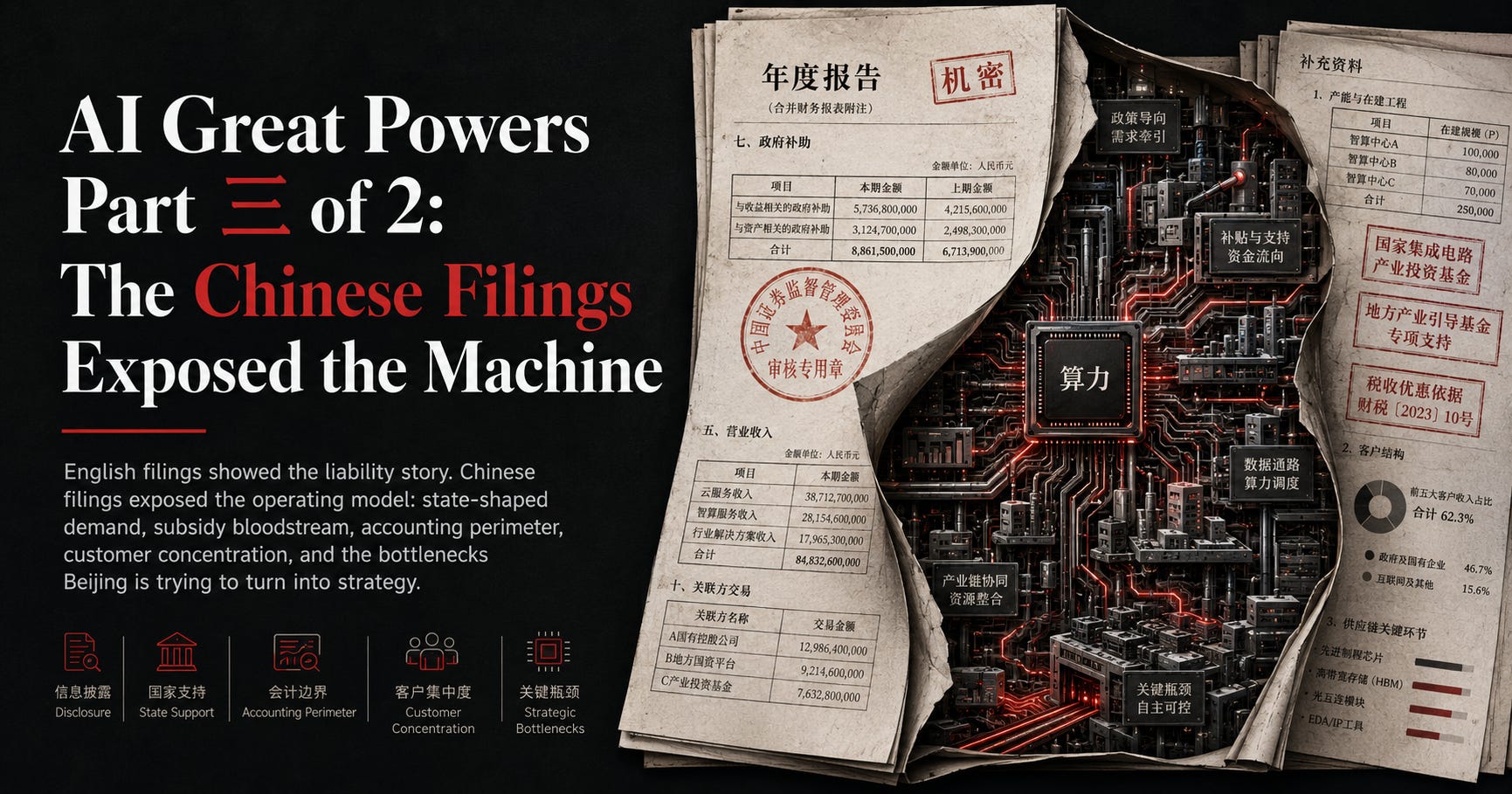
I started this as a two-part series on the AI Great Powers because proprietary information and strategic thinking leak out in financial filings. Part 1 was hardware. Part 2 was model-builder capital. Then I found the Chinese-language filings. They were not a cleaner translation of the English filings. They were a different disclosure regime, and that regime exposed state support, accounting gaps, customer dependence, and self-reliance psychology that the English record mostly missed.
That was the Eureka moment. This is part 三 in a two-part series.
But the useful answer is narrower than “Chinese filings tell the truth and English filings lie.” The Chinese language was not the encryption. The filing regime was. For most companies that matter to China’s indigenous AI hardware effort, there is no English filing to compare against. The audited record exists in Chinese because the companies report to Chinese exchanges, Chinese regulators, and Chinese investors. Where both English and Chinese documents exist, differences often come from the same company filing under a different accounting standard, to a different regulator, for a different audience.
That distinction is the strategic leak. The English-only record systematically misses the state support, customer concentration, domestic-substitution narrative, R&D accounting, and self-described bottlenecks that are visible in the Chinese record.
The rest of this post is the evidence trail. The strategic version is this:
China’s AI companies tell two different stories because they are speaking to two different audiences.
The research data was current as of June 6, 2026. FX note: all USD equivalents for RMB figures in this post are rough reader conversions at RMB 6.77 per US$1. (RMB = Renminbi, the official currency of the People’s Republic of China).
To foreign investors, the story is compliance, generic geopolitics, and downside risk. To domestic regulators and Chinese investors, the story is self-reliance, domestic substitution, state-backed market formation, and endurance under pressure.
The difference is not just tone. It changes the numbers.
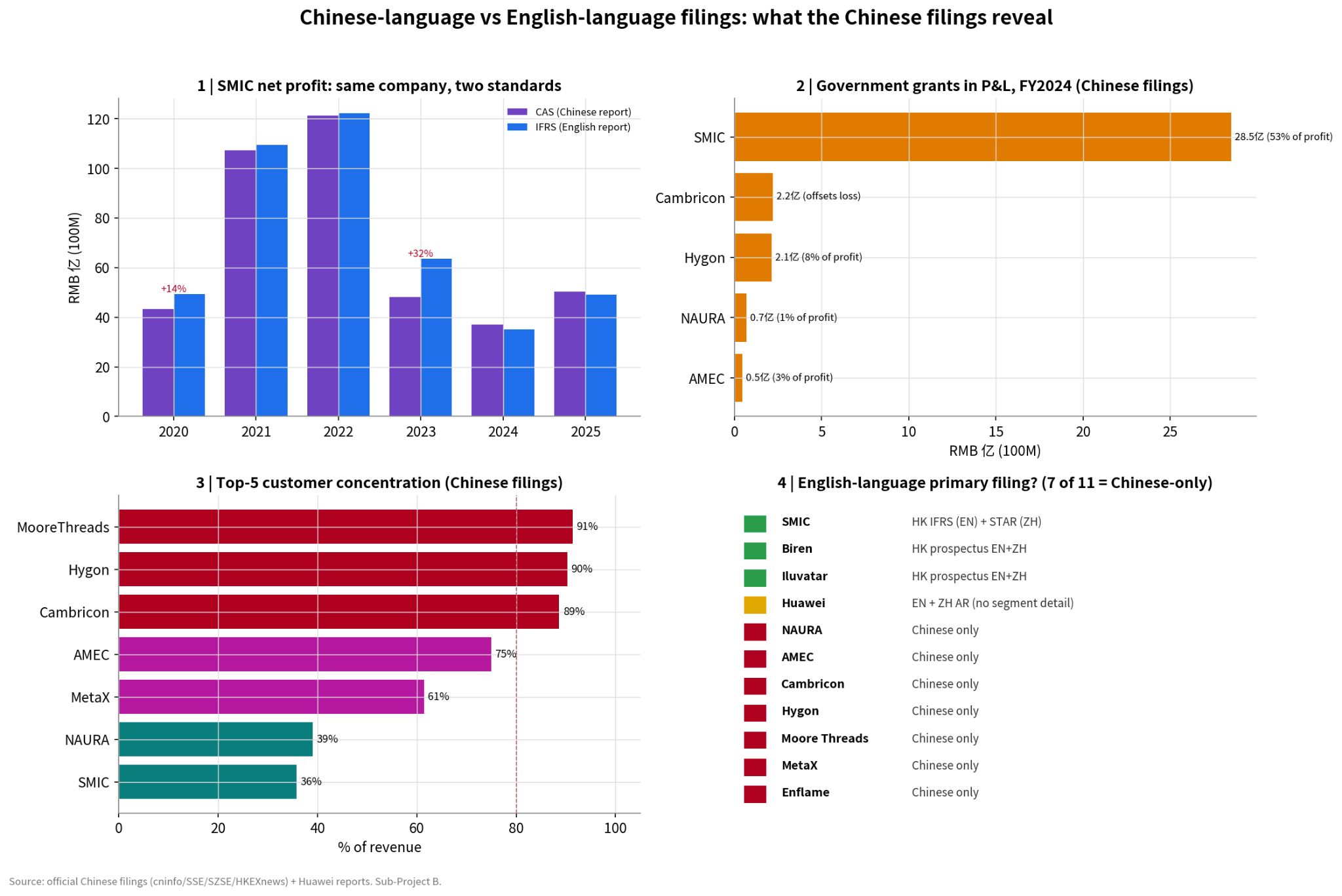
SMIC (Semiconductor Manufacturing International Corp) is the clean natural experiment. In FY2023, the same company reported net profit attributable to shareholders of RMB 4.82 billion, about US$0.71 billion, under China Accounting Standards in its Shanghai STAR Chinese filing, but RMB 6.35 billion, about US$0.94 billion, under IFRS in its Hong Kong English filing. That is a 31.6% gap. The Chinese filing shows both numbers and the reconciliation. The English filing shows only the IFRS result.
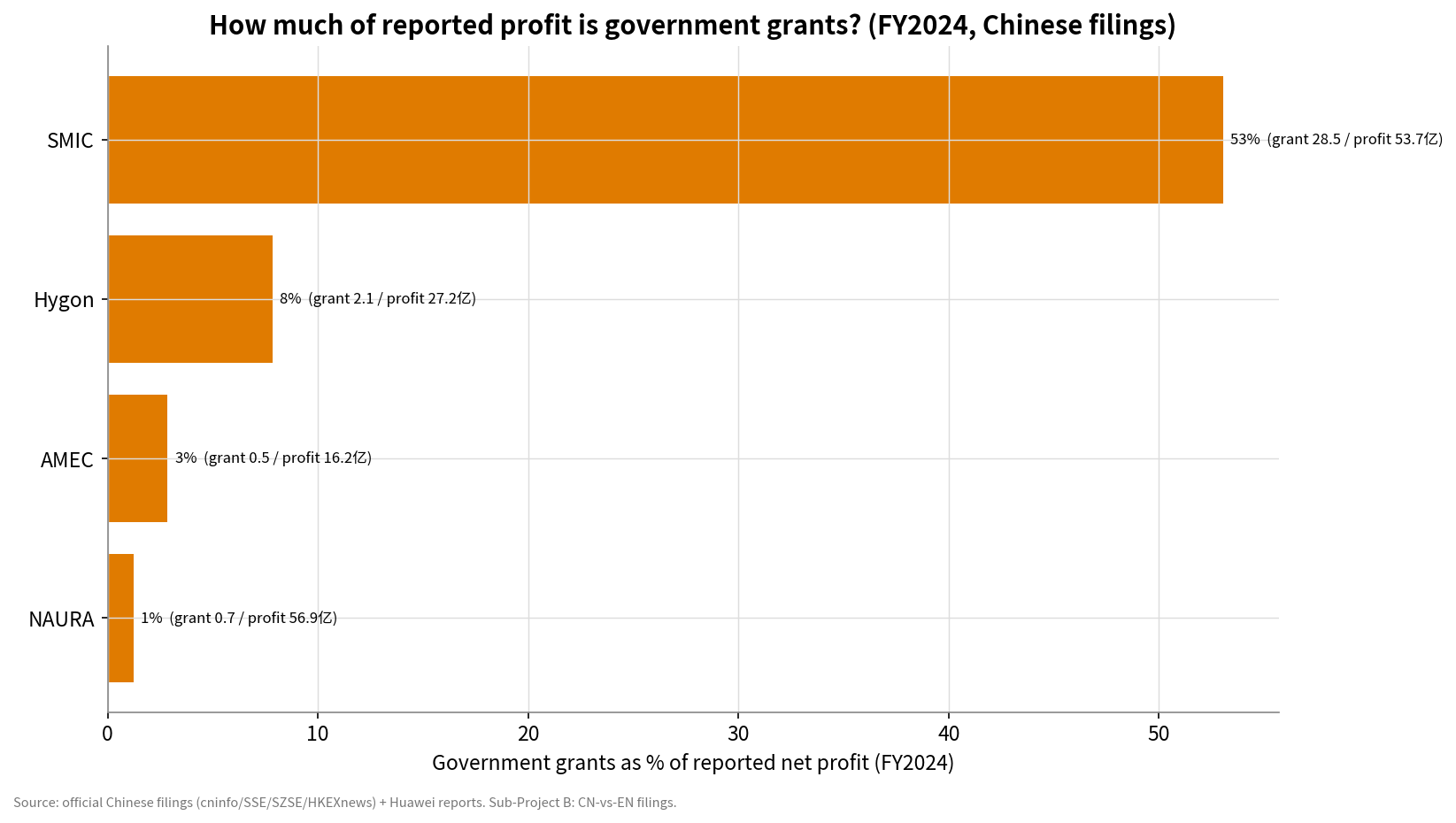
The government-support picture also changes. In the FY2024 Chinese filings, five highlighted chip manufacturers booked about RMB 34.0 billion, about US$5.0 billion, of government grants through the profit-and-loss statement. SMIC alone booked RMB 28.5 billion, about US$4.2 billion, about 53% of its total net profit and about 77% of profit attributable to shareholders. For most of the other companies, those grant amounts exist only in Chinese because there is no English filing.
The customer-risk picture changes too. The latest Chinese filings show top-five customers accounting for 91% of Moore Threads revenue, 90% of Hygon, 89% of Cambricon, 75% of AMEC, and 61% of MetaX. The follow-up research mapped the buyers behind those percentages. The buyer is often not “the market.” It is China Mobile, Sugon, government AI compute centers, telecom SOEs (State Owned Enterprises), public-service compute platforms, and SOE channels.
The model-company side has the same pattern but through a different accounting mechanism. iFlytek capitalizes roughly 40% of R&D under CAS (China’s Accounting Standard). In FY2025, its total R&D investment was about 21% higher than the income-statement R&D expense line. Its government grants recognized through P&L were about 167% of net profit. Its English annual report dropped the entire Chinese financial-report section where those details live. Tencent, by contrast, says no significant development expenditures were capitalized. So the R&D accounting problem is real, but it is not universal.
The biggest unresolved question from Part 1 got sharper. The rumored roughly US$30 billion Huawei-linked fab subsidy is not hidden inside Huawei. Huawei’s Chinese bond documents show campuses, R&D sites, staff housing, and land-use rights, not a fab subsidy. The best current answer is more interesting: the money is on the state’s balance sheet, which is exactly why no Huawei filing shows it.
Accounting perimeter matters.
That is not the kind of sentence that lights up a room.
It is the sentence that keeps you from being fooled when you’re following the money.
The most important subjective finding is what Chinese companies say they fear. The hardware-side follow-up found 105 fear-quotes across 11 companies. The most recurring fears are export controls, customer concentration, supplier concentration, advanced lithography/process, key materials and spares, losses/runway, software ecosystem lock-in, EDA/IP, advanced packaging, and HBM. The model-side follow-up found the same logic in software form: GPU supply continuity, project acceptance, no proven foundation-model business model, overseas access, capex pressure, and token price compression.
In a Great Power competition, you do not just ask what the other side is building.
You ask what they are scared of.
Then the nature of competition determines what you do with those fears.
What I Measured
The project was an offshoot of two prior research projects.
The Great AI Hardware Power project covered Huawei, SMIC, NAURA, AMEC, Cambricon, Hygon, Moore Threads, MetaX, Biren, Enflame, Iluvatar, and the surrounding Chinese AI-chip supply chain. The Chinese-language phase assembled 81 primary documents: Chinese annual reports, STAR prospectuses, Huawei Chinese annual reports and bond documents, SMIC Hong Kong and Shanghai filings, and bilingual Hong Kong prospectuses.
The Great AI Model Power project covered Alibaba, Tencent, Baidu, iFlytek, ByteDance where possible, and U.S. hyperscaler controls. The Chinese-language phase built a 113-document corpus across Tencent, iFlytek, Baidu, Alibaba Chinese releases, and U.S. comparators.
The question was not whether China is good at AI.
The question was narrower:
What can we infer from the Chinese-language financial record that the English-language financial record did not reveal?
There were three axes:
First, numbers. Do the accounting standards change profit, R&D, grants, or comparability?
Second, disclosure scope. Does one regulatory regime force the company to itemize things the other regime aggregates or omits?
Third, framing. Does the same geopolitical reality get narrated differently to domestic and foreign audiences?
The answer is yes across all three. But the mechanism differs by company.
Finding 1: The Largest Language Difference Is Existence
The biggest difference between English and Chinese filings is not translation.
It is whether the filing exists at all.
On the hardware side, 7 of 11 key AI-chip and equipment companies publish primary audited financials in Chinese only: NAURA, AMEC, Cambricon, Hygon, Moore Threads, MetaX, and Enflame.
That is the heart of the Chinese indigenous AI hardware effort.
If you only read English, you are not reading a sterile version of the record. You are missing the record.
This matters because the Chinese-only companies are exactly the companies that expose the most useful strategic details. Huawei hides Ascend inside a giant private company. But Cambricon, Hygon, Moore Threads, MetaX, Biren, Iluvatar, and Enflame cannot hide the economics once they list or file to list. Their filings show what domestic AI-chip programs look like when the chip business is visible: high R&D intensity, recurring losses for the startups, state support, extreme customer concentration, and constant pressure to build domestic alternatives to foreign tools and ecosystems.
The English-only analyst is forced into secondary summaries.
The Chinese-reading (cough translating cough) analyst gets the audited pressure gauges.
Finding 2: The $30B Was Not In Huawei Because It Was Not Huawei’s Balance Sheet
One of the open questions from Part 1 was where the rumored roughly US$30 billion in PRC subsidy and fab money went.
The first answer was unsatisfying: it was not in Huawei.
The better answer is now more useful: it could not be in Huawei because the rumored fab pool is not booked to Huawei.
The follow-up work traced the claim back to a 2023 Semiconductor Industry Association presentation reported by Bloomberg. That matters because it means the US$30 billion number is an estimate, not a filing-derived amount. SIA and Huawei did not substantiate it.
But the accounting perimeter result is strong.
Across Huawei’s Chinese bond documents, the research team found zero government-grant line items and zero Big Fund or SASAC references. Huawei’s visible construction-in-progress is R&D campuses and staff housing, not fabs: Gangtou talent apartments at RMB 5.2 billion, about US$0.77 billion; Shanghai Qingpu R&D at RMB 10.2 billion, about US$1.5 billion. Huawei’s intangibles are mostly land-use rights.
So the quotable conclusion is this:
The roughly US$30 billion is not hidden in Huawei. It is on the state’s balance sheet, which is exactly why no Huawei filing shows it.
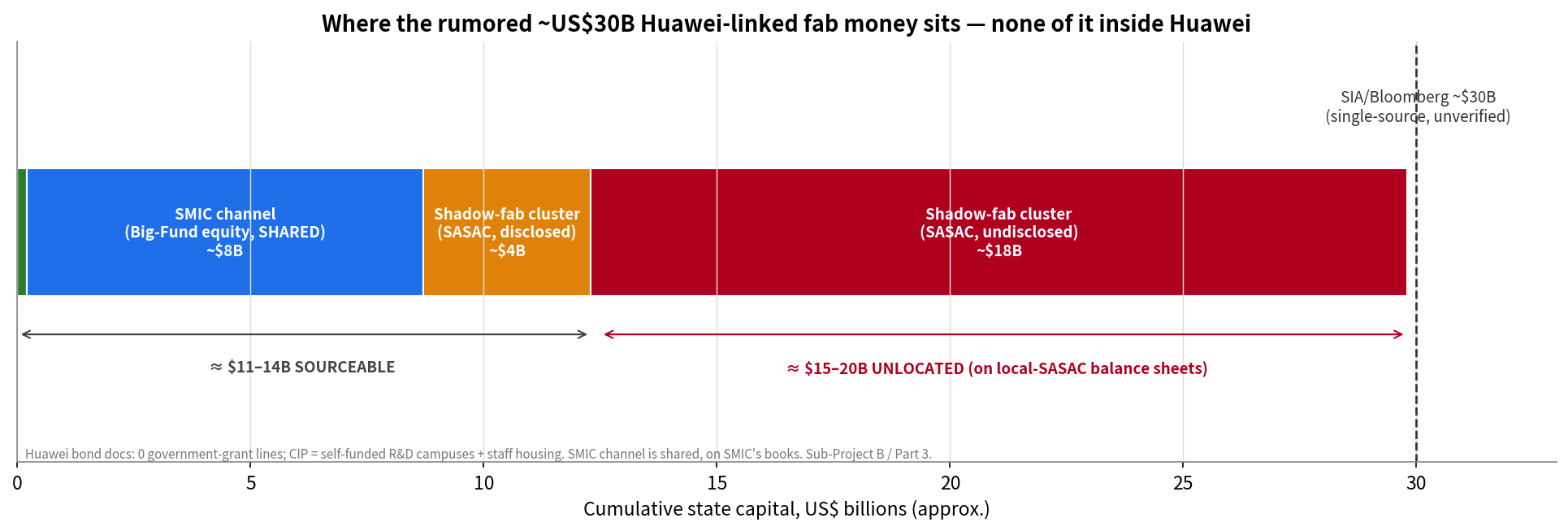
The follow-up research splits the money into three perimeters.
Direct Huawei support is effectively zero for fab subsidy. Huawei has real state interaction. It does not have a disclosed fab subsidy pool in its accounts.
The SMIC ecosystem channel is visible in SMIC’s books, not Huawei’s. Big Fund and local funds put roughly US$8-9 billion of equity into SMIC South, Jingcheng, and Dongfang. SMIC also had RMB 4.12 billion, about US$0.61 billion, of deferred grants, including RMB 2.85 billion, about US$0.42 billion, recognized through FY2024 P&L. SMIC construction-in-progress rose from RMB 27.7 billion to RMB 92.6 billion, about US$4.1 billion to US$13.7 billion, from 2020 to 2025.
The shadow-fab cluster is the hard part. SiCarrier, SwaySure, PXW, PST, Pengjin, DGGMT, and Qingdao SiEn sit around Shenzhen, Dongguan, and Qingdao SASAC vehicles, not Huawei ownership. The sourced disclosed slice is about US$3.6 billion: SiCarrier’s US$2.8 billion 2025 round, SwaySure’s RMB 5.0 billion, about US$0.74 billion, registered capital, and PXW’s RMB 158 million, about US$23 million, land item. The research team’s best estimate is that another US$15-20 billion remains unlocated as undisclosed construction capex on local-government balance sheets.
That sounds evasive only if you are looking for the money in the wrong company’s filing.
The strategic structure is the point. Huawei can design and de facto operate around a state-owned fab/equipment cluster without legally owning the balance sheet. The state can carry the capital intensity. Huawei can carry the systems integration, demand signal, and technical direction.
This is CFO camouflage with Chinese characteristics.
Not “we have no fab strategy.”
“The fab strategy is not in our company.”
What the Chinese public-company filings do show directly is the annual subsidy bloodstream running through the listed ecosystem.
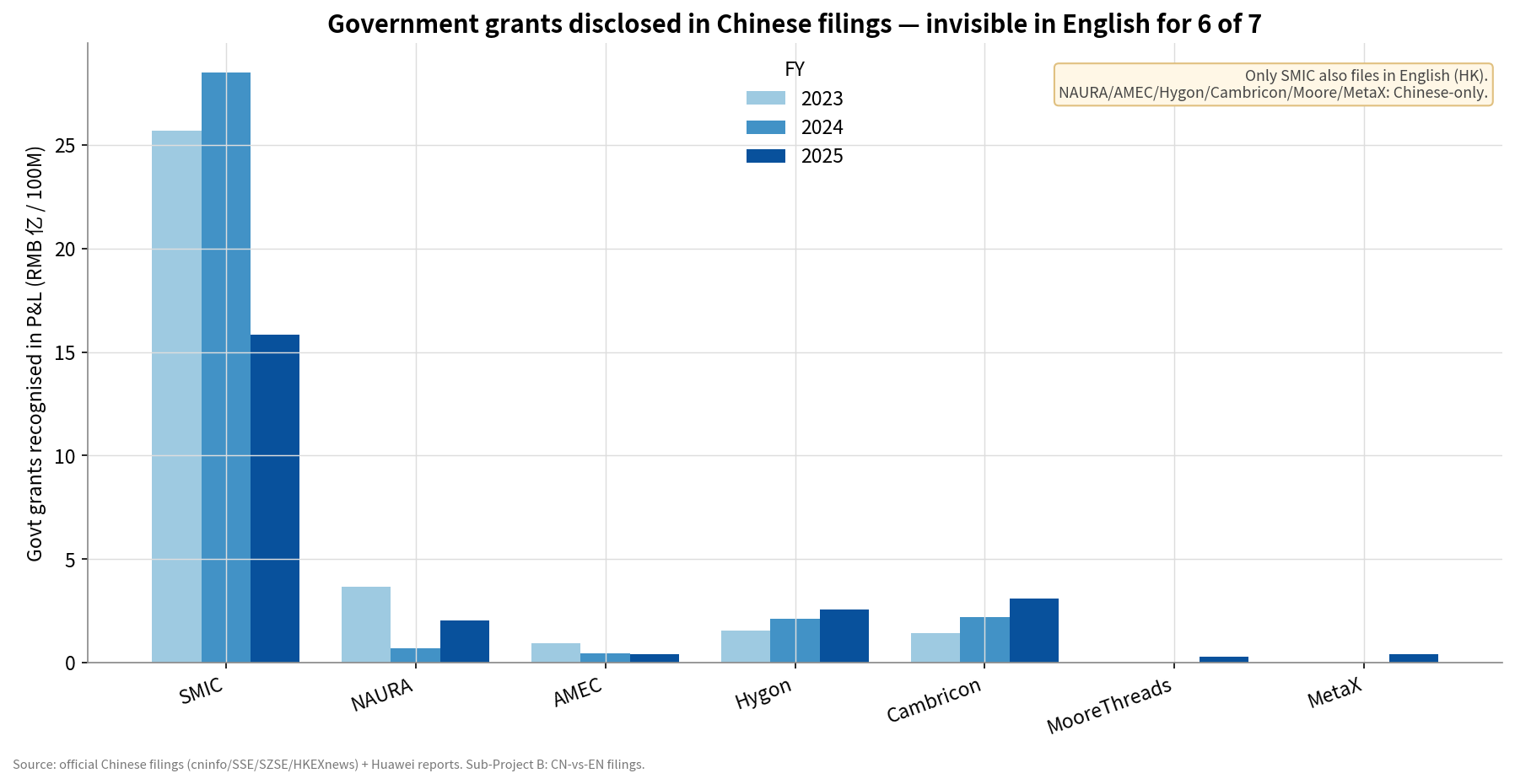
In FY2024, five highlighted manufacturers booked about RMB 34.0 billion, about US$5.0 billion, of government grants through the profit-and-loss statement:
SMIC: RMB 28.5 billion, about US$4.2 billion.
Cambricon: RMB 2.20 billion, about US$325 million.
Hygon: RMB 2.13 billion, about US$315 million.
NAURA: RMB 0.70 billion, about US$103 million.
AMEC: RMB 0.46 billion, about US$68 million.
SMIC is the big one. Its FY2024 grants were about 53% of total net profit and about 77% of profit attributable to shareholders. But if you look really closely, they are also booking deferred income as a liability instead of profit for some of the grants. Translated from accounting into English, that means that SMIC still has not met or delivered the requirements the Chinese government attached to the grant. SMIC has the cash in the bank, but still had to do something before accounting standards let them “earn” the money. Thank you Josh Neff for years of corporate finance lessons.
For the loss-making chip startups, the grants matter differently. They do not make the companies profitable. They reduce the burn.
On the model-company side, iFlytek is the sharpest example. From FY2022 through FY2025, its government grants recognized through P&L exceeded net profit every year. In FY2024, grants were about 187% of net profit. In FY2025, about 167%.
Read that plainly.
Without state grants, iFlytek is roughly break-even to loss-making.
That does not mean iFlytek is fake. It means iFlytek is a nominally private AI champion operating inside a state-supported strategic market.
But the model-side follow-up adds an important guardrail. Do not conflate the chip-side and model-side grant stories.
The chip side has large absolute grants. The model side has smaller absolute grants that swamp thin profit.
iFlytek’s grants were not RMB 10-14 billion a year, about US$1.5-2.1 billion. That was a unit trap in an earlier internal note. The correct figure is roughly RMB 1.0-1.4 billion a year, about US$0.15-0.21 billion. The ratio was still the point: those grants were 167-193% of net profit from FY2022 through FY2025.
Alibaba is different again. Its biggest visible state benefit is not an itemized grant. It is tax. The follow-up ledger shows a FY2025 corporate-income-tax benefit of RMB 20.3 billion, about US$3.0 billion, from preferential rates and tax holidays, plus RMB 9.3 billion, about US$1.4 billion, of R&D super-deduction. Tencent and Baidu also disclose grants and tax benefits, but under their listing regimes much of that support is visible in English too.
That is the clean version:
State support is real, but it does not enter every account through the same door.
Finding 3: Same Company, Different Profit
SMIC is the cleanest accounting experiment in the whole project.
It files in Hong Kong under IFRS and in Shanghai under China Accounting Standards. Same company. Same fiscal year. Different accounting standards. Different numbers.
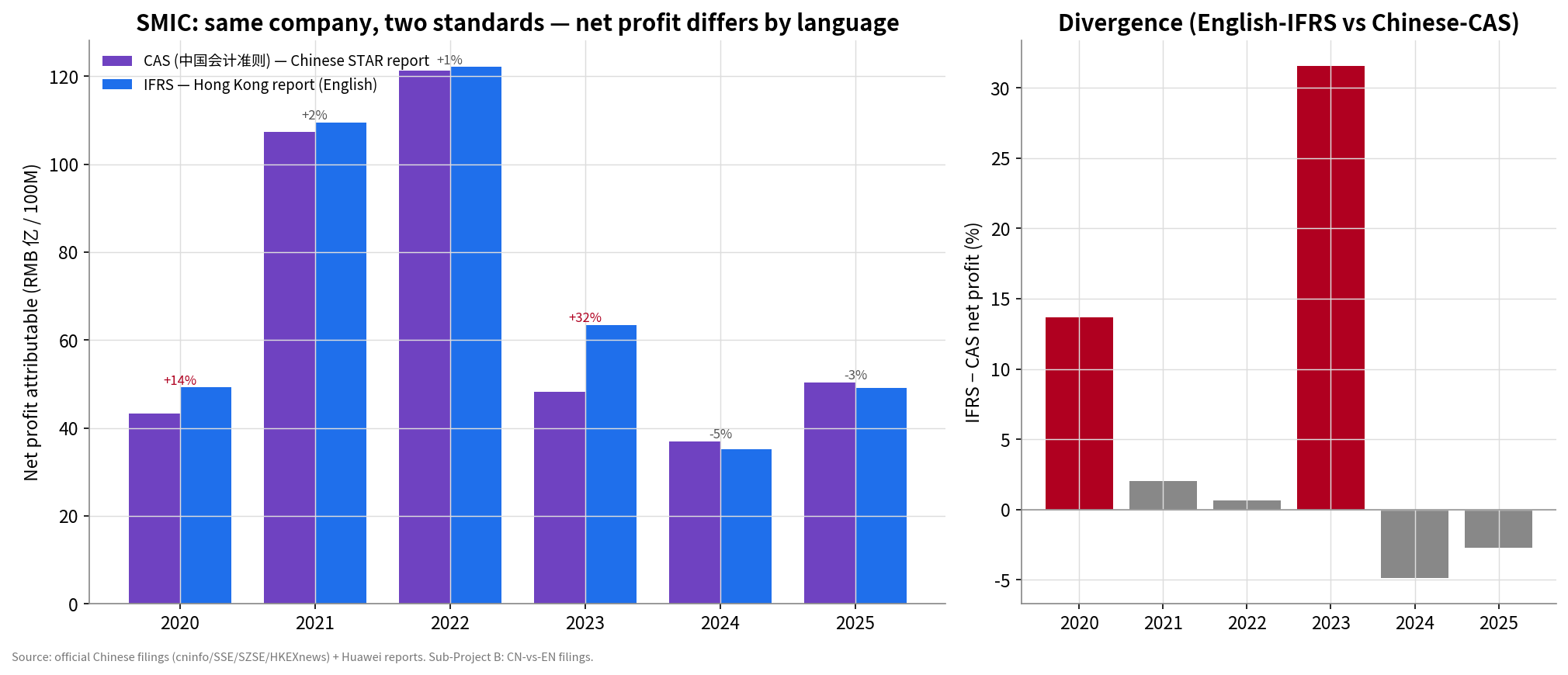
In FY2023, SMIC reported RMB 4.82 billion, about US$0.71 billion, of net profit attributable to shareholders under CAS in the Chinese STAR filing. The IFRS number in the Hong Kong English filing was RMB 6.35 billion, about US$0.94 billion.
That is not a rounding error.
It is a 31.6% difference from one reconciling item: passive dilution of equity in associates.
The Chinese filing has the section that matters: differences in accounting data between domestic and overseas standards. It prints both numbers and reconciles the gap line by line. The English filing does not show the CAS number.
So an English-only reader can say “SMIC profit” and be technically correct under IFRS while missing the fact that the Chinese domestic filing reports a materially different profit.
This is not fraud.
This is accounting.
But accounting is strategy when everyone else is reading the wrong accounting standard.
Finding 4: CAS R&D Accounting Flatters The Model-Side Earnings
The model-side project found a different accounting asymmetry.
Tencent and Baidu do not show big numeric differences between English and Chinese editions when the underlying accounting standard is the same. That was an important negative control. It means you cannot just compare Chinese words to English words and declare victory.
iFlytek is different because it is a CAS filer.
Under CAS, iFlytek capitalizes a large share of R&D. That means some development spending becomes an asset instead of an immediate expense. The income-statement R&D line is not the same thing as current-year R&D effort.
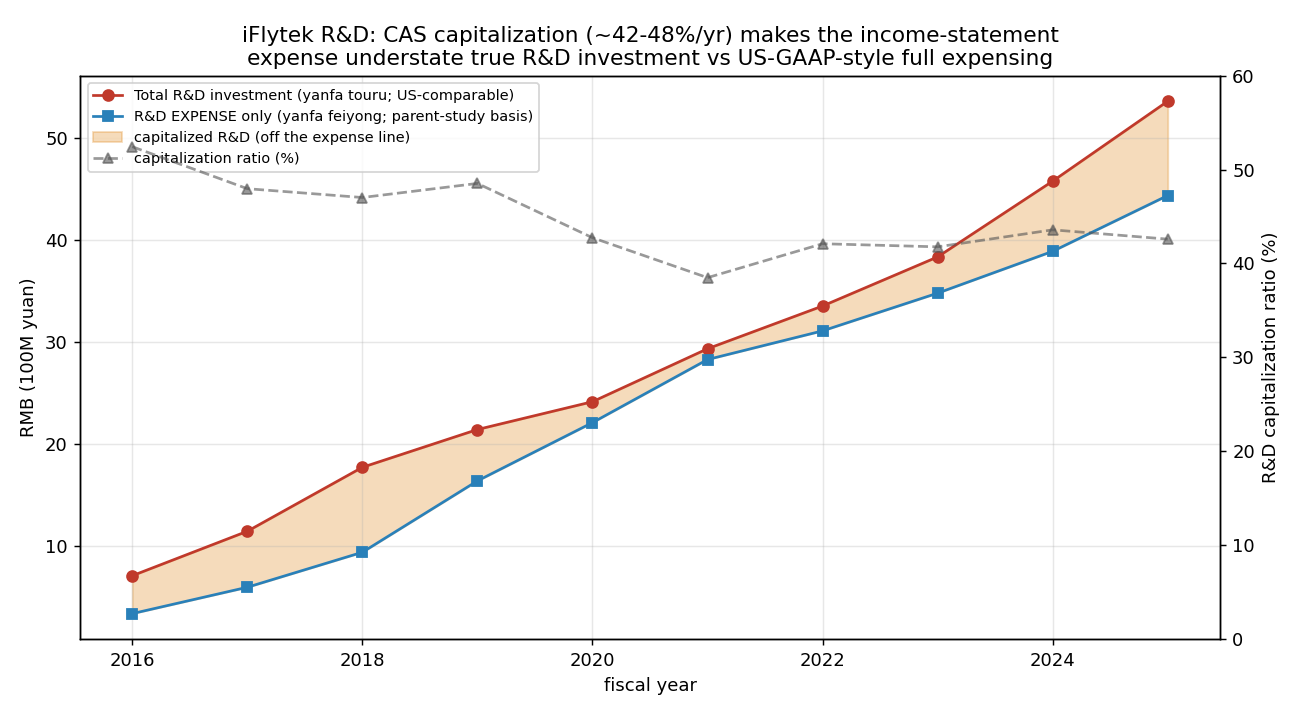
iFlytek capitalized roughly 38-52% of R&D across the studied years. In FY2024, total R&D investment was about 17.7% higher than the expensed R&D line. In FY2025, about 20.8% higher.
This does not overturn Part 2’s China-versus-U.S. hyperscaler capex conclusion. iFlytek was not the core of that aggregate.
The follow-up research also closed the obvious objection: what if Tencent is doing the same thing under IFRS?
Tencent says it is not. Its filings state that no significant development expenditures had been capitalized. Against Tencent R&D of RMB 70.7 billion, about US$10.4 billion, in FY2024 and RMB 85.7 billion, about US$12.7 billion, in FY2025, the capitalized share is effectively zero. Tencent is a clean all-expensed comparator.
So the accounting lesson is narrower and stronger.
iFlytek is not proof that every Chinese model builder flatters earnings through capitalization.
It is proof that a CAS specialist can look materially different from a U.S. GAAP or mostly all-expensed IFRS peer if you compare the wrong R&D line.
If you compare a CAS filer to a U.S. GAAP filer using only the income-statement R&D expense line, you are not comparing the same thing. A U.S. filer expenses essentially all current R&D. iFlytek’s accounting lets a meaningful portion sit on the balance sheet and amortize later.
That makes current earnings look better than they would under a full-expense treatment.
Again, not fraud.
Accounting. Less graciously, this can also be called Financial Engineering.
And again, accounting is strategy when the comparison is cross-border.
Finding 5: The English iFlytek Report Dropped The Good Part
iFlytek’s English annual report is a useful example because it did not merely translate differently.
It abridged the filing.
The FY2024 Chinese annual report was 289 pages. The English report was 141 pages. It kept the front-half narrative and governance sections. It dropped the entire 179-page financial-report section.
That missing section included the auditor’s report, full CAS financial statements, and the footnotes that matter most for this project:
the government-grants note;
the capitalized-R&D-by-project table;
the related-party notes;
subsidiary financials;
tax incentives;
data-resource notes.
So the English-reading investor gets the strategy story and the headline numbers, but misses the audited machinery that explains state support and R&D accounting.
That is not just a language gap.
That is a document-design gap.
The company did not need to lie in English. It just needed to leave out the 179 pages where the interesting accounting lived.
The follow-up work found an even better example inside the A-share filing.
iFlytek booked a RMB 1.014 billion bad-debt provision, about US$150 million. That was about 1.8x its RMB 560 million, about US$83 million, net profit. Receivables were about 35% of assets. The company also explicitly retreated from low-margin, long-collection government-end projects.
That is the dark side of policy-pulled demand.
The subsidy beats the profit.
But the unpaid receivables might break the company. Let that sink in. One big customer who refused to or couldn’t pay cost them more than 21 months worth of profit. Contrast that to the US companies who are pouring billions of dollars of profit into their AI engine.
That is the kind of line the English summary document does not give you. It changes the market read. State-shaped demand is not only a tailwind. It is also project risk, collection risk, and margin risk.
Finding 6: The Market Is More State-Shaped Than The English Record Showed
The Chinese filings make the market structure clearer.
The indigenous AI-chip companies are not selling into a broad, diversified commercial market. Many are selling into concentrated institutional demand.
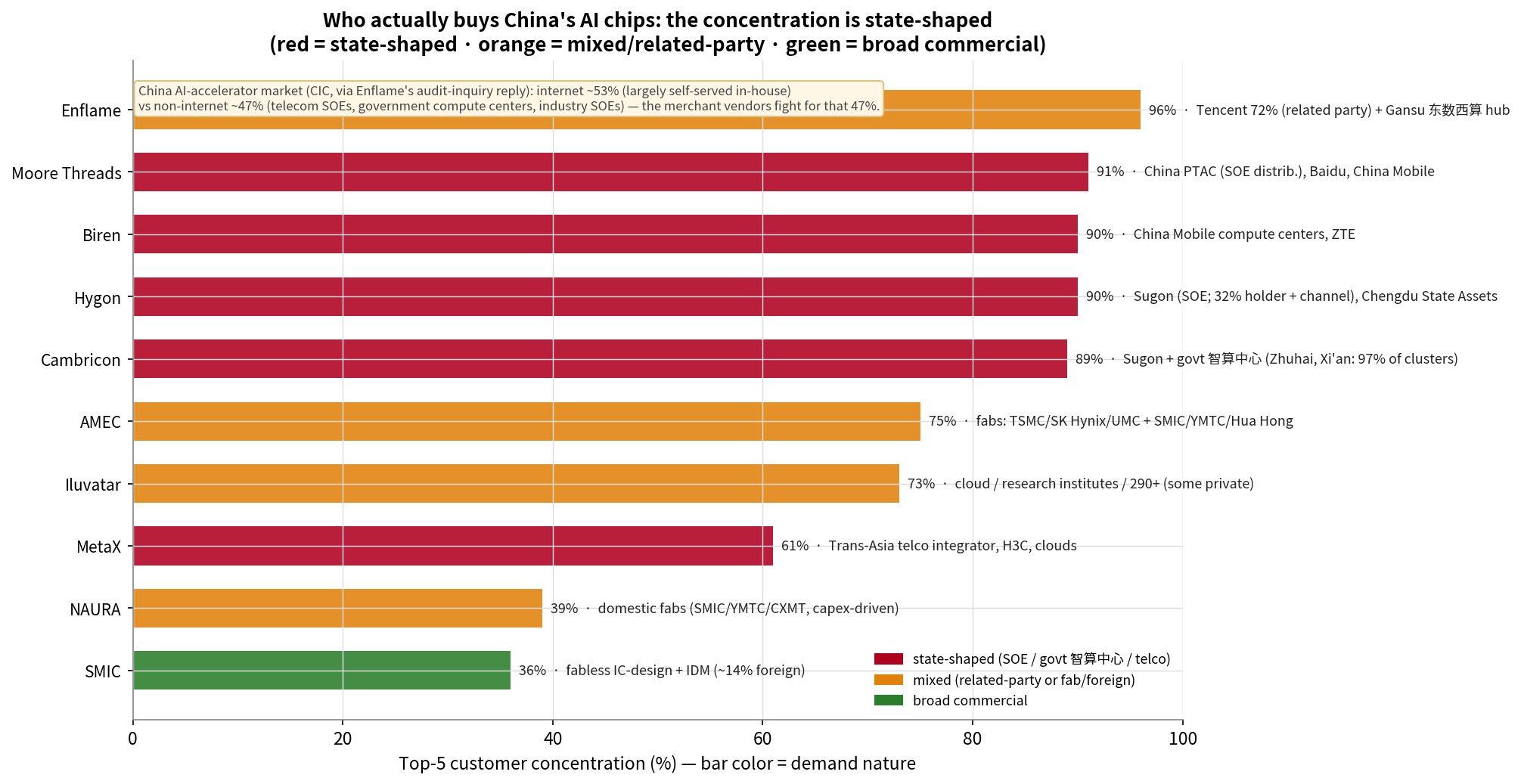
Latest top-five customer share:
Moore Threads: 91.36%.
Hygon: 90.28%.
Cambricon: 88.66%.
AMEC: 75.00%.
MetaX: 61.46%.
NAURA: 39.03%.
SMIC: 35.8%.
High concentration is not unusual for young chip companies. But this degree matters because it tells you what kind of market China is building.
This is not millions of independent buyers pulling a neutral technology through normal market demand.
The follow-up research mapped the anchor buyers behind those percentages.
Moore Threads’ 2023 anchor buyer was China PTAC, an SOE (State Owned Enterprise) distributor, with Baidu and China Mobile also in the orbit. Hygon runs through Sugon, which is both an SOE channel and a shareholder. Cambricon’s historical cloud-card demand runs through Sugon and government AI compute centers in places like Zhuhai Hengqin and Xi’an Fengdong. Biren appears in China Mobile compute centers. MetaX sells through telco-services integrators and H3C-type channels. Enflame is tied to Tencent demand and Gansu’s East-Data-West-Compute hub.
The concrete channels behind “top five customers equal 90%” are telecom SOEs, government 智算中心, public-service compute platforms, SOE distributors, and state-shaped data-center projects.
That is the upgrade from the original finding.
The market is not just concentrated.
It is concentrated because the buyer is often the government.
The research team’s best market split, drawn from Enflame’s own audit-inquiry reply citing CIC data, is that China’s AI-accelerator market is about 53% internet demand and 47% non-internet demand. But the internet side is heavily self-served by ByteDance, Alibaba, and Tencent. The merchant AI-chip vendors fight for the non-internet side: telecom SOEs, government public-service compute, industry SOEs, and project-based policy demand.
So when the state pushes domestic-chip share through carriers, public compute centers, and government procurement, it creates a market for indigenous chips that would not clear the same way in an open price/performance contest against unrestricted NVIDIA.
That does not mean the chips have no commercial value. Compute can be resold through compute leasing. It means the procurement decision is policy-shaped before it is market-shaped.
Demand, capital, and procurement policy are tangled together.
That has two opposite implications.
It makes the market durable while the state wants it to be durable.
It also makes the market fragile if a small number of buyers, projects, or procurement rules change.
That is the strategic shape of Chinese AI industrial policy: more coordinated than a pure market, more brittle than a pure market.
Finding 7: Candor Follows The Filing, Not The Language
The subjective findings are the most interesting.
The companies are not just reporting numbers. They are telling different stories to different audiences.
On the hardware side, Huawei’s Chinese annual report names the U.S. Entity List events and foregrounds Ascend, Kunpeng, open-source ecosystems, and domestic substitution. Huawei’s English annual report treats the same universe mainly as export-control compliance, training, and risk management.
SMIC’s Chinese STAR filing gives the specific Entity List chronology and the U.S. “presumption of denial” policy for items used at 10nm and below. The English Hong Kong filing is more generic: geopolitics, macro conditions, supply-chain risk.
Biren’s Chinese prospectus frames the move to domestic suppliers and in-house alternatives as a long-term benefit. The English version leans more on legal analysis and the conclusion that the Entity List should not have a material impact.
The model-side study validated the same pattern more rigorously.
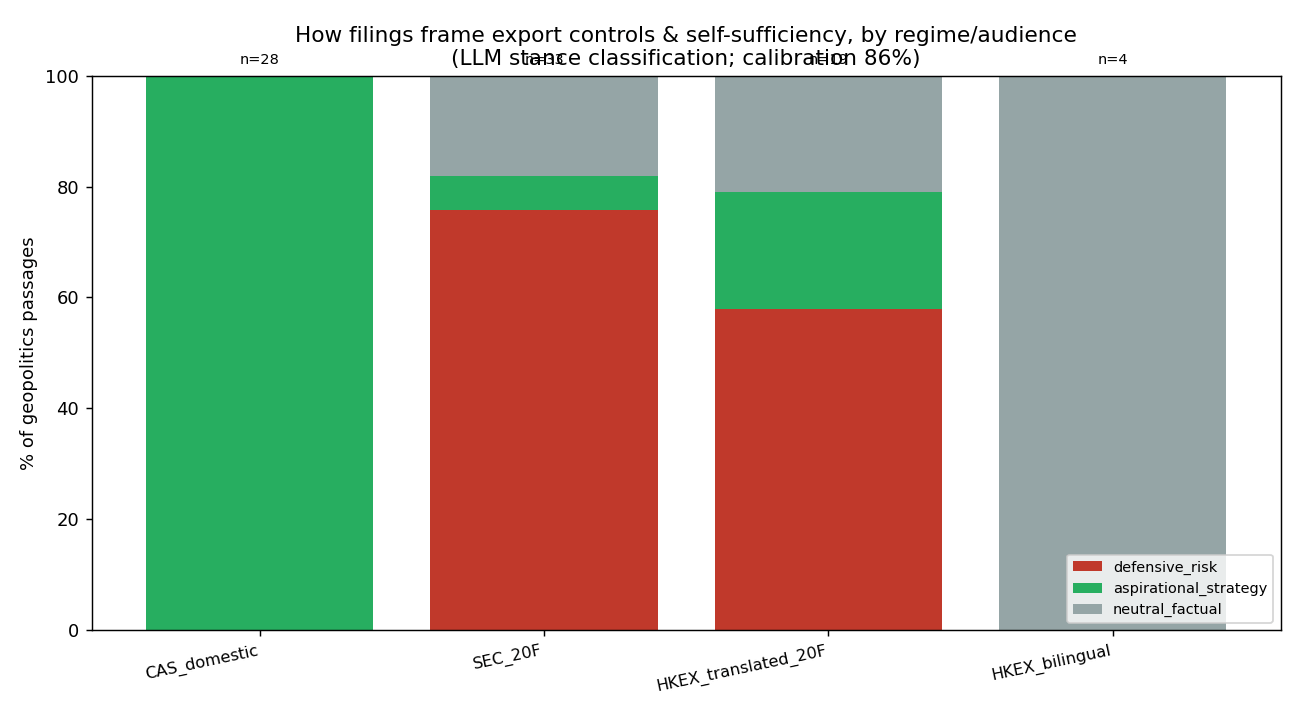
The LLM framing classifier found iFlytek’s domestic CAS passages were 100% aspirational/self-reliance. The U.S.-facing SEC 20-F passages for Alibaba and Baidu were 76% defensive risk. Baidu’s translated 20-F and Tencent’s bilingual report worked as negative controls: same content did not magically flip just because it was Chinese.
That means the signal is not “Chinese words are more aggressive.”
The signal is filing regime and audience.
To the domestic audience, sanctions become proof of endurance. Being cut off becomes the origin story for 自主可控, 国产替代, 信创 (replacing all foreign IT stacks with Chinese equivalents), and domestic compute. To the foreign investor, the same facts become risk factors, legal compliance, export controls, sanctions, and uncertainty.
The Alibaba follow-up makes the rule sharper.
Alibaba’s substantive chip, export-control, and impairment risk lives in the English 20-F. Its Chinese public documents carry mostly results-release and safe-harbor language. A Chinese-only reader of Alibaba’s public Chinese releases would not see Alibaba’s chip fear. The English SEC filing shows it because the SEC regime demands it.
So the honest rule is not “Chinese is more candid.”
It is “mandated filings are more candid about the thing that regulator forces into view.”
iFlytek’s A-share CAS filing forces subsidy notes, R&D capitalization, receivables, and project-risk detail into Chinese. Alibaba’s 20-F forces export-control and impairment risk into English. Tencent stays more euphemistic either way.
This is not uniquely Chinese. Every company tells different stories to different audiences.
But it is strategically useful because the domestic story reveals the mission, while the foreign securities-law story often reveals the liability.
Finding 8: They Tell Us What They Fear
Part 1 was about what hardware China can still build.
Part 2 was about whether the model builders spend like U.S. hyperscalers.
Part 3 adds the more useful targeting question:
What do Chinese AI companies themselves describe as constraints?
The answer is not subtle.
On the hardware side, the follow-up extracted 105 distinct fear-quotes across 11 hardware firms. The recurrence ranking is useful because it separates my outside interpretation from their own disclosures.
Every company cites export controls or Entity List pressure.
Ten of 11 cite customer concentration.
Ten of 11 cite supplier concentration.
Eight cite advanced lithography or process constraints.
Eight cite key materials, spares, or service support.
Eight cite losses or runway.
Eight cite software ecosystem or CUDA-style lock-in.
Seven cite EDA or IP.
Seven cite advanced packaging.
Four cite HBM or advanced memory directly, which is actually under-disclosure relative to importance because many designers buy HBM indirectly through packaging and foundry channels.
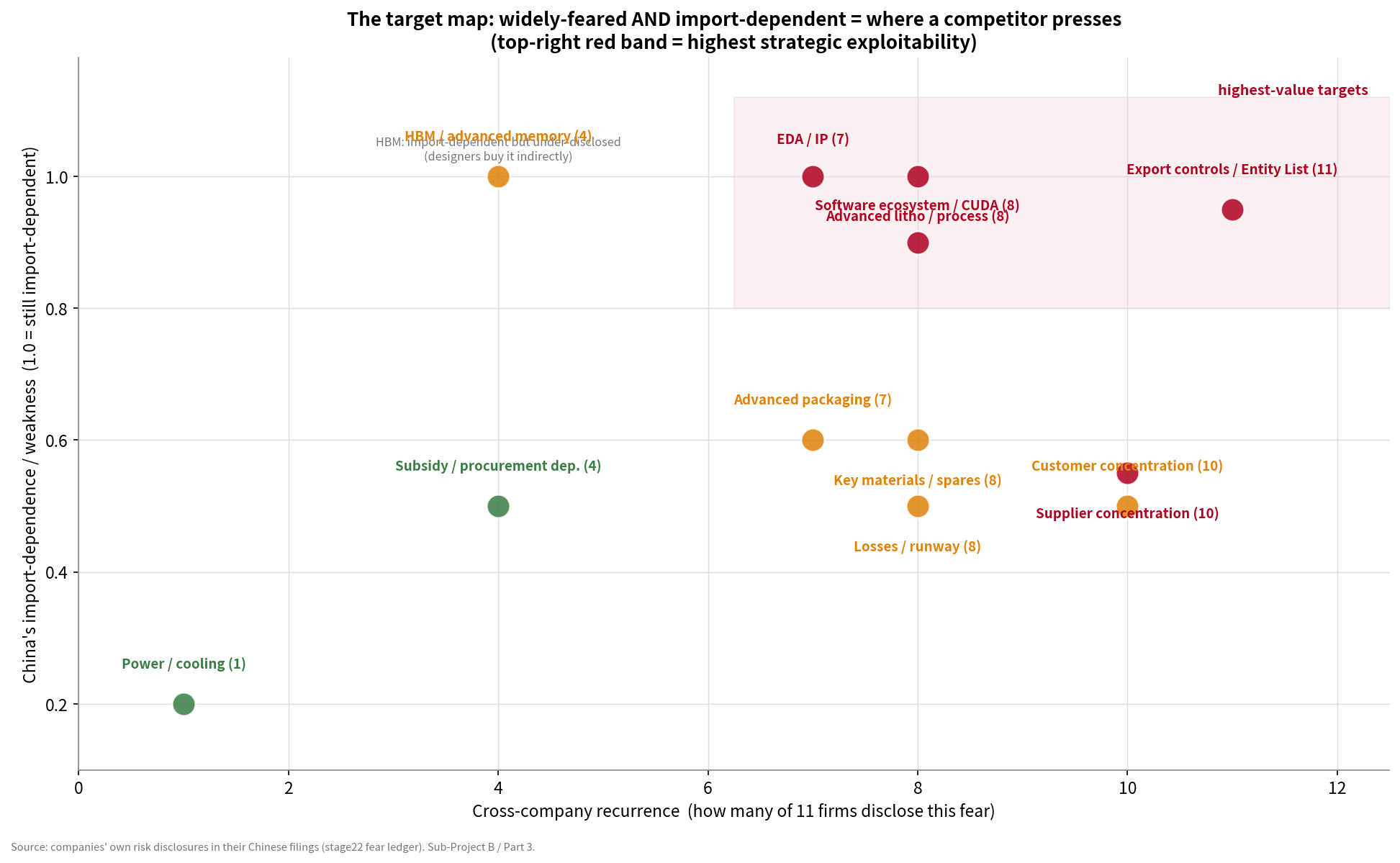
The strategic target map is the important figure. It puts fears on two axes: how many companies disclose the risk and how import-dependent China still is. The top-right is the pressure frontier: widely feared and still foreign-controlled.
That is EDA, advanced lithography/process, software ecosystem lock-in, and HBM.
That is the list I would brief.
There are good quotes behind it.
SMIC describes barriers spanning IP cores, the EDA toolchain, and process technology. Hygon describes ecosystem barriers as a self-reinforcing instruction-set flywheel. MetaX’s flagship GPU introduces HBM3/HBM3e memory technology, which means its strategic part depends on the exact memory layer Part 1 identified as the gate.
The filings do not just say “we are strong.”
They say where strength still depends on someone else.
On the model side, the fears are different.
Baidu says foundation models and generative AI are still early and lack a mature business model. It warns that commercialization failure could impair capitalized assets. It also warns that if it cannot procure enough advanced semiconductor chips due to export controls, it may face capacity constraints, rising costs, and degraded performance.
iFlytek’s domestic story is triumphant, but the operational dependency is visible in Chinese: domestic compute upgrades, single-card performance gaps, ecosystem maturity gaps, project acceptance, public-sector demand, and state support. It is the only firm in the model-side set with a named fully domestic wanka-scale training cluster, Feixing-1, at 95% utilization in 2024. It is also the firm that admits domestic compute still trails on per-card performance and ecosystem maturity.
Alibaba is building its own silicon at scale, with more than 100,000 T-Head cards on public cloud, but it frames the architecture as heterogeneous, not fully domestic frontier training. Baidu uses Kunlun and PaddlePaddle adaptation across 60-plus chip families, while still hedging with domestic and international compute. Tencent mostly says as little as possible and talks about supply-chain diversification without printing “GPU.”
The monetization fears are just as important as the compute fears.
Baidu says there is no mature business model for foundation models and generative AI. Ernie Bot went free in April 2025 as inference costs fell. iFlytek’s MaaS/API revenue grew fast, but on a cost-down, free-API, mid-size-model strategy. Baidu’s AI-native marketing revenue reached RMB 2.7 billion, about US$0.40 billion, up 110%. Alibaba’s AI cloud product revenue grew at triple digits for 11 consecutive quarters. Tencent’s near-term AI profit pool is high-margin advertising, especially Video Accounts and WeChat Search.
Put those together and the strategic map is simple.
The hardware firms fear the physical choke points: memory, lithography, EDA, packaging, materials, and suppliers.
The model firms fear the economics: GPU supply, domestic compute performance, project acceptance, bad receivables, token price compression, unproven monetization, public-sector demand dependence, and regulatory constraints.
If you are a Great Power competitor, that is not just interesting.
That is a target list.
Finding 9: China Is Running A State-Funded GPU Tournament
The Chinese filings also improve the market-structure forecast.
China is not building one NVIDIA-killer.
It is running a state-funded tournament.
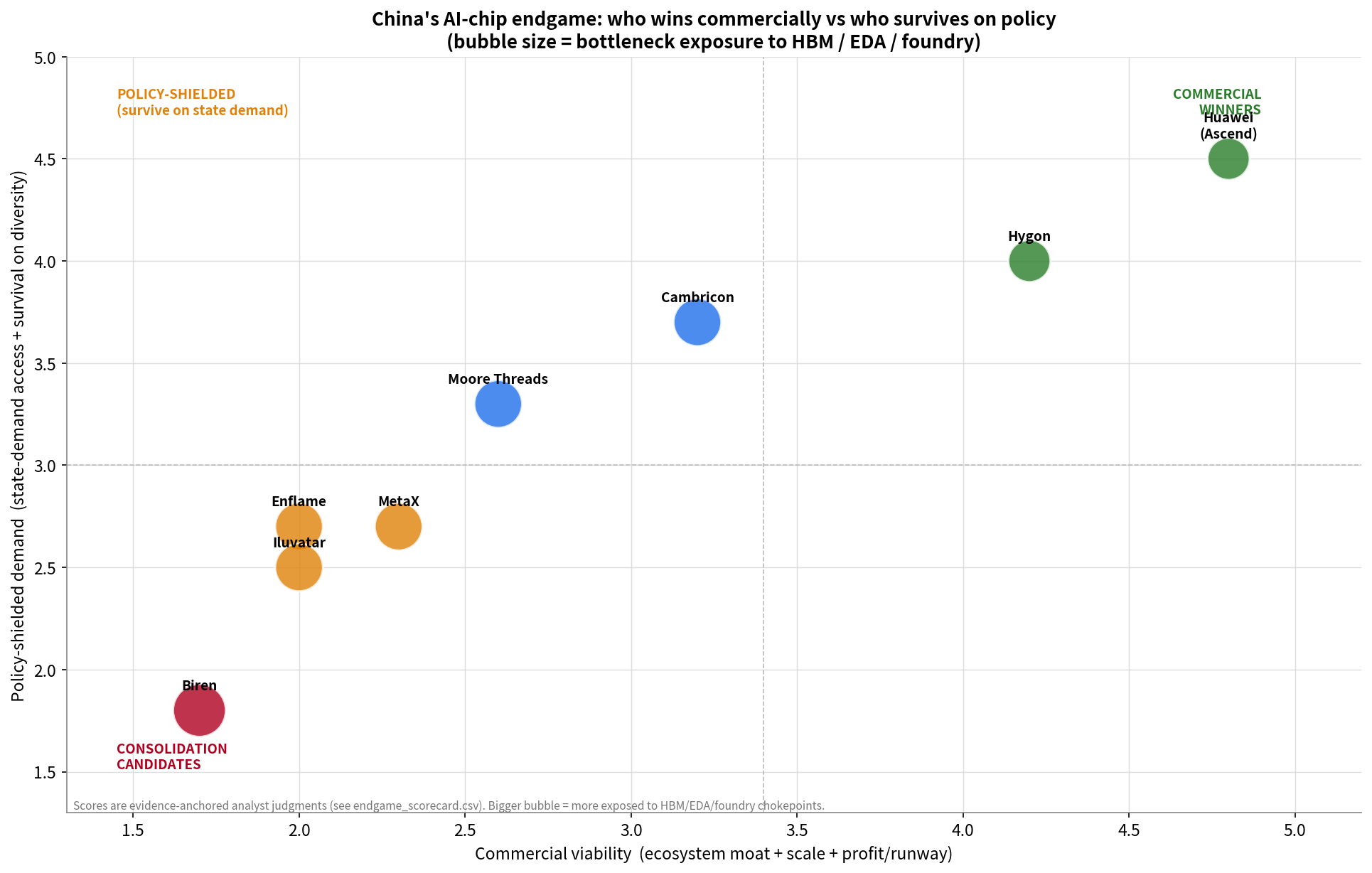
The follow-up scorecard split the AI-chip designers by commercial viability, policy-shielded demand, and bottleneck exposure.
Huawei Ascend and Hygon are the two durable-moat candidates. Huawei has the system position: Ascend partners, developers, CloudMatrix, captive demand, and the ability to coordinate around SMIC and the state-backed stack. Hygon has the unusual CPU-plus-DCU position, a CUDA-like ecosystem, a 6,000-partner organization, and actual profitability.
Cambricon is the policy-backed inflection case. It had the 2025 revenue break, first annual profit, and demand substitution after export controls, but it remains almost entirely domestic and Entity-List-exposed.
Moore Threads, MetaX, and Enflame look more like policy-shielded survivors. They matter because the state wants diversity and bargaining leverage in the domestic GPU ecosystem. They are not yet proof of a broad commercial market clearing on price and performance.
Biren and Iluvatar are more obvious consolidation candidates because their revenue bases are smaller and their exposure to HBM, EDA, foundry access, and Entity List pressure is higher.
The article-level inference is this:
The winner is unlikely to be the company with the best single chip demo.
The winner is the company with the deepest ecosystem, the most reliable domestic compute stack, enough state-shaped demand to survive, and the least fragile path through HBM, EDA, foundry, and software lock-in.
That is why Huawei and Hygon look more strategically important than a long tail of GPU startups, even when the startups have impressive technical claims.
What The Chinese Filings Did Not Prove
The Chinese filings did not prove China has caught up.
They did not prove Huawei can build millions of high-end Ascend accelerators in 2026.
They did not prove Alibaba, Tencent, Baidu, ByteDance, or iFlytek are spending private capital at U.S. hyperscaler scale.
They did not find a clean US$30 billion Huawei fab subsidy inside Huawei. The follow-up work instead found the better explanation: sourceable ecosystem and SASAC-linked pieces, with the remainder likely on local-government balance sheets that do not publish company-style line items.
They did not turn every management claim into fact.
Chinese filings are still filings. They are written by management, lawyers, accountants, and investor-relations teams. They are self-interested documents. They obscure some things. They omit others. They sometimes say less than the English filing because the foreign regulator asks a different question.
SMIC is the reminder. The Chinese filing is richer on CAS/IFRS reconciliation, use-of-proceeds, R&D projects, and domestic risk chronology. The English Hong Kong filing is richer on some financial-risk-note customer concentration and share-based-payment detail.
So the right rule is not “Chinese always says more.”
The right rule is “each filing regime exposes a different surface.”
Read both.
What Would Change My Mind
Four things would move this conclusion.
First, a clean public filing for the remaining US$15-20 billion of shadow-fab construction capex. The follow-up ledger sources roughly US$11-14 billion of the rumored US$30 billion pool and gives a credible local-SASAC explanation for the rest. A hard filing from a Shenzhen, Dongguan, or Qingdao project vehicle would move the claim from “best perimeter hypothesis” to “located capital.”
Second, evidence that visible annual grants and tax benefits are only a small part of a much larger off-statement support system available to the same firms. That could include power subsidies, land, directed procurement, state-backed debt, loan guarantees, government compute purchases, or project receivables that are effectively state financing.
Third, proof that Chinese domestic compute has closed the practical performance and ecosystem gap faster than the filings imply. If domestic accelerators, memory, interconnect, compilers, and software stacks become good enough at scale, the chokepoint map changes.
Fourth, evidence that the model layer monetizes faster than the companies currently admit. A token price war with no proven business model is one world. A profitable vertical AI deployment machine is another.
The first two would say we are still missing money or misclassifying state support.
The second two would say the money matters less than the substitution machine.
I take both possibilities seriously.
What I Now Believe
Part 1 showed that China can keep building AI hardware under constraint.
Part 2 showed that Chinese public model builders are not funding compute at U.S. hyperscaler scale.
Part 3 shows that the English-language record understated how state-shaped, subsidy-dependent, customer-concentrated, filing-regime-dependent, and strategically self-aware the Chinese AI ecosystem is.
The corrected mental model is not “China is blocked.”
It is also not “China has caught up.”
It is this:
The United States has an abundance machine. China has a constraint machine.
The abundance machine throws private capital, cloud cash flow, GPUs, data centers, and power contracts at the frontier.
The constraint machine turns sanctions into procurement rules, domestic-compute mandates, state grants, tax holidays, public AI platforms, local-SASAC fab balance sheets, IPO funding, forced ecosystem building, and a national story about self-reliance.
Both are Great Power systems.
They produce different filings because they produce different companies.
The Chinese filings matter because they show the constraint machine in its own language and its own accounting perimeter. They show where state support enters the accounts, and where it does not because the state kept the balance sheet. They show where customer demand is concentrated and who the buyers are. They show where CAS makes earnings and R&D look different. They show where domestic-facing management teams describe export controls as the pressure that forged self-reliance. They show the bottlenecks the companies themselves still worry about.
That is the leak.
Not one secret number.
The operating model.
The English filings told me China was building under constraint.
The Chinese filings showed me how constraint became the strategy.