
I went hunting for hidden fabs, and the hunt handed me something I didn’t ask for: a target deck. Every coordinate I verified to find China’s AI bottleneck is also a coordinate someone could put in a UAV flight plan. This post is about why publishing that map makes war less likely, not more.
Bottom line up front
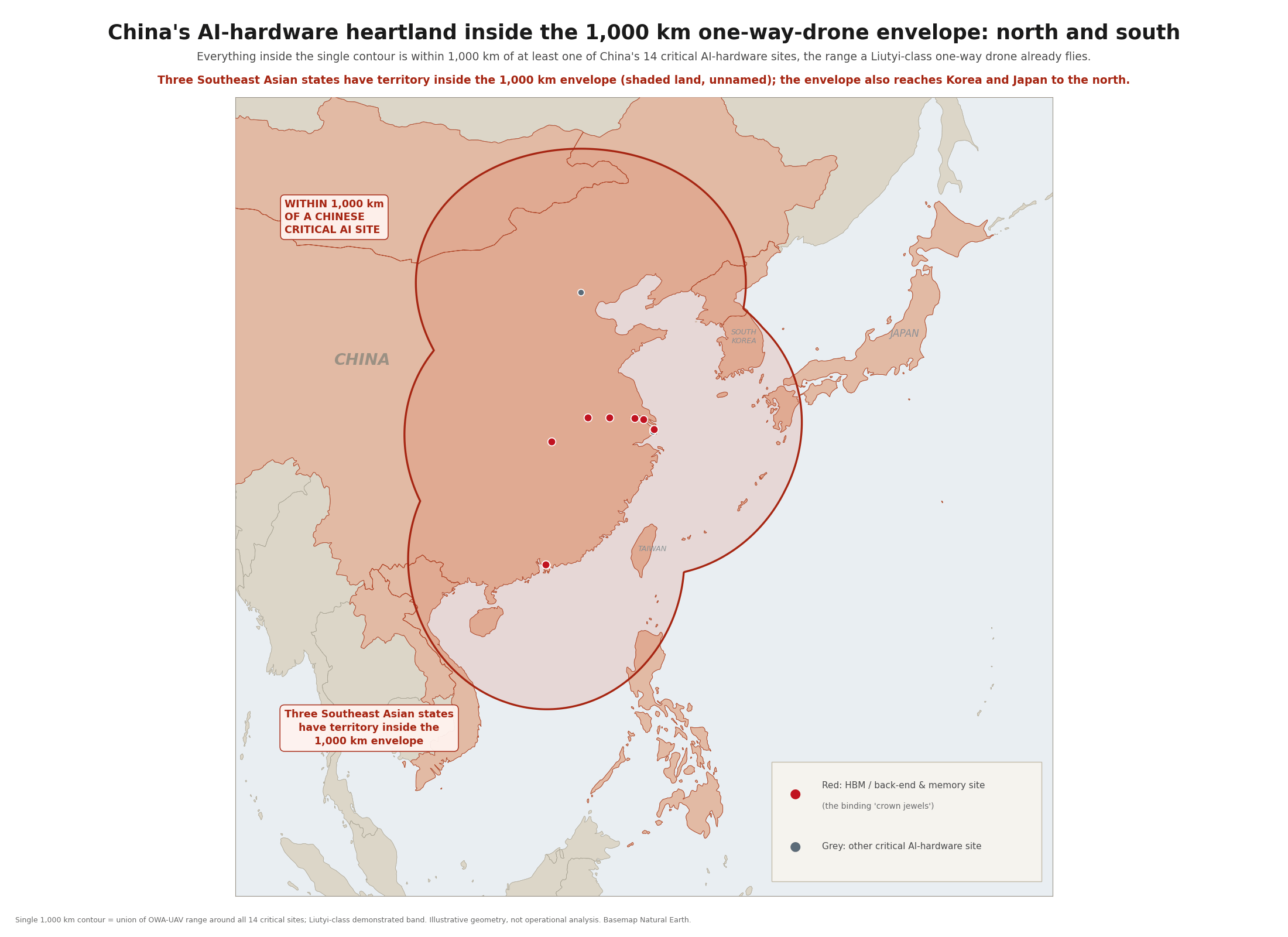
The hunt that mapped China’s AI-hardware bottleneck also, unavoidably, mapped its exposure. Thirteen of China’s fourteen critical AI-hardware facilities sit within 900 kilometers of Taiwan, inside the conservative ~1,000 km band of the one-way attack drones Ukraine mass-produces today for a reported ~$200k each. The binding layer, the HBM (high-bandwidth memory) chain that Part 6 showed caps the entire accelerator ceiling at ~225k 910C-equivalents in 2026 (P10–P90: 192–270k), is a coastal phenomenon, concentrated on the most exposed geography China has. The lone site protected by the tyranny of distance is SMIC-North in Beijing at 1,678 km, sits on the non-binding logic layer: distance protects the one thing China already has in surplus.
Three more findings ride on the map. The data centers everyone worries about are the wrong target. They are the slack layer, overbuilt and rebuildable; the memory chain is not. The seizure fantasy fails: nationalizing the foreign-owned fabs on Chinese soil adds approximately zero AI compute. And the map has a mirror image: drawn from the other direction, the same rings cover Hsinchu, Tainan, and the Korean memory plants. Both sides’ AI hardware is hostage to the same war.
That symmetry is the argument. I publish this to point out the rising price of a war over Taiwan, not to plan one.
Every claim here is time-boxed: imagery claims are stamped to the collection date of the frame, document claims to the filing date, and “as of June 2026” is the series freshness stamp. A built shell is not an operating fab. Where I project, I label the projection and its confidence.
The map I didn’t set out to draw
This series began as an accounting question and became a physical atlas: 59 fabs cataloged, 14 graded critical, every coordinate polygon-verified, the build state of the important ones confirmed on commercial sub-meter imagery (Part 4 walks the method). Criticality, remember, means position on the binding layer, not size: the narrowest link in China’s AI hardware is the HBM stacking back-end, so a modest packaging plant in Pudong outranks a famous gigafab (Part 6 owns that arithmetic).
Here is the thing about a verified atlas of an adversary’s limiting factor: it is an exposure map whether you intend it or not. Any facility precise enough to analyze is precise enough to hold at risk. The coordinates are public method; the weapon ranges have always been public speculation until Ukraine started using UAVs at distance. The only real choice is whether the exposure gets discussed soberly, in the open, with its limits stated, or only in classified facilities with access to real intelligence assessments of weapons capabilities. The former is deterrence.
So I drew the rings. Carefully.
Two wars, one lesson
Two recent wars frame what the map means. The 2025–26 Iran war showed strategic effect can come from striking a handful of vital industrial sites, not from trading blows attrition-for-attrition. Ukraine demonstrates the means at commodity prices: mass-produced one-way attack drones (OWA-UAVs, cheap propeller-driven strike drones flown one way into the target) at a reported ~$200k each (Liutyi-class unit costs), demonstrated to roughly 800–1,000 km in 2024–25 combat. These are not exotic capabilities. And the escalation path is fast: in roughly three and a half years from invasion, Ukraine also fielded a 1,000+ km-class land-attack cruise missile: the FP-5, in serial production from August 2025, its 3,000 km figure still a maker claim, its existence not.
The deterrence-relevant reading is not “Taiwan should copy Ukraine.” It is narrower: a weaker belligerent, under attack, demonstrably built deep-strike capability in thousands of cheap airframes within a few years. In the case of Iran, they proved they could launch in sufficient quantity that they could overcome integrated air defense systems. That is now the planning floor on both sides of the strait. The map answers what sits inside its reach.
Walking the map
China’s 14 critical AI-hardware facilities (color-coded by binding layer) against public-spec weapon-range geometry: inverse range rings for the Ukrainian-style ~1,000 km OWA-UAV class (Liutyi-class demonstrated envelope; reported longer-range types flagged †) and the ~1,600 km Tomahawk Block IV/V, plus illustrative launch geographies (Taiwan, the Ryukyus, northern Luzon, and three open-ocean naval boxes). Ranges are published or manufacturer-reported specifications (sources: CSIS Missile Threat, Militarnyi, manufacturer claims; reported-only figures flagged †). Illustrative geometry, not operational analysis: no aimpoints, no facility-internal detail; air defenses, hardening, and dispersal are not modeled. HuaweiFabHunt, June 2026.
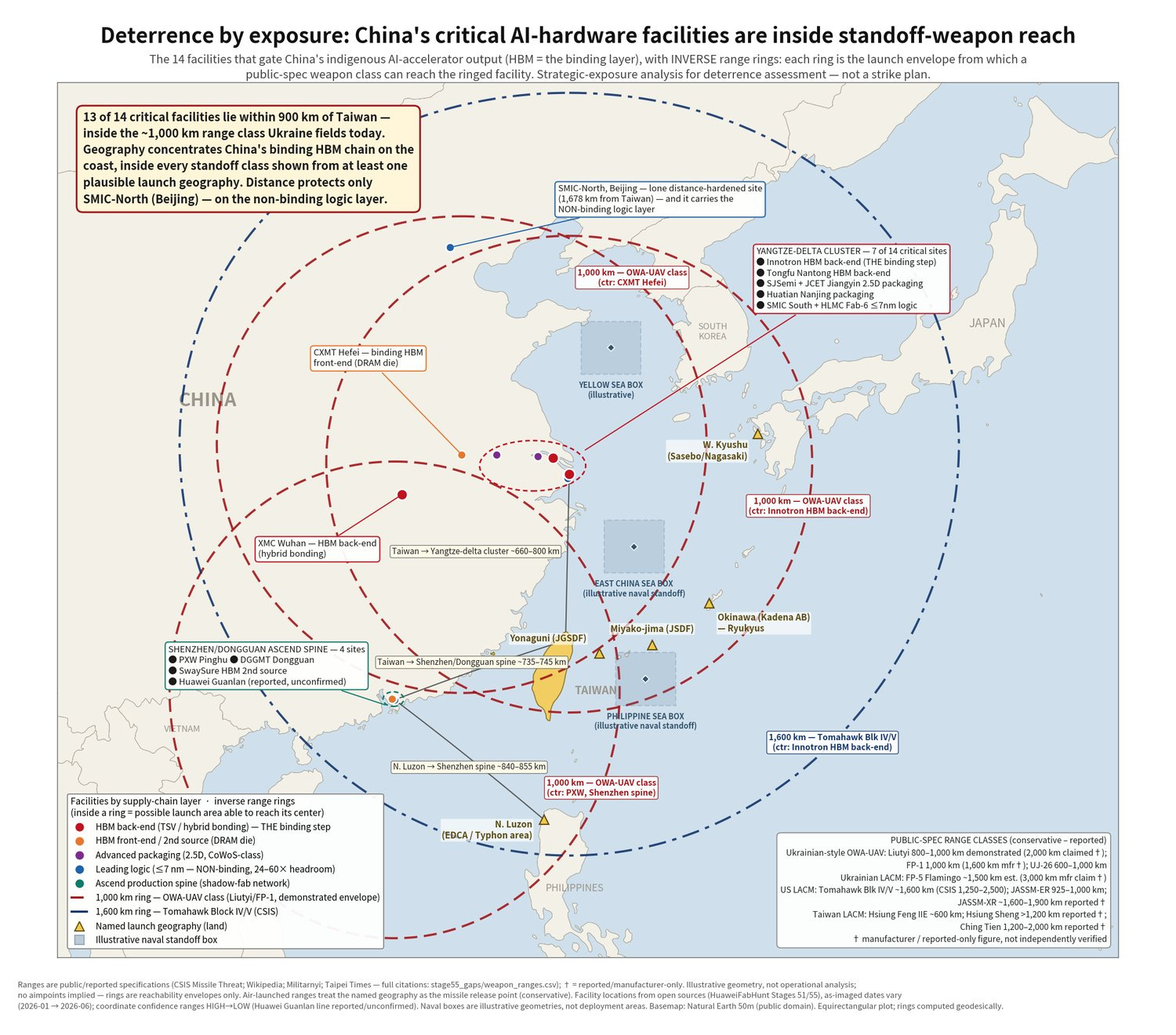
The method is the credibility, so here it is. Every distance here is a geodesic from a verified facility coordinate to a region-level launch geography: the northern tip of Taiwan, a Ryukyu garrison island, an illustrative naval box reduced to a single point. No aimpoints, no approach routes, no facility-internal detail. Conservative and reported ranges stay separate; air-launched missiles count the stated geography as the release point, understating real reach by the aircraft’s combat radius. Everything reruns from two CSVs: a 10-system range table and a 14×12 distance matrix. Public coordinates, public specs, high-school spherical trigonometry. I did this without access to any classified information or planning tools. Anyone can bound this problem, which is precisely why pretending it doesn’t exist protects no one.
The Yangtze delta is the heart of the exposure. The binding HBM chain (Innotron’s stacking back-end in Pudong, the Jiangsu packaging and OSAT belt, SMIC South’s compute-die line) sits roughly 660–800 km from Taiwan (Innotron itself: 660.1 km from Cape Fugui). Watch the baseline, because this is where careless analysis goes wrong: the scarier-sounding 410–555 km figures are distances from an illustrative East China Sea naval box, not from Taiwan. From that seaward standoff geometry the delta cluster sits inside even conservative JASSM-ER range (~925 km) and far inside Tomahawk’s ~1,600 km; from the Philippine Sea box east of the island chain (920–1,045 km) it is Tomahawk-reachable, and the band straddles the conservative JASSM-ER edge (~925–1,000 km): the two nearest sites sit just inside it, the rest beyond. Two baselines, two stories. Never mix them.
The Shenzhen/Dongguan spine is the southern mirror. The shadow-fab cluster this series found (PXW, DGGMT, SwaySure) sits 735–745 km from Taiwan and ~850 km (841–853) from northern Luzon, inside both the OWA-UAV class and conservative JASSM-ER from either geography; the naval boxes are another story: Tomahawk-only from the East China Sea box (~1,225 km), and beyond every conservative band on the table from the Yellow Sea (~1,732 km). Even the “inland” hedges don’t escape: CXMT Hefei at 863 km and XMC Wuhan at 900 km still fall inside the conservative ~1,000 km drone band.
Add it up and 13 of the 14 critical facilities lie within 900 km of Taiwan. The exception, SMIC-North in Beijing at 1,678 km, is genuinely distance-hardened against everything but the reported-only † bands. And it sits on the non-binding logic layer, where Part 6 found 24–60× headroom. (It is also 743 km from the Yellow Sea box, so even “hardened” is Tomahawk-relative, not absolute.) Geography concentrated China’s scarcest input on its most exposed coast, for ordinary reasons (talent, ports, supply chains), and left distance protecting the layer that doesn’t need protecting.
One sentence on fragility, and only one, because the point is general industry knowledge and the specifics belong to no one’s blog: a semiconductor fab depends on continuous ultrapure water, clean uninterrupted power, and vibration-free operation, and even a near-miss power interruption can scrap the wafers in process (months of output) without a round landing on the cleanroom.
The wrong target
Here is where most strike-map talk goes wrong: it points at the data centers. The instinct is understandable: the halls are huge, new, and photogenic. It is also backwards. Data centers are the slack layer of China’s AI buildout, not the binding one. China builds AI data-center capacity roughly 15–30× faster than it can fill it with chips; buildings, power, and cooling are all in surplus, and at Gui’an the disclosed substation build runs years ahead of the chips available to plug into it (Part 7 walks the empty halls; the supply-side ceiling and that demand-side evidence corroborate each other: the data-center study consumed this project’s ceiling as an input, and everything it could observe independently came back consistent with it). A data hall is concrete, commodity racks, and switchgear; a destroyed one is a construction project measured in months, and China demonstrably executes those faster than anyone.
The HBM chain is the opposite object. It is a handful of buildings, filled with export-controlled tools China can no longer buy (Part 6 walks the bonder chokepoint), running a yield-fragile process China has not yet mastered at volume. Destroyed capacity on that layer is not rebuilt in a year. On this project’s numbers it is the better part of a decade, which is the entire reason Part 8’s clock runs to ~2033. The range rings matter precisely because of what sits inside them: not the server halls, which are replaceable, but the one industrial chain that is not.
Wrong target, in one antithesis: the halls are where the chips would go. The memory line is why they aren’t there.
The seizure fantasy, compressed
The other war-game move that always comes up: can’t Beijing just seize TSMC Nanjing, Samsung Xi’an, and SK Hynix Wuxi, the foreign-owned fabs already on Chinese soil? I modeled exactly that, fab by fab, and the answer is no: nationalization adds approximately zero AI compute (the S0→S1 delta is ~0; AC-04), because none of the seven foreign-owned fabs in China runs an HBM line or holds an EUV tool. The most advanced logic on the list is TSMC Nanjing’s 16nm, and what seizure actually buys is a decaying one-time injection of commodity memory as foreign tools, spares, and recipes are cut off within months. The binding layer is HBM. Seizure delivers none of it, and forfeits China’s remaining foreign tool flow in the bargain. The full seven-fab workup (capacity, tool dependencies, decay curves, blowback) is in the facility appendix; Part 6 carries the capacity logic.
A vulnerability you cannot buy, build quickly, or steal is the definition of strategic exposure. That is what the amber dots on the map are.
The glass house
Now turn the map around, because the honest version of this analysis does not end with China exposed and everyone else safe. The mirror image is public record, not a finding of this project: TSMC’s leading-edge logic, the silicon under essentially every Western frontier AI model, is concentrated in a handful of campuses on Taiwan itself, an island 130 km from the mainland at the strait’s narrowest point. The world’s HBM is stacked almost entirely in South Korea, by exactly two companies (SK Hynix and Samsung), with most of the remainder bonded in Taiwan and Japan. Draw the same rings from the other direction (and that direction needs no $200k drones; the mainland’s missile inventory and its published ranges are not in dispute) and the entire allied AI-hardware stack sits inside them, at comparable or shorter distances than anything on my map.
Both sides’ AI ambitions live in the same glass house. Neither side’s AI accelerator supply survives a Taiwan war intact: China loses the HBM chain it cannot rebuild for the better part of a decade; the West loses the logic and memory base it has no near-term substitute for. That symmetry is not a flaw in the deterrence argument. It is the deterrence argument. Mutual exposure of the thing both great powers have decided they cannot do without is as close as this domain gets to a stabilizing fact, but only if it is legible. An exposure nobody has quantified deters nobody.
What this map is for
So, stated plainly. A protracted shutdown of the HBM chain would not dent China’s AI program at the margin; it would set domestic AI-hardware output back years, because that chain is the ceiling. And the means to hold it at risk costs drones, not battalions. The same sentence, nouns swapped, is true of the other side of the strait. The point of publishing the geometry is to make the cost of the war plain enough, to both audiences, that the war stays hypothetical. Exposure that is legible raises the price of starting something; exposure that is denied just waits to be discovered mid-war. Better priced in now.
This is also why the non-kinetic lever matters more than this map does: the export controls that built the ceiling in the first place are the instrument that works without a shot. What worked, what leaked, and what to watch: that scorecard is coming in Part 10.
Honest limits
Every range here is a published or manufacturer-reported specification, not a measured capability. The reported-only figures (FP-1’s ~1,600 km, JASSM-XR’s ~1,900 km, Ching Tien’s 1,200–2,000 km, the FP-5’s ~3,000 km maker claim) are flagged † throughout; the well-evidenced anchors are Tomahawk (~1,600 km), JASSM-ER (~925–1,000 km), and the Liutyi class (~800–1,000 km demonstrated in combat). The geometry is illustrative great-circle distance from region-level launch areas, not a strike solution. And the map models none of the things that would decide an actual campaign: integrated air defenses, hardening, redundancy, dispersal, and reconstitution all exist on both sides of this analysis and all cut against the simple picture a range ring paints. What the map shows is exposure, not outcome. And exposure alone is reason enough for everyone involved to prefer that the question never be tested.
Receipts
Load-bearing claims in this piece are on my substack
13 of 14 critical facilities within 900 km of Taiwan; CXMT Hefei 863 km, XMC Wuhan 900 km; SMIC-North 1,678 km, non-binding layer: geodesic distances from verified facility coordinates (
critical_facilities.csv) to region-level geographies; rerunnable from the CSVs.Baseline hygiene: Yangtze delta = 660–800 km from Taiwan; 410–555 km is the East China Sea naval-box figure: never mixed; Innotron 660.1 / 407.3 km respectively.
Weapon ranges, conservative/reported, sourced and flagged: CSIS Missile Threat, Militarnyi, Wikipedia-aggregated manufacturer figures; † = reported-only; the ~3.5-years-to-field point attaches to the FP-5 LACM class (invasion Feb-2022 → serial production Aug-2025), not the OWA-UAVs; full source URLs and dates in
weapon_ranges.csv.Seizure adds ~0 AI compute (S0→S1 ≈ 0): AC-04 (high confidence) + the seven-fab nationalization model (
foreign_fab_nationalization.csv); detail in the facility appendix and Part 6.Data centers = the slack layer (15–30× build-vs-fill; Gui’an power-vs-chips): Part 7’s claims, restated here with attribution; convergence phrasing per the series’ standing rule.
The glass-house mirror (TSMC/Korea concentration): public record, cited as context, not a finding of this project.
What would change this assessment (as of June 2026, none has fired): (1) verified inland duplication of the HBM stacking back-end, meaning a second, distance-hardened site reaching volume; (2) observed dispersal or hardening of the binding-layer facilities (new construction at interior sites tied to the named operators); (3) weapon-range revisions that move the conservative bands materially (e.g., the OWA-UAV class demonstrating sub-800 km only, or the † figures being confirmed); (4) the binding layer itself moving: if Part 6’s HBM constraint breaks, this map’s amber dots stop being the story.
Every distance is computed, not asserted; every range is public spec; imagery claims are stamped to collection dates. Map and underlying imagery credits: Natural Earth basemap; facility imagery © Maxar/Vantor, SkyFi, Esri as credited per frame. Deterrence-framed throughout: no aimpoints, no facility-internal vulnerability detail, defenses and hardening not modeled.