
Something I learned years ago as a wee wittle hacker was that you do something once, and then you automate it. What I came to articulate as a more wizened CEO is that it’s the automation which creates the speed and scale required to operate in the cyber domain. This is the story of the bear hunt for Huawei’s shadow fab. The method, the misses, and why the misses improved the confidence in the assessment. Later articles in the series apply the hunt at a China-wide scale.
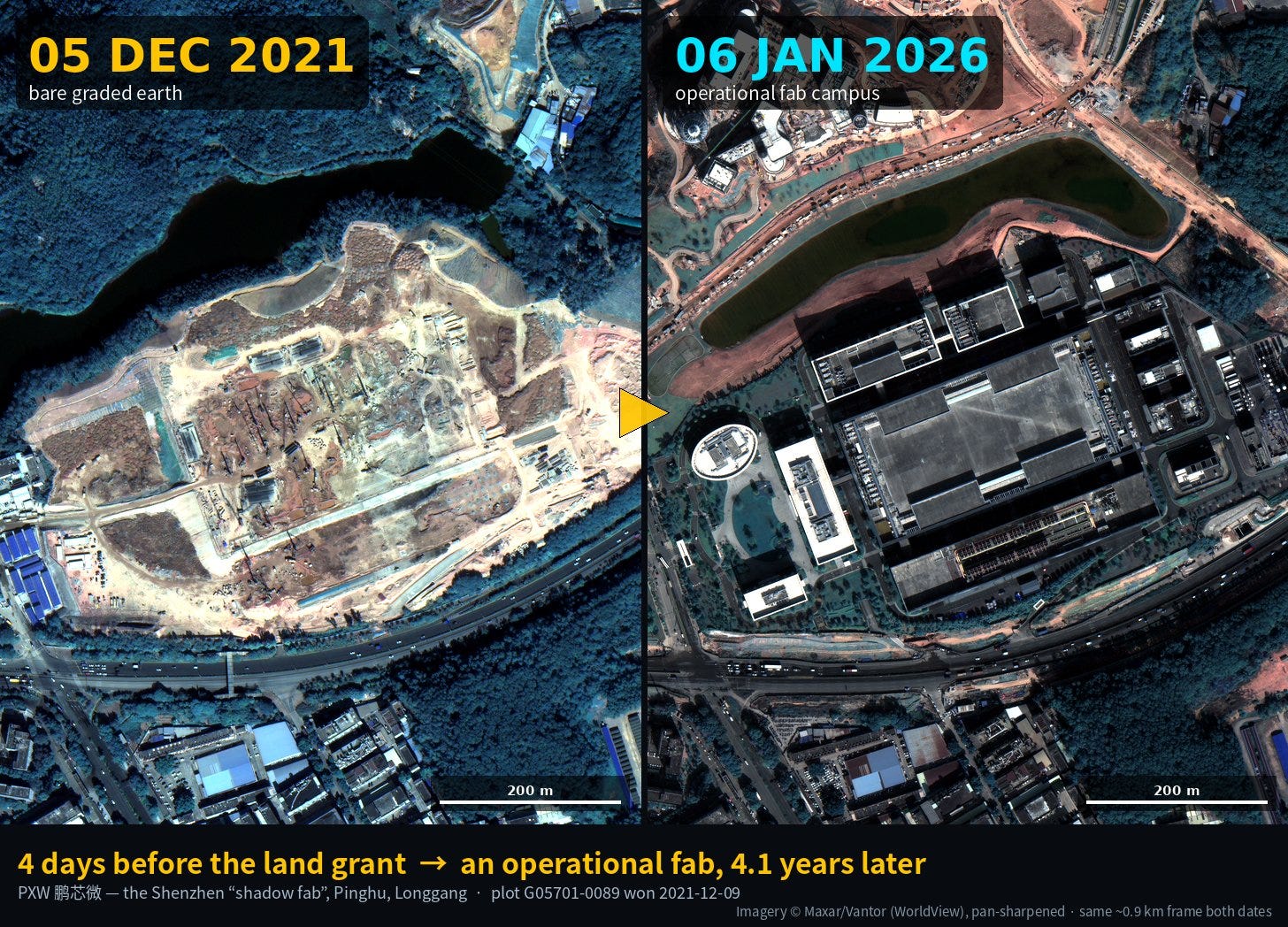
How to read it: same ~0.9 km box, two dates. Left: bare graded earth, 2021-12-05, four days before PXW formally won the plot. Right: an operational fab campus, 2026-01-06. What to see: a fab that appears on nobody’s balance sheet, built in ~4.1 years, timed by satellite. Imagery © Maxar/Vantor (WorldView).
Results up front
This series rests on a map of China’s AI-hardware build: who is making the chips, where, and with whose money. Before you trust any conclusion drawn from that map, you should ask how the map was made. This post is the answer. The rest of the series tells you what the map says.
The hunt started with a number that shouldn’t exist: roughly US$15–20 billion of chip-fab spending around Huawei that appears on nobody’s audited balance sheet. Not Huawei’s. Not any listed company’s. The money was real (the fabs kept getting photographed), but the paper trail had been scattered. Deliberately, as far as I can tell. Whose money it turned out to be is Part 5’s story.
What this post delivers is the method that turned a rumor into a census: 59 fabs in the facility atlas, 59 chip designers, 14 facilities graded critical, a claims ledger (published on my substack) of 17 load-bearing claims with 0 refuted after adversarial review, and 122 claims traced end-to-end in the write-up (109 clean, 10 imprecise, 3 contradictions, all fixed before publication). The method is nine boring databases, one pivot trick, and a discipline of publishing my own mistakes. The mistakes are in here too: a viral skybridge that never existed, a bike-share dock impersonating a chip plant, and two satellite frames I paid for that photographed the wrong thing.
One convention before we start, because it governs everything: every claim here is time-boxed. Imagery claims are stamped to the collection date of the frame; document claims to the filing date; “as of June 2026” is the series freshness stamp. A built shell is not an operating fab. Where I project, I label the projection and its confidence.
The eureka came from reading in the wrong language
English coverage of Huawei’s “shadow fabs” is a hall of mirrors: aggregators quoting aggregators, three different companies blurred into one campus. But Chinese-language sources don’t blur. A financial filing names a subsidiary. A municipal environmental-impact assessment (EIA, the permitting document a polluting facility must file) names a street address. A land-grant notice names a plot number.
The moment I started cross-reading Chinese financial filings against local-government paperwork, entities that English sources had conflated snapped apart into distinct companies on distinct plots. And entities nobody had connected snapped together.
The insight is not that China hides everything. It is that China discloses locally what it obscures nationally. And almost nobody reads the local paperwork. If it wasn’t 0945 I would be toasting the Chinese bureaucrats with my last bottle of Moutai.
Nine modalities and the pivot engine
So I automated it, the process not the Moutai drinking. Nine analysis modalities, each a different lens on the same physical fab: financial filings, government filings, satellite imagery, supplier and equipment evidence, trade and customs data, corporate registries, subsidy funds, technical teardowns, and the trade press (leads only, never primary). The figure carries the detail.
How to read it: each node is an evidence mode; each edge is a documented pivot where one mode unlocked another. What to see: no single mode finds a hidden fab. The intersection does. HuaweiFabHunt Stage-56 method graphic, June 2026.
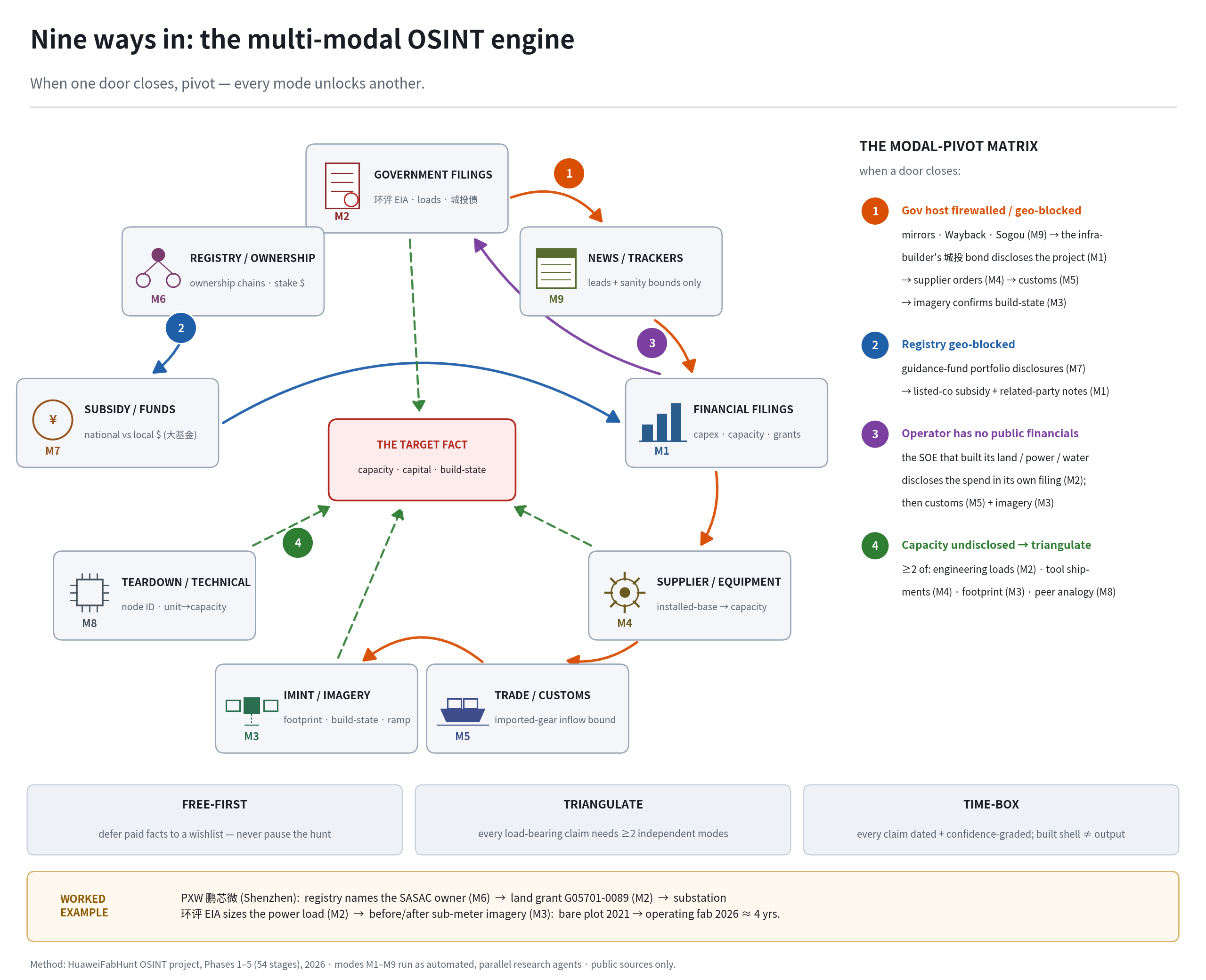
The engine of the method isn’t any single mode. It’s the pivot. China’s disclosure regime is selectively opaque: the closer a facility sits to Huawei, the darker its paperwork. But when one mode is blocked, another unlocks it. The fab didn’t build its own substation or water plant; a municipal infrastructure builder did, and that builder’s bonds, tenders, and grid announcements must say what the money built. Engineering loads imply capacity. Capacity implies tool orders, which surface in suppliers’ customer disclosures. Tools imply imports, which surface in customs data. And everything implies concrete and steel, which satellites see for free (until I paid for sub-meter imagery).
A facility that is invisible in every individual mode is pinned down by the intersection.
Here is the infrastructure pivot working on the hardest case. The Dongguan fab campus known as DGGMT sits behind a firewalled provincial environmental portal, and its operator publishes no financials. Dead end? No. The grid spoke instead. A dedicated 110 kV substation named 智造一 (3×63 MVA, 189 MVA total, indoor gas-insulated switchgear) was publicly reported energized on 2024-12-04, built explicitly “to supply a semiconductor high-end manufacturing project.” The upstream 220 kV feeder energized 2026-01-04. Two dated grid events, from power-industry announcements, that size the fab’s electrical appetite and bracket its ramp window, for a facility whose own paperwork is dark. The fab said nothing. Its electricity bill talked.
That is the whole method in one anecdote. Opaque target, garrulous neighbors.
Proof it works: PXW, walked end to end
The cleanest demonstration is PXW (鹏芯微), the shadow logic fab in Pinghu, Shenzhen. Four modes, one verdict.
Registry. The corporate registry showed a new chip company run by an ex-Huawei executive, owned not by Huawei but by a Shenzhen municipal state investment vehicle. The U.S. Commerce Department’s Bureau of Industry and Security (BIS) later put PXW on the Entity List (2022-12-19) and designated it Huawei-affiliated under Footnote 5 (2024-12-05). Personnel and sanctions said Huawei; equity said the city. Hold that thought for Part 5.
Land. A land-grant record showed PXW winning plot G05701-0089: 346,500 m² of permitted building, with a 3,840 m² substation carve-out. That carve-out is the tell. Office parks don’t reserve a city block for a grid connection. Fabs do.
Power. A substation filing then anchored the feed, the same infrastructure pivot as Dongguan. Paper now said, loudly: a real fab should exist on this exact plot.
Pixels. Commercial imagery closed the loop. It’s the image at the top of this post. The before-frame, 2021-12-05, shows bare graded earth, collected four days before PXW formally won the plot. The after-frame, 2026-01-06, shows a complete, operational fab campus: main cleanroom hall, wings, east utility yard, south cooling banks. Greenfield to operational in about 4.1 years. That build clock became my calibration anchor for projecting every other construction site in the atlas.
How to read it: numbered callouts on the 2026-01-06 frame: cleanroom hall, utility yard, cooling, the substation parcel. What to see: every annotation is an analyst inference, labeled as such, on a dated frame. Imagery © Maxar/Vantor WorldView (pan-sharpened, ~0.54 m/px), as imaged 2026-01-06. Authors note: the pins are a little off in this imagery, I haven’t yet figured out a reliable/repeatable/automateable process to place pins without a ton of hand editing.
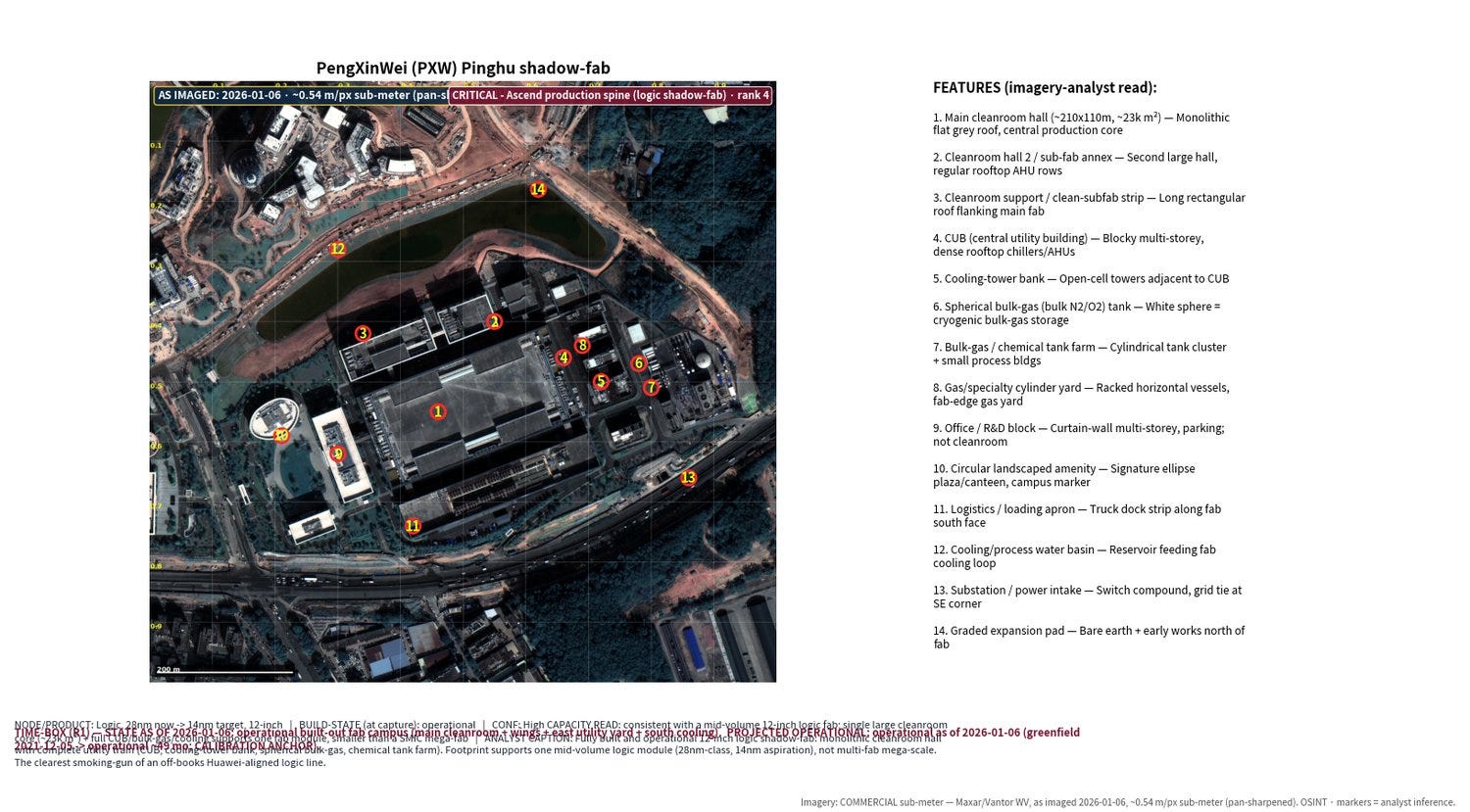
No single source proves it. Four together do. That is not a slogan. It is the acceptance test every facility in the atlas had to pass: triangulation across at least two independent modes, graded for confidence, before a row got written.
The mechanics, for the engineers
Three pieces of plumbing do a surprising share of the work.
Polygon verification beats point pins. OpenStreetMap will happily serve you a point named after a company. And a point is just a claim someone typed. The Overpass API lets you query for ways instead: closed polygons tagged as industrial land or buildings, with names, that you can overlay on imagery and cross-check against a registered address. A named polygon that matches a fab-shaped roofline and reverse-geocodes to the company’s registered street address is evidence. A bare point is a rumor with coordinates. Every coordinate in the final atlas carries a grade from this chain (pin → polygon → address → visual). Anything that failed a step is marked down to area-level or left blank, on the record. And nothing below polygon-verified got money spent on it.
Chinese coordinates lie to you by law. Chinese web maps are required to use GCJ-02, a deliberately distorted coordinate datum that offsets true WGS-84 positions (WGS-84 = the global GPS datum satellites task against) by a few hundred meters, varying non-linearly with location. Copy a pin from a Chinese map service into a satellite tasking order without converting and your expensive frame is centered on the building next door, or the lake. The pipeline converts everything to WGS-84 at ingestion and treats any unconverted Chinese-sourced coordinate as radioactive.
Radiation EIAs are a geolocation gift. A fab’s ion implanters and X-ray tools are licensed radiation sources in China, so the operator files a radiation-safety EIA with the local ecology bureau, typically naming the legal entity and its street address. These filings are mundane, public, and devastatingly precise. It was primary-source radiation EIAs that placed SiCarrier’s facility in Pinghu (平龙西路753号) and SwaySure’s memory fab at Xiangshan Sci-Tech Park in Longhua: kilometers apart, in different districts. Which mattered, because the internet had welded them together.
The failures are the credibility engine
A method you can trust is one that catches its own mistakes, so here are mine, with what each one hardened into a rule.
The skybridge that wasn’t. A widely circulated claim had a 70-meter skybridge linking SiCarrier’s halls to a Huawei loading dock in Guanlan: covert integration you could photograph. I chased it. I bought imagery near it. And the primary sources unwound the whole thing: the claim traces to an aggregator, not the Financial Times piece it pretended to quote (the FT said “wafer bridges” on Huawei’s own plot; SemiAnalysis’s “wafer bridge” referred to SMIC). The radiation EIAs above put the actual facilities kilometers apart, and the imaged west-Guanlan campus (as imaged 2026-01-25 at 0.35 m) is office and R&D blocks. No fab. No skybridge. Rule: aggregator claims are leads, never sources; trace every viral detail to its primary document before spending a dollar on it.
The bike-share dock named 通富微电. Hunting Tongfu Microelectronics’ advanced-packaging base in Nantong, I trusted an OpenStreetMap point bearing the company’s name. It was a bike-share dock at a logistics-park corner, about 600 m from the real plant. A dock, with bicycles. I have sub-meter overhead imagery of bicycles now. The genuine Suxitong-park base was subsequently pinned free of charge: EIA siting anchors matched the visible road grid and neighbors exactly (31.8530, 120.9788; med-high confidence, June-2026 triangulation). Rule: polygon-verify, never point-trust. I will not be out-geolocated by a bicycle rack twice.
The two frames that missed. Two purchased satellite frames photographed the wrong thing entirely, and both failures share a cause: I had accepted an area-level pin instead of verifying the building polygon first. One frame (collected 2025-01-29), tasked on my cataloged coordinate for SMIC’s Tianjin site, came back showing farmland and solar panels. The real fab sat ~18 km southeast, found afterward, for free, by the polygon-address-visual chain above. The other (collected 2025-04-08), tasked near a city-centroid pin for Tongfu, imaged the old-city lake core. Scenic. Useless. Meanwhile every frame tasked on a polygon-verified coordinate hit its target. Rule: the pin-verification standard applies before procurement, not after.
And one miss that wasn’t. A Wuhan frame (imaged 2026-02-22) I had written off as off-target turned out to contain the fab after all: an operating 12-inch campus sitting at the frame’s eastern center. The first analysis missed it because my brief anchored the analyst to my own wrong expectation of where the plant should be. Re-briefed with the OpenStreetMap boundary polygon and no editorializing, the second pass found it immediately. Rule: hand the analyst boundaries, not beliefs.
Failure published is method proven. Every one of these is in the claims ledger next to the successes, and the rules they produced (triangulate across two independent modes, polygon-verify every coordinate, time-box every assessment, confidence-grade everything) are now the project’s reflexes, not its aspirations.
What imagery can and cannot prove
One honest limit to close the method on, because it bounds everything the satellite work can claim.
Satellites are superb at shells: cleanroom halls, utility yards, cooling banks, cranes, graded pads (the build state of a facility, stamped to a collection date). They cannot see through a roof. The process step that actually gates China’s AI hardware, stacking high-bandwidth memory (HBM, the specialized stacked memory every serious AI chip must be packaged with), happens inside windowless cleanrooms and is opaque to overhead imagery. Two independent analyst passes over every relevant site reached the same verdict: no HBM or advanced-packaging line is imagery-resolvable anywhere (AC-12). A finished shell is not output. Maybe government grade hyperspectral imagery can detect the fabs’ exhaust gasses. That said, I’m going to add thermal overhead to my quarterly revisit to detect waste heat.
So the imagery tells you where and when. The paperwork tells you how much. The binding numbers in this series come from filings, tool-vendor evidence, and forward indicators, never from pixels alone.
Where the hunt goes from here
The map is built. Now it starts paying off.
The money question this hunt opened (who actually wrote the $15–20 billion that appears on no balance sheet, and why the answer isn’t “Beijing” in the way you’d expect) is Part 5. The hunt also ends at a single number: how many AI accelerators China can actually build in a year, derived from the binding constraint the census exposed. That arithmetic, with the heaviest receipts in the series, is Part 6. And the map itself has consequences nobody designed: plot every critical facility and the geometry that emerges has military meaning. Part 9 draws it.
The method is not the decoration on this series. It is the product. Anyone can assert a conclusion about China’s chip program; the map of who-found-what-how is the thing you can check.
I went looking for a bear. I came back with a census.
Receipts
Load-bearing claims in this piece (full ledger, published on my substack, 17 claims, 0 refuted):
PXW greenfield → operational in ~4.1 years (bare earth 2021-12-05, four days before land grant G05701-0089 → operating campus 2026-01-06). AC-13, high confidence; Maxar/Vantor frames + land-grant record + registry + BIS Entity-List/Footnote-5 actions.
The “70 m skybridge” is refuted: a WinBuzzer aggregator conflation; primary radiation EIAs place SiCarrier (Pinghu) and SwaySure (Longhua) kilometers apart; west-Guanlan campus = office/R&D as imaged 2026-01-25 (0.35 m). Project claims ledger C12 + Stage-10 provenance chain.
DGGMT substation chain: 110 kV 智造一 (189 MVA GIS) energized 2024-12-04; upstream 220 kV feeder energized 2026-01-04; identity high confidence from grid-industry announcements and tenders.
Tongfu Suxitong base pinned 31.8530, 120.9788: med-high, June-2026 free triangulation (EIA siting anchors + imagery); the OSM point was a bike-share dock; which Nantong plot runs the HBM trial work remains labeled inference.
No HBM/2.5D back-end is imagery-resolvable at any site: AC-12; two independent analyst passes, both negative.
Census counts: 59 fabs 59 designers, 14 critical facilities, 122 traced write-up claims.
What would change my mind (as of June 2026, none has fired): (1) a primary source, not an aggregator, substantiating the Guanlan skybridge; (2) public plot-level attribution settling where Tongfu’s HBM trial line actually runs; (3) a volume-production fab surfacing that the 59-row atlas missed; (4) any demonstrated imagery technique that resolves the HBM stacking step from orbit.
Every imagery claim above is stamped to its collection date; document claims to filing dates. Imagery © Maxar/Vantor (WorldView) and Esri World Imagery as credited per frame.