
Once American AI achieves Recursive Self-Improvement (RSI), then every month we hold China back roughly doubles America’s lead. On November 10, Anthropic told the SEC it has met its own threshold for AI speeding up AI research, so the RSI clock may already be running. In my model of that race, American AI ends 2032 hundreds of times as capable as China’s if we protect it, and about 5 times as capable if not. The only thing guaranteed about modeling the future is that the model is wrong; it just needs to be right enough to be actionable. The model says that it’s time for the export-control policy discussion to move past GPUs and into the levers for the RSI era of controlled chain reactions.
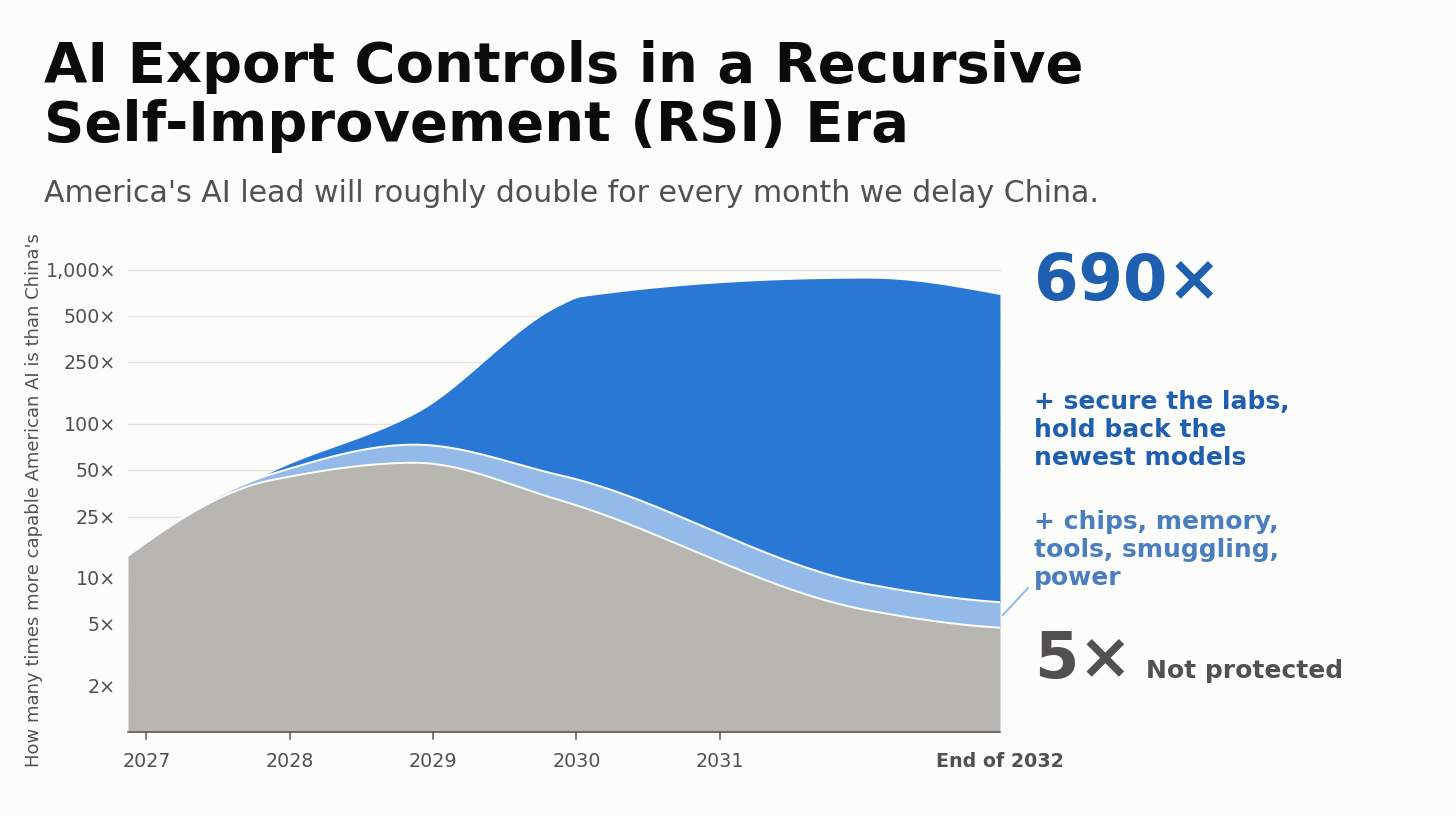
By the end of 2032, American AI is about 5 times as capable as China’s if we don’t protect it; about 7 times with chip, memory, tool, smuggling and power controls, and about 690 times once the labs are secured and the newest models held back.
The RSI clock might have started. Anthropic’s filing with the Securities and Exchange Commission says “we made a determination that we have met this threshold based on what we expect from future models and our overall rate of progress, rather than on what we have observed from current models.” It is hand-wavy language in a financial filing that needs to be hand-wavy because they get sued if they’re wrong. And they just sold stock on Wall Street, so you can read it skeptically. Regardless, if we’re debating whether the RSI era has started or not, we should be working the strategic competition aspects now.
What follows is that every lever including chip export controls has one job: to buy time. A month sounds small. Each month’s growth rate is about a 20% improvement. Pretty good for a month. But recall that Einstein purportedly said, “Compounding [interest] is the 8th wonder of the world.” Invest $1 at a little over 20% a month, doubling every 3.7 months, and you have about $700 by late 2029. That last month alone adds about $150 and you only invested $1. Self-improvement only makes the curve grow more quickly. That’s why the AI industry is starstruck over Recursive Self-Improvement.
So when we think of policy that protects our AI system in terms of buying a month, think of it as buying the month at the end of the curve of all of our protections and not the beginning of the curve. I started this project wondering if there was a sweet spot where enough GPUs were leaking into China that it slowed their own GPU development and the scaling laws would hold them back. Nope.
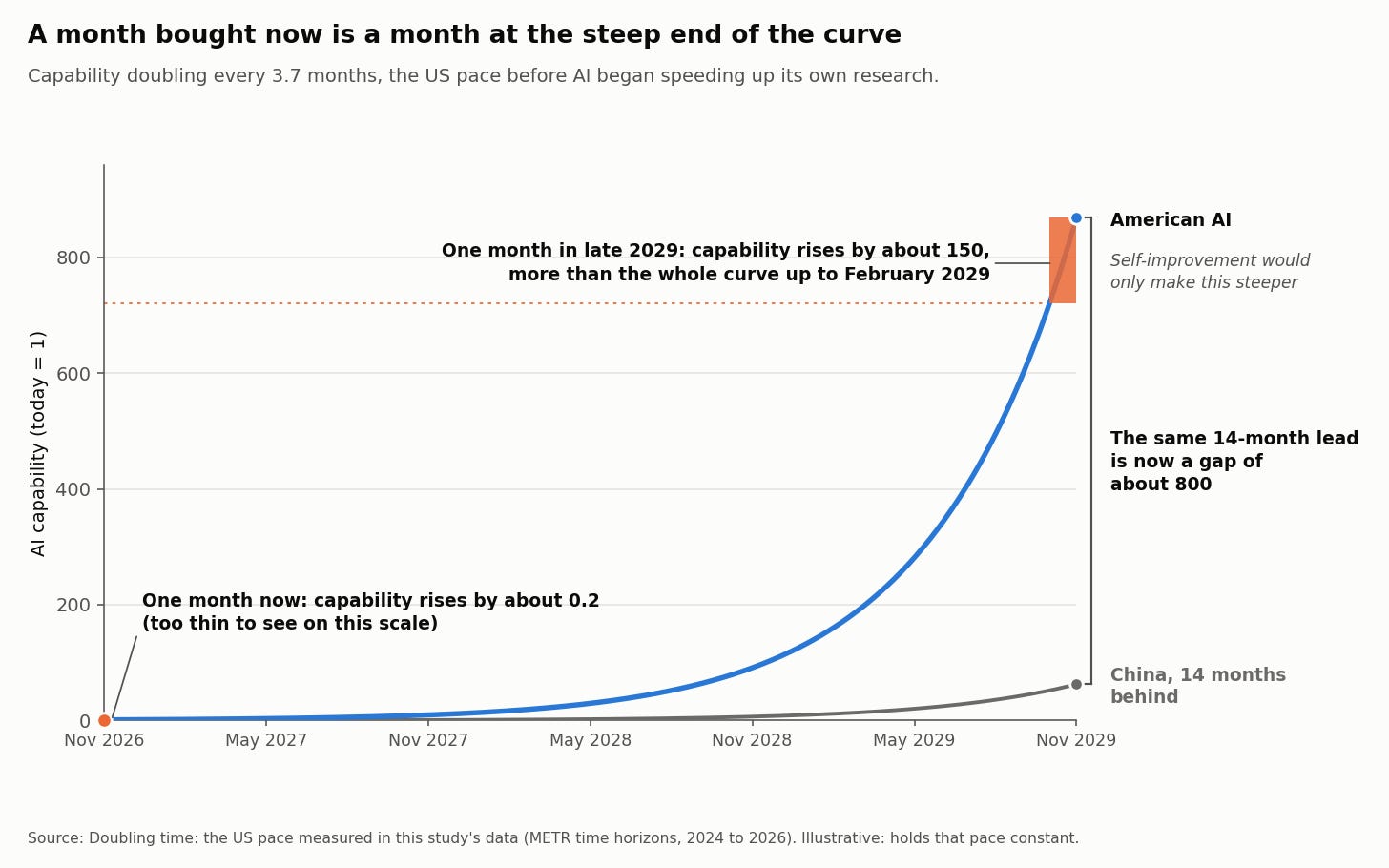
A month of lead today is worth about 720 times more AI capability by late 2029.
Compounding self-improvement makes the lead climb, but the leaks out of the AI labs limit it
The leader’s AI improves the leader’s AI, the improved AI does the next round of research faster, and with each round the follower drops further behind. The loop is Recursive Self-Improvement, aka RSI. It is a chain reaction: the curve steepens as it runs, and the lead grows on itself while the leader keeps what it learns. Two countries pull apart on curves like that.
How far they pull apart depends on information leaks: how much of what US labs learn reaches China through silicon valley party chatter, copied models, distilled traces, published work or theft. Holding China back means keeping what the labs learn from leaking. My model is a simulation of the two countries, run eight thousand times, and it assumes that two-thirds of what US labs learn reaches China within two months. At that rate China is not held back for long, and the lead grows much more slowly. Information leakage is very, very expensive.
The first paragraph talks about the lead as a multiple of how many times as capable American AI is over Chinese AI. The chart below counts the same lead in months of American progress assuming today’s pace. Capability doubles every 3.7 months at that pace, so each doubling of the lead is 3.7 months on the chart, however few calendar months it took.
Counting the models American labs have built and use internally, the US leads China by about 14 months today (as METR estimated Anthropic’s own index). That makes American AI about 14 times as capable as China’s today (the matching 14s are a coincidence). The lead climbs to about 24-25 months with full RSI through the end of 2032. A lead of twenty-five months is about 100 times as capable. Pulling the protective levers below makes it to hundreds of times. But it requires shutting down information leaking out of the frontier AI labs. This has started reminding me of the early nuclear race of the Soviets to build the bomb and the Americans to stay the sole nuclear power.
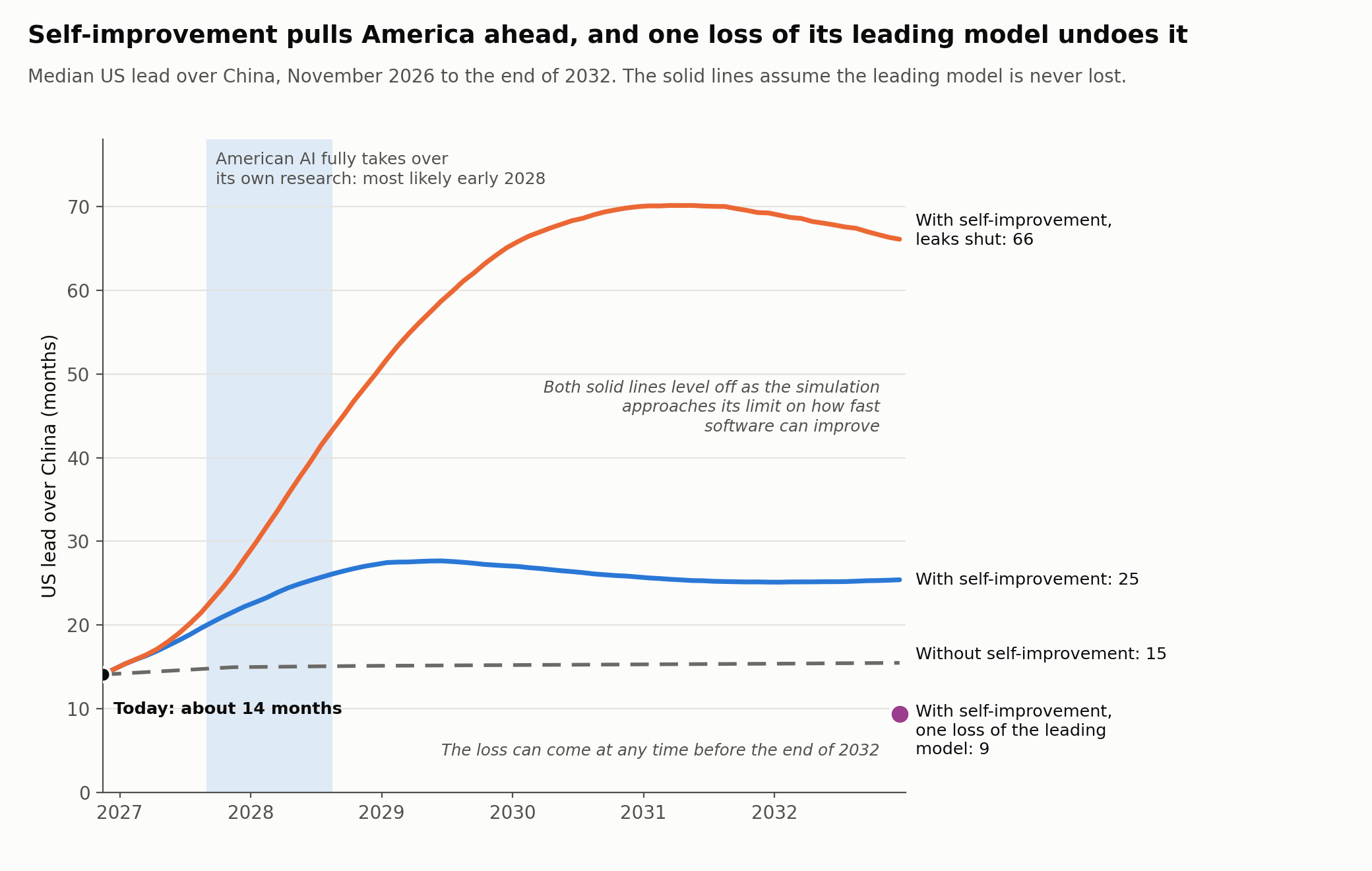
The lead is measured in months of American progress at today’s pace. Unreleased American models have a ~14-month lead today. If the model is never stolen, then the lead grows to ~25 months in 2032. The lead grows to about 66 months if the information leaks are shut down.
The lead lives or dies in a few labs
That lead does not exist in chip factories or pre-export control stockpiles. It lives in a few American labs, in the trained models and the know-how to build the next ones. Both can be copied. Both can be stolen. A model is a collection of files, and know-how is hopefully well-documented inside the frontier labs. Which means the part of American power that grows exponentially is also the part easiest to steal.
One stolen model is enough to undo it. In the simulation, China gets a stolen model’s capability and does not need America’s compute advantage to run the model. One theft of the leading lab’s newest model leaves the US lead at about 9 months at the end of 2032, where it would have been about two years otherwise. It actually puts China closer than they are today in late 2026 because the stolen model lets China’s AI start doing its own research from where America’s was. The lead can snap back in however long it takes to copy a few terabytes of model weights.
RAND says the top tier of lab security is “currently not possible”. That is where regulators should be stepping in.
Chip controls still buy time
Today’s chip controls were built for an AI race build on slcaling laws measured in GPUs. Denying China chips meant denying China progress. The existing export controls still hold that physical layer of the race, and they keep buying time until chips stop being the sole driver of the scaling laws.
Moving the restrictions is another matter. We have tried loosening those restrictions since mid-2025 when Washington re-offered three chips, the H20, the RTX Pro 6000D and the H200. Beijing blocked or throttled all three. But loosening those restricts costs far more than I expected. In the simulation, allowing those lower-tier chip exports costs the lead about a month by late 2029. And we measure a lost month off the steep end of the growth curve. Former CEO hat on for a second: loosening the restrictions after RSI has been publicly achieved is better business since companies will throw far more money at buying GPUs hoping not to be left behind, even though they will never catch up.
After achieving self-improvement, further tightening of chip controls buys very little. Every tighter export control tested adds less than half a month to the US lead The best result is anti-smuggling enforcement which adds about two weeks. Tighter controls on memory chips or chipmaking tools add about a week each. More chips add to China’s total computing. China’s counter move would be to concentrate their compute power in their leading AI labs. What decides the race now is how fast a country’s AI improves itself, and if that model is stolen.
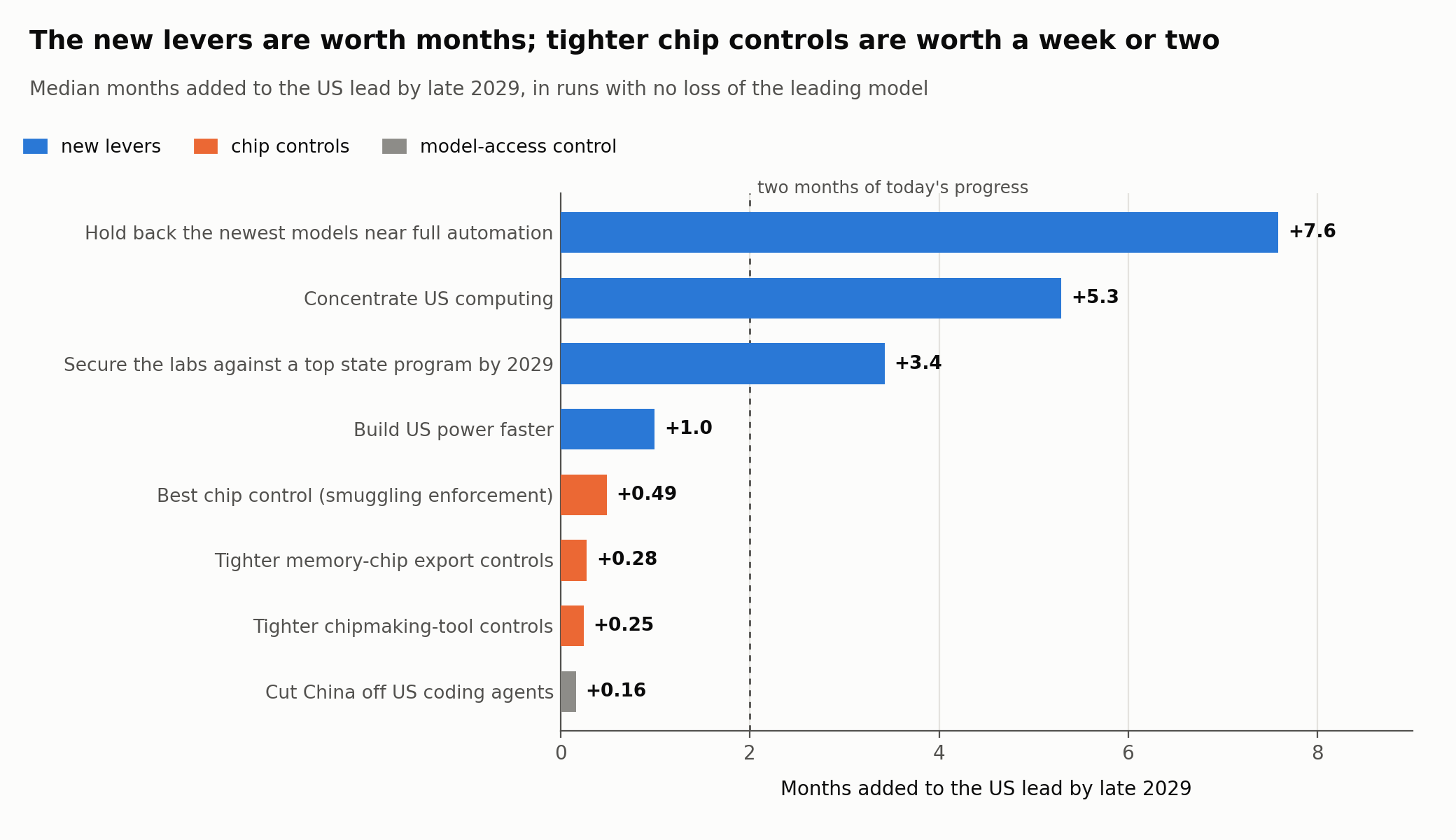
The lead is measured in months of American progress at today’s pace.
The levers for the RSI era rely on security that takes years to put in place
Three levers buy the most time, and it’s all time at the steep end of the growth curve. Lab security comes first because it is the lever that protects from a stolen model. The chart leaves that out. It’s effectively table stakes in AI policy.
America has put a controlled chain reaction in private hands before. The Atomic Energy Act of 1946 made nuclear weapons knowledge “restricted data”. The 1954 Act licensed private firms to run nuclear reactors as long everyone with access to restricted data was cleared. That nuclear licensing is a poly template for labs whose models have to be deployed on the internet, and with a workforce that is largely uncleared.
Secrecy did not stop a determined near-peer in the cold war. The Soviet Union tested its first bomb in August 1949 which about four years before the CIA’s “most probable date”. The historian David Holloway concluded that Soviet spies had cut months tp years, off the work. Secrecy bought a year or two at best. But a year or two of compounding growth may result in an insurmountable lead.
The second lever is holding back the newest models. It matters as AI nears full automation, because by then the newest model is itself the frontier AI lab. Release it and anyone can put it to work or learn from its answers. Keeping it inside is the longest bar on the chart. It gives more than seven months of unrestricted compounding growth. It also cuts against how the labs make their revenue. I almost wrote that the labs would need a new business model, but they probably need a business model better than selling tokens anyway to support their lofty valuations.
The third lever concentrates American computing into a few select frontier AI labs. That means putting more computing behind fewer companies and larger training runs. It adds more than five months of lead.
Lab security takes years, and the simulation puts full RSI most likely around early 2028. It could be far earlier, or it could be far later, or it could be never. The best time to plant a tree was a hundred years ago. The second best time is today.
The next race is decided inside the AI labs, not the chip fabs
The export-control fight was about the last race, when the thing that mattered shipped in containers and could be stopped at a port. Those chips drove the scaling laws. The controls still buy time and should stay. The next few years are about keeping what the labs know inside the labs. That’s where we can still buy time for compounding growth to create an insurmountable lead.